

Key Takeaways
Your mind has no hidden depths — the surface is all there is
This is the book's central, radical claim. Nick Chater argues there is no inner world of pre-formed beliefs, desires, hopes, and fears lurking beneath conscious experience. Like characters in a novel — he uses Anna Karenina as his recurring example — our mental "depths" are as fictional as the inner life of a literary character. Tolstoy's Anna has no true motives beyond what's on the page; a real Anna would be equally unable to recover her "true" motivations, because there are none to recover.
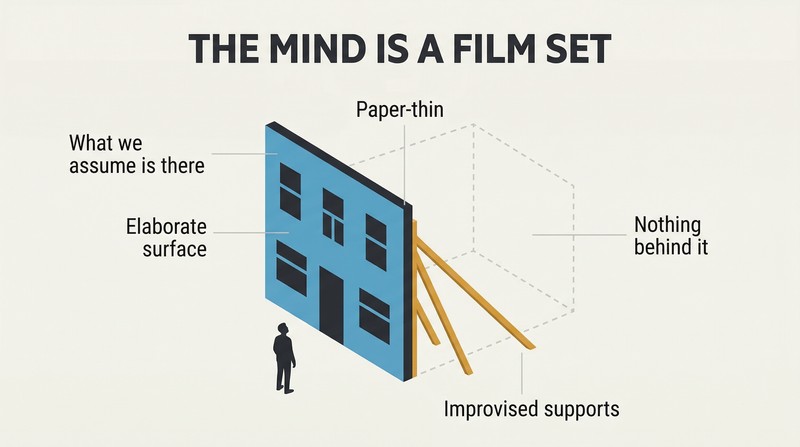
The mind is flat, like a film set. Our momentary conscious experience — fragmented, sketchy, improvised on the spot — isn't the shimmering surface of a vast inner sea. It is all there is. The stories we tell about our beliefs and motives are inventions, not dispatches from hidden depths.
You read one word at a time — your brain fakes panoramic vision
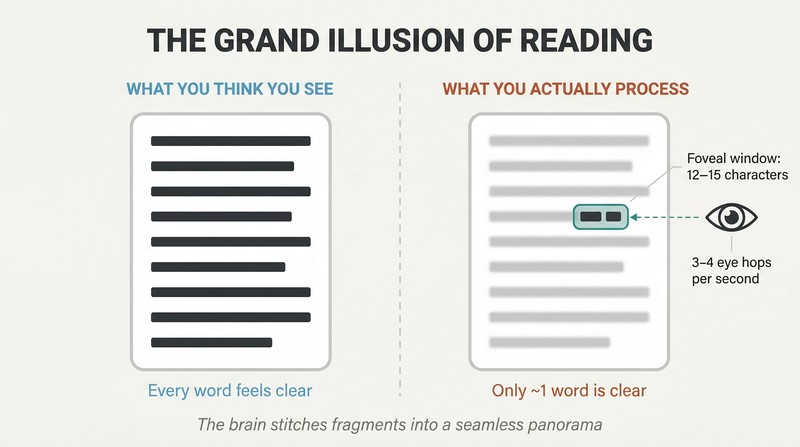
Gaze-contingent experiments reveal the trick. Researchers replaced all text on a screen with Xs except a window of 12 – 15 characters around wherever the reader's eye landed. Reading proceeded completely normally — nobody noticed anything wrong. We identify roughly one word per eye fixation; everything else is an inchoate blur. Outside a few degrees of the fovea, we're nearly color-blind, yet we experience the world as richly detailed and multicolored.
This is the grand illusion. Our eyes hop three to four times per second, and each hop creates a fresh interpretation. The brain stitches these fragments into a seamless panorama so fluently that we believe all the detail was already "loaded" in our minds. It wasn't. The world feels complete because any question about it is answered almost instantly by a flick of the eye — not because the answer was pre-stored.
You understand far less than you feel you do — about nearly everything
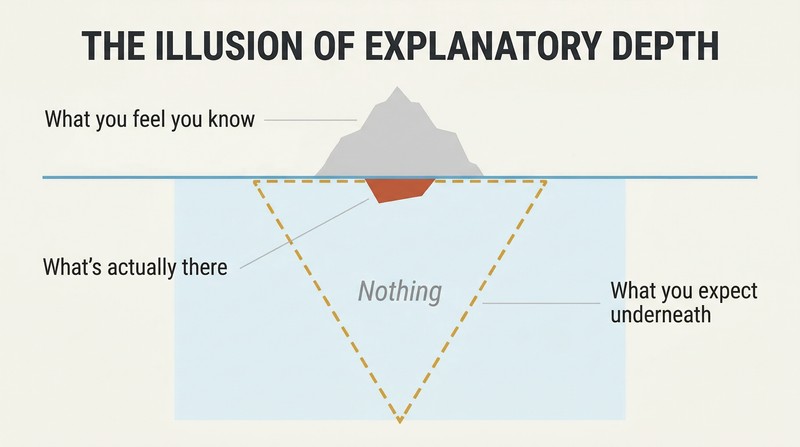
Try explaining common physics. What happens when you drop coffee, sugar, and ball-bearings on a kitchen floor? You "know" roughly what happens, but your explanation immediately spirals into contradiction. Psychologists call this the illusion of explanatory depth: the bizarre gap between our feeling of understanding and our actual ability to produce coherent explanations — whether about fridges, bicycles, tides, or political issues.
Early AI confirmed there's nothing underneath. From the 1950s through the 1980s, artificial intelligence researchers tried to extract human common-sense knowledge and systematize it into computer databases. The project failed spectacularly at step one: people's verbal explanations weren't messy summaries of hidden coherent theories. They were loose, self-contradictory fragments, invented on the spot. There were no inner theories to extract.
Emotions aren't messages from within — they're guesses about your body
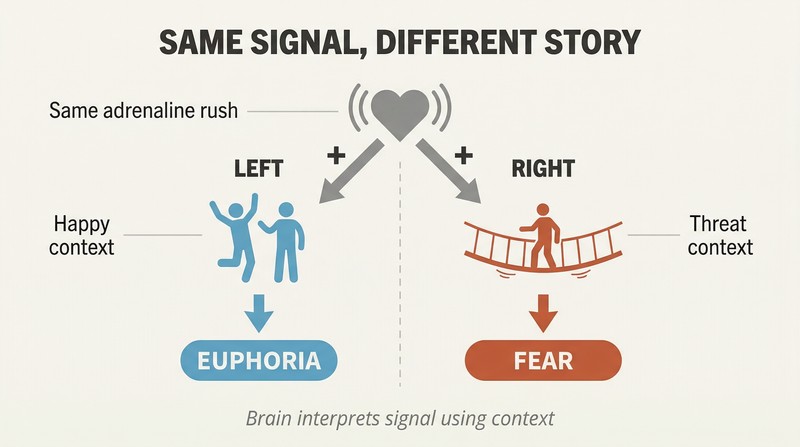
Adrenaline produces opposite emotions depending on context. In Schachter and Singer's 1962 experiment, volunteers injected with adrenaline sat with a stooge acting either manically happy or angrily irritable. Same drug, opposite felt emotions: euphoria with the happy stooge, fury with the angry one. Participants told about adrenaline's effects beforehand were less affected — they attributed their racing heart to the shot, not to their "feelings."
Your body provides crude signals; your brain interprets them. Just as the Kuleshov effect shows the same neutral face looking grief-stricken or lustful depending on context, we "read" our own bodily signals the same way. Dutton and Aron demonstrated this strikingly: men who crossed a high, wobbly suspension bridge found the female experimenter at the end significantly more attractive — their fear-induced adrenaline was reinterpreted as attraction.
Most people will passionately defend a choice they never made
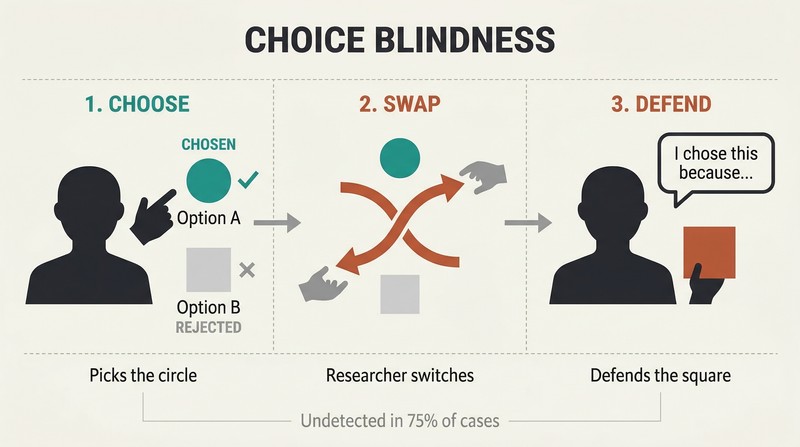
Researchers swapped people's choices — most never noticed. Psychologists Johansson and Hall asked people which of two faces they preferred, then secretly handed back the non-chosen face. Most didn't spot the switch and fluently justified why they "chose" the face they'd actually rejected — citing features like "nice earrings" belonging to the other face. Justifications were equally confident whether the choice was real or fake. This is choice blindness.
It extends to politics and taste. Before Sweden's 2010 election, researchers secretly reversed questionnaire answers to reflect opposing political views. Three-quarters of switches went undetected, and people defended their "new" positions. In supermarket jam tests, double-ended jars let researchers serve the rejected flavor — people happily defended it. Nearly half of political participants actually shifted their voting intentions as a result.
Your left brain is a spin doctor making up reasons on the fly
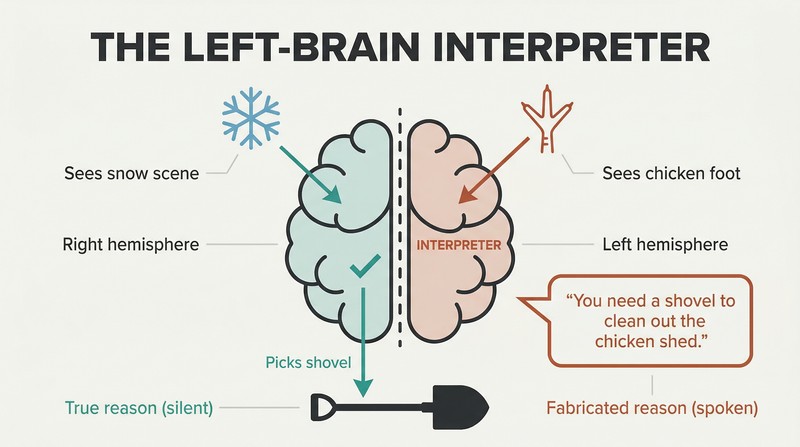
Split-brain patients reveal the storyteller. Neuroscientist Gazzaniga showed split-brain patient P.S. a snowy scene (routed to the right hemisphere) and a chicken's foot (routed to the left). The right brain's left hand picked a shovel to match the snow; the language-processing left brain saw only the chicken foot. Explanation? "You need a shovel to clean out the chicken shed." Entirely wrong — perfectly fluent.
Your intact brain does the same thing. Gazzaniga calls this system the interpreter — a left-hemisphere storytelling module that generates plausible explanations for whatever we do. In normal brains, it operates identically: we act first, then a justification materializes so fast we assume the justification caused the action. But the explanation is improvised after the fact, not retrieved from any archive of motives.
Insight doesn't incubate underground — it's one lucky fresh thought
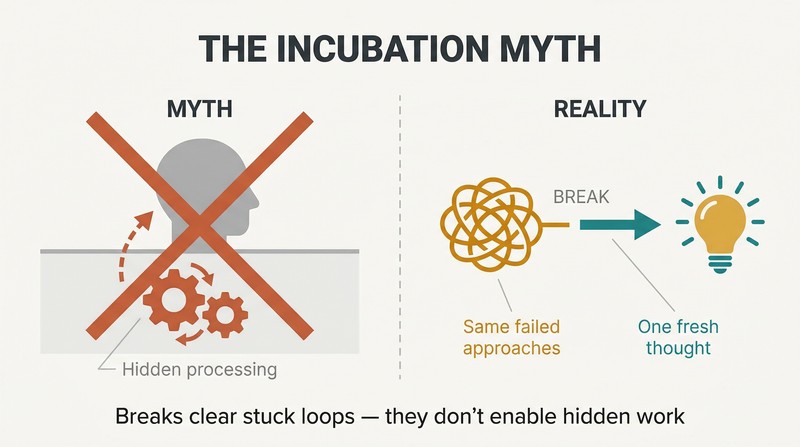
Poincaré was wrong about his own breakthroughs. The great mathematician believed his unconscious churned through solutions while he went about his day, delivering answers in sudden flashes. Composer Hindemith claimed entire compositions appeared "like lightning." But both were fooled by the same illusion: when a solution appears suddenly, we assume it was pre-computed in the background.
Breaks help by clearing mental cul-de-sacs, not enabling hidden work. When stuck, the brain loops through the same failed approaches. Returning later, free of those loops, you see the problem fresh. The flash of insight happens in a single cycle of thought when you lock onto the right interpretation — like suddenly seeing a Dalmatian in an ambiguous black-and-white image. Experiments on memory retrieval confirm: when you switch tasks, all processing on the previous task stops completely.
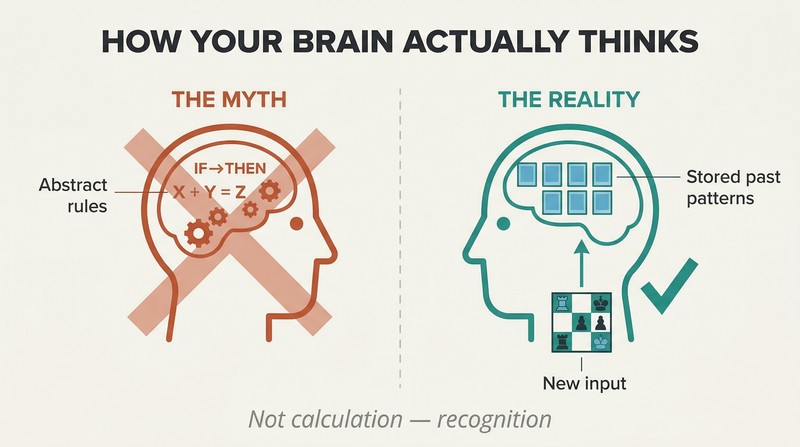
Your brain works by reusing the past, not applying abstract rules
Chess grandmasters don't out-calculate opponents. In 1922, Capablanca beat 102 of 103 simultaneous opponents at roughly ten moves per minute. He wasn't computing faster — he was reading each position through a vast library of past games. Experiments show grandmasters memorize meaningful positions nearly perfectly after five seconds but are no better than beginners with random arrangements. What we can't interpret, we can't remember.
"Found faces" show how flexibly the brain transforms precedents. We see faces in handbags, cheese-graters, and wash basins — objects spectacularly unlike actual faces. The brain relates current input to memory traces of past interpretations through perception-memory resonance, stretching and transforming them with astonishing creativity. Each person is a unique tradition: a layered history of past thoughts and experiences that shapes every new thought.
Treat destructive thoughts as passing inventions, not inner truths
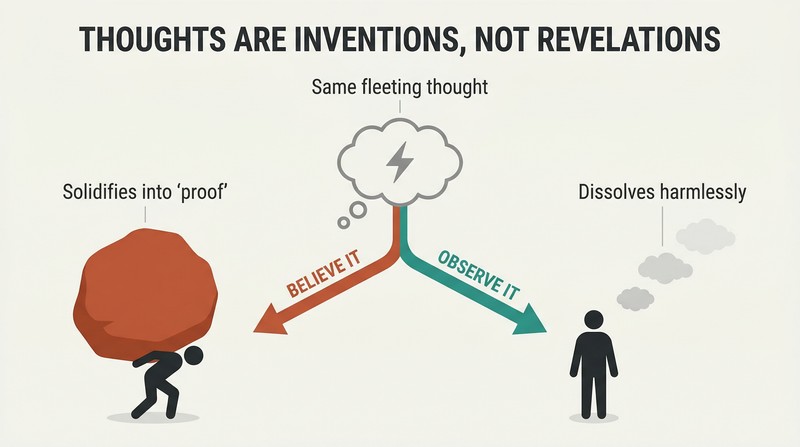
Bertrand Russell destroyed his marriage with a single thought. While bicycling one afternoon in 1901, he "realized" he no longer loved his wife Alys. Rather than treating this as a momentary creation — perhaps the product of a frustrating day — Russell interpreted it as an infallible revelation from his emotional depths. The marriage was effectively over from that moment, though they didn't divorce for twenty years.
Mindfulness therapy applies this insight directly. The approach teaches people to see destructive thoughts — especially those linked to depression and anxiety — as momentary inventions that can be observed, criticized, and dismissed. This becomes far easier once you abandon the illusion that emotions are messengers from your inner core. They aren't dispatches from the deep. They're stories your brain just made up, and you have some power to set them aside.
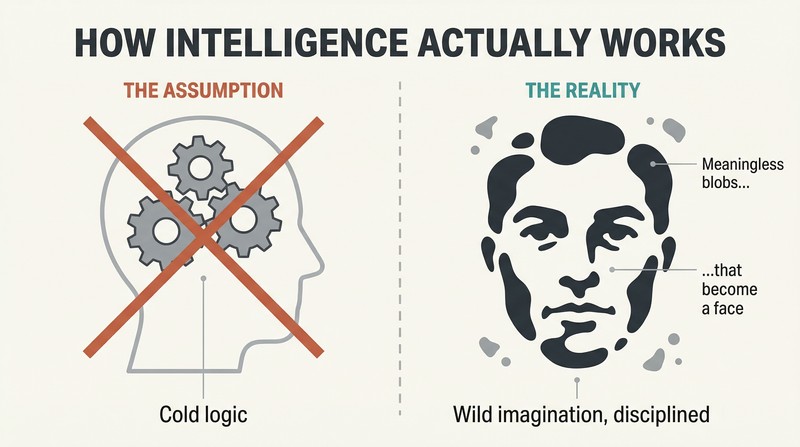
Intelligence is wild imagination disciplined, not cold logic applied
Mooney's faces prove imagination drives perception. Psychologist Craig Mooney created stark black-and-white images that initially look like meaningless blobs but resolve, suddenly and permanently, into vivid human faces with distinct expressions, ages, and personalities. This perceptual leap — from chaos to meaning — is the basic operation underlying all human intelligence, and it far exceeds what any current AI can replicate.
Even IQ tests measure imaginative flexibility. "Space is to ruler as time is to: metronome, chronometer, clock, stopwatch?" Solving this requires creative mapping between domains, not calculation. Our language is drenched in metaphor — we're "under pressure," "stretched thin," feeling "up" or "down" — because seeing one thing in terms of another isn't decorative. It is, Chater argues, the secret engine of thought itself.
Analysis
Chater's book is among the most intellectually ambitious works in popular cognitive science of the past decade, attempting a wholesale demolition of folk psychology's most fundamental furniture — beliefs, desires, stable preferences, unconscious thought. Where most books in this genre modify the intuitive picture (revealing biases here, heuristics there), Chater argues the entire framework is rotten. There are no beliefs to be biased, no preferences to be inconsistent. This places him alongside eliminative materialists like Paul and Patricia Churchland, but he arrives from a different direction: through converging evidence from experimental psychology, the failure of symbolic AI, and connectionist computation.
The book's greatest strength is its cumulative architecture. Chater doesn't merely assert that mental depth is an illusion — he systematically demonstrates it across perception (gaze-contingent tracking, stabilized images), explanation (illusion of explanatory depth ), emotion (Schachter-Singer), choice (choice blindness ), and creative thought (Poincaré, Hindemith). Each domain independently converges on the same conclusion.
There are productive tensions, however. Chater's treatment of the unconscious is occasionally too sweeping. While the Freudian unconscious deserves challenge, implicit learning, priming effects, and skill consolidation during sleep suggest some subconscious processing that doesn't fit neatly into his 'one task at a time' framework. The book also sometimes conflates two distinct claims: that we lack stable, coherent inner representations (well-supported) and that there are no inner representations at all (more contentious). The rise of predictive processing frameworks — which model the brain as building hierarchical generative models of the world — suggests something very like 'inner theories,' even if implemented in the connectionist architecture Chater favors.
Nonetheless, as both provocation and synthesis, the book succeeds brilliantly. It forces readers to confront the possibility that introspection isn't a window into the mind — it's a mirror reflecting only the brain's latest improvisation.
Review Summary
The Mind is Flat explores the controversial idea that our minds lack depth and operate through constant improvisation. Chater argues against the existence of an unconscious mind, positing that our thoughts and emotions are instantaneous creations based on past experiences. While some readers find the book insightful and well-researched, others criticize its repetitiveness and lack of consideration for alternative views. The book's central thesis challenges traditional psychological theories, sparking debate about the nature of consciousness, decision-making, and human intelligence.
People Also Read





Glossary
The grand illusion
Illusion of rich perceptual experienceThe pervasive illusion that we simultaneously perceive a rich, detailed, multicolored world, when in fact we process roughly one word, object, or color at a time. The illusion is sustained because the brain can answer any perceptual question almost instantly via rapid eye movements, creating the false impression that all information was already 'loaded' in the mind.
The cycle of thought
Brain's one-at-a-time processing rhythmChater's framework for how the brain processes information: a sequential series of cooperative computational steps, each locking onto one set of sensory information, imposing meaning on it, and producing a conscious result. Each step draws on vast networks of neurons working simultaneously, but the brain can solve only one problem per step. The conscious 'read-out' of each step constitutes our stream of experience.
The interpreter
Left brain's storytelling moduleTerm coined by neuroscientist Michael Gazzaniga for the language-processing system in the left hemisphere that spontaneously generates explanations for our actions, choices, and experiences. Discovered through split-brain research, the interpreter fabricates plausible-sounding justifications even when it has no access to the actual causes of behavior—and does so with complete fluency and confidence.
Choice blindness
Failing to notice swapped choicesA phenomenon discovered by psychologists Petter Johansson and Lars Hall in which people fail to detect that their expressed choice has been secretly switched by an experimenter—and then proceed to confidently defend the choice they never actually made. Demonstrated with facial preferences, political attitudes, and jam taste tests, it reveals that our justifications are improvised after the fact, not retrieved from stored preferences.
Illusion of explanatory depth
Overestimating one's own understandingA term from psychologists Rozenblit and Keil describing the systematic gap between people's feeling of understanding how something works and their actual ability to explain it. When pressed for explanations of everyday phenomena—how a fridge works, why coffee splashes—people produce mangled, self-contradictory fragments, revealing that the feeling of understanding is itself a cognitive illusion.
Cooperative computation
Brain-style parallel neural processingChater's term for the computational style of the brain, in which vast networks of individually sluggish neurons collectively solve problems by simultaneously exchanging signals, cross-checking, and converging on a coordinated interpretation. Unlike conventional computers that execute billions of tiny sequential steps, cooperative computation takes one 'giant step' at a time—explaining why we can process only one meaningful pattern per moment.
Perception-memory resonance
Current perception shaped by past interpretationsChater's concept describing how the brain interprets current sensory input by simultaneously matching it against a vast store of memory traces from past perceptual interpretations. This resonance occurs in parallel across the entire memory store and can involve highly flexible, non-obvious transformations—as when the brain 'sees' a human face in a cheese-grater by mapping past face memories onto present sensory input.
FAQ
1. What is The Mind is Flat by Nick Chater about?
- Core thesis: The Mind is Flat argues that the mind has no deep, hidden layers of beliefs, desires, or unconscious thoughts; instead, our conscious experience is a sequence of momentary interpretations created on the spot.
- Flat mind model: Nick Chater challenges the traditional view of a deep inner self, proposing that our thoughts, feelings, and motives are improvised in real time rather than retrieved from a mental storehouse.
- Implications for psychology: This perspective reshapes our understanding of perception, memory, emotion, decision-making, and creativity, questioning the existence of unconscious mental processes.
- Scientific challenge: The book critiques established ideas in psychology, neuroscience, and philosophy, offering a new model based on brain-style computation and improvisation.
2. Why should I read The Mind is Flat by Nick Chater?
- Radical rethinking: The book offers a revolutionary perspective on how the mind works, overturning long-held assumptions about unconscious processes and mental depth.
- Scientific and philosophical integration: Chater draws on decades of psychological experiments, neuroscience, and philosophy, providing a rigorous and comprehensive critique of common-sense psychology.
- Practical insights: Understanding the flat mind helps explain phenomena like inattentional blindness, the illusion of multitasking, and the nature of insight, offering valuable tools for personal growth and decision-making.
- Engaging and accessible: The book uses vivid examples from literature, experiments, and everyday life to make complex ideas understandable and relevant.
3. What are the key takeaways from The Mind is Flat by Nick Chater?
- No hidden mental depths: Our minds do not contain stable, deep beliefs or motives; thoughts and feelings are constructed in the moment.
- Improvised self: The sense of a coherent inner self is an illusion created by the brain’s interpreter, which invents justifications and narratives after the fact.
- Perception and memory as interpretation: Both perception and memory are processes of interpretation, not faithful recordings or representations of reality.
- Practical implications: Recognizing the mind’s improvisational nature can help us manage emotions, make better decisions, and foster empathy in relationships.
4. What are the best quotes from The Mind is Flat by Nick Chater and what do they mean?
- “The mind is flat.” This encapsulates Chater’s core thesis that there are no hidden depths to the mind—only surface improvisations.
- “We are all improvisers, moment by moment.” This highlights the idea that our thoughts, feelings, and decisions are created on the fly, not retrieved from a deep inner store.
- “The grand illusion is that we see a rich, detailed world all at once.” This quote addresses the illusion of perceptual richness, emphasizing that our experience is piecemeal and constructed.
- “Our explanations are inventions, not discoveries.” Chater argues that introspection and self-justification are creative acts, not windows into a hidden mental reality.
5. What does Nick Chater mean by the “illusion of mental depth” in The Mind is Flat?
- No hidden inner world: The illusion is the mistaken belief that our minds contain a rich, stable inner world of beliefs, desires, and motives beneath conscious thought.
- Invented explanations: Introspections and justifications are creative inventions made on the spot, not reports of pre-existing mental states.
- Parallel with fiction: Just as fictional characters have no true inner life beyond the text, real people’s inner mental states are similarly constructed and lack a fixed, deep reality.
- Challenge to psychology: This view questions traditional psychological methods that seek to uncover hidden motives or unconscious beliefs.
6. How does The Mind is Flat by Nick Chater explain the “cycle of thought”?
- Definition: The cycle of thought is a sequence of cooperative neural steps, where the brain focuses on one problem or set of sensory information at a time, creating meaning with each step.
- Sequential processing: Unlike computers, the brain cannot multitask; it solves one problem at a time, explaining the limits of conscious attention.
- Consciousness as output: Our conscious experience is the output of each cycle, meaning we are only aware of the interpretations produced, not the underlying neural computations.
- Shaping future thought: Each cycle leaves traces that influence future interpretations, forming mental habits and channels.
7. How does The Mind is Flat by Nick Chater explain perception and the “grand illusion”?
- Illusion of richness: We believe we perceive a rich, detailed world all at once, but in reality, perception is piecemeal and limited to what the brain currently attends to.
- Sequential snapshots: Our eyes make rapid jumps (saccades), and each fixation is a new cycle of thought interpreting a fragment of sensory input.
- Dynamic construction: The brain rapidly shifts focus, piecing together fragments over time to create the impression of a stable, detailed world.
- Perception as inference: The mind infers and constructs interpretations, filling in gaps and resolving ambiguities on the fly.
8. What does The Mind is Flat by Nick Chater say about unconscious thought and multitasking?
- Unconscious thought is a myth: There is no evidence for complex unconscious mental work happening in the background; the brain can only focus on one problem at a time.
- Insight explained: Sudden insights arise from the cycle of thought locking onto a new interpretation, not from hidden unconscious processing.
- Multitasking illusion: Multitasking is mostly rapid switching of attention, not simultaneous processing, with rare exceptions for highly practiced, distinct tasks.
- Inattentional blindness: Experiments show people can miss obvious stimuli when focused elsewhere, demonstrating the narrow channel of conscious attention.
9. How does The Mind is Flat by Nick Chater describe memory and its role in thought?
- Memory as interpretation: Memories are fragments of past interpretations, not raw sensory data or faithful recordings.
- Precedents guide perception: The brain uses these memory traces to interpret new sensory input, creating resonance between past and present.
- Layered mental landscape: Each cycle of thought leaves traces that shape future thoughts, forming mental habits and unique personal histories.
- No deep storage: There is no hidden store of deep beliefs or motives—just a history of layered precedents.
10. What is the role of the “interpreter” in the brain according to The Mind is Flat by Nick Chater?
- Left hemisphere storyteller: The interpreter is a brain system, mainly in the left hemisphere, that invents explanations and narratives to justify our actions and choices after the fact.
- Confabulation: It creates plausible but often inaccurate stories to explain behavior, even without access to the true causes, as shown in split-brain experiments.
- Maintaining coherence: The interpreter helps maintain a sense of mental unity and coherence by generating justifications that align with past behavior and current context.
- Limits of self-knowledge: Our self-understanding and reasons for actions are often fabricated, not retrieved from a deep inner truth.
11. How does The Mind is Flat by Nick Chater explain emotions and feelings?
- Emotions as interpretations: Feelings are constructed by interpreting ambiguous physiological signals in the context of the current situation, not pre-existing inner states.
- Context-dependent: The same bodily signals can be interpreted as different emotions depending on environmental cues, as shown in classic psychological experiments.
- Momentary inventions: Emotions like love are momentary inventions, not deep inner truths, and understanding this can help us navigate emotional experiences more flexibly.
- Implications for relationships: Recognizing the constructed nature of emotions can improve emotional regulation and interpersonal understanding.
12. What are the practical implications of the “flat mind” model in The Mind is Flat by Nick Chater for understanding ourselves and others?
- Skepticism about introspection: We should be cautious about trusting our introspections and justifications, as they are often invented rather than discovered.
- Flexibility and creativity: Recognizing the mind as an improviser highlights human creativity and the ability to reshape thoughts and behaviors over time.
- Emotional regulation: Understanding emotions as interpretations can help us manage feelings by changing context or reinterpreting bodily signals.
- Empathy and relationships: Accepting that others’ motives and feelings are also constructed can foster empathy and reduce conflicts based on assumed hidden intentions.
About the Author
Other books by Nick Chater

Download PDF
Download EPUB
.epub digital book format is ideal for reading ebooks on phones, tablets, and e-readers.








































