
Key Takeaways
1. Ancient Roots of Market Suspicion
"The more men value moneymaking, the less they value virtue."
Moral Disparagement. From classical Greece to early Christianity, commerce and the pursuit of material gain were viewed with deep suspicion. Philosophers like Plato and Aristotle saw moneymaking as inimical to civic virtue, which demanded devotion to the city-state and its military defense. They believed wealth lacked natural limits, leading to greed (pleonexia) and moral hazard.
Christian Hostility. The Gospels and early Church Fathers were intensely hostile to riches, warning that wealth threatened salvation. They echoed the classical assumption that material wealth was fixed, so one's gain was another's loss. The most reviled form of commerce was usury—lending money at interest—which was condemned as unnatural and sinful, a practice often relegated to Jews, further tainting attitudes toward trade.
Civic Republicanism. This tradition, drawing on classical ideals, identified "virtue" with public service and "liberty" with political participation, requiring citizens to be independent landowners. Commerce was seen as corrupting, fostering self-interest over public good, and leading to societal "corruption" and eventual dissolution, a view exemplified by figures like Charles Davenant.
2. Enlightenment's Revaluation of Commerce
"A Traveller who writes in that Spirit, is a Merchant of a noble Kind, who imports into his Country the Arts and Virtues of other Nations."
Commerce for Peace. Voltaire, a key figure in the Enlightenment, championed market activity not primarily for wealth, but for its political benefits. He argued that the pursuit of economic self-interest was less dangerous than religious zealotry, promoting peaceful coexistence among diverse faiths. His famous depiction of the London Royal Exchange showed Jews, Muslims, and Christians dealing together peacefully, reserving the term "infidel" only for those who went bankrupt.
Universal Opulence. Adam Smith, building on this, presented the market as the most effective engine for improving the standard of living for the vast majority, leading to "universal opulence." He argued that the human "propensity to truck, barter, and exchange" drives the division of labor, specialization, and innovation, making society wealthier. Smith's "invisible hand" metaphor illustrated how individual self-interest, channeled through competitive markets, unintentionally benefits society by providing cheaper goods and fostering industriousness.
Moral Character. Smith also valued commercial society for the character it fostered, promoting "inferior virtues" like prudence, industry, and self-control. He argued that success in the market depended on "solid professional abilities, joined to prudent, just, firm, and temperate conduct," making it less morally corrupting than feudal or court societies. He saw the cash nexus as liberating, replacing direct personal dependency with contractual relations, thus increasing individual freedom.
3. Conservative Alarm: Market as Destroyer of Culture
"Trade, without doubt, is in its nature a pernicious thing; it brings in that wealth which introduces luxury; it gives rise to fraud and avarice, and extinguishes virtue and simplicity of manners; it depraves a people, and makes way for that corruption which never fails to end in slavery, foreign or domestic."
Erosion of Tradition. Justus Möser, an 18th-century German conservative, viewed the market as a destructive force, threatening the local cultural particularity of his home region, Osnabrück. He argued that international trade created new, artificial needs, undermining traditional guild-based production and the intertwined social and political structures. Möser lamented the displacement of artisans by shopkeepers selling foreign goods, and the peddler's role in corrupting rural morals by introducing "luxuries."
Loss of Honor and Place. Möser defended a corporatist, inegalitarian society where honor, property, and political participation were linked to inherited status. He saw the market and enlightened absolutism as eroding this system, diminishing the "honor" of guilds and creating a growing class of propertyless wage laborers (Nebenwohner) who lacked a sense of belonging. He even defended serfdom as superior to free labor, arguing it fostered paternalistic care from lords.
Burke's Veil of Culture. Edmund Burke, while a supporter of commerce, feared that unchecked rationalism and market forces could destroy the "veil of culture" – the inherited customs, manners, and institutions (like the aristocracy and the Church) that restrained human passions and provided social stability. He argued that the French Revolution, driven by "men of money" and "men of letters," was stripping away this veil, leading to barbarism and the triumph of avarice over virtue, as seen in the exploitation of India by the East India Company.
4. Hegel's Ethical Framework for Civil Society
"The right of the subject’s particularity to find satisfaction, or—to put it differently—the right of subjective freedom, is the pivotal and focal point in the difference between antiquity and the modern age."
Individuality and Wants. Hegel saw the market (civil society) as the central feature of the modern world, crucial for developing a sense of individual self-worth and recognizing others as individuals. He argued that human wants are not merely "natural" but are refined by imagination and culture, leading to ever-differentiated "needs." The market, far from being anarchic, is a system for the mutual satisfaction of these evolving wants, and even creates new ones through entrepreneurial activity.
Work and Purpose. For Hegel, earning a living in civil society is a key way men gain individuality and purpose. He rejected the Romantic lament of specialization, arguing that accepting one's place in the division of labor and achieving "professional rectitude" is essential for modern virtue. This identification with one's profession, along with the family and the state, provides "mediations" between the individual and the universal, giving life direction and meaning.
Limits of Civil Society. Despite its benefits, civil society has inherent defects. Unbounded wants can lead to "bad infinity"—a joyless, endless pursuit of more. The market also creates a new form of poverty: specialized workers rendered jobless by dynamism, leading to "pauperism" and resentment. Hegel believed the state, through public policy and education, must mitigate these issues and provide a sense of collective purpose beyond individual self-interest, which is found in the family and the state itself.
5. Marx's Radical Critique: Alienation and Exploitation
"Capital is dead labor which, vampire-like, lives only by sucking living labor, and lives the more, the more labor it sucks."
Capitalism as Exploitation. Karl Marx, heavily influenced by Engels, fundamentally condemned capitalism as a system of exploitation. He adopted the labor theory of value, asserting that all economic value comes from human labor. Profit, or "surplus value," is the difference between the value workers create and what they are paid, making all profit inherently ill-gotten. He used vivid metaphors like "vampirism" to describe capital's parasitic nature, feeding on "living labor."
Alienated Labor. Marx argued that capitalism alienates workers from their labor, the products they create, their fellow humans, and their "species-being." Work becomes a means of survival rather than an act of creative self-expression, forcing individuals into one-sided specialization and dulling their minds. This "alienated labor" dehumanizes individuals, reducing them to mere appendages of machines and commodities.
The "Jewish Problem" and Money. Marx linked his critique of capitalism to traditional anti-Jewish stereotypes, arguing that the "worldly basis of Jewdom" was "practical need, self-interest," and its "worldly cult" was "bargaining (Schacher)." He claimed that money, the "worldly god" of the Jews, had become the universal god of Christian peoples, making "the social emancipation of the Jew" equivalent to "the emancipation of society from Jewdom"—a society where all human ties are dissolved by egoism.
6. Arnold's Cultural Mission: Battling Philistinism
"Can any life be imagined more hideous, more dismal, more unenviable?"
Critique of Philistinism. Matthew Arnold, a Victorian intellectual, lamented the rise of "philistinism"—the narrow, materialistic, and uncultured mentality of the commercial middle classes. He saw their prodigious love of "industry, trade, and wealth" as leading to a self-satisfaction that hindered higher aspirations. Arnold argued that this class, "drugged with business," lacked "culture" and "ideas," reducing life to a pursuit of "machinery" (means) without regard for ultimate ends.
Culture as Perfection. Arnold defined "culture" as "a pursuit of our total perfection by means of getting to know... the best which has been thought and said in the world." He contrasted this with the "mechanical and material civilisation" of his age, advocating for "disinterestedness"—the impartial search for truth and beauty—to counteract the utilitarian mindset. He believed culture should be democratized, making "the best... current everywhere" to elevate society.
State and Education. Arnold argued that the British middle class's emphasis on individual liberty and suspicion of government led to an underdeveloped state, incapable of pursuing the general interest. He championed a stronger state, guided by "Aliens" (cultured intellectuals like himself), to foster education and counteract the market's negative cultural effects. He advocated for universal, state-funded schooling to cultivate "general intellectual cultivation" and prevent the "moronization" caused by narrow, practical education.
7. Weber & Simmel: Rationality, Individuality, and Disenchantment
"Unlimited greed for gain is not in the least identical with capitalism, and is still less its spirit."
Rationality and Efficiency. Max Weber, a German sociologist, argued that capitalism is characterized by a unique "instrumental rationality"—the methodical calculation of the most efficient means to achieve ends. This rationality, also seen in modern bureaucracy and science, leads to the "disenchantment of the world," displacing magic and mystery with causal explanations. Weber distinguished this from mere greed, noting that "unscrupulousness" was more characteristic of backward economies.
Ambivalence of Rationality. While acknowledging capitalism's efficiency and dynamism, Weber was ambivalent about its cultural effects. He feared that instrumental rationality could lead to a "wholesale destruction of meanings," where individuals become so caught up in the pursuit of means (money, professional excellence) that they lose sight of substantive ends. He stoically accepted "limitation to specialized work" as a condition of modern life, rejecting Marx's vision of multifaceted individuals.
Money and Individuality. Georg Simmel, another German sociologist, explored how the money economy fostered new forms of individuality. Money, as an abstract means of exchange, habituates individuals to abstract, calculating thought. It creates a "dialectic of means and ends," where means can become ends in themselves, leading to a "tragedy of culture" as individuals face a proliferation of cultural choices they cannot fully assimilate. However, Simmel also saw money as enabling new, looser forms of association and allowing individuals to belong to multiple social circles, fostering unique personal identities.
8. Sombart's Cultural Despair and the "Jewish Spirit"
"The will to enrich himself makes the merchant unscrupulous, egoistic, and self-willed, treating all human beings except his nearest friends as only means to his ends. He is the embodiment of Gesellschaft."
Capitalism's Cultural Decline. Werner Sombart, a prominent German social scientist, viewed capitalism with profound despair, seeing it as the "graveyard of culture." He contrasted the "natural" precapitalist economy of artisans and peasants with the "artificial" modern capitalist system, which, despite quantitative gains in productivity, led to a qualitative loss of inner peace, connection to nature, and traditional faith. He condemned urban life as "asphalt culture" and saw capitalism as destroying the soul and leading to cultural "massification."
The "Jewish" Character of Capitalism. Sombart controversially linked the rise of modern capitalism to the "Jewish spirit." He argued that Jewish history and religion predisposed Jews to the rationalistic, calculative, and abstract mentality characteristic of capitalism. He claimed Jews excelled in trade and finance, particularly as "perfect stock-exchange speculators," due to their egoism, self-interest, and teleological orientation towards distant goals, making them adept at using money as a pure means.
Antisemitic Synthesis. Sombart's work provided a scholarly veneer for antisemitic arguments, portraying the triumph of capitalism as the replacement of concrete, particularist, Christian "Gemeinschaft" (community) by an abstract, universalistic, "judaized Gesellschaft" (society). He was criticized by contemporaries like Lujo Brentano and Max Weber for selecting evidence to fit his prejudices, but his ideas were widely adopted by integral German nationalists and later by Nazi ideologues.
9. Totalitarian Temptations: The Quest for Community
"Only through discipline can the party be capable of putting the collective will into practice."
Alienation to Revolution. Georg Lukács, a Hungarian intellectual, was deeply influenced by Simmel and Weber but rejected their ambivalence towards capitalism. He saw modern life as a "totality" of alienation and fragmentation, leading to a meaningless existence. Radicalized by World War I and the Bolshevik Revolution, he embraced communism as the solution, believing it offered a cause to which one could devote one's whole life, providing discipline and an all-encompassing community.
Capitalism as Illusion. In History and Class Consciousness, Lukács argued that capitalism created "thingafication" (reification), dulling the working class's ability to see capitalism as a changeable historical construct. He claimed that "bourgeois thinkers" were incapable of recognizing capitalism's inherent contradictions, as doing so would be "tantamount to suicide." Only Marxist intellectuals, with their "point of view of totality," could pierce this "system of illusion" and awaken the proletariat to its revolutionary role.
Freyer's Right-Wing Totalitarianism. Hans Freyer, a German intellectual, shared Lukács's alienation from bourgeois society and quest for community, but turned to the radical right. He saw capitalism as destroying cultural particularity and leading to universal meaninglessness. Freyer believed only a "total state," rooted in the "Volk" (nation as a homogeneous, historical community), could subordinate technology and the economy to a collective purpose, resisting the "slimy flood of commercialism" and re-creating a closed, self-affirming community.
10. Schumpeter's Irony: Creative Destruction's Downfall
"Capitalism is being killed by its achievements."
Creative Destruction. Joseph Schumpeter, an Austrian economist, argued that capitalism's essence is "creative destruction"—a dynamic process where entrepreneurial innovation constantly revolutionizes the economy, making old industries and ways of life obsolete. Entrepreneurs, driven by a "will to prove oneself superior" and "the joy of creating," introduce new products, markets, and methods, leading to spectacular profits that are eventually eroded by imitation.
Resentment and Decline. Schumpeter, drawing on Nietzsche, believed that this dynamism inevitably creates "Ressentiment"—the psychological antipathy of those displaced or outcompeted by innovation. He argued that capitalism's success in raising living standards and promoting "rationalistic individualism" paradoxically undermines its own social and cultural foundations. The constant questioning of institutions and the erosion of traditional loyalties, combined with the resentment of the unsuccessful, sap the confidence of the capitalist class.
Intellectuals as Gravediggers. Schumpeter famously asserted that capitalism's "gravediggers" are not the proletariat, but intellectuals. He defined intellectuals as "secondhand dealers in ideas" who, lacking direct responsibility for practical affairs, are prone to criticism and resentment. They channel diffuse discontents into coherent anticapitalist ideologies, which, despite capitalism's economic triumphs, ultimately delegitimize the system and lead to its demise, often at the hands of a state that fails to understand or defend it.
11. Post-War Discontents: Affluence and Repression
"The love of money as a possession—as distinguished from the love of money as a means to the enjoyments and realities of life—will be recognised for what it is, a somewhat disgusting morbidity, one of those semicriminal semi-pathological propensities which one hands over with a shudder to the specialists in mental disease."
Keynes's Moral Critique. John Maynard Keynes, the influential British economist, predicted that capitalism could solve the "economic problem" of scarcity, leading to unprecedented affluence. However, he expressed deep moral antipathy towards the "money-motive," particularly "the love of money as a possession," which he deemed a "disgusting morbidity." He hoped that in a future of abundance, society could shed "pseudo-moral principles" like avarice and usury, valuing "ends above means" and embracing a more aesthetic, less purposeful life.
Marcuse's One-Dimensional Society. Herbert Marcuse, a German-American philosopher, argued that even affluent, welfare-state capitalism was a form of "totalitarianism without terror." He claimed that society achieved "domination through sex and affluence" by creating and satisfying "false needs" through mass media and advertising, thereby pacifying the population and stifling genuine liberation. This "repressive desublimation" channeled erotic energy into consumerism and superficial sexuality, preventing deeper, more creative forms of "Eros."
The Revolution That Never Happened. Marcuse, like Lukács, sought to explain why the working class had not revolted. He concluded that capitalism had successfully integrated the proletariat by raising living standards and creating a "one-dimensional" consciousness, where individuals could not imagine alternatives to the existing system. He believed that "critical theory" and marginalized groups (intellectuals, outcasts) were the only hope for awakening society from its "stupification" and realizing a "pacification of the struggle for existence" through a less repressive, more creative form of life.
12. Hayek's Liberal Defense: Spontaneous Order and Limited Government
"Economic control is not merely control of a sector of human life which can be separated from the rest; it is the control of the means for all our ends."
Market as Information System. Friedrich Hayek, an Austrian-British economist, defended the market as a "spontaneous order" that efficiently coordinates widely dispersed knowledge and diverse human purposes. He argued that market prices act as crucial signals, conveying information about the relative scarcity and value of resources, which no central planner could ever possess. This dynamic process, driven by entrepreneurial "resourcefulness," constantly discovers new needs and ways to fulfill them, leading to unprecedented prosperity.
Critique of "Social Justice." Hayek vehemently opposed attempts to reshape the market according to notions of "social justice," which he deemed a "quasi-religious superstition" lacking clear meaning. He argued that a liberal capitalist "Great Society" thrives precisely because it does not impose a single, shared vision of the good life or reward individuals based on a common scale of merit. Instead, it allows individuals to pursue their varied purposes (selfish or altruistic) within a framework of abstract, impersonal rules of law, protecting individual liberty from collective coercion.
Hazards of Intervention. Hayek warned that government intervention, even with good intentions, inevitably distorts market signals and leads to unintended negative consequences, as seen in rent control's impact on housing and labor markets. He feared that democratic pressures for "social justice" would lead to ever-expanding state control over the economy, eroding individual freedom and economic dynamism, ultimately leading to "the road to serfdom." He advocated for constitutional limits on legislative power and even denationalization of money to protect the market's spontaneous order.
Review Summary
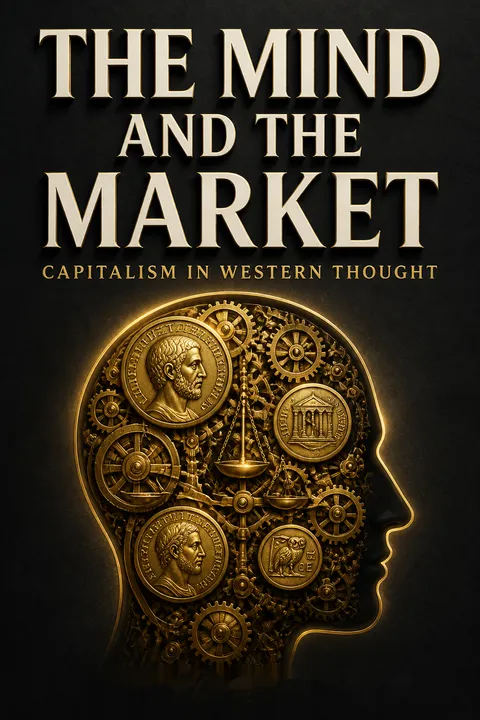
The Mind and the Market receives generally strong praise, averaging 4.17/5. Readers appreciate its accessible exploration of capitalist thought across centuries, tracing ideas from Voltaire and Adam Smith through Marx, Hegel, Keynes, and Hayek. Many highlight its rich historical context and interdisciplinary approach. Persian-language reviewers particularly value its balanced perspective on capitalism's cultural and social impacts. Some critics note the author's visible liberal-conservative bias, occasional repetitiveness, and uneven treatment of capitalism's critics, particularly Marx. Translation quality is frequently praised among Persian reviewers.
People Also Read




Download PDF
Download EPUB
.epub digital book format is ideal for reading ebooks on phones, tablets, and e-readers.








































