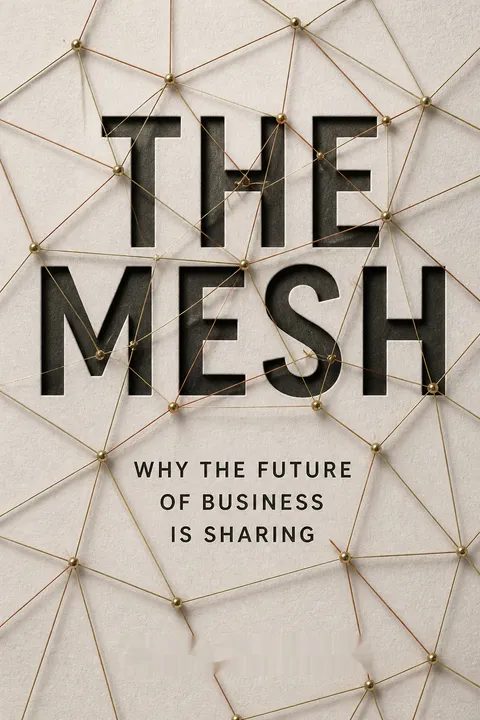

Key Takeaways
1. The Mesh: Access Over Ownership
Fundamentally, the Mesh is based on network-enabled sharing—on access rather than ownership.
A simple idea. The Mesh introduces a powerful concept: some things are simply better shared. This emerging business model shifts the focus from individual ownership to convenient, network-enabled access to goods and services. Instead of buying, maintaining, and storing items like cars, tools, or even Christmas trees, consumers gain access to them precisely when and where they need them, reducing personal and environmental costs.
Beyond traditional sharing. Unlike old-fashioned rental companies, Mesh businesses are built on sophisticated information infrastructure, leveraging mobile, web, and social networks. This allows them to define and deliver highly targeted, personalized goods and services. The core strategy is to "sell" the same product multiple times, multiplying profits, customer contact, and opportunities for additional sales and brand strengthening.
Efficiency and value. This model deploys physical assets more efficiently, boosting the bottom line while lowering pressure on natural resources. The Mesh offers dramatically improved service and choice at a lower personal cost, making it an irresistible alternative to the traditional ownership mindset that has often blinkered business brains.
2. Four Forces Driving the Mesh Revolution
The Mesh arrives just in time. Powerful forces drive it.
Economic reset. The global economic crisis has created a deep distrust of older brands and models, making consumers more willing to try new alternatives. People are rethinking what they truly value, shifting away from excessive acquisition towards simpler, more meaningful lives, creating an opening for new, cost-effective models.
Environmental imperative. Climate change and depleted natural resources are rapidly increasing the cost and risk of doing business the old way. The global population growth demands more efficient sharing of resources, pushing pragmatic businesses and governments towards sustainable practices.
- Landfills generate methane gas, accelerating global warming.
- Moving and disposing of waste requires significant energy.
Urban density. A million new people move to cities every week, creating greater urban density. This environment is perfect for Mesh businesses, as more people nearby make services like car, bike, or tool sharing more cost-effective and profitable. Walkable cities with abundant amenities naturally foster Mesh adoption.
Network maturity. Over two decades of investment in the Internet, mobile infrastructure, and social networks have matured to a point where businesses can provide better, more personalized services exactly when needed. This invisible network enables a level of service and ad hoc coordination that was previously impossible, connecting physical goods to users in real-time and space.
3. The Mesh Advantage: Data-Driven Trust
Every Mesh transaction is an opportunity to deliver on the promise you make to your customers—to give them convenient access to customized goods and services.
Virtuous circle of trust. The Mesh model thrives on a series of repeated transactions, each an opportunity to gather and exchange information with the customer. This frequent interaction allows businesses to learn, test, play, and engage, creating a "virtuous circle of trust" that refines superior experiences, partnerships, products, and offers.
- Learn: Collect data on usage, preferences, and feedback.
- Test: Introduce new services or product variations.
- Play: Experiment with partnerships and offers.
- Engage: Foster deeper customer relationships.
Leveraging infrastructure. Mesh businesses start with a huge technical advantage, building upon billions spent on existing platforms like Amazon Web Services, PayPal, and social networks. This significantly lowers financial and time barriers for new ventures, allowing them to deploy assets they don't own but can easily access, making them agile and capital-efficient.
The curator effect. Social networks amplify the Mesh advantage, as satisfied customers become powerful "discoverers" or "curators" who influence their friends and family. A recommendation from a trusted source is fifty times more likely to persuade someone to buy a product, making word-of-mouth marketing a powerhouse for Mesh businesses. This organic spread of positive experiences is far more effective than traditional advertising.
4. Heirloom Design: Products Built to Share
For most of human history, those who designed the tools and temples, the roads and aqueducts, the musical instruments and microscopic lenses, have sought to make products and structures that are durable, functional, efficient, and attractive.
Reversing obsolescence. The Mesh signals a return to first principles of good design, reversing the "planned obsolescence" of the throwaway culture. Products in a Mesh business must be durable, functional, and easy to use, designed for repeated use, repair, upgrading, and "upcycling" at the end of their life cycle.
- Durable: Built to last through many uses.
- Flexible: Adaptable for different users and modular.
- Reparable: Easily fixed with standardized parts.
- Sustainable: Reduces waste and conserves resources.
Cost-sharing quality. While heirloom-quality products are often expensive for individual ownership, the Mesh model spreads this cost across many transactions and users. This allows for higher quality products that are safer and more reliable, offering a competitive advantage to Mesh businesses and a better value proposition for customers.
Continuous feedback loop. Mesh businesses maintain constant information flow about their products, including customer feedback, which can be fed back to manufacturers. This direct, two-way communication helps improve product design over time, ensuring that products evolve to meet user needs and preferences, unlike traditional models where customer feedback is often filtered or delayed.
5. Trust is the Core Currency of the Mesh
Earning and maintaining the customer’s trust has always been important in business. But social and mobile networks have changed the equation, tipping the balance of power considerably toward the customer.
Radical transparency. In today's hyper-connected world, a brand is defined more by customer experience and word-of-mouth than by company messaging. Mesh businesses, being "hypersocial," must constantly earn and maintain trust through reliability, fulfilling expectations, and being responsive to evolving customer needs.
- Say what you do: Manage and frequently revisit expectations.
- Do what you say: Consistently deliver on promises.
- Perpetually delight: Exceed expectations with every interaction.
Trials and micro-commitments. Mesh businesses often introduce themselves through promising trials or "tapas" style offers, allowing customers to make small commitments and gradually build comfort with new services. This low-stress entry point helps overcome reluctance to non-traditional models and fosters organic market growth as customers experience the value firsthand.
Handling negative feedback. In an age of radical transparency, negative experiences can spread rapidly. Mesh businesses must pay attention, act quickly, and be boldly honest when problems arise. Acknowledging mistakes, explaining corrections, and being straight with the public builds trust and allows customers to give companies another chance, reinforcing loyalty.
6. The Mesh Ecosystem: Partners and Niches
A core strength of the Mesh is the ability to fully integrate clusters of partners and systems for sharing information.
Integrated partnerships. Mesh businesses thrive by forming ecosystems of partners that share information and common purpose, much like natural systems. This integration expands opportunities for offering diverse services, from transportation and travel to food and finance, creating greater value for customers and partners alike.
- Cross-promotion: Heineken partnering with taxi services for safe rides.
- Service bundles: Home exchange services pairing with car-sharing.
- Data sharing: Partners using aggregated customer data for personalized offers.
Niche identification. The Mesh's robust information infrastructure allows businesses to easily identify and fill viable market niches. Companies like Etsy, which caters to crafters, or Prosper, which fills gaps in traditional lending, demonstrate how specialized communities can be served more effectively than by large, generalized platforms.
Adaptability and resilience. Mesh businesses are inherently resilient, structured to adapt quickly to changing conditions or consumer desires. Their deep integration with customers and partners enables rapid iteration and adjustment of offerings, ensuring products and services remain fresh and relevant, unlike rigid traditional models.
7. Openness Accelerates Mesh Innovation
Why create share platforms where ideas and information can be freely shared? Once the core offering is refined, traditional business logic dictates that a more proprietary approach will distinguish you from competitors, and create protection against them.
Beyond proprietary control. While traditional businesses often guard intellectual property, Mesh businesses benefit immensely from open sharing of ideas and information, especially in their early stages. This open architecture drives hyper-innovation, fosters a greater sense of community, and accelerates development.
- Open design: Architecture for Humanity's Open Architecture Network.
- Open source software: Mozilla Firefox's collaborative development.
Building momentum and trust. Sharing information with partners and communities in the early life cycle of a business builds momentum, support, and trust. This collaborative vetting process refines initial offerings, avoids costly mistakes, and allows businesses to go to market faster with less capital.
Transparency as a signal. In today's environment, companies perceived as closed and proprietary are increasingly disfavored. Transparency signals "nothing to hide," building trust with customers, partners, and regulators. This ethos of sharing and openness, reminiscent of the early Web, is crucial for nurturing the next generation of healthy social innovations.
8. Big Businesses Can (and Must) Mesh
When people ask me whether major corporations can join the Mesh, my short answer is: many already have.
Strategic adoption. Major corporations can and do adopt Mesh strategies, either fully or partially, to gain market share and increase profits. Even sales-focused companies can use "Mesh divisions" to test new products with preferred customers, cultivating richer relationships and gaining valuable insights before mass production.
Five ways to Mesh:
- Enable Mesh businesses: Provide platforms and services (e.g., Amazon Web Services, Facebook).
- Leverage physical assets: Turn owned products and materials into share platforms (e.g., Goodyear offering tire services).
- Engage partners: Mutually share resources and data for better products (e.g., Better Place's EV ecosystem).
- Integrate supply chains: Develop forward and reverse chains for efficiency and upcycling (e.g., Walmart's sustainability efforts).
- Extend ecosystems: Partner with Mesh businesses to reach new markets (e.g., hotels integrating car-sharing).
From retailer to service provider. Big-box retailers like Walmart or Best Buy have a massive opportunity to shift from selling disposable goods to becoming product service and repair providers. This would deepen customer relationships, generate new profit streams (e.g., Best Buy's Geek Squad), and contribute to a "reverse supply chain" for recycling and upcycling materials.
9. Netflix: A Masterclass in Meshing
Netflix used what I’d call a textbook Mesh strategy—if a Mesh textbook existed—to beat Blockbuster.
Exploiting vulnerabilities. Netflix identified Blockbuster's Achilles' heel: late fees, which alienated its best customers. By offering a subscription model with no late fees and convenient DVD delivery via mail, Netflix directly addressed a major customer pain point, winning over a frustrated market.
Information as core business. Netflix's true genius lay in its function as an information business. Its web-based platform collected vast amounts of data on customer selections and ratings, enabling a sophisticated "recommendation engine" that continually suggested personalized movie choices. This data-driven approach fostered deep customer engagement and satisfaction.
Strategic partnerships and innovation. Instead of expensive advertising, Netflix partnered with DVD player manufacturers, offering free rentals and promoting its "no late fees" promise. It also fostered innovation through initiatives like the million-dollar contest to improve its recommendation algorithm, demonstrating the power of collaboration in refining its service and brand.
10. Seed Your Own Mesh: Opportunities Abound
When you start any business, choose something that’s gotten under your skin. It should be something you’re passionate about and willing to obsess about at weird hours.
Everyday problems, Mesh solutions. Look at your daily life for high-cost, underutilized physical assets or activities that cause friction. From commuting and childcare to gardening and office space, countless opportunities exist to apply a Mesh model, improving customer experience and creating new business leverage.
- High-cost assets: Cars, specialized tools, designer handbags.
- Underutilized spaces: Spare rooms, garages, community gardens.
- Life transitions: New parents needing baby gear, retirees downsizing.
Define, refine, and scale. Start by defining your market and core offering, then engage early adopters to refine your business model based on real feedback. This iterative process allows for "cheap and high-value mistakes" before scaling up, ensuring your offer is compelling and your initial customer base provides strong word-of-mouth.
Leverage existing tech. The cost of starting a Mesh business is significantly reduced by leveraging existing application service providers (ASPs) and software as a service (SaaS) platforms. These "services in the cloud" provide access to infrastructure, hosting, payment processing, and fulfillment, allowing entrepreneurs to focus on their unique value proposition rather than building everything from scratch.
People Also Read






Download PDF
Download EPUB
.epub digital book format is ideal for reading ebooks on phones, tablets, and e-readers.








































