
Key Takeaways
1. The Market Revolution: A Clash of Cultures
As market revolution stressed Americans into unparalleled mobilization, both spiritual and political, the Hero of New Orleans found another commanding role.
A fundamental conflict. The Market Revolution, spanning 1815-1846, represented a profound struggle between the capitalist market and the deeply conservative, land-based subsistence culture of early America. This era saw the irresistible force of market values—individualism, competitive wealth, commodity production—clash with the immemorial provider of survival, the land, which fostered family obligation, communal cooperation, and modest comfort. This conflict reshaped American society, economy, and politics.
Indian and white subsistence. Native American cultures, intimately dependent on the natural order, lived communally and egalitarianly, extracting subsistence directly from the land. They were tragically decimated by European microbes and the market's insatiable demand for furs and goods. White subsistence farmers, while adopting some Indian agricultural practices, also relied on large families and cheap land for their patriarchal independence, but their mode of life was ultimately doomed by its own population dynamics and the receding frontier.
Agrarian crisis and market penetration. By the late 18th century, demographic pressure and land scarcity in older northeastern settlements led to an agrarian crisis, forcing many into wage labor or supplementary crafts. This vulnerability allowed the market to penetrate rural areas, transforming traditional ways and fostering a new ethic of "sharp bargaining" among Yankees. The post-War of 1812 commercial boom, centered in New York City, then dramatically accelerated this market revolution, drawing more people into its orbit and intensifying the clash of cultures.
2. Government as the Engine of Capitalist Development
The American economy's takeoff was fueled by the unusually feverish enterprise of its market sector.
State-level initiatives. After Federalists lost control of the federal government, entrepreneurial interests shifted their developmental demands to state governments. Republican legislatures, particularly in commercial states like New York and Pennsylvania, actively promoted economic growth by granting direct state loans to manufacturing, authorizing lotteries and tax exemptions for private businesses, and conferring monopolies. This commitment to a political economy of capitalism became an essential stage of the market revolution.
Transportation infrastructure. The most dramatic government intervention was the use of state credit to finance massive transportation networks. The Erie Canal, completed by New York State in 1825 at a cost of $7 million, drastically cut shipping costs and generated immense profits, sparking a nationwide transportation revolution. Other states followed with canals and railroads, extending the division of labor and creating specialized regional markets.
Corporate power. State policies also fostered the corporate form of business organization, which was crucial for assembling the large capital needed for these ventures. From just seven private business corporations chartered before the Revolution, the number soared to over three hundred during the 1790s. Banks, in particular, provided a circulating medium of bank notes, pooling capital and galvanizing entrepreneurial energies, despite initial opposition from those who viewed them as fraudulent.
3. The Legal Revolution: Reshaping Law for Enterprise
With impressive creativity and speed, the legal profession supplied a new law.
Lawyers as shock troops. Lawyers, mushrooming in number due to proliferating contractual relationships, became the main purveyors of capitalist ideology. They took over electoral and legislative politics, bending legislation to entrepreneurial interests. More fundamentally, they reshaped the common law in state courts, largely beyond public scrutiny, to serve the demands of the market.
Judicial activism. Lawyer-judges, replacing laymen on the bench, seized power from juries by instructing them on points of law and publishing their decisions as precedents. Figures like Federalist James Kent and Republican Joseph Story systematized American law, adapting it to the "exigencies and changes of society." This "judicial legislation" prioritized marketability and development over traditional property rights.
Favoring capital. The new legal framework systematically favored capital and entrepreneurs. It abolished entails to make land freely marketable, gave priority to business uses of property (e.g., waterpower for mills), and eroded common-law liability to encourage risk-taking. The doctrine of eminent domain was vastly expanded, allowing the state to seize private property for "public purpose" projects like canals and railroads, often with minimal compensation to original owners.
4. The Panic of 1819: Capitalism's Traumatic Awakening
In the crisis of 1819, the market's explosive growth forced its multiple contradictions—economic, political, constitutional, and moral—simultaneously to a head.
Boom-and-bust reality. The postwar boom, fueled by speculative excess and an explosion of bank charters, turned into a devastating bust in 1819. This was America's first experience of widespread economic prostration, revealing the inherent instability of the capitalist market. Urban centers faced mass unemployment and business failures, while rural areas saw foreclosures and property liquidations.
National Bank's role. The Second Bank of the United States, intended to stabilize the currency, instead succumbed to the speculative mood, expanding loans and note issues, particularly in the booming West. Its subsequent ruthless contraction, aimed at saving itself, triggered a cascade of state bank failures and a collapse in commodity prices, making it impossible for debtors to repay loans.
Shattered consensus. The panic shattered the "Era of Good Feelings" and intensified market disruption. It ignited antinomian insurgency in religion and a new class politics in the states, as public anger focused on bankers and the paper system. This crisis, coupled with the Missouri controversy over slavery, exposed deep political, constitutional, and moral contradictions, setting the stage for a generation of conflict over the republic's destiny.
5. Democratic Insurgency: The People Rise Against Elites
Hard times shattered Monrovian consensus to inaugurate an era of hard feelings.
Public wrath. The Panic of 1819 ignited widespread anger, particularly against bankers who had encouraged borrowing and now showed no mercy. People felt corrupted and robbed by the "paper system" of bank notes and credit. This public fury translated into political revolt, as a populace that had ignored entrepreneurs in prosperous times now blamed them for their distress.
State-level political upheavals. In many western states, where reckless bank credit had fueled speculative excesses, farmer majorities enacted debtor-relief laws and even issued state paper money to protect small debtors. These measures, often struck down by the judiciary, reflected a deep-seated preference for "hard money" (gold and silver coin) as a symbol of stability and equity against the market's "legerdemain tricks upon paper."
Jackson's rise. This surge of democratic sentiment, often expressed through antibank and anti-speculator rhetoric, propelled Andrew Jackson into national prominence. Initially backed by entrepreneurial interests, Jackson quickly embraced a hard-money, antibank stance, identifying himself as the "plain cultivator of the soil" and champion of the common folk against a corrupting and exploitative market elite. His popularity signaled a profound shift in American politics, challenging the traditional leadership of the gentry.
6. The Second Great Awakening: Cultural Adaptation to Market Stress
As the magical New Light validated everyperson's heart against authority in church and state, plebeian evangelicalism became the predominant form of American Christianity.
Spiritual mobilization. The market's disruptive growth and the Panic of 1819 intensified spiritual anxieties, leading to the Second Great Awakening. This era saw a doubling of church affiliation and a pervasive spiritual preoccupation among ordinary folk. The "New Light" of antinomian revivalism, emphasizing emotional conversion and direct access to divine grace, became the predominant form of American Christianity, challenging traditional authority in both church and state.
Come-outerism and communalism. Many evangelicals, repelled by the market's egotism, embraced "Come-outerism," seeking spiritual perfection in church communities of righteousness and love. Radical sects, like the Shakers and Mormons, experimented with communalism and celibacy, reconstructing human relationships around values of love, community, and equality. Baptists and Methodists, with their democratic theology and emphasis on heartfelt emotion, became the largest American denominations, embodying the egalitarian localism of the subsistence culture.
Moderate Light and capitalist accommodation. A "Moderate Light" emerged, blending antinomian fervor with the self-discipline of arminian effort. Led by figures like Jonathan Edwards's disciples (Hopkins, Dwight, Beecher, Taylor), this movement channeled evangelical zeal into a "gradualist millennialism," where human effort contributed to a Christian Utopia. This subtly reconciled anxious Americans to capitalist imperatives, equating Christian virtue with self-repressive capitalist effort and laying the groundwork for a "Christian capitalist republic."
7. Ethos vs. Eros: Reshaping Gender and Sexuality for Capitalism
Through collective repression—arising periodically ever since against intoxicants, drugs, and the varied guises of sexuality—middle-class society disciplined recalcitrant inclinations to capitalist effort.
Middle-class formation. The "middle class," defined by an ideology of effortful "character" and self-improvement, emerged as a dominant cultural force. This mythology, fueled by the promise of upward mobility and the fear of poverty, atomized society into a marketplace where success was attributed solely to individual exertion. This ideology, however, masked a widening gap between wealth and poverty, and the "self-made man" was often a myth.
Family transformation. The nuclear family, uprooted by migration and economic change, became the crucible for this cultural transformation. Children, no longer an economic asset, required rigorous socialization for market competition. This led to a dramatic and sustained repression of human fertility, as families sought to limit births through new contraceptive practices like coitus interruptus, reflecting a profound shift in sexual behavior.
Sexual repression and purity. A radical redefinition of gender roles accompanied this shift. Men were driven to extremes of aggression and self-control in the competitive public sphere, while women were relegated to an altruistic domestic sphere, becoming "True Women"—weak, selfless, and pure. A powerful purity movement, led by women, targeted prostitution and male licentiousness, while a male crusade against masturbation (Todd, Graham) linked sexual indulgence to failure and effeminacy, enforcing a new antierotic phobia.
8. Jacksonian Democracy: The Hard Money Challenge
By attacking banking as well as internal improvements and Indian rights, he would hold the state-rights ground against planter power and nullifier heresy for a democratic Union.
Jackson's radical mandate. Andrew Jackson, swept into office by a democratic mandate, saw his reelection as a directive to fight the "Bank War" to a finish. He viewed the national Bank as a "hydra of corruption" and a "Nobility System" that enriched the few at the expense of the many. His hard-money stance, advocating gold and silver coin over paper currency, resonated with farmers and workers who felt exploited by the inscrutable paper system.
The Bank War. Jackson's determination to remove federal deposits from the national Bank, despite opposition from Congress and his own Cabinet, ignited a fierce political struggle. He bypassed Congress, firing Treasury Secretaries until he found one (Taney) willing to execute his order. Nicholas Biddle, the Bank's president, retaliated by severely contracting loans, hoping to force Congress to recharter the Bank, but his actions backfired, leading to widespread public anger and the Bank's eventual demise.
Limits of democracy. While Jackson's hard-money campaign mobilized a formidable producer-class politics, it faced significant challenges. The Constitution's federal-state division of powers shielded state banks from national interference, and many "Democrats by trade" subtly supported state-bank credit. Despite Jackson's efforts, the "paper system" entrenched in the states survived, leading to a patchwork of partial reforms rather than a fundamental overhaul. This demonstrated the limits of majority rule against entrenched capitalist interests.
9. The Bourgeois Republic: Cultural Hegemony Through Print and Education
By the 1840s an exfoliating cultural infrastructure and the powerful new medium of cheap print were carrying the American bourgeoisie to the most pervasive hegemony of any modern ruling class.
Yankee cultural offensive. The northeastern commercial gentry, particularly Boston Brahmins, consolidated their cultural authority through Unitarian institutions and generous endowments. Simultaneously, pious Yankees outside Boston tamed popular antinomianism into the "Moderate Light," spreading a pansectarian middle-class culture of effort and self-improvement across the North. This two-pronged offensive blurred regional differences and promoted capitalist success as a measure of gentility.
Literacy and schooling. A surge in literacy and schooling became the cutting edge of this cultural conquest. Public and private schools, particularly in the Northeast, expanded rapidly, driven by parents preparing children for market competition and by bourgeois reformers like Horace Mann. Mann advocated tax-supported free schools as a "barrier against" the "ignorant and vicious" masses, aiming to discipline children for a homogeneous middle-class society.
The print revolution. Technological innovations like stereotyping, steam presses, and cheaper paper fueled an explosion of print. Benevolent societies (Bible, Tract, Sunday-School) pioneered mass distribution of religious and moralistic literature, while the penny press, initially catering to working-class interests, eventually became a tool for promoting jingoistic patriotism, nativism, and racism, further solidifying bourgeois cultural hegemony.
10. Slavery: Capitalism's Great Contradiction
"Slavery is the pivot of our industrialism today as much as machinery, credit, etc.," Karl Marx observed in the 1840s.
Capitalist slavery. Slavery, while morally abhorrent, was central to the global capitalist market, particularly the booming cotton industry. The American cottonocracy systematically dehumanized black chattels as market commodities, using absolute property rights and labor exploitation to fuel the industrial revolution. This system, though less brutal in terms of slave mortality than Latin American slavery, poisoned the liberal republic with virulent white racism.
The law of bondage. Southern law, exemplified by State v. Mann (1829), explicitly defined slaves as property whose submission required the master's absolute power. This legal framework facilitated routine violence, the internal slave trade, and the denial of basic human rights, including marriage and literacy. The commodification of black bodies, however, also incentivized masters to manage slaves for both production and reproduction, leading to a spectacular increase in the slave population.
Resistance and proslavery. Slaves resisted dehumanization by building their own vibrant culture of family, religion, and folk traditions, often expressing defiance through trickster tales and spirituals. White fears of slave insurrections (Vesey, Turner) and northern antislavery attacks drove the South into a desperate defense of slavery as a "positive good." This proslavery ideology, often rooted in claims of black racial inferiority, served to mute class conflict among whites and unite them in defense of the peculiar institution.
11. Manifest Destiny: Expansionism and the Road to Civil War
A geographical line, coinciding with a marked principle, moral and political, once conceived and held up to the angry passions of men, will never be obliterated; and every new irritation will mark it deeper and deeper.
Texas and Oregon. The 1840s saw a surge of American expansionism, driven by land hunger, economic opportunity, and a jingoistic "manifest destiny." The annexation of Texas, a slaveholding republic, and the push for Oregon territory, ignited fierce sectional conflict over the extension of slavery. This expansionism, fueled by racist Anglo-Saxonism, aimed to secure a continental domain for the republic.
Polk's aggressive policy. President James K. Polk, a Jacksonian protege, pursued an aggressive foreign policy to acquire California and secure Oregon. He provoked war with Mexico to seize vast territories, including New Mexico and California, and negotiated a compromise with Britain over Oregon. His tactics, however, alienated many, and the war's success, ironically, boosted the popularity of Whig generals like Zachary Taylor, who would become his successor.
The Wilmot Proviso. The acquisition of new territories immediately reignited the slavery debate. David Wilmot's amendment, proposing to ban slavery from any territory acquired from Mexico, passed the House with strong northern support but failed in the Senate. This "White Man's Proviso," fusing antislavery sentiment with racism, signaled an irreversible sectional crisis. It aimed to reserve new lands for "free white labor," ultimately empowering a Republican antislavery coalition and setting the stage for the Civil War.
Review Summary
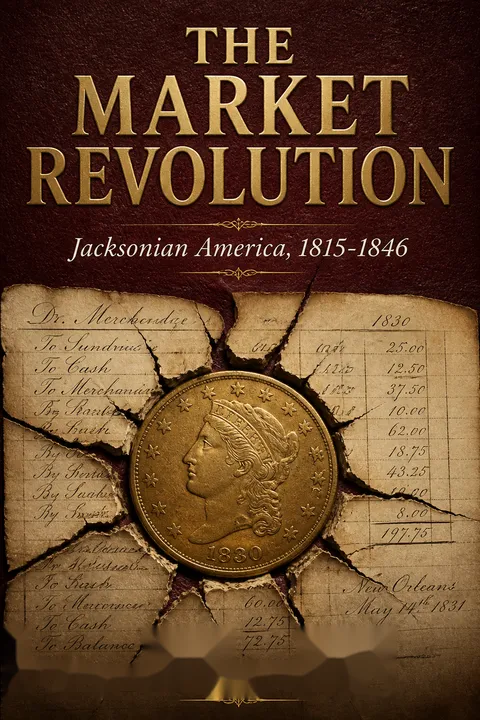
Reviews of The Market Revolution are mixed, averaging 3.63/5. Readers appreciate Sellers' ambitious scope, tracing America's shift from subsistence farming to capitalism, and his analysis of class, religion, politics, and culture in the Jacksonian era. Many find the Marxist framework insightful, particularly regarding the Bank War and democratic resistance to capitalism. However, common criticisms include dense, often unclear prose, poorly defined terms, overreliance on market forces as explanation, and an uneven structure. Most reviewers suggest it suits academic historians rather than casual readers.
People Also Read


Download PDF
Download EPUB
.epub digital book format is ideal for reading ebooks on phones, tablets, and e-readers.








































