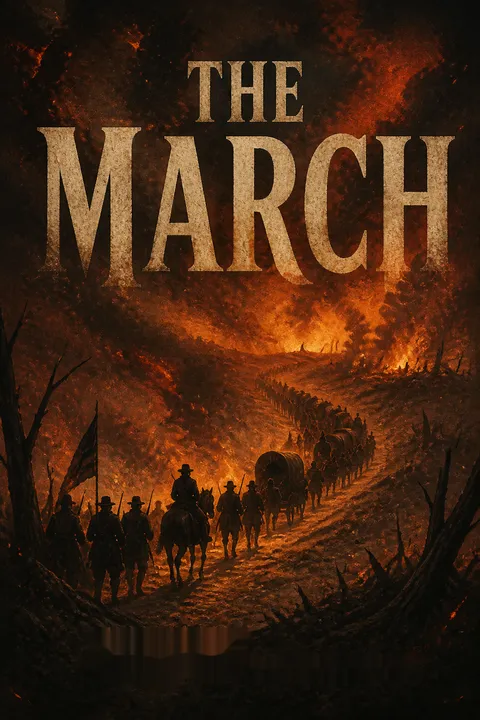

Plot Summary
Dawn of Destruction
In the predawn hush, the Southern world is upended as General Sherman's army draws near. Plantations are thrown into chaos—families like the Jamesons scramble to save what they can, while slaves sense the tremors of change. The old order, built on slavery and privilege, is threatened by the relentless advance of blue-coated soldiers. The fear and confusion are palpable: some flee, some resist, and some, like the young Pearl, stand at the threshold of a new, uncertain freedom. The land itself seems to shudder as the Union army's approach signals not just military conquest, but the collapse of a way of life. The dawn brings not hope, but the first flames of destruction.
Freed by Fire
As the Union army sweeps through Georgia, the enslaved seize their chance for freedom. Pearl, a mixed-race girl, is left behind by her white father and mistress, clutching the tokens of her past and the promise of a future she can barely imagine. The plantation is looted and burned, its wealth and order consumed by the army's foragers. The newly freed gather, uncertain whether to follow the army or remain in the ruins. Their joy is mingled with fear—freedom is a word, not yet a reality. The world they knew is gone, and the road ahead is both open and perilous, marked by the smoke of burning homes and the distant thunder of marching men.
Prisoners and Pretenders
In a Confederate prison, two unlikely companions—Arly, a wily trickster, and Will, a young deserter—face execution. Their banter masks terror and longing for home. When the Union army's approach disrupts the prison, they are offered a reprieve: fight for the Confederacy or rot in their cells. Thrust into battle, they survive by wit and luck, eventually donning the uniforms of dead Union soldiers to escape. Their journey is a dance of shifting allegiances, survival, and the search for meaning in a world where identity is as fluid as the muddy rivers they cross. Their fates entwine with the chaos of war, each step a gamble between life and death.
The Army Consumes All
Sherman's army is a living organism, devouring the land as it moves. Towns like Milledgeville and Savannah are overrun, their homes and institutions repurposed or destroyed. Civilians—like Emily Thompson, the judge's daughter—are swept up in the tide, their lives upended by occupation, loss, and the relentless churn of war. The army's needs override all else: food, shelter, and even people are requisitioned. The boundaries between conqueror and conquered blur as black and white, soldier and civilian, are forced into uneasy proximity. The march is not just a military campaign, but a force that remakes the world in its wake.
The Surgeon's Burden
Amid the carnage, Dr. Wrede Sartorius, a German-born Union surgeon, becomes a pillar of calm and efficiency. His field hospitals are islands of order in a sea of chaos, where limbs are lost and lives are saved or ended with equal detachment. Emily, drawn to his intellect and compassion, finds purpose as his assistant, even as she questions the morality of their work. Sartorius's innovations and cold rationality set him apart, yet he is haunted by the suffering he cannot alleviate. The war's brutality is distilled in the surgeon's tent, where science and humanity are tested to their limits.
The Orphaned and the Lost
The march leaves behind a trail of orphans—literal and figurative. Pearl, now a drummer boy in disguise, searches for identity and acceptance among the Union ranks. Wilma, a former slave, finds love and hope with Coalhouse, a freedman determined to claim his forty acres. The young and the dispossessed—black and white—are forced to navigate a world without the anchors of family or home. Their journeys are marked by small acts of kindness, fleeting connections, and the ever-present threat of violence. In the chaos, they forge new bonds and dream of futures that may never come.
The March Unites Strangers
As the army pushes into the Carolinas, disparate lives intersect. Arly and Will, still masquerading as Union men, drift through the ranks, their luck both a blessing and a curse. Pearl's secret is discovered by Sherman's staff, who protect her out of respect for the general's grief over his lost son. Emily and Sartorius's relationship deepens, even as the war's horrors strain their connection. Freed slaves, refugees, and soldiers form a moving tapestry of suffering and resilience. The march is both a crucible and a crossroads, forging unlikely alliances and testing the limits of endurance.
The Burning of Columbia
Columbia, South Carolina, becomes the war's most vivid inferno. As Sherman's army enters, fires—set by retreating Confederates, looters, and perhaps the wind itself—consume the city. Soldiers, drunk on victory and whiskey, become both liberators and destroyers. Civilians, black and white, flee or cower as their world burns. The boundaries of civilization dissolve in the flames, exposing the raw nerves of hatred, revenge, and despair. For some, like Emily and Mattie, the destruction is both literal and symbolic—the final severing of ties to the antebellum past.
Love and Disillusionment
In the aftermath of Columbia's burning, love and loss intertwine. Emily, exhausted and disillusioned, questions her place beside Sartorius, whose scientific detachment both attracts and repels her. Pearl, torn between her white and black identities, seeks solace in Stephen Walsh, a Union soldier who sees her as she is. The war has stripped away illusions, leaving only the bare truth of human need and vulnerability. Relationships are forged and broken in the crucible of suffering, and the promise of peace is shadowed by the scars of what has been lost.
The Ghost Army Moves On
As the army moves north, the landscape is littered with the remnants of war—dead men, ruined towns, and broken dreams. Arly, ever the survivor, adopts new disguises and schemes, dragging along Calvin, a black photographer's apprentice. The army's passage is marked by both heroism and atrocity, as discipline frays and vengeance simmers. The march becomes a ghostly procession, haunted by the memories of those left behind. For some, like Mattie and her son, the journey is a search for lost family; for others, like Pearl and Stephen, it is a quest for a place to belong.
Surrender and Suspicion
With Lee's surrender at Appomattox, the war's end seems near, but peace is fragile. Sherman's negotiations with Johnston are shadowed by suspicion and political intrigue. The assassination of Lincoln sends shockwaves through the army, threatening to unravel the fragile order. Old hatreds flare, and the line between justice and revenge blurs. Freed slaves, promised land and liberty, face new uncertainties as the machinery of government grinds into motion. The march's survivors must navigate a world where victory is ambiguous and the future is anything but secure.
The End of the March
As the columns reach Goldsboro and Raleigh, the great army that once devoured the South begins to scatter. Soldiers dream of home, while others—like Pearl, Stephen, and Calvin—plan new journeys northward. The bonds forged in war are tested by the demands of peace. For some, the end of the march is a release; for others, it is a loss of purpose. The land, scarred and silent, bears witness to the cost of victory. The survivors must reckon with what they have done, what they have lost, and what they hope to build in the ruins.
Aftermath and Reckoning
In the war's wake, questions of justice and memory loom large. Arly's attempt to assassinate Sherman ends in execution, while Calvin's fate hangs in the balance. Sartorius, summoned to Washington, witnesses the death of Lincoln and the nation's collective grief. The survivors—black and white, soldier and civilian—must find ways to live with the past. The promise of freedom is complicated by prejudice, poverty, and the lingering wounds of war. The march is over, but its legacy endures in the lives of those who walked its path.
The Price of Freedom
For the newly freed, the end of slavery is both liberation and exile. Wilma and Coalhouse debate whether to claim land in the South or seek new lives in the North. Pearl, caught between worlds, must choose her own path. The promises of "forty acres and a mule" are fraught with uncertainty and betrayal. The struggle for dignity and self-determination continues, as the realities of racism and poverty temper the euphoria of emancipation. Freedom is not a gift, but a challenge—a daily act of courage and hope.
The Photograph and the Assassin
The desire to record and control history culminates in a fateful photograph. Arly, masquerading as a photographer, attempts to assassinate Sherman during a staged portrait, but is thwarted and executed. Calvin, blinded in the chaos, is left to ponder the meaning of his craft and his survival. The episode is a microcosm of the war's contradictions: the urge to memorialize, the persistence of violence, and the fragility of order. The photograph becomes both a symbol of memory and a reminder of the dangers that linger even in victory.
The War's Quiet End
As Sherman and Johnston negotiate the terms of surrender, the war's end is marked by both relief and sorrow. The assassination of Lincoln casts a pall over the celebrations, and the future of the South—and the nation—remains uncertain. The survivors, weary and changed, must find ways to live in a world remade by violence and loss. The march is over, but its echoes persist in the memories of those who endured it. The land is quiet, but the work of healing has only begun.
New Roads, New Names
With the war's end, the characters set out on new journeys. Pearl and Stephen, joined by Calvin and David, head north, dreaming of new lives in Baltimore and New York. The road ahead is uncertain, marked by the scars of war and the challenges of freedom. The past cannot be undone, but the future is theirs to shape. As they travel, they carry with them the lessons of the march: resilience, compassion, and the enduring hope for a better world.
Analysis
Doctorow's The March is a sweeping meditation on the transformative power of war—its capacity to destroy, to liberate, and to remake both individuals and societies. By centering the narrative on Sherman's infamous campaign, Doctorow explores the dissolution of old orders and the birth of new identities. The novel's polyphonic structure invites readers to inhabit the perspectives of the powerful and the powerless, the victors and the vanquished, revealing the war's impact on every stratum of society. Central to the novel is the theme of identity—how it is constructed, performed, and undone in times of crisis. The fluidity of race, gender, and allegiance reflects the instability of a world in flux, while the recurring motif of the march as a living organism underscores the inescapable interconnectedness of all who are caught in its path. Doctorow's prose is both lyrical and unsparing, capturing the beauty and horror of a world in transition. The novel ultimately suggests that history is not a grand narrative of heroes and villains, but a tapestry of ordinary lives shaped by extraordinary events. The lessons of The March are as relevant today as they were in the aftermath of the Civil War: freedom is hard-won and fragile, justice is elusive, and the work of healing—personal and collective—continues long after the guns fall silent.
Review Summary
Reviewers widely praise The March as a sweeping, cinematic historical novel depicting General Sherman's Civil War campaign. Doctorow's ensemble cast — including Pearl, a light-skinned freed slave, surgeon Wrede Sartorius, and Confederate misfits Arly and Will — draws consistent admiration. Many compare the novel's scope to Tolstoy, while others note its lack of a single protagonist. The vivid prose, rich characterizations, and unflinching portrayal of war's brutality earn high marks, though some find it less compelling than Doctorow's Ragtime.
People Also Read


Characters
Pearl Wilkins Jameson
Pearl is the mixed-race daughter of a white plantation owner and an enslaved woman, embodying the contradictions of the antebellum South. Her pale skin allows her to pass as white, but her identity is shaped by both privilege and oppression. Orphaned by war, she becomes a drummer boy in Sherman's army, navigating the dangers and opportunities of freedom. Pearl's journey is one of self-discovery—she must reconcile her longing for belonging with the realities of race, gender, and power. Her relationships—with Roscoe, her surrogate father; with Emily and Mattie, her stepmother; and with Stephen Walsh, her lover—reflect her struggle to claim agency in a world that would define her by blood and color. Pearl's resilience and intelligence drive her forward, but her freedom is always shadowed by the legacy of slavery and the uncertainty of the future.
Emily Thompson
Emily is the daughter of a prominent judge, raised in privilege and tradition. The war shatters her world, stripping away family, home, and certainty. Forced to confront the realities of occupation, loss, and violence, Emily finds unexpected strength as a nurse in Sartorius's field hospital. Her relationship with Sartorius is both a refuge and a source of existential questioning—she is drawn to his intellect and detachment, yet yearns for emotional connection. Emily's journey is one of adaptation and survival; she must redefine herself in a world where the old rules no longer apply. Her compassion and intelligence allow her to bridge the divides of class and allegiance, but she is haunted by the costs of war and the limits of her own agency.
Wrede Sartorius
Sartorius is a German-born surgeon in the Union army, a man of science and discipline. His detachment and innovation make him a leader in the chaos of war, but also isolate him from those around him. Sartorius is both fascinated and appalled by the suffering he witnesses; his commitment to healing is tempered by a recognition of the limits of medicine and the brutality of war. His relationship with Emily offers a glimpse of intimacy, but his emotional reserve and obsession with his work create distance. Sartorius's journey is one of professional mastery and personal loneliness—he seeks meaning in the face of overwhelming loss, and his legacy is both the lives he saves and the scars he cannot heal.
Arly Wilcox
Arly is a Confederate deserter, a master of disguise and deception. His wit and cunning allow him to navigate the shifting allegiances of war, adopting new identities as circumstances demand. Arly's partnership with Will is both comic and tragic—a dance of survival in a world where trust is a luxury. His schemes ultimately lead him to impersonate a photographer and attempt to assassinate Sherman, an act that ends in his execution. Arly embodies the chaos and moral ambiguity of war; his refusal to be pinned down by loyalty or principle is both his strength and his undoing.
Will Kirkland
Will is a young Confederate deserter, swept up in events beyond his control. His friendship with Arly offers both protection and peril, as he is drawn into a world of deception and danger. Will's journey is one of reluctant adaptation—he is neither hero nor villain, but a boy forced to become a man in the crucible of war. His longing for home and love is never fully realized, and his fate is a testament to the randomness and tragedy of conflict.
Calvin Harper
Calvin is a black apprentice to a Union photographer, caught between worlds by his race and his craft. After being blinded in the chaos of Arly's assassination attempt, Calvin must rely on others for survival. His commitment to recording history through images is both a source of pride and a burden—he understands the power of memory and the importance of bearing witness. Calvin's journey is one of resilience and adaptation; his blindness does not diminish his vision, but sharpens his sense of purpose and belonging.
Stephen Walsh
Stephen is a Union soldier from New York, pragmatic and introspective. His relationship with Pearl offers both solace and challenge, as he must navigate the complexities of race, love, and ambition. Stephen's skills as a carpenter and nurse make him indispensable, but his true longing is for meaning and companionship. His journey is one of self-discovery and commitment—he dreams of a future with Pearl, even as he recognizes the obstacles they face.
Mattie Jameson
Mattie is the wife of a plantation owner, a woman whose life is defined by duty and denial. The war strips her of home, family, and sanity; her grief for her sons and her inability to adapt leave her adrift. Mattie's relationship with Pearl is fraught with resentment and regret—she is both stepmother and stranger, unable to bridge the gap between love and obligation. Her descent into madness is both a personal tragedy and a symbol of the South's collapse.
Wilma Jones
Wilma is a former slave who seizes her freedom with determination and hope. Her partnership with Coalhouse Walker is a testament to resilience and the power of love. Wilma's journey is marked by practical wisdom and emotional strength—she navigates the challenges of emancipation with both caution and ambition. Her story reflects the broader struggle of freedpeople to claim dignity and agency in a world still hostile to their aspirations.
General William Tecumseh Sherman
Sherman is the architect of the march, a man driven by purpose and haunted by the costs of victory. His leadership is both admired and feared—he is capable of both compassion and ruthlessness. Sherman's grief for his lost son and his ambivalence about the war's legacy add depth to his character. He is both a symbol of Union power and a man struggling with the moral ambiguities of conquest. His interactions with subordinates, civilians, and enemies reveal a complex blend of pragmatism, empathy, and self-doubt.
Plot Devices
The March as Living Organism
Doctorow structures the narrative around Sherman's march as a living, consuming entity—an "immense organism" that devours the land, people, and institutions in its path. The march is not just a backdrop, but a character in itself, shaping the destinies of all who encounter it. This device allows the novel to explore the interconnectedness of individual lives and the larger forces of history, emphasizing the ways in which war transforms both the landscape and the soul.
Shifting Perspectives and Interwoven Narratives
The novel employs a polyphonic structure, shifting between the perspectives of soldiers, civilians, freed slaves, and generals. This mosaic approach mirrors the chaos and complexity of war, allowing readers to experience the march from multiple vantage points. The interwoven narratives create a sense of simultaneity and interconnectedness, highlighting both the diversity of experience and the common threads of suffering, hope, and resilience.
Disguise, Passing, and Identity
Characters frequently adopt new identities—Pearl passes as a white drummer boy, Arly and Will don enemy uniforms, Calvin navigates the world as both black and photographer. These acts of disguise are both practical and symbolic, reflecting the instability of identity in a world upended by war. The device underscores themes of race, gender, and belonging, and raises questions about authenticity, loyalty, and the possibility of reinvention.
The Photograph as Memory and Threat
The motif of photography runs throughout the novel, symbolizing the desire to record, control, and remember the past. The act of taking a photograph becomes both an assertion of agency and a potential act of violence, as seen in Arly's assassination attempt. The photograph is both a tool of memory and a reminder of the dangers of representation—what is captured, what is omitted, and who controls the narrative.
Foreshadowing and Irony
Doctorow employs foreshadowing to build tension and underscore the unpredictability of war. The promise of freedom is shadowed by the realities of racism and poverty; the end of the march brings not peace, but new struggles. Irony pervades the narrative—victory is bittersweet, justice is ambiguous, and the survivors are left to grapple with the consequences of choices made in extremity.

Download PDF
Download EPUB
.epub digital book format is ideal for reading ebooks on phones, tablets, and e-readers.








































