
Plot Summary
The Haunted Sierra Morena
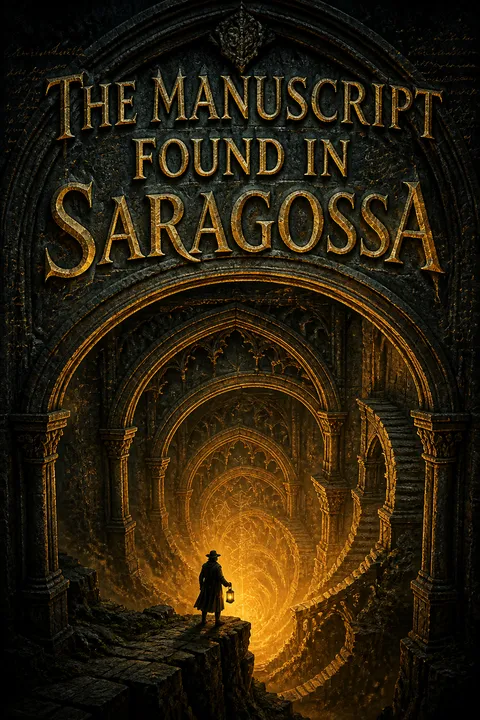
Alphonse van Worden, a young Walloon officer, travels through the wild Sierra Morena, ignoring warnings of bandits and supernatural dangers. He loses his servants and provisions, and spends a night in the eerie, abandoned Venta Quemada inn. There, he is seduced by two mysterious Moorish sisters, Emina and Zubeida, who claim kinship and offer him love and wealth if he converts to Islam. After a night of pleasure, he awakens beneath a gallows, surrounded by corpses, unsure if his experiences were real or dreams. This opening sets the tone for a journey where reality, fantasy, and the supernatural blur, and where every encounter is a test of courage, faith, and identity.
Seduction and Secret Lineage
Emina and Zubeida recount their upbringing in a harem, their passionate attachment to each other, and their longing for a husband of Gomelez blood. They reveal the ancient history of the Gomelez family, descended from Massoud ben Taher, and the secret of the castle of Cassar Gomelez, with its mysterious underground chambers and rituals. Alphonse is tempted by the promise of immense wealth and power, but his Christian faith and sense of honour hold him back. The sisters' seduction is both literal and symbolic, representing the allure of the unknown and the dangers of abandoning one's roots.
Trials of Honour and Faith
Alphonse's journey becomes a series of trials: he is imprisoned by the Inquisition, threatened with torture, and rescued by the bandit Zoto. He is repeatedly tested—by supernatural threats, by the demands of honour, and by the expectations of his lineage. Each ordeal is both a literal danger and a metaphorical challenge to his identity. The narrative explores the tension between personal desire and inherited duty, between reason and superstition, and between the Christian and Muslim worlds that shape Alphonse's heritage.
Bandits, Brigands, and Betrayals
Zoto, the bandit chief, recounts his family's history of crime, honour, and betrayal, blurring the lines between villainy and virtue. His story is one of poverty, envy, and the seductive power of violence and revenge. The bandits' code of honour is as rigid and paradoxical as that of the aristocracy, and their exploits are both thrilling and tragic. Alphonse's encounters with Zoto and his brothers force him to question the nature of justice, loyalty, and the true meaning of honour.
Gypsy Chief's Revelations
The gypsy chief, Pandesowna, becomes a central figure, weaving together the stories of many characters—nobles, outlaws, lovers, and wanderers. His own life is a picaresque journey through Spanish society, marked by inconstancy, curiosity, and a love of adventure. The gypsy camp becomes a microcosm of the world, where stories are exchanged, identities are fluid, and the boundaries between reality and fiction dissolve. Through the gypsy's tales, the novel celebrates the power of storytelling to create meaning and community amid chaos.
The Cabbalist's Mysteries
Don Pedro de Uzeda, the cabbalist, introduces Alphonse to the world of Jewish mysticism, secret languages, and the pursuit of immortality. His story, and that of his sister Rebecca, explores the dangers and seductions of forbidden knowledge. The cabbalist's experiments with the cabbala, his visions of celestial brides, and his encounters with spirits and demons blur the line between enlightenment and madness. The castle of Uzeda becomes a place of both refuge and peril, where the search for truth leads to ever deeper mysteries.
Ghosts, Vampires, and Visions
The narrative is haunted by ghosts, vampires, and other supernatural beings—some real, some imagined. Stories within stories recount encounters with seductive demons, haunted houses, and cursed objects. The boundaries between dream and reality, sanity and madness, are constantly tested. These tales serve as metaphors for the characters' inner struggles, their fears and desires, and the pervasive uncertainty of a world where nothing is as it seems.
The Wandering Jew's Curse
The Wandering Jew, Ahasuerus, appears as a figure of eternal exile, cursed to wander the earth for mocking Christ. His story, spanning centuries and continents, is a meditation on the nature of suffering, the search for redemption, and the impossibility of escape from one's past. Through his encounters with Alphonse and the cabbalist, the novel explores themes of religious identity, persecution, and the longing for belonging in a world of perpetual displacement.
Love, Disguise, and Deception
Love stories—often involving disguises, mistaken identities, and secret marriages—abound. Characters fall in and out of love, pursue forbidden passions, and are caught in webs of jealousy and intrigue. The boundaries between self and other, truth and deception, are constantly blurred. These tales highlight the instability of identity and the ways in which love can both liberate and ensnare.
The Geometry of Fate
Don Pedro de Velásquez, the geometer, represents the Enlightenment ideal of reason and the quest to understand the world through mathematics and science. His attempts to apply geometric principles to human behaviour, emotion, and history are both comic and poignant, revealing the limits of rationality in a world governed by chance, passion, and the irrational. The novel satirizes the pretensions of science while acknowledging its power to illuminate and order experience.
The Secret of Cassar Gomelez
The climax of the novel reveals the secret of the Gomelez family: an underground world, a hidden gold mine, and a centuries-old conspiracy to preserve wealth, power, and identity. Alphonse is initiated into the mysteries of Cassar Gomelez, learns the true nature of his lineage, and is offered a share of the treasure. The revelation is both a reward and a burden, tying him to a history of violence, secrecy, and divided loyalties.
The Collapse of Illusions
As the underground world is destroyed and the conspiracies unravel, the characters are forced to confront the limits of their dreams and the illusions that have sustained them. The stories that once offered escape and meaning are revealed as fragile and contingent. The novel reflects on the nature of fiction itself—the pleasures and dangers of storytelling, the impossibility of closure, and the inevitability of loss.
The Gold Beneath the Mountain
The discovery of the gold mine beneath Cassar Gomelez is both a literal and symbolic climax. The wealth that has sustained generations is finally exhausted, and the secret world collapses. The characters must reckon with the consequences of their actions, the price of ambition, and the fleeting nature of fortune. The gold, once a source of hope and power, becomes a symbol of the futility of human striving.
The End of the Underground World
With the destruction of the underground domain, Alphonse and the other survivors return to the world above, changed by their experiences but uncertain of their place in it. The novel ends with a sense of ambiguity and open-endedness, as the characters seek to make sense of their past and find a new path forward. The manuscript itself, found in Saragossa, becomes a testament to the enduring power of stories to preserve memory, create community, and offer solace in a world of uncertainty.
Analysis
A labyrinth of stories exploring identity, faith, and the search for meaningThe Manuscript Found in Saragossa is a dazzling, polyphonic novel that defies easy categorization. Blending elements of the gothic, picaresque, philosophical tale, and adventure story, it is above all a meditation on the instability of identity and the power of storytelling. Through its nested narratives, shifting perspectives, and ambiguous supernatural elements, the novel explores the tensions between reason and faith, tradition and change, belonging and exile. Its characters are caught between worlds—Christian and Muslim, noble and outlaw, male and female, reality and dream—reflecting the complexities of eighteenth-century Europe and the enduring human quest for meaning. The novel's ultimate message is one of tolerance, curiosity, and the necessity of embracing uncertainty. In a world where every truth is provisional and every story is open to reinterpretation, the only certainty is the need to keep telling stories—to make sense of the past, to imagine new futures, and to find connection in the midst of chaos.
Review Summary
Readers widely praise The Manuscript Found in Saragossa as a labyrinthine masterpiece of nested stories within stories, drawing comparisons to The Arabian Nights and The Decameron. Most admire its extraordinary blend of Gothic horror, picaresque adventure, philosophy, eroticism, and humor, set against 18th-century Spain. The intricate structure — tales embedded within tales — challenges but rewards attentive readers. A minority found the complexity exhausting and the characters difficult to connect with. Overall, it is celebrated as a uniquely imaginative, timeless work of remarkable originality.
People Also Read
Characters
Alphonse van Worden
Alphonse is the central figure, a young Walloon officer whose journey through the Sierra Morena becomes a labyrinthine quest for identity, honour, and meaning. Raised with a rigid sense of honour and duty, he is repeatedly tested by supernatural temptations, moral dilemmas, and the seductions of love and wealth. His encounters with bandits, gypsies, cabbalists, and ghosts force him to question his beliefs and confront the contradictions of his heritage—Christian and Muslim, noble and outlaw. Over the course of the novel, Alphonse matures from a naïve, rule-bound youth into a more self-aware, if still uncertain, man, shaped by the stories and secrets of those he meets.
Emina and Zubeida
Emina and Zubeida are mysterious Moorish sisters who seduce Alphonse and reveal his connection to the Gomelez family. Raised in a harem, their passionate attachment to each other and longing for a shared husband reflect both innocence and transgression. They embody the allure of the exotic and the dangers of forbidden knowledge, tempting Alphonse with promises of love, wealth, and power if he abandons his faith. Their shifting identities—sometimes women, sometimes demons or vampires—mirror the novel's themes of illusion, transformation, and the instability of desire.
The Gypsy Chief (Pandesowna/Avadoro)
The gypsy chief is a charismatic, protean figure whose life story weaves together the fates of many characters. Both an outsider and an insider, he moves freely between worlds—noble and criminal, Christian and Muslim, reality and fiction. His camp is a space of storytelling, where identities are fluid and the boundaries between truth and invention dissolve. As a narrator, he embodies the novel's celebration of polyphony, tolerance, and the pleasures of narrative, while also exposing the dangers of deception and the fragility of community.
Don Pedro de Uzeda (The Cabbalist)
Uzeda is a Jewish cabbalist whose quest for immortality and secret wisdom leads him into dangerous territory. His experiments with the cabbala, his visions of celestial brides, and his encounters with spirits and demons reflect both the aspirations and the perils of the Enlightenment pursuit of knowledge. Uzeda's relationship with his sister Rebecca is marked by both affection and rivalry, and his story explores the limits of reason, the seductions of the occult, and the costs of transgressing boundaries—religious, moral, and psychological.
Rebecca de Uzeda
Rebecca is Uzeda's sister, a gifted cabbalist who struggles with the expectations placed upon her as a woman and as a potential bride for celestial beings. Her story is one of longing—for love, for knowledge, for a place in the world. Torn between the demands of her family, her faith, and her own desires, Rebecca's journey is both a quest for autonomy and a meditation on the limits of freedom. Her encounters with Alphonse and Velásquez reveal her vulnerability, intelligence, and the tragic consequences of seeking meaning in a world of shifting certainties.
Don Pedro de Velásquez (The Geometer)
Velásquez is a nobleman obsessed with applying the principles of geometry and mathematics to every aspect of life—emotion, history, religion. His attempts to quantify love, fate, and human behaviour are both satirical and poignant, highlighting the limits of reason in a world governed by chance, passion, and the irrational. Velásquez's story is a parody of Enlightenment optimism, but also a tribute to the human desire to find order and meaning amid chaos.
Zoto and His Brothers
Zoto and his brothers are outlaws whose stories blur the lines between villainy and virtue. Their exploits—marked by violence, loyalty, and betrayal—mirror the contradictions of the society they inhabit. Zoto's narrative, in particular, explores the ways in which honour can be both a source of dignity and a justification for cruelty. The bandits' world is one of shifting allegiances, moral ambiguity, and the constant threat of violence, serving as a dark mirror to the aristocratic codes of the novel's other characters.
The Wandering Jew (Ahasuerus)
The Wandering Jew is a figure of perpetual displacement, cursed to wander the earth for mocking Christ. His story, spanning centuries and cultures, is a meditation on suffering, redemption, and the search for belonging. As both a character and a symbol, he embodies the novel's themes of exile, religious identity, and the burden of history. His encounters with Alphonse and the cabbalist serve as reminders of the limits of human understanding and the inescapability of the past.
The Great Sheikh of the Gomelez
The Great Sheikh is the patriarch of the Gomelez family, guardian of the underground world and its hidden gold. His story is one of ambition, secrecy, and the struggle to preserve identity in the face of persecution and change. As both a leader and a prisoner of his own schemes, the sheikh represents the costs of power, the dangers of isolation, and the ultimate futility of trying to control fate.
Don Roque Busqueros
Busqueros is a minor nobleman whose insatiable curiosity and meddling cause chaos wherever he goes. Both comic and sinister, he is a master of gossip, intrigue, and manipulation. His presence in the novel serves as a reminder of the dangers of unchecked curiosity, the perils of social ambition, and the ways in which small actions can have far-reaching consequences.
Plot Devices
Nested Narratives and Storytelling
The novel's most distinctive device is its use of nested narratives—stories within stories, often several layers deep. Characters recount their own tales, which contain the stories of others, creating a dizzying web of interconnections. This structure mirrors the themes of uncertainty, ambiguity, and the search for meaning. The act of storytelling becomes both a way to make sense of the world and a means of escape from it. The narrative constantly calls attention to its own artifice, inviting readers to question the boundaries between truth and fiction.
Initiation and Ordeals
Many characters undergo rituals of initiation—whether into secret societies, criminal bands, or the mysteries of Cassar Gomelez. These ordeals serve as tests of courage, faith, and loyalty, and often involve the renunciation of former identities or beliefs. The motif of initiation reflects the novel's preoccupation with transformation, the instability of identity, and the costs of belonging.
Supernatural and Rational Explanations
The novel delights in blurring the line between the supernatural and the rational. Ghosts, vampires, and demons appear, but their reality is always in question—are they real, or the products of dreams, drugs, or psychological disturbance? This ambiguity serves as a commentary on the limits of reason, the persistence of superstition, and the ways in which belief shapes experience.
Satire and Parody
The novel is rich in satire—of aristocratic codes of honour, Enlightenment rationalism, religious dogma, and the conventions of storytelling itself. Characters like Velásquez parody the pretensions of science, while the endless duels and intrigues lampoon the absurdities of noble society. The tone is often ironic, inviting readers to question the values and assumptions of the world depicted.
Foreshadowing and Recurrence
The narrative is woven with recurring motifs—gallows, gold, secret chambers, haunted inns, and seductive women—that foreshadow later events and create a sense of interconnectedness. These patterns reinforce the themes of fate, repetition, and the inescapability of the past.
Download PDF
Download EPUB
.epub digital book format is ideal for reading ebooks on phones, tablets, and e-readers.








































