

Key Takeaways
Ordinary people will torture strangers when an authority calmly orders it
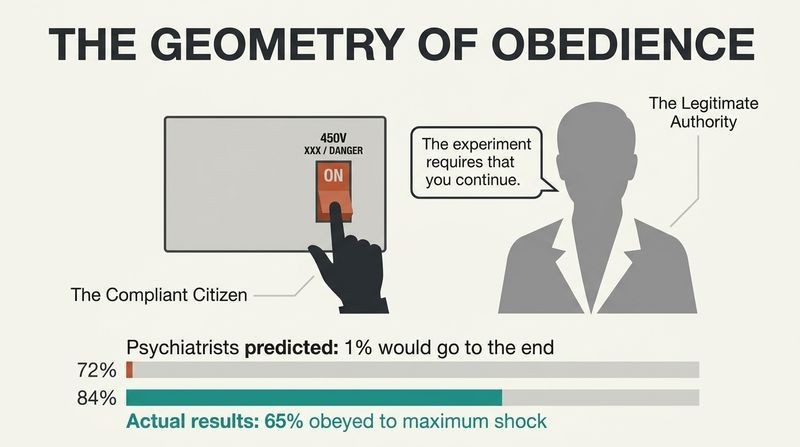
The core discovery that shocked the world. In 1961, at Yale, Stanley Milgram staged a fake experiment on "punishment and learning." Volunteers recruited by newspaper ad were told to shock a stranger with escalating voltage, from 15 up to 450 volts, each time he flubbed a word-pair task. The victim was an actor, the shocks fake, but subjects did not know that.
Sixty-five percent obeyed to the maximum. New Haven bakers, clerks, and engineers pushed switches labeled "Danger: Severe Shock" and "XXX" simply because a man in a gray lab coat said the experiment required it. Milgram's psychiatrists had predicted barely 1 percent would go that far. No physical force was used. Ordinary conscience, Milgram concluded, is easily trampled by situational pressure from a legitimate authority.
What's striking is Milgram's inversion of the postwar assumption that only monstrous personalities commit atrocities. His subjects were not sadists but dutiful citizens. The finding dovetails with Philip Zimbardo's Stanford Prison Experiment and Hannah Arendt's reporting on Eichmann, forming a triad of situationist evidence. Yet modern critics (Gina Perry's archival work) note Milgram's obedience rate varied wildly across 24 conditions, and that some subjects doubted the shocks were real. The headline 65 percent belongs to one specific condition. This does not erase the effect, but it warns against reducing a nuanced program of experiments to a single terrifying statistic.
Blame the situation, not the character, when explaining bad behavior
Situationism is the lens. Milgram inherited from his mentor Kurt Lewin the idea that behavior is a product of the immediate "life space," the field of forces acting on a person here and now, rather than fixed personality traits. His genius was proving that invisible forces, unspoken social rules and norms, shape conduct more powerfully than we assume.
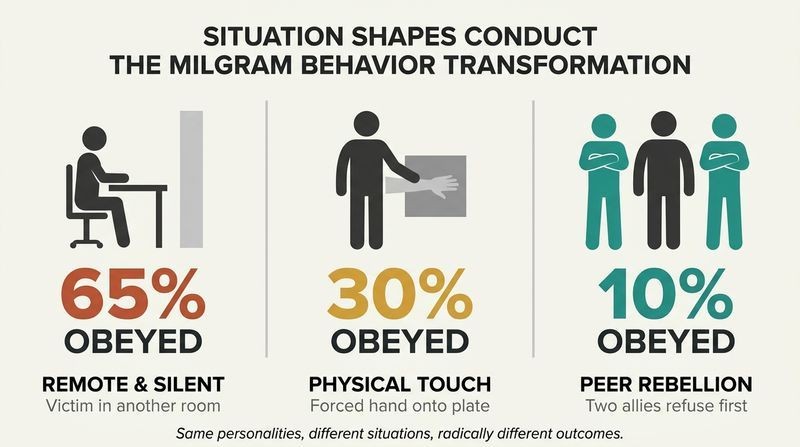
Proximity changed everything. In his four-part series, obedience dropped as the victim came closer. When the learner was in another room and silent, 65 percent fully obeyed. When subjects had to physically press the victim's hand onto a shock plate, only 30 percent did. When two rebellious peers refused first, obedience collapsed to 10 percent. Same people, different situations, radically different morality.
The situation-versus-trait debate Milgram fueled erupted into a formal controversy after Walter Mischel's 1968 Personality and Assessment. Decades later, most psychologists accept an interactionist compromise: situations pull hardest, but stable dispositions still filter responses. Milgram himself chaired a dissertation on why some individuals resist authority, acknowledging personality matters. The proximity findings anticipate modern work on "moral disengagement" (Bandura) and the psychology of drone warfare, where physical and emotional distance from victims lowers inhibition. The peer-rebellion result is the most hopeful and underquoted: dissent is contagious, which is why whistleblower cultures and dissent channels genuinely change organizational behavior.
Obedience works by handing your conscience to whoever gives orders
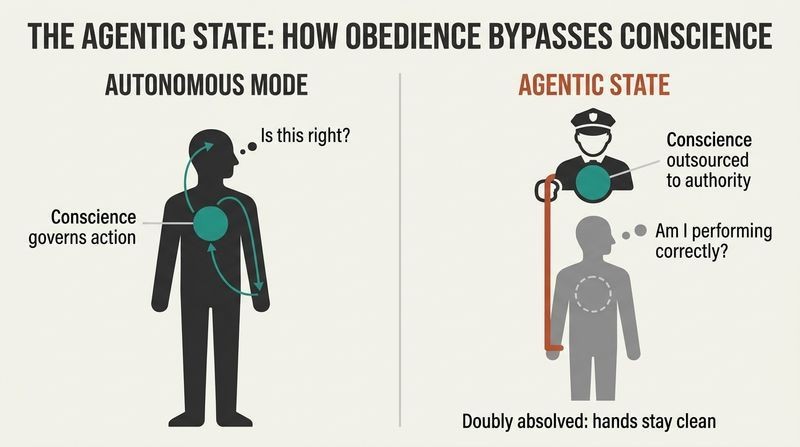
The agentic state. Milgram's theory of why people obey: humans can toggle from an autonomous mode, where conscience governs action, into an "agentic state," in which they see themselves as instruments carrying out another's will. Once you accept an authority's legitimacy, you also accept their definition of reality. If the authority says the victim deserves it, you outsource that moral judgment.
Responsibility evaporates. Subjects stopped asking "Is this right?" and started asking "Am I performing correctly?" One chilling variation produced the highest obedience of all: 92.5 percent continued when someone else pressed the switch and the subject performed only a supporting role. Distance from the final act let people feel doubly absolved: authority sanctioned it, and their own hands stayed clean.
The agentic-state concept is widely regarded as the weakest part of Milgram's work, and he knew it. Critics point out it cannot explain why obedience varied so much between conditions that shared the same authority structure. The idea reads as post hoc storytelling grafted onto data. Yet the underlying observation, that bureaucracies fragment responsibility until no one feels culpable, is profound and echoes Max Weber on rationalized bureaucracy and Zygmunt Bauman's Modernity and the Holocaust. The 92.5 percent "accessory" finding is arguably Milgram's most policy-relevant: it explains how ordinary supply-chain workers, accountants, and clerks enable atrocity without ever seeing blood.
Milgram embedded Nazi horror in a New Haven lab to end our distancing
A survivor's question made scientific. The Holocaust haunted Milgram, son of Jewish immigrants whose European relatives perished. His opening journal paragraph explicitly framed obedience research against Nazi genocide. By demonstrating destructive obedience close to home, in 1960s Connecticut, he made it impossible for Americans to dismiss atrocity as a uniquely German pathology.
Explaining is not excusing. Milgram argued a common psychological process operated in both his lab and the death camps: ordinary people following orders. He drafted a preface for the German edition warning that Americans would staff gas chambers too. Yet he insisted his work explained how people could be led to cruelty without excusing the perpetrators, who transformed a mere potential into actual slaughter.
The Holocaust framing is Milgram's greatest rhetorical strength and his most contested claim. Historians like Christopher Browning (Ordinary Men) found his insights confirmed in Reserve Police Battalion 101. But others note the Nazi record brims with zeal, initiative, and sadism, timing deportations to Jewish holidays, that pure obedience cannot explain. Even Arendt, whose "banality of evil" phrase Milgram embraced, later acknowledged crimes far exceeding dutiful bureaucracy. The honest synthesis: Milgram illuminates the compliant majority and the desk-bound enablers, but not the hate-driven cruelty. Obedience is one mechanism among several, powerful precisely because it recruits the normal, not the deviant.
Test what people actually do, never just what they say they'll do
Milgram's experimental creed. He distrusted surveys and hypotheticals. Only in action, he insisted, can you see the real forces driving social behavior. His entire career hunted for concrete, observable behaviors that resolved a genuine conflict: mail the letter or not, press the switch or refuse, give up your seat or stay put.
Predictions failed spectacularly. Yale seniors estimated barely 1 percent would deliver the maximum shock. Psychiatrists were wrong "by a factor of 500," in Milgram's phrase. The gap between what people predicted and what they did became a recurring theme. Even his subway riders and the famous 38 Kitty Genovese witnesses revealed how poorly intuition forecasts conduct under real situational pressure.
This methodological stance makes Milgram a forerunner of behavioral economics and the modern replication-minded push toward field experiments over self-report. The prediction gap he documented is now formalized as the "empathy gap" and "intention-behavior gap" in psychology, and as revealed-versus-stated preference in economics. His approach carries real ethical cost, which is precisely why it became controversial. It also carries validity risk: critics argue elaborate deception introduces its own artifacts (demand characteristics). Still, the principle endures in A/B testing, audit studies of discrimination, and lost-wallet field experiments. Watching behavior beats asking about it, because people are unreliable narrators of their own future actions.
A dropped letter reveals prejudices people would never admit aloud
The lost-letter technique. Milgram invented an ingenious indirect poll. Scatter stamped, addressed but unmailed letters on sidewalks and in phone booths. A finder decides whether to mail it. If it is addressed to a group they detest, they may not. The return rate becomes an unobtrusive measure of hidden attitudes, free of the social-desirability bias that corrupts interviews.
It worked. Letters to "Medical Research Associates" and to a private individual were mailed about 70 percent of the time. Letters to "Friends of the Nazi Party" and "Friends of the Communist Party" reached only 25 percent. In the segregated South, white neighborhoods mailed pro-segregation letters more; black neighborhoods reversed the pattern. The method predicted the 1964 election outcome ward by ward.
The lost-letter technique pioneered unobtrusive measurement, a tradition later codified in Webb's classic Unobtrusive Measures and revived digitally by the "lost e-mail" method and audit studies. Its strength is dodging the impression-management that plagues polling on race, politics, and taboo topics, exactly the domain where modern pollsters still stumble (the "shy Tory" and "shy Trump" effects). Its weakness, which Milgram flagged, is noise: children, street cleaners, and illiterate finders add variance, so huge samples are required, and it works only for polarized issues. A high schooler using 1,600 letters found upscale Manhattanites backing school vouchers, self-interest overriding stated liberal politics.
Any two strangers on Earth link through about six acquaintances
The small-world method. Milgram gave people in Nebraska a folder to route toward a target stockbroker near Boston, using only first-name acquaintances who might know the target better. Among completed chains, the average number of intermediaries was roughly six. This gave us the phrase "six degrees of separation," though the play and film, not Milgram, popularized it.
A quantifiable property of huge networks. Milgram's real innovation was counting the links and proving close interconnectedness is a general, measurable feature of social structure, contradicting intuition (one friend guessed 100 intermediaries). Decades later, mathematicians Watts and Strogatz showed the same short-path property in power grids, neural networks, and film-actor databases. Barabasi found any two web pages average 19 clicks apart.
The six-degrees finding launched network science, now foundational to epidemiology, marketing, and counterterrorism. But the iconic number deserves an asterisk: in Milgram's Nebraska study only about 26 percent of chains completed, and Watts's 2003 global email replication saw just 384 of 24,163 chains finish, though completed ones averaged four to seven links. Judith Kleinfeld's archival critique argues Milgram cherry-picked his most successful study and that low completion rates undermine the tidy myth. The deeper truth survives: large sparse networks are traversable in surprisingly few steps. The romantic "six" is less robust than the structural insight, which reshaped how we model contagion, information flow, and influence.
City dwellers ignore strangers to survive constant sensory overload
Overload as the master concept. Why are urbanites less helpful than small-towners? Milgram borrowed "overload" from systems theory: cities bombard residents with more input than they can process, so people adapt by filtering, allocating less time per stranger, and disengaging. Rudeness is not moral failure but psychological triage.
Evidence and the familiar stranger. Milgram's team found city residents in Chicago, New York, and Philadelphia gave less help to phone callers and door-knockers than rural residents. He coined the "familiar stranger," someone you see daily, like a fellow commuter, but never speak to. Nearly 90 percent of commuters recognized at least one, yet fewer than a third would start a conversation. The barrier only breaks, he observed, in a shared crisis like a fire or flood.
Milgram elevated urban rudeness from a moral complaint to a testable cognitive-load hypothesis, anticipating attention-economy research and the modern concept of "attention as a scarce resource." The familiar stranger presciently maps onto digital life: we recognize thousands of online faces we never truly engage. David Shenk later applied overload to information glut, and it explains email triage and social-media disengagement. A fair critique, which Milgram conceded, is that he never ran a proper rural control for the familiar-stranger study, so overload there is plausible rather than proven. Still, the reframe humanizes city dwellers: their aloofness is adaptive filtering, not coldness, and it dissolves under genuine emergency.
Break a tiny social norm and feel your own throat close up
Norms are invisible until violated. Milgram's mother-in-law wondered why no one offers elderly riders a seat. His answer: had she ever asked? The class experiment that followed, politely asking seated subway passengers to surrender their seats, produced a stunning result. About half complied when asked with no justification. But the real discovery was the experimenters' own agony.
The tension was physical. Students reported it as one of the hardest things they had ever done. Milgram tried it himself and found the words lodged in his throat; once seated, he felt his face blanch and thought he might perish. This mirrored the stress of his obedience subjects, revealing that unspoken norms wield power through the crippling anxiety their violation triggers, as if breaking a mild rule were a moral transgression.
This is Milgram at his most experiential: the researcher becomes the subject and discovers that norm-violation anxiety is somatic, not merely cognitive. The finding prefigures work on social pain sharing neural circuitry with physical pain (Eisenberger and Lieberman, 2003) and explains why embarrassment feels genuinely unbearable. It also illuminates why people stay frozen in emergencies, why bystanders do not intervene, and why simple assertiveness (asking for a raise, returning faulty goods) is so hard. Behavioral economists call adjacent effects "the awkwardness tax." Practically, the lesson is liberating: the barrier to violating trivial norms is your own manufactured dread, usually far larger than others' actual reaction.
Groundbreaking findings and ethical harm can be the same experiment
The controversy that reshaped research. Diana Baumrind attacked Milgram in 1964 for subjecting people to severe stress and possible lasting harm to their self-image and trust in authority. Subjects had sweated, trembled, stuttered, and dug fingernails into flesh. One combat veteran described himself as an "emotional wreck." Milgram operated in an ethical vacuum with no formal guidelines.
His defense, and the aftermath. Milgram surveyed participants: 84 percent were glad they took part, only 1.3 percent regretted it, and a psychiatrist found no lasting harm in 40 "worst cases." He pioneered the term "debriefing." Yet the storm contributed directly to modern safeguards: the APA's 1973 ethics code and federally mandated Institutional Review Boards in 1974. The experiment, in its original form, effectively became impossible to run.
Milgram's follow-up survey was genuinely ahead of its time; almost no researcher then checked on subjects' wellbeing afterward. Still, the 84-percent-glad statistic is self-report from people who may have rationalized their compliance (cognitive dissonance predicts exactly this). The debate crystallized the tension between scientific value and participant welfare that still governs research. A 2009 partial replication by Jerry Burger, capped at 150 volts and heavily pre-screened, found comparable obedience, suggesting the core effect survives ethical constraints. The IRB regime Milgram helped trigger now draws criticism for overreach on benign social research, an irony: the safeguards born from his work sometimes block work far gentler than his.
Inoculate against blind obedience by teaching people they are vulnerable
Knowledge as antidote. Milgram's darkest finding carried a practical payoff. Once people understand how readily authority overrides conscience, they can guard against it. Former subjects reported that reading his work helped them resist unjust authority. Latin American dissidents drew courage from it; a torture survivor in Argentina said Milgram helped him understand that his tormentors were "normal people."
Institutions acted. The U.S. Military Academy requires cadets to study Milgram in two psychology courses. In the early 1970s, soldiers were shown training films on how to disobey illegitimate orders, a shift one military psychologist called a true revolution in military history, credited to Milgram and the My Lai massacre. Business schools now teach the experiments to warn employees against unethical directives from superiors.
This reframes Milgram from prophet of doom to civic educator. The inoculation logic parallels William McGuire's "inoculation theory" of persuasion resistance: exposure to weakened forms of a threat builds defenses. It also grounds modern compliance training, whistleblower protections, and aviation's Crew Resource Management, which explicitly authorizes juniors to challenge captains after crashes traced to unquestioned authority. The peer-rebellion condition (obedience collapsing to 10 percent) supplies the mechanism: institutionalizing dissent works. A caveat worth naming: awareness alone is a weak shield, and knowing about a bias rarely eliminates it. Durable resistance requires structural permission to disobey, not just a memorable undergraduate lecture.
Curiosity that treats ordinary life as a lab beats grand theory
A phenomenon-hunter, not a theory-builder. Milgram's career defied specialization. He studied obedience, then national conformity, mental maps of Paris, TV violence, cyranoids (people who speak words fed through an earpiece by a hidden source), and why steam rises from city streets. Colleagues who prized programmatic, theory-driven research saw a dilettante flitting between novelties; it likely cost him tenure at Harvard and the APA's top award.
The cost and the payoff. Because his work asked questions rather than tested theories, it did not accumulate into a "school" like Festinger's cognitive dissonance. Each finding stood alone. Yet this same playful, curiosity-first instinct, treating a subway car or a lost letter as an instrument, produced more genuinely original methods than nearly any social scientist of his century. He fused artistic imagination with experimental rigor.
Milgram embodies a tension in science: hedgehogs who dig one deep theory versus foxes who roam. The academy rewards hedgehogs with citations and named effects; foxes like Milgram get remembered by the public and forgotten by tenure committees. His phenomenon-first style resembles what Stigler and later Nassim Taleb praise as tinkering, exploration that yields serendipitous discovery over deductive theory-testing. The downside is real: without theory, findings do not compound, and replication or extension flounders. But in an era now worried about sterile, incremental "gap-filling" research and a replication crisis born partly of theory-driven p-hacking, Milgram's insistence on studying vivid, real-world behavior looks less like a flaw and more like a lost virtue.
Analysis
Thomas Blass's biography is not a self-help book but a life-and-legacy portrait of the twentieth century's most consequential social psychologist, which makes it unusually hard to distill: it interleaves personal narrative (a Bronx baker's son, Harvard, tenure heartbreak, four fatal heart attacks by 51) with a sprawling research corpus and decades of ethical and scientific controversy. The through-line worth extracting is Milgram's unifying thesis, that the intangible, unverbalized forces of a situation govern behavior more powerfully than character or conscience, and that these forces can be made visible through ingenious, often theatrical, experiments.
What elevates the book beyond hagiography is Blass's evenhandedness about Milgram's flaws: the agentic-state theory was weak, the Holocaust analogy captures compliant enablers but not zealous killers, the small-world "six" rests on low completion rates, and the obedience ethics remain genuinely troubling. A rigorous modern reader should hold two truths simultaneously. First, the obedience effect is robust and has survived constrained replication (Burger 2009, virtual-reality versions). Second, the popular reduction to a single 65-percent figure erases the 24-condition architecture that is the actual scientific contribution, showing how proximity, peer rebellion, and diffused responsibility swing obedience from 10 to 92.5 percent.
Milgram matters today because his questions migrated everywhere: network science, behavioral economics, urban studies, research ethics, military law, and business compliance. He is arguably the intellectual ancestor of the field-experiment and unobtrusive-measurement traditions now ascendant amid psychology's replication reckoning. His methodological creed, watch what people do rather than trust what they say, is more defensible than ever, even as his cavalier deception would never clear a modern IRB, an irony given that his own work spawned those boards. The enduring lesson is dual: humans are dangerously malleable before legitimate authority, and awareness plus institutionalized dissent are our best, if imperfect, defenses.
Review Summary
The Man Who Shocked The World is a biography of Stanley Milgram, the social psychologist famous for his obedience experiments. Reviewers praised the book for its engaging portrayal of Milgram's life and work, including his contributions to the "six degrees of separation" concept. Many found the detailed accounts of his experiments fascinating. Some readers wished for more focus on Milgram's research and less on personal details. Overall, the book was well-received for its insights into Milgram's personality, his impact on social psychology, and the controversies surrounding his work.
People Also Read

Download PDF
Download EPUB
.epub digital book format is ideal for reading ebooks on phones, tablets, and e-readers.








































