

Key Takeaways
See a constitution as a garment tailored to a living body
A constitution is a relationship, not a document. Peterson borrows a 1583 analogy from the diplomat Sir Thomas Smith: a frame of government fits a society like a shoe fits a foot. Too tight or too loose, and the body rebels. A constitution has three parts:
1. The body of society (land, people, economy, environment)
2. The frame of government (institutions, customs, the common law)
3. The written instruments (charters, statutes, the 1787 text)
No written text can capture the whole. Just as a map never equals the terrain, the parchment always fails to encompass a society's actual life. The English word once meant the physical makeup of a body. Reading the Constitution alone tells you almost nothing about how America truly governs itself.
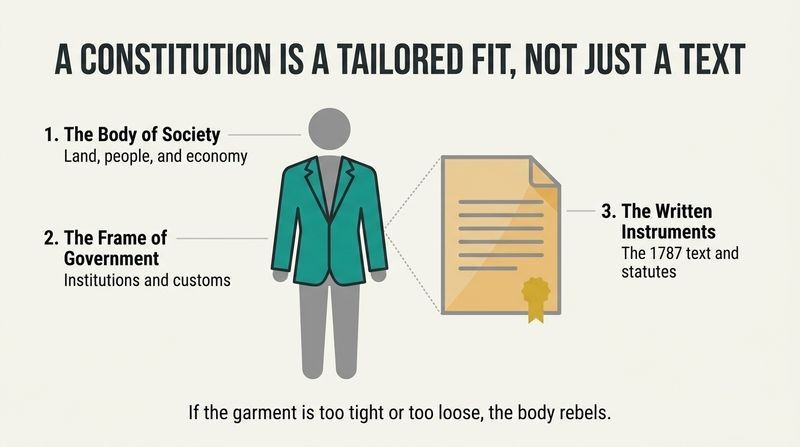
This relational framing is the book's engine, and it usefully dissolves a false binary. Americans are taught the Constitution is a sacred written object, while Britain famously has an 'unwritten' one. Peterson shows both are hybrids of text, custom, and institution. The insight resonates with legal scholar Karl Llewellyn's 'working constitution' and with anthropologist Clifford Geertz's view of law as local knowledge. One tension worth flagging: if the text is always inadequate to the body, what stops interpreters from claiming the body demands whatever they want? Peterson's answer, that written instruments still discipline power, keeps the framework from collapsing into pure pragmatism.
Constitutions are really fights over land: who holds it, who pays
Follow the land to understand power. In 1086 William the Conqueror surveyed England in the Domesday Book, cataloguing 15,000 places, their livestock, ploughlands, and expected annual yield in pounds, shillings, and pence. It was a giant rate book mapping who owed what to whom. The legal historian Frederic Maitland quipped that English constitutional law is basically an appendix to the law of real property.
Scarcity shaped the system. England was a land-scarce island where power flowed to whoever controlled the soil. Magna Carta (1215), the Petition of Right (1628), and the English Bill of Rights (1689) were all crises over a king demanding revenue beyond what landholding customarily owed. Each dressed up a transactional bargain as ancient, eternal liberty.
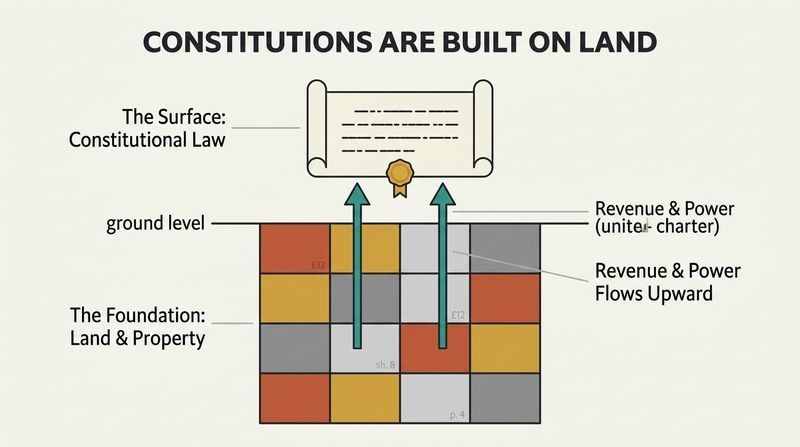
Grounding constitutionalism in property economics aligns Peterson with a long materialist tradition, from Charles Beard's controversial 1913 economic reading of the founders to Thomas Piketty's data on how landed wealth structures political power. The Domesday framing is genuinely illuminating: it reframes 'rights' talk as downstream of resource extraction. A useful counterweight comes from Douglass North's institutional economics, which argues that secure property rights and credible constraints on rulers were themselves engines of growth, not merely spoils. Land mattered, but so did the legal technology, courts, deeds, and coinage, that made land legible and taxable in the first place.
Empires shatter when the government can't stretch to fit a swollen body
The Revolution was a family quarrel over a shared constitution. Colonists did not reject the British constitution; they claimed to defend it. Between 1688 and 1776 the colonial population exploded from roughly 200,000 to 2.5 million, nearly a quarter of the British realm, yet the empire's framework never adjusted. Colonies sent no members to Parliament and stood outside its taxation system, even as Scotland was formally united in 1707.
Both sides were right, which is why war came. Under settled British practice, king and Parliament held sovereign power to tax; under colonial charters, only local assemblies could consent. Neither reading was wrong, and neither could be reconciled. The empire had outgrown its constitution's capacity to contain it, and the fabric tore.
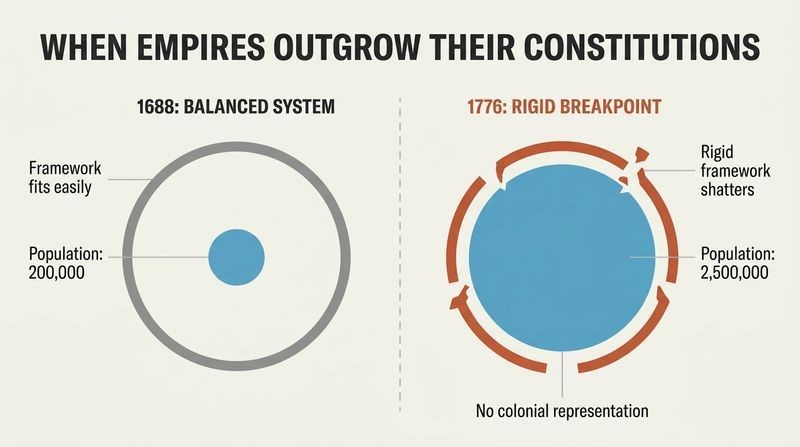
Peterson's diagnosis reframes 1776 not as ideological rupture but as institutional lag, a system failing to update itself against demographic reality. This echoes historian J.G.A. Pocock and connects to modern political science on 'institutional drift,' where rules calcify while conditions race ahead. The unstated payoff is a warning about the present United States, where representation has similarly failed to track a shifting population. A skeptic might note that ideas and identity, not just structural mismatch, drove the break; affection for Britain ran deep, as the 1775 Olive Branch Petition shows. Structural strain created the tinder, but belief lit it.
The Constitution was built as a machine for seizing land and minting states
Meet the Domesday Machine. Peterson's central metaphor: the federal government was engineered as a technology to extinguish Indigenous land title, survey and commodify the land, move white settlers onto it, and organize them into new states. The land ordinances of 1784, 1785, and 1787 laid the blueprint before the Constitution was even drafted, projecting a grid of townships and future states across the trans-Appalachian West.
It worked with breathtaking speed. Over the nineteenth century the United States added 32 states to the original 13, expanded territory under statehood from 365,000 to 3.4 million square miles, and grew from 4 million to 63 million people. Britain had failed to govern its western conquests after 1763; the new republic turned that same problem into a continent-devouring success.
Casting the Constitution as an expansion engine rather than a liberty charter is the book's most provocative and clarifying move. It dovetails with recent scholarship on 'settler colonialism' by Patrick Wolfe and with Ned Blackhawk's argument that Indigenous dispossession sits at the center, not the margins, of American history. The machine metaphor also has explanatory economy: it links finance (land sales retiring war debt), military policy, and federalism into one purpose. The provocation invites a question Peterson embraces: if the system's core function was dispossession, then celebrating its efficiency is morally fraught. The machine's genius and its violence were inseparable.
The Bill of Rights was a bolt-on; expansion was the founding purpose
What the Constitution says is not what it was for. Slavery, though shaping the most basic question of representation, is never named in the 1787 text, only alluded to as 'other Persons.' Western lands and Indian affairs appear in just a handful of clauses. Yet these were the animating challenges. The famous Bill of Rights emerged only as a concession to quiet Anti-Federalist backlash during ratification, modifying earlier state and English precedents.
Defending rights was not the reason the document was created. The reason was to give the national government new powers and tools: to admit states, regulate commerce with Indian tribes, make treaties the supreme law, raise armies, and control the national domain. Every founding-era constitution existed to solve a concrete crisis, not to state timeless truths.
This deflates a cherished civic myth without cynicism. The claim that the Bill of Rights was reactive is well supported; Madison initially thought it unnecessary. Peterson's deeper point, that constitutions are crisis instruments rather than philosophical treatises, is a bracing corrective to originalist reverence that treats the text as scripture. It resonates with Linda Colley's argument that modern constitutions were forged by the pressures of war and finance. The caution: emphasizing purpose over text can understate how the Bill of Rights, whatever its origins, became load-bearing. Founding intent and subsequent function diverge, and a document can outgrow the narrow purpose that birthed it.
Jefferson's silence on Louisiana handed Congress a power the people never gave
The dog that failed to bark. In 1803 Jefferson privately insisted that buying the vast Louisiana Territory and making states from foreign land required a constitutional amendment, because the 1787 text fixed the nation's boundaries. Adding alien territory would remake the body of the nation and needed the people's consent. Yet he chose ordinary politics over principle and stayed publicly silent, borrowing Sherlock Holmes's clue: the curious incident was the dog that did nothing.
A precedent that reshaped everything. Congress admitted Louisiana as a simple legislative act. Josiah Quincy warned in 1811 that treating expansion as a routine 'common power' would eventually tear the union apart. The amendment process, requiring broad national consensus, was bypassed. Henceforth a bare congressional majority could acquire territory and manufacture states at will.
The Holmes framing is memorable and the constitutional stakes are real: Jefferson traded a durable structural safeguard for immediate opportunity. What makes this compelling is the counterfactual Peterson dangles. Had amendment been required, expansion might have been slower and less weaponizable for sectional advantage. This is a strong example of what political scientists call a 'critical juncture,' where a low-visibility procedural choice locks in a high-consequence path. One might push back that expansion's momentum was probably unstoppable regardless of process. But Peterson's narrower claim holds: bypassing consensus turned nation-remaking into a partisan tool, precisely the danger the amendment threshold was designed to prevent.
Weaponizing statehood for sectional power dragged the nation into civil war
Statehood became a game with permanent stakes. Once expansion ran on simple majorities, each side in the slavery struggle raced to admit friendly states, since a new state meant senators, representatives, and Electoral College votes forever. The Missouri Compromise (1820), the Compromise of 1850, and the Kansas-Nebraska Act (1854) were all attempts to manage this balance. Lincoln won in 1860 without appearing on most Southern ballots, and the South, fearing it could never again win the expansion game, seceded.
The Confederates diagnosed the flaw. Their 1861 constitution copied the U.S. text but fixed the gap: it explicitly authorized acquiring new territory and required a two-thirds vote to admit new states. They understood, as Jefferson privately had, that adding states fundamentally alters the compact.
The irony that secessionists produced a sharper constitutional diagnosis than the framers is the chapter's dark punchline. Peterson's argument complements the standard account (slavery caused the war) with a structural mechanism: the war was fought partly over control of an expansion engine that had no consensus brake. This is a valuable addition to a crowded field, echoing Leonard Richards's work on 'the slave power.' The framing also illuminates why the balance was so combustible: statehood is irreversible, so every admission permanently shifted the field. It reframes antebellum politics as a contest not merely of morality but of demographic engineering.
Past the 100th meridian, the settlement machine ran out of rain
Geography stopped the machine cold. For eighty years, clearing Indian title reliably drew settlers who farmed the land and formed states. West of the 100th meridian, where annual rainfall drops below twenty inches, that formula collapsed. Even free land under the 1862 Homestead Act could not conjure dense family farming; in 1890 Ohio alone had more than twice as many farms as all eleven far-Western states and territories combined.
Two prophets saw it. The self-taught economist Henry George argued land speculation was impoverishing settlers and betraying republican equality, proposing a single tax on land value. The geologist John Wesley Powell urged organizing the arid West into watershed commonwealths governed by water, not arbitrary survey lines. Congress ignored both, and inequality among the states returned with a vengeance.
Environmental determinism can be a blunt instrument, but Peterson wields it precisely: the aridity line is a real climatic threshold that reshaped political economy. Powell's watershed proposal, elaborated in his 1878 arid lands report, has been vindicated by a century of Western water wars, and Marc Reisner's 'Cadillac Desert' documents the ecological reckoning now arriving with the shrinking Colorado River. Henry George's single tax remains a live idea among economists who prize land-value taxation for its efficiency. The deeper lesson is that constitutions embed environmental assumptions; the 1787 design silently presumed a well-watered, endlessly farmable continent that simply did not exist past the plains.
Empty states like Nevada became engines of permanent minority rule
A state built by telegraph. In 1864 Nevada wired its entire draft constitution to Washington so its three electoral votes could bolster Lincoln's reelection, despite having only 10,000 to 20,000 settlers, far below the population that normally justified a single House seat. The British observer James Bryce called it a 'rotten borough,' controllable by a silver-mining ring.
Partisan state-making entrenched inequality. Republicans later admitted the Dakotas, Washington, Wyoming, and Idaho, several with tiny populations, to lock in Senate majorities, excluding more populous but Democratic-leaning New Mexico and Utah. The careful nineteenth-century practice of admitting roughly equal states had equalized the union by 1860. The arid West reversed it. Today only 17 of 50 states exceed the average state population, so Senate majorities can represent a minority of Americans.
This connects a nineteenth-century maneuver directly to a twenty-first-century pathology: the structural overrepresentation of small states. Peterson supplies the origin story for a distortion political scientists now measure precisely, where the Senate and Electoral College can hand power to a popular minority. The 'rotten borough' label is apt and pointed, since Americans fought a revolution partly against exactly such unrepresentative seats. A fair complication: the Senate's equal-state design was a deliberate founding compromise, not an accident, so the problem is partly baked in. What Peterson adds is that partisan state-making after 1864 amplified a latent flaw into a systemic one.
Washington rebuilt the nation in the twentieth century without touching the text
Phoenix is the parable. A desert village of 3,152 people in 1890 became a metropolis of nearly a million by 1990, built by federal dams, subsidized air conditioning, military bases, interstate highways, and Social Security snowbirds. Multiply that story across the South and West, and the population redistributed dramatically while old industrial cities like Detroit and St. Louis shrank.
The government transformed; the parchment did not. Federal spending grew roughly 200-fold in real terms across the century. The Sixteenth and Seventeenth Amendments (1913) created the income tax and direct election of senators, quietly severing the founding link between taxation and representation. Then, after 1920, the structural amendment process essentially stopped. The New Deal, the national security state, and the Cold War remade America through interpretation, not text.
The Phoenix case study is superb narrative economics, making an abstract argument tangible: the Sunbelt was a federal creation, not a triumph of rugged individualism. This complements Bruce Schulman's work on federal money reshaping the South. Peterson's sharpest structural point is that the income tax broke the taxation-representation nexus that ran from Magna Carta forward, enabling wealth from the Northeast to fund development elsewhere without proportional cost. The unsettling implication, developed by scholars of the 'living constitution,' is that a government reshaped entirely by interpretation rests on shifting sand. What courts grant through reading, they can revoke through rereading, as originalism now demonstrates.
A free people can refit its constitution; the founders insisted on it
The garment no longer fits the body. By the twenty-first century, the written text describes almost none of what the modern government actually does, and originalist jurisprudence increasingly treats the 1787 document as a cage rather than a blueprint. Meanwhile the challenges are unprecedented: a warming climate, resource consumption that would require five Earths if globalized, and grotesque inequality, none imaginable to the framers.
The founders' real inheritance is the power to begin again. The Declaration of Independence and the 1780 Massachusetts constitution both assert that when government fails its purposes, the people may alter or abolish it. Peterson invokes Rexford Tugwell's 1974 draft of a redesigned constitution not as the answer but as proof that rethinking is legitimate. History suggests major constitutional change rarely comes 'constitutionally,' so it is wise to have a plan ready.
Ending on the right to refit is both bracing and risky. Peterson honors the founders' most radical idea, popular sovereignty over fundamental law, against a culture that idolizes their specific text. This aligns with Aziz Rana's critique of American constitutional veneration. Yet the closing carries a sober warning: the most forceful attempt to remake the compact was the Confederacy, whose cause and methods were monstrous. That history should temper romanticism about constitutional conventions, which can empower the worst actors as easily as the best. The honest takeaway is not that change is safe, but that stasis, given the widening gap between text and reality, may be more dangerous.
Analysis
Peterson's achievement is to make the Constitution strange again. By stretching the timeline back to 1066 and forward to a speculative 2090, he denaturalizes a document Americans treat as timeless, revealing it as a contingent tool built for a specific job: converting a continent of Indigenous land into white-settler states. The 'Domesday Machine' is the book's organizing genius, linking medieval English land law, colonial charters, the 1785 survey grid, and Sunbelt dam-building into one continuous logic of extraction and expansion. This is history in the mode of the Annales school and of environmental historians like William Cronon, privileging deep structures (land, water, demography, money) over the usual courtroom-and-convention drama. Its freshest contribution is treating westward expansion and Indigenous dispossession as the Constitution's central purpose rather than a footnote, joining recent work by Ned Blackhawk and Gregory Ablavsky. The book's most portable analytical tool is the three-part definition of a constitution as a relationship among body, frame, and text, which yields a diagnosis of the present crisis: the body and frame have transformed beyond recognition while the written instrument froze after 1920. Where the argument is most debatable is its functionalism. Reducing the founding to a land engine risks underweighting the genuine ideological work of rights, federalism, and separation of powers, which took on lives independent of their origins. Peterson knows this, conceding the Bill of Rights and creedal ideals became real forces. The analysis of minority rule (the Nevada rotten borough, the broken taxation-representation link) is empirically strong and politically urgent, connecting nineteenth-century maneuvers to contemporary Senate and Electoral College distortions. The epilogue's call to refit the constitution is intellectually consistent but practically fraught, as Peterson himself notes that the last great refit attempt was the Confederacy. The book leaves readers with a productive discomfort rather than a program, which suits its subject.
Download PDF
Download EPUB
.epub digital book format is ideal for reading ebooks on phones, tablets, and e-readers.








































