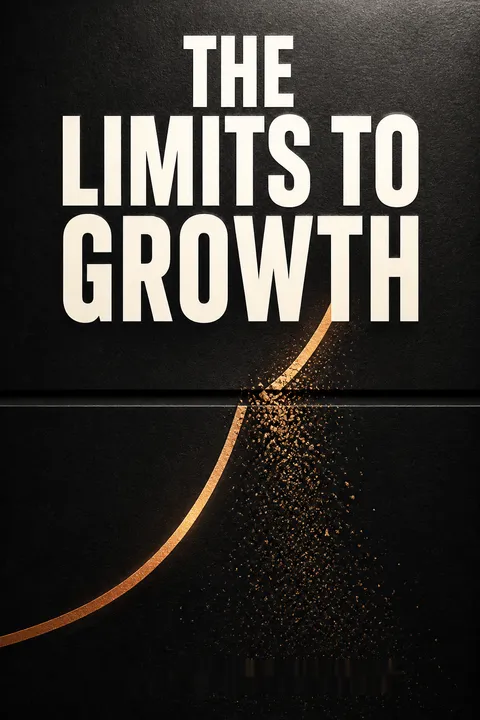

Key Takeaways
1. Exponential Growth Drives Unsustainable Trajectories
Exponential growth-the process of doubling and redoubling and redoubling again-is surprising, because it produces such huge numbers so quickly.
Unseen acceleration. Most people intuitively think of growth as a linear process, adding a constant amount over time. However, exponential growth, where a quantity increases proportionally to what's already there, leads to surprisingly rapid and massive increases. This fundamental difference is often misunderstood, causing society to underestimate the speed at which problems can escalate.
Illustrative analogies. Consider the classic chessboard riddle, where grains of rice double on each square, quickly exceeding the world's supply. Or the lily pond, where a plant doubling daily covers half the pond on the 29th day, leaving just one day before it completely chokes the water. These examples highlight how exponential growth can appear insignificant for a long time, then suddenly become overwhelming, leaving little time to react.
Self-reinforcing motors. In the global system, population and industrial capital are the primary drivers of exponential growth. Living creatures self-reproduce, and capital (factories, machines, money for investment) can create more capital. This inherent positive feedback structure means that, unless constrained, both population and the economy are predisposed to grow exponentially, continuously increasing humanity's ecological footprint.
2. Planetary Limits Are Real and Being Exceeded
The human economy is now using many critical resources and producing wastes at rates that are not sustainable. Sources are being depleted. Sinks are filling and, in some cases, overflowing.
Finite Earth. The Earth is a finite system with limited sources for materials and energy, and limited sinks to absorb waste and pollution. Any physical growth, including human population and its economic activity, cannot continue indefinitely. The book emphasizes that these are not just theoretical concerns but observable realities.
Daly's rules. Economist Herman Daly proposed three simple rules for sustainability, which the book endorses:
- Renewable resources: Use rate ≤ regeneration rate.
- Nonrenewable resources: Use rate ≤ rate at which renewable substitutes are developed.
- Pollutants: Emission rate ≤ assimilation rate of the environment.
Current global practices violate these rules across multiple domains.
Overshoot is here. Evidence suggests humanity has already overshot the Earth's carrying capacity. The "ecological footprint," a measure of land area required to support human activity, indicates that by the turn of the millennium, humanity was using resources 20% faster than the planet could regenerate them. This is seen in:
- Declining per capita grain production since 1985.
- Shrinking natural forests and increasing degradation of remaining ones.
- Depleting groundwater aquifers and drying rivers.
- Rising atmospheric CO2 concentrations and global temperatures.
- Accelerating species extinction rates and declining ecosystem services.
3. Delays Make Overshoot Inevitable, Collapse Possible
A system cannot come into an accurate and orderly balance with its limit if its feedback signal is delayed or distorted, if that signal is ignored or denied, if there is error in adapting, or if the system can respond only after a delay.
Three causes of overshoot. Overshoot occurs due to a combination of:
- Rapid growth (often exponential).
- A limit or barrier.
- Delays in perceiving the limit and responding to it.
These delays can be physical (e.g., pollutants slowly migrating through ecosystems, population momentum) or political/social (e.g., slow scientific consensus, bureaucratic inertia, denial).
Irreversible damage. Overshoot can lead to two outcomes: oscillation (bouncing around the limit, eventually stabilizing if the environment recovers) or collapse (irreversible damage to the resource base, leading to a rapid decline). The latter is driven by "erosion loops," positive feedback mechanisms that accelerate degradation once a threshold is crossed. For example, overgrazing leads to soil erosion, which further reduces vegetation, creating a downward spiral.
Unmanageable systems. Any system with feedback delays, slow physical responses, thresholds, erosive mechanisms, and rapid growth is inherently unmanageable. It cannot steer itself away from hazards in time. The faster the growth, the higher the overshoot, and the more severe the potential collapse. Recognizing these systemic properties is crucial for understanding why current trajectories are problematic.
4. Technology and Markets Alone Are Insufficient
Technology and markets operate only on imperfect information and with delay. Thus they can enhance the economy's tendency to overshoot.
Tools, not solutions. While powerful, technology and free markets are merely tools that serve the goals and time horizons of society. If society's implicit goals prioritize endless growth and short-term profit, these tools will be directed towards exploiting nature and widening inequality, potentially accelerating collapse rather than preventing it.
Inherent limitations. Markets and technology face several limitations:
- Costs: Technical solutions (e.g., pollution abatement, resource extraction from lower-grade ores) often have non-linear costs, becoming exponentially more expensive as limits are approached. At some point, the cost of coping outweighs the benefits of growth.
- Delays: Market signals (prices) and technological responses are subject to significant delays. The oil price shocks of the 1970s, for instance, illustrate how market adjustments can take years, causing booms and busts, and often failing to reflect long-term physical depletion or environmental costs.
- Externalities: Markets often fail to account for "externalities" like pollution or ecosystem degradation, leading to misallocation of resources and continued environmental damage. The destruction of global fisheries, driven by technological advances in fishing and market demand, exemplifies how an unregulated common resource can be driven to collapse.
Blind to the long term. The market is inherently short-sighted, responding to immediate scarcity or surplus rather than impending physical limits. It does not inherently value ultimate sources or sinks until they are nearly exhausted, by which point attractive solutions may no longer be available. Therefore, relying solely on these mechanisms without conscious guidance is a recipe for continued overshoot.
5. The Ozone Story Proves Global Cooperation is Possible
The ozone depletion caused by human-produced chlorine and bromine compounds is expected to gradually disappear by about the middle of the twenty-first century as these compounds are slowly removed from the stratosphere by natural processes. This environmental achievement is due to the landmark international agreement to control the production and use of ozone-depleting substances.
A global success story. The depletion of the stratospheric ozone layer by chlorofluorocarbons (CFCs) serves as a powerful example of humanity successfully confronting a global limit. Despite initial scientific uncertainty, industry resistance, and political delays, the world collectively recognized the threat, negotiated international agreements, and implemented solutions.
Overshoot and response. CFC production grew exponentially until the mid-1970s, when scientists first warned of ozone depletion. The discovery of the "ozone hole" over Antarctica in 1985 provided undeniable evidence of overshoot. This spurred the 1987 Montreal Protocol, which mandated a phase-out of CFCs. Subsequent agreements tightened restrictions as new scientific data emerged, demonstrating adaptive governance.
Lessons learned. The ozone story highlights several crucial points for addressing global challenges:
- Monitoring: Continuous scientific monitoring and honest reporting are essential.
- Political Will: International cooperation and political leadership are achievable, even without perfect scientific certainty or immediate economic damage.
- Adaptability: Agreements must be flexible, allowing for periodic reassessment and stronger measures if needed.
- Innovation: Industry can adapt and develop substitutes with less disruption than initially predicted.
- Collective Action: Scientists, governments, corporations, environmentalists, and consumers all played vital roles.
6. Sustainability Requires Fundamental Systemic Change
The structural causes of overshoot over which people have the most power are the ones we did not change in chapter 6, namely those that drive the positive feedback loops causing exponential growth in human population and physical capital.
Beyond technical fixes. While technological and economic adjustments can buy time and alleviate immediate pressures, they do not address the root causes of overshoot. True sustainability demands a fundamental restructuring of the global socioeconomic system, shifting away from the ingrained pursuit of perpetual physical growth.
Qualitative development. A sustainable society would prioritize qualitative development over physical expansion. It would use material growth as a deliberate tool for specific social goals, rather than an endless mandate. This involves discriminating between beneficial and harmful forms of growth, and consciously choosing to stop growth once its purpose is achieved.
Changing feedback structures. Systemic change means altering the information flows, goals, incentives, and rules that drive behavior. This includes:
- Balancing birth rates with death rates.
- Aligning investment rates with depreciation rates.
- Ensuring equitable distribution of resources and opportunities.
- Redefining success beyond material accumulation.
This transformation is profound, akin to the agricultural or industrial revolutions, but it must be a conscious, guided process.
7. Delaying Action Worsens Future Prospects
Every year of delay in starting the transition toward a sustainable equilibrium reduces the attractiveness of the trade-offs and choices that will be realistically available after the transition has been achieved.
Shrinking options. The World3 model consistently shows that postponing fundamental changes to achieve sustainability leads to increasingly dire outcomes. A 20-year delay in implementing sustainable policies (e.g., stabilizing population and moderating consumption while adopting eco-efficient technologies) results in a significantly larger population, higher pollution levels, greater resource depletion, and ultimately, a lower quality of life.
Escalating problems. When action is delayed, the system's problems become larger and more interconnected. More capital is diverted to crisis management (e.g., fighting pollution, extracting scarcer resources), leaving less for long-term investment in human welfare or sustainable infrastructure. This can overwhelm society's "ability to cope," leading to a more turbulent and less successful future.
The cost of inaction. The choice is not between action and no action, but between different futures. Delaying the transition to sustainability means:
- Fewer nonrenewable resources remaining.
- Higher peak pollution levels and greater environmental damage.
- Larger populations to support with diminished resources.
- Reduced overall human welfare and life expectancy.
At some point, continued delay means that even the most comprehensive sustainable policies will be insufficient to prevent collapse.
8. A Sustainable Society is Desirable, Not Stagnant
I cannot ... regard the stationary state of capital and wealth with the unaffected aversion so generally manifested towards it by political economists of the old school. I am inclined to believe that it would be, on the whole, a very considerable improvement on our present condition.
Beyond misconceptions. A sustainable society is often mistakenly equated with stagnation, poverty, or authoritarian control. However, the book argues that it can be a dynamic, evolving, and highly desirable state. John Stuart Mill, over 150 years ago, envisioned a "stationary state" as a significant improvement, freeing humanity from the relentless struggle for material gain.
Qualitative flourishing. Instead of physical expansion, a sustainable society would focus on qualitative development:
- Material sufficiency: Ensuring adequate and secure living standards for all, eliminating poverty.
- Environmental health: Regenerating ecosystems, minimizing pollution, and using resources efficiently.
- Human fulfillment: Fostering creativity, intellectual challenge, community, and non-material sources of satisfaction.
This shift would allow for a flourishing of science, art, and culture, unburdened by the strains of endless growth.
Flexible and equitable. Such a society would not be rigid or centrally controlled. It would embrace diversity, local autonomy, and continuous learning. Rules and laws would be designed to protect freedoms and internalize environmental costs, guiding choices towards long-term well-being. It would be a world where human ingenuity is directed towards improving the "Art of Living" rather than merely accumulating more.
9. Five "Soft" Tools Are Essential for Transition
Visioning, networking, truth-telling, learning, and loving.
Catalysts for change. While often dismissed as "unscientific," these five tools are crucial for initiating and sustaining the profound societal transformation required for sustainability. They operate within positive feedback loops, meaning that even small, consistent applications can lead to enormous, systemic change.
Practical applications:
- Visioning: Imagining a truly desired, sustainable future, unconstrained by current "feasibility." This provides direction and motivation.
- Networking: Building connections among like-minded individuals and groups to share information, support, and amplify efforts, fostering a sense of collective purpose.
- Truth-telling: Actively countering misinformation and affirming ecological and social realities, ensuring that information streams are not corrupted by lies or denial.
- Learning: Approaching action as humble experimentation, being open to mistakes, and continuously adapting strategies based on feedback, rather than imposing rigid, unproven policies.
- Loving: Cultivating compassion, generosity, and solidarity—for humanity, nature, and future generations. This fosters the collective spirit necessary for global partnership and shared sacrifice.
A conscious revolution. The transition to sustainability is a conscious operation, unlike past revolutions. It requires humanity to embrace its best qualities and collectively choose a path towards a better world. While the outcome is uncertain, choosing to believe in and work towards this third scenario—one of real limits but also real possibilities for a much better world—is the only way to make it a reality.
Review Summary
Reviews of The Limits to Growth are largely positive, averaging 4.17/5. Many praise it as a groundbreaking, timely work on exponential growth, resource depletion, and environmental collapse, noting its continued relevance decades after publication. Supporters highlight its systems dynamics approach and sobering scenarios. Critics argue the World3 model oversimplifies complex systems, ignores technological progress, and reflects outdated Malthusian thinking. Several reviewers note that despite early dismissal by pro-growth establishments, real-world trends have closely tracked the book's "business as usual" scenarios, lending its warnings renewed urgency.
People Also Read







About the Author
Other books by Donella H. Meadows
Download PDF
Download EPUB
.epub digital book format is ideal for reading ebooks on phones, tablets, and e-readers.








































