
Key Takeaways
1. Embrace the Leader's Checklist as a Foundational Tool
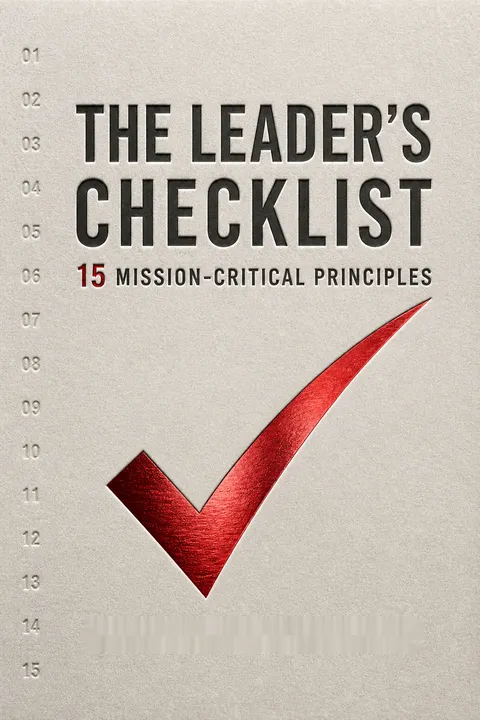
The Leader’s Checklist is composed of 15 core principles applicable to most leaders, in most endeavors, in most circumstances.
Preventing lapses. Just as pilots and surgeons rely on checklists to prevent critical errors, leaders can benefit from a structured set of principles to navigate complex situations. This approach mitigates leadership lapses, not only in routine matters but especially when jobs, businesses, or even lives are on the line. The checklist serves as a kick-in-the-pants reminder of often-neglected parts of the job.
Universal applicability. The core 15 principles are surprisingly consistent across companies and countries, forming a robust template for decision-making regardless of the challenge or setting. While few leaders face the extreme pressures of a mining disaster or a financial collapse, the underlying principles for effective action remain the same. The checklist provides a clear roadmap for building an enterprise in good times and facing worst-case scenarios.
Beyond intuition. While intuition and gut instinct are valuable, they are most effective when informed by experience and a systematic approach. The checklist acts as a trigger for leadership action, ensuring that even seasoned professionals consider all critical elements, especially under stress. It's a sensible guarantee against missing any vital step, transforming leadership from an art into a more reliable, learnable skill.
2. Master 15 Mission-Critical Leadership Principles
From my own reading, too, I have become convinced that with leadership, as with much else, brevity is the soul of wit.
Core competencies. Effective leadership hinges on a concise set of 15 time-tested principles, distilled from extensive research and real-world application. These principles cover strategic thinking, team engagement, decisive action, and ethical conduct, providing a comprehensive framework for any leader. They are designed to be as simple as possible, but not simpler, ensuring maximum utility.
Key principles include:
- Articulate a Vision: Formulate and communicate a clear, persuasive vision.
- Think and Act Strategically: Develop pragmatic short- and long-term plans.
- Honor the Room: Express confidence and support for your team.
- Take Charge: Embrace responsibility, even if not formally delegated.
- Act Decisively: Make good, timely decisions and ensure execution.
- Communicate Persuasively: Deliver clear, indelible messages.
- Motivate the Troops: Build on diverse motives to draw the best from each person.
- Embrace the Front Lines: Delegate authority and stay close to the work.
- Build Leadership in Others: Develop leadership throughout the organization.
- Manage Relations: Build enduring personal ties and harness workplace passions.
- Identify Personal Implications: Help everyone understand the impact on their work and future.
- Convey Your Character: Ensure others appreciate your integrity.
- Dampen Over-Optimism: Counter hubris and focus on latent threats.
- Build a Diverse Top Team: Assemble an able roster capable of resolving challenges.
- Place Common Interest First: Prioritize common purpose over personal self-interest.
Consistent emergence. These principles consistently emerge from leadership development exercises, regardless of industry, economic conditions, or geographic location. They are corroborated by academic studies, reviews of established leadership programs, and the self-reported experiences of successful leaders.
3. Guard Against Over-Optimism to Prevent Catastrophe
Dampen Over-Optimism. Counter the hubris of success, focus attention on latent threats and unresolved problems, and protect against the tendency for managers to engage in unwarranted risks.
The AIG lesson. The spectacular collapse of American International Group (AIG) in 2008 serves as a stark reminder of the dangers of unchecked over-optimism. Despite repeated warnings from regulators and auditors about the exceptional risks taken by its Financial Products division, AIG's top executives failed to anticipate a worst-case scenario. Their focus on rapid growth and annual bonuses blinded them to the mounting dangers of subprime mortgages and the potential for credit rating downgrades.
Hubris of success. Company success can breed excessive confidence and risk-taking, leading leaders to ignore warning signs and engage in unwarranted risks. AIG's leadership extended too much leash to a division that was a "shooting star," contributing mightily to profits but operating with insufficient oversight. This illustrates a predictable path of human behavior where robust growth leads to unrealistic appraisals of low-probability, high-impact threats.
Anticipate the storm. A critical leadership obligation is to recognize and counteract these behavioral shortcomings before they wreak havoc. Had AIG's leadership applied the principle of dampening over-optimism, they would have prepared for a downgrade, set aside collateral, and potentially averted a historic corporate collapse. This principle compels leaders to look beyond momentary euphoria and steer the enterprise through both prosperous and challenging times.
4. Build a Diverse and Capable Top Team
Leaders need to take final responsibility, but leadership is also a team sport best played with an able roster of those collectively capable of resolving all the key challenges.
Chile's triumph. The dramatic rescue of 33 trapped Chilean miners in 2010 exemplifies the power of building a diverse and highly capable top team. Mining Minister Laurence Golborne, despite his lack of mining experience, recognized his limitations and assembled a band of specialists. He brought in an experienced engineer for technical know-how, a psychologist for family and organizational relations, and a well-connected insider for government mobilization.
Collective strength. Golborne's team was diverse in capabilities and experience, allowing them to tackle the multifaceted challenges of the rescue. He fostered an environment where experts could provide guidance and rationale for technical proposals, while he retained final authority for critical decisions. This collaborative approach, where different expertise converged, was crucial for vetting multiple extraction plans and ultimately succeeding against immense odds.
Beyond individual heroics. While individual leadership is vital, complex, high-stakes situations demand a collective effort. Golborne's success wasn't just his own; it was a testament to his ability to organize, motivate, and empower a team of specialists. This principle underscores that a leader's effectiveness is amplified by the strength and diversity of their inner circle, ensuring that all key challenges can be addressed comprehensively.
5. Prioritize Common Interest Above All Else
In setting strategy, communicating vision, and reaching decisions, common purpose comes first, personal self-interest last.
Chamberlain's reconciliation. Joshua Lawrence Chamberlain's actions at Appomattox in 1865, orchestrating the ceremonial surrender of the Confederate Army, embody the principle of placing common interest first. Despite having been wounded multiple times by Confederate soldiers, Chamberlain ordered his Union troops to "carry arms"—a posture of respect—as the defeated Rebels marched past. This gesture, a "salute returning a salute," prioritized national reconciliation over personal animosity or the desire for humiliation.
Selfless leadership. This principle, often termed "servant" or "selfless" leadership, emphasizes that a leader's role is fundamentally about the mission and purpose of the organization, not personal gain or ego. It aligns with the U.S. Marine Corps dictum, "The officer eats last," and Jim Collins's observation that "Level 5" leaders in "Good to Great" companies are characterized by unwavering focus on the enterprise's mission.
Moral compass. In moments of high stakes or deep division, it is often least natural to set aside personal feelings. Yet, it is precisely then that this principle becomes most vital. Chamberlain's act, though unorthodox and criticized by some peers, served President Lincoln's broader vision of reunification. It demonstrates that true leadership involves making decisions and gestures that embody the organization's highest purpose, even when it requires personal sacrifice or goes against immediate emotional impulses.
6. Customize Your Checklist for Context and Role
Given the vast diversity of leadership roles, one size definitely does not fit all in this endeavor.
Tailored for success. While the 15 core principles provide a universal foundation, effective leadership demands customization of the checklist for distinct times and contexts. What works for one company, role, country, or specific moment may not be entirely suitable for another. This adaptability ensures relevance and maximizes impact.
Dimensions of customization:
- Company: Google's checklist emphasizes individual creative sparks and small teams, while GE's focuses on teaching others to lead divisions and continuous innovation.
- Role: CEOs need principles for investor relations and shareholder value, while company directors prioritize partnering with management and guiding strategy.
- Country: Indian business leaders, for example, embrace "The India Way," emphasizing holistic employee engagement, improvisation, creative value propositions, and a broad mission beyond profit.
- Moment: Leading during a recession requires confronting reality and reaffirming mission, while leading organizational change demands creating a compelling rationale and small, transformative steps.
- Personal Place: A soldier's checklist for patrolling differs from a firefighter's Mayday protocol or a sales manager's pre-sales preparation.
Dynamic and responsive. Customization is not a one-time event but an ongoing process. Leaders must continuously adapt their checklist to reflect evolving circumstances and the unique demands of their immediate environment. This ensures that the principles remain pertinent and actionable, preventing a static list from becoming outdated or ineffective.
7. Bridge the Knowing-Doing Gap Through Active Learning
Even the best checklist has no value unless it is routinely activated to guide a leader’s behavior.
Beyond knowledge. A common pitfall for leaders is the "knowing-doing gap"—understanding what should be done but failing to execute it. To overcome this, managers must actively engage in learning avenues that embed the checklist principles into their routine behavior. This transforms theoretical knowledge into practical, consistent application.
Six learning avenues:
- Study leadership moments: Analyze biographies, observe leaders, and participate in development programs to learn from others' successes and failures (e.g., Merck's River Blindness decision).
- Solicit coaching and mentoring: Obtain fine-grained, informed feedback on leadership capacities to identify areas for improvement.
- Accept stretch experiences: Seek new responsibilities outside your comfort zone to test and strengthen checklist application.
- Conduct after-action reviews: Regularly reflect on past leadership actions to identify what worked, what was missed, and what needs refinement (e.g., Lenovo's weekly reviews).
- Endure stressful moments: Transform challenging experiences into learning opportunities, building resilience and readiness to apply the checklist (e.g., Cisco's post-Internet bubble survival).
- Experience others' moments: Vicariously or directly engage in critical leadership tests to build appreciation for when and how to invoke the checklist.
Acquired skill. Activating the Leader's Checklist is an acquired skill, not a natural one. Consistent engagement with these learning avenues helps leaders internalize the principles, making their application more automatic and effective, especially under pressure.
8. Continuously Test and Refine Your Leadership Principles
Systematic study does not always confirm the status quo or even what is intuitively accepted.
Dynamic adaptation. A Leader's Checklist is not static; it must be dynamic and adaptable, constantly updated to reflect new situations and accumulated experience. This continuous improvement through recurrent testing and frequent refinement ensures its relevance and effectiveness in a rapidly changing world. Intuition alone can be misleading, and rigorous evaluation is essential.
Evidence-based revision. Testing can lead to surprising reconfigurations. For example, Google's HR found that technology expertise, initially deemed vital for leaders, had less impact than other abilities like articulating strategy and fostering career development. Similarly, a financial services firm discovered that only a small subset of its 39 identified leadership capacities significantly impacted financial performance, leading to a radical revision of its development programs.
Invaluable insights. Careful evaluation helps confirm existing principles and reveals what may be missing or outdated. By systematically studying leadership moments, both triumphs and failures (like AIG's collapse or the Chilean rescue), the checklist becomes progressively more grounded in evidence and complete in its coverage. This iterative process ensures the checklist remains a powerful, relevant tool for guiding leadership action.
9. Lead in Crisis with Command, Connection, and Coordination
When we look at leadership during a disaster, whether it is in an emergency response or in business or in nonprofits, it is the combination of what we call C5: command and control, connect, collaborate, and coordinate.
Beyond traditional command. Joseph Pfeifer, the FDNY Chief of Counterterrorism and Emergency Preparedness, learned from 9/11 that catastrophic events demand more than just "command and control." While authoritative leadership is foundational, complex, fast-moving, and high-stakes events require leaders to also connect, collaborate, and coordinate across diverse parties. This "C5" approach is crucial for effective disaster response.
Information sharing and interdependency. A key lesson from 9/11 was the critical need for information sharing, not only within the intelligence community but also among emergency responders. During a disaster, there's an inherent "organizational bias" where groups pull inward. Leaders must actively counter this by fostering interdependency and building pre-built capacities for sharing intelligence among diverse parties before calamity strikes.
Forming networks. Leaders must hastily form networks at the scene of an incident, connecting firefighters, law enforcement, medical personnel, and emergency operations centers. This flattening of command allows major decision-makers to collaborate and coordinate resources effectively. Whether it's a Mumbai-style attack or a natural disaster, the ability to integrate multiple resources and work across organizational silos is paramount for saving lives and mitigating impact.
10. Cultivate the Human Element: Motivate and Honor Your Team
Frequently express your confidence in and support for those who work with and for you.
The missing link. One of the most frequently overlooked principles in leadership practice is "Honor the Room." Leaders often fail to explicitly acknowledge and appreciate the talents, efforts, and contributions of their team members. This simple act of expressing confidence and gratitude is crucial for fostering engagement and building trust, ensuring that employees feel valued and respected.
Beyond directives. Effective leadership is not just about giving orders; it's about sharing the danger and demonstrating personal commitment. As Chief Pfeifer learned, firefighters will follow a leader who has "skin in the game" and appreciates the risks they face. Leaders must be present on the front lines, understanding the challenges, and providing consistent motivation. This involves identifying individual "hot buttons" and weaving personal pride and shared purpose into communications.
Sustaining morale. In challenging times, maintaining morale and commitment is paramount. Laurence Golborne, during the Chilean miners' rescue, made it a point to regularly thank the workers, reinforcing their sense of importance and commitment. Leaders must shield their teams from undue external pressure while providing unwavering support and optimism. By cultivating strong personal ties and fostering an environment where upward guidance is sought, leaders can draw the best from each individual and build a cohesive, high-performing team.
Review Summary
The Leader's Checklist receives mixed reviews (3.48/5), with readers praising its practical 15-point leadership framework and real-world examples. Supporters appreciate its conciseness and applicability across various scenarios. However, critics frequently cite excessive repetition, with the same stories (Chilean miners, 9/11) revisited throughout. Many find the content overly simplistic, better suited as a brief article than a full book. Several reviewers question whether leadership can truly be reduced to a checklist format. While some value it as a reference tool, others feel it lacks depth and actionable implementation guidance.
People Also Read









Download PDF
Download EPUB
.epub digital book format is ideal for reading ebooks on phones, tablets, and e-readers.








































