Key Takeaways
1. The Nazi Worldview: A Coherent, Anti-Universalist System
The Nazis answered these questions with a large body of texts, speeches, and images, exhorting people to look to what was most concrete, closest to home, most tangible: from a welter of contradictory ideas, all of which seemed to carry the same weight, from the clang and clash of warring religious faiths, blood, flesh, and “race” were held out as a reference, as a beacon.
Beyond madness and barbarity. The Nazi worldview, often dismissed as madness or barbarity, was presented by its proponents as a coherent and logical system. They believed their actions were not criminal but a necessary response to Germany's perceived distress, offering clear answers to existential questions in a confusing post-WWI world. This perspective allowed individuals like Dr. Wilhelm Bayer and Otto Ohlendorf to genuinely believe in their innocence, seeing their deeds as fulfilling a "historic" and "glorious" task.
Rejection of universalism. Central to this worldview was the explicit rejection of universal human equality and political freedom, cornerstones of Western democratic thought. Instead, Nazism championed a particularistic and holistic set of norms, asserting that action must be for the "Germanic-Nordic race alone" and the "community," not for a "dangerous and dissolving chimera" called humanity. This stance was seen as a direct counter to the "one hundred and fifty years of error" stemming from the French Revolution and Judeo-Christian values.
Biology as the sole law. The ultimate authority for Nazi thought and action was "biology," understood as the only true and tangible law. This biological determinism, selectively endorsed by ancient philosophers like Plato and Seneca, stood against norms regarded as hostile to life itself. The goal was to establish a new normativity that would nurture and care for the German people, rather than "fettering and annihilating them, both legally and morally."
2. Nature as the Supreme Law: Blood, Race, and Struggle
If one must believe at all costs in a divine commandment, then it should be this one: to preserve the race.
Unity of all life. Nazi ideology posited a profound unity between humans, animals, and nature, rejecting any "human exception" or metaphysical separation between the physical and divine. This animistic view, contrasting with Judeo-Christian "disenchantment" of the world, saw God manifest everywhere in nature, making nature sacred. Consequently, humans were subject to the same "natural law" as all living things, including the "law of the preservation of the race" and the "struggle for life."
Eternal struggle. The core principle of this natural law was "All life is struggle" (Alles Leben ist Kampf), presented not as a metaphor but as a divine law essential for "the perfection of all living things." Weak and nonviable elements were to be eliminated with "pitiless harshness," as nature allowed "only the best vital force to survive." This justified both internal "struggle against epidemics, illnesses" and external warfare against perceived enemies.
Germanic piety and ethos. The Nordic race, shaped by a harsh climate, was believed to have an innate understanding of this struggle, developing an ethos of "courage and toughness." This "Nordic ethos" was seen as the source of all moral life, where "God is always a friend and comrade," unlike the "vengeful, terrible, and terrifying god of the Jews." This "religion of the here and now" focused on the "eternal life" of biological substance, making "fidelity to the order of divine creation, fidelity to the laws of life, to the voice of blood, to oneself" the highest moral duty.
3. Judeo-Christianity and Liberalism: Sources of German Alienation
The Jewry uses the Church as a political institution . . . to infect other peoples with the Jewish mindset.
Denaturing the German soul. Nazi discourse vehemently condemned Judeo-Christianity and liberalism as "foreign doctrines" that had "denatured" the German people. They argued that these ideologies instilled a "contempt for nature" and the body, leading Germans to see the world as a "vale of tears" and their bodies as sources of sin. This "spiritual circumcision" was a "Jewish ruse" to sap Germanic strength, replacing authentic culture with "manipulative refinement of the rabbis."
The "Jewish" law of abstraction. Jews were portrayed as "beings of abstraction" who, hating reality, invented artificial laws. Their "strict monotheism" and "metaphysical worldview" separated God from the world, leading to a "disenchanted matter" and a focus on "speculative intelligence." This contrasted with Germanic animism. The Jews were "people of the Law" because they lacked natural instinct, relying on "constraining and inanimate written word" due to their "mixed and unstable" biological substance, which made them "intellectually and psychologically schizophrenic."
French Revolution: a Jewish revolution. The French Revolution, with its principles of "Liberty, Equality, Fraternity," was deemed a "Jewish Revolution," an "attack on life itself by what was alien to the race." It promoted "universal human equality" and "exalted mediocre and failed humans," leading to "racial chaos" and the "de-Nordification" of France. Liberalism, individualism, and democracy were all seen as "degenerate products" that dissolved national solidarity and undermined the "natural order" of hierarchy and difference, ultimately serving Jewish interests.
4. Restoration through Biological Revolution: Eugenics and Purity
To create a law that follows the laws of life, a law of the race, it is not enough to add the word “race” into past legal systems. Legal relations must be reorganized around a new nexus: the life of the German people.
Copernican revolution of values. The year 1933 marked a "Copernican revolution," shifting the center of the legal, political, and mental universe to "the people and its life." This "bionomy" meant law was the expression and realization of biology, with "Lebensrecht" (right to life) becoming paramount. The goal was to restore "ancient, eternal laws" of nature, which science (biology and medicine) had now confirmed, making them the "irrefutable" groundwork for a new political system.
Eugenics as "humane" action. The "Law for the Prevention of Hereditary Disease" (July 1933), mandating sterilization for "hereditarily ill" individuals, was presented as a "humane law" and "humanity's most humane act." This "negative eugenics" was justified as the "highest form of moral action," saving families from suffering, liberating the German people from "useless and suffering beings," and preventing the transmission of pathologies to future generations. It was framed as "brotherly love" and "foresight," aligning with nature's pitiless selection.
Procreation of the pure and strong. Beyond sterilization, the "biological revolution" aimed for the "procreation of the pure and strong." The Nuremberg Laws (1935) prohibited "racial mixing" between Aryans and Jews, seen as a "necessity of the biological and historical context." Marriage was no longer a private choice but a duty to the race, ensuring "German blood, German honor, and genealogical health" were protected. This radical redefinition of morality and law was presented as a return to "natural order," where "the laws of nature that we saw governing the lives of plants and animals were also valid for men."
5. Warfare as Life's Law: Internal and External Struggle
This strug gle is a divine law. It makes pos si ble the perfection of all living things.
Total war, total society. The principle "All life is struggle" permeated every aspect of Nazi thought, justifying both internal and external warfare. The "Volksgemeinschaft" had to transform into a "Kampfgemeinschaft" (community of struggle), organized along military lines with the Führer as its unquestioned leader. This "total war" required the entire people to form a "unified community of defense and war," where "all legal norms" were subsumed under the imperative of defending the race and the Reich.
Harshness as a virtue. German "harshness" was presented as a virtue born of suffering, a necessary "iron armor" against enemies who had exploited German kindness. This justified extreme brutality, especially in the East, where "harshness makes the future kind." Soldiers were taught to overcome "sentimentalism" and "pity," as these were weaknesses that endangered the race. The "categorical imperative" for each individual was "to return to his ranks in the community and to submit to its order," fighting "without meanness or sentimentalism."
Criminal law as eradication. Criminal law was re-imagined as a tool of war, aimed at "protection of the people," not the criminal. Concepts like "Nullum crimen, nulla poena sine lege" were discarded in favor of "No crime without punishment." Criminals were seen as biologically flawed, "parasites" or "pests" to be "eradicated" rather than reformed. Special courts and police powers, like "Schutzhaft" (protective detention) and "Vorbeugungshaft" (preventive detention), were "armored divisions of the law," designed for swift, unconstrained action against "enemies within."
6. The Volksgemeinschaft: Ultimate Value, Absolute Loyalty
The individual’s role as member of the community requires certain duties toward it. All of the duties an individual must discharge as a member of the community constitute the field that the police must survey, in the name of the state.
Organic unity, absolute loyalty. The "Volksgemeinschaft" (people's community) was the supreme value, demanding absolute loyalty and internal homogeneity. Any dissent or internal division was intolerable, especially in the presence of the enemy. Himmler emphasized that "Nordic blood" was a unifying force, not a source of internal separation. This meant treating "subordinates as comrades in race," not as objects, and always prioritizing the collective good over individual desires or scruples.
Police as racial guardians. The police, particularly the Gestapo, were redefined as guardians of the "racial order," operating "independently of all constraint" and "above the law." Their mission was to protect the "political health of the German body," discerning and eliminating "germs of destruction." This involved "preventive police detention" (Vorbeugungshaft) and "protective detention" (Schutzhaft), which bypassed judicial oversight, treating potential threats as biological pathogens.
Sippenhaft: collective responsibility. The concept of "Sippenhaft" (familial detention or shared responsibility of family/clan) extended punishment beyond the individual, holding entire families accountable for the actions of one member. This was justified by "old German practice" and biological logic: "this man is a traitor, his blood is bad, it is traitor’s blood, it must be eradicated." This collective responsibility reinforced the idea that the individual was inseparable from the racial collective, and any taint affected the whole.
7. Colonization of the East: Lebensraum and Racial Domination
The millennial tradition of German colonization in the East, which was reduced to dust in Versailles, is now experiencing a power ful re-nais sance, which will give our people its right to live for the centuries and millennia to come.
Right to life and space. The conquest and colonization of the East were presented as a "natural justice," providing the Germanic-Nordic race with its essential "Lebensraum" (living space). This was a direct response to the "intolerable historical and biological injustice" of the Treaty of Versailles, which had left Germany as a a "Volk ohne Raum" (people without room). The East, rich and fertile, was seen as a "nursery and hot house for Germanic blood," destined to nourish a growing German population of hundreds of millions.
Agricultural utopia and racial purity. The colonization project aimed to create an an "agricultural utopia," reconciling economic imperatives with "Rassenhygiene." This involved "Flurbereinigung" (consolidation of farmland) and "Umpflanzung" (transplantation) of German populations, who would "put down new roots" in the "dark, fertile, fecund soil." This was not mere "colonial policy" but an organic incorporation, where "the land and the soil have been placed in German hands" and "the entire space" Germanized, ensuring "the cohesion of our race."
Enslavement of "subhumans." The Slavic populations of the East were deemed "Untermenschentum" (subhumans), destined for "servitude" and "exploitation to the point of exhaustion." They were to be "deprived of intelligence of their own," reduced to a "Volkssplitter" (fragmented people), and used as "labor reserve for wretched tasks." This brutal treatment, including planned famine, was justified by the belief that "a human life has no value" in these countries and that "the Slav is a born slave seeking his master."
8. The Jewish Question: A Biological Threat Demanding Extermination
If the international Jewish financiers should once again succeed in plunging the nations into a world war, the result will not be the Bolshevization of the world and thus the victory of the Jewry, but the destruction of the Jewish race in Eu rope.
Millennia of racial war. The "Jewish question" was framed as the culmination of "six thousand years of racial war" and "Jewish hatred" against Nordic humanity. Jews were blamed for starting WWI, causing Germany's defeat, and instigating WWII. This narrative presented the Holocaust not as a crime, but as a "legitimate defense" against an ancient, existential threat. The "unsparingly wipe out all Jews in Europe" was seen as fulfilling "history's will" and a "duty to the past."
Jews as "biological danger." Jews were consistently depicted as "bacilli," "parasites," and "microbes," a "pathological plague" threatening the "health of the Aryan race." This "biomedical anti-Semitism" justified "segregation and elimination" as public health imperatives. The "Jewish morality" was portrayed as inherently criminal, promoting "theft and pillage of Gentile property" and "rape of Gentile women," further solidifying their image as an existential threat.
"Cool" and "consistent" extermination. The "Final Solution" was presented as a "logical solution, even if it is violent," to be carried out "coldly and without hesitation." The extermination of Jewish women and children was justified by the argument that "these children will grow up" to become "hate-filled avengers," posing a future threat. This "uncompromising consequentialism" was deemed "decent" and "humane" by Himmler, as it served the "existence and preservation of our Nordic blood," ultimately a "fight to the death between the Aryan race and the Jewish bacillus."
9. Rejection of Formal Law: The Führer's Will and Instinctive Justice
The laws of life are always identical, they are always the same. We do not want to rebuild our people according to abstract theories elaborated by some foreign brain, but by following the eternal laws shown to us by experience and history, and which we know.
Law of life over abstract laws. Nazi ideology fundamentally rejected formal, abstract law, viewing it as a "rabbinic ooze" and a "dead and deadly matter" that stifled life. Instead, they advocated for a "law of life" derived directly from nature, instinct, and the "blood" of the German people. The "tyranny of the paragraph" was to be replaced by a dynamic, fluid legal system that served the "vital needs and the growth of our race," making "life itself" the ultimate legal authority.
The Führer as supreme judge. The Führer's will was considered synonymous with the "law of life" and the "moral conscience of the German people." Hitler, as the "supreme judge," could "force each person to do his duty" and dismiss anyone who failed, even judges. This meant that "formal law" could be disregarded if it contradicted the "higher law" of the people's survival. The "Enabling Act of March 23, 1933," effectively dissolved the hierarchy of norms, making the Führer's will the ultimate source of all legislation.
Judicial freedom and "good common sense." Judges were encouraged to practice "analogy" and "concretization," drawing from "the non-formalized law of the community of the people" and "good common sense." This allowed them to "fill in the lacunae of the laws" and ensure rulings aligned with the "spirit of the National Socialist revolution." The goal was to make the law "swift, agile, and efficient," transforming judges into "soldiers of the home front" who would "eradicate pests with no conscience from the body of the people."
10. The Millennium: A Vision of Eternal Racial Reign
The earth would not be what it is without Nordic blood, Nordic culture, and Nordic minds. If we wish to preserve our Nordic race, we must eliminate the others.
Ending history, beginning the Reich. The Nazi project was deeply eschatological, aiming to "put an end to History" and usher in a "millennium" of eternal racial reign. This was not a mere slogan but a "carefully thought out, and very serious political program" to establish a "new order" in Europe. The "Ostgrenze" (Eastern frontier) was to be a "biological protective wall," secured by "peasant-soldiers" who would "cleanse" the East of foreign blood and ensure the "consolidation of the German race."
Nature's limits and racial biotope. The limits of this expansion were defined by nature itself, specifically the "climatic borderline" marked by the eastern limit of the beech tree (Buche). This "invisible" natural border dictated the "biotope" for the Nordic race, beyond which it risked "degenerating." Colonization was to create a "harmonious landscape" mirroring the "peaceful being" of the Nordic man, ensuring that "the new German Lebensraum in the East" would become a permanent "homeland" for German colonists.
Uncompromising consequentialism. The ultimate goal was the "eternal life for Germany," achieved through "uncompromising" and "consistent" action. This meant eliminating "others" who threatened the Nordic race, a task that the current generation had to complete to spare future generations. The "Führerbefehl" (Führer's order) for the destruction of Reich infrastructure in 1945, even if it meant the German people's demise, was justified by this ultimate biological logic: "If we must lose the war, the German people will be lost, too."
Review Summary
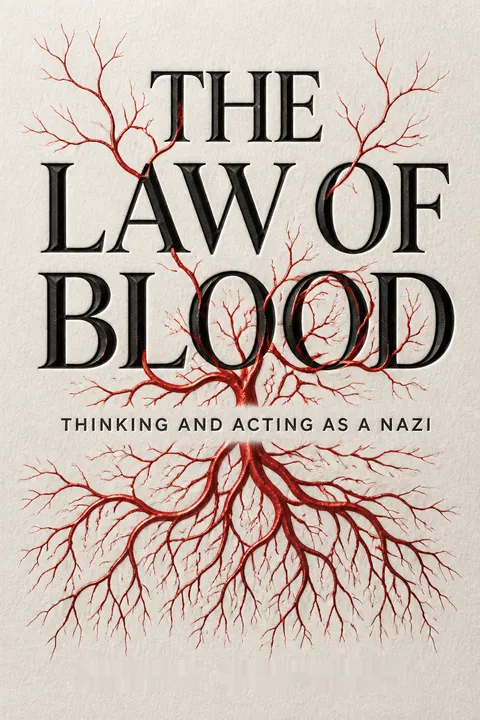
The Law of Blood by Johann Chapoutot examines Nazi ideology through extensive analysis of primary sources including speeches, legal documents, films, and propaganda. Reviewers praise its rigorous scholarship in reconstructing the Nazi worldview, particularly their anti-Christian theology, biological racism, legal philosophy, and belief in natural law based on blood and race. The book reveals how Nazi crimes were justified within their coherent, though abhorrent, ethical framework. While some find it repetitive or academically dense, most consider it essential for understanding how educated people embraced genocidal ideology. The disturbing content makes it challenging but necessary reading for comprehending this dark period.
People Also Read



Download PDF
Download EPUB
.epub digital book format is ideal for reading ebooks on phones, tablets, and e-readers.








































