

Key Takeaways
The reading crisis is a hidden knowledge crisis in disguise
The core thesis. American schools treat reading comprehension as a portable set of skills (finding the main idea, making inferences, identifying captions) that can be drilled on any text. Wexler argues this is backwards. Comprehension depends overwhelmingly on background knowledge, not transferable technique.
The evidence is damning: two-thirds of students score below proficient in reading, a figure stuck for over twenty years despite billions spent. Meanwhile only 18% of eighth-graders are proficient in U.S. history. The elementary literacy block swallows 90 minutes to three hours daily while social studies gets 16 minutes and science 19. Kids spend a decade practicing skills on random passages about birds, then clouds, then bridges, never accumulating the connected knowledge that actually unlocks difficult text.
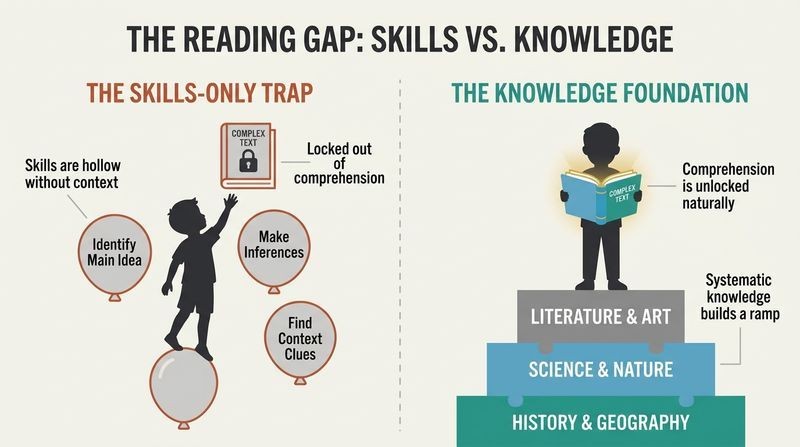
What makes this argument powerful is its parsimony: one mechanism explains stagnant scores, the persistent income gap, and civic ignorance simultaneously. It aligns with cognitive scientist Daniel Willingham's dictum that reading tests are knowledge tests in disguise. A skeptic might note that decoding failures also drag scores down, and Wexler concedes decoding must be taught as a discrete skill. The deeper provocation is institutional: an entire profession has optimized for the wrong variable. That mirrors other fields where a plausible-but-false theory ('teach the skill directly') persisted because it felt intuitive and no one measured the counterfactual carefully enough.
A kid who knows baseball out-reads a 'better reader' who doesn't
The experiment that proves knowledge trumps skill. In 1987, researchers Recht and Leslie built a miniature baseball field and had 64 middle-schoolers read a passage describing a half-inning, then reenact it with wooden figures. Students were pre-sorted by reading ability and baseball knowledge.
The result upended the skills theory. Kids who knew baseball understood the passage well regardless of their measured 'reading level.' Weak readers who knew baseball outperformed strong readers who didn't. A parallel study read preschoolers a book about birds (which wealthier kids knew more about); richer children scored higher. But when the same kids read about invented animals called 'wugs,' where nobody had prior knowledge, the comprehension gap vanished. The gap was never a skills gap. It was a knowledge gap.
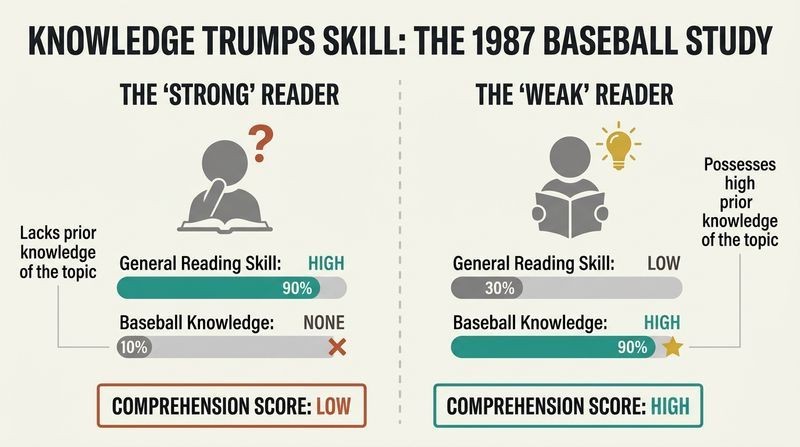
This is the empirical keystone, and it generalizes beyond reading. Expertise research (Chase and Simon's chess studies) shows masters recall board positions brilliantly only when pieces form real-game patterns; scramble them randomly and experts lose their edge, exactly like the strong readers who didn't know baseball. Knowledge lets us 'chunk' information, freeing working memory. One caution: the effect size of prior knowledge, while large, does not make decoding or vocabulary irrelevant. The honest reading is that comprehension is multiplicative, not additive. Zero knowledge times great skill still yields poor understanding, which is precisely why endless skill-drilling on unfamiliar topics stalls out.
Stop drilling comprehension skills; teach history and science instead
The actionable reversal. If knowledge drives comprehension, the fastest route to better readers is not more strategy practice but a coherent, cumulative curriculum rich in history, science, geography, and the arts, starting in kindergarten.
Wexler documents the contrast through two first-grade classrooms. One teaches 'captions' as an abstract text feature; kids stay confused and disengaged. Another reads aloud about mummies and ancient Babylon; the same demographic of low-income children is riveted, absorbing words like sarcophagus and fertile. The knowledge-building teacher wasn't more gifted. She simply used a content-rich curriculum. Strategy instruction has diminishing returns (fifty sessions help no more than ten), functioning like a reminder to check your work rather than a tool that generates understanding. Time freed from skills drills can build knowledge, where benefits have no ceiling.
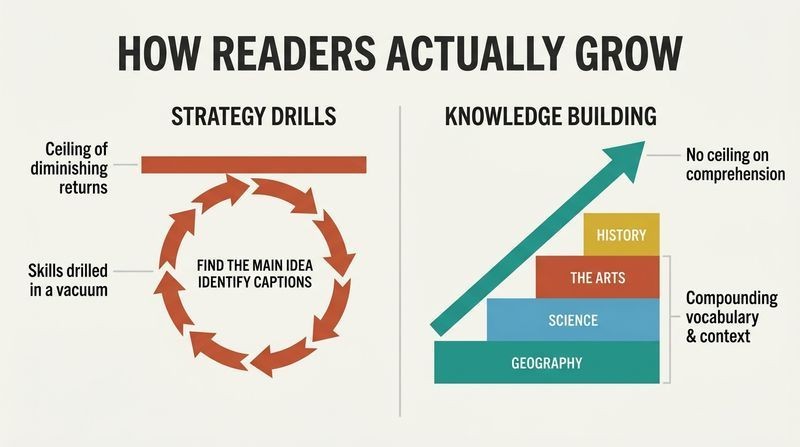
The prescription is refreshingly concrete, but implementation is where reformers stumble. Wexler's own reporting shows a single teacher switching approaches rarely moves the needle without a school-wide, multi-year curriculum, because knowledge compounds across grades. This is a coordination problem, not an individual-willpower problem, which is why it resisted the hero-teacher model of reform. There's also a sequencing subtlety worth flagging: 'teach content' does not mean abandon phonics. The strongest synthesis is dual: systematic decoding instruction plus knowledge-building read-alouds and discussion. Schools that pick only one half tend to fail, which partly explains why well-intentioned pendulum swings keep disappointing.
Reading has two engines; only one should be drilled like math
Decoding versus comprehension. Cognitive science draws a sharp line educators have blurred. Decoding (translating letters into sounds and words) genuinely is a skill, best taught through systematic, explicit phonics. Done well, roughly 95% of children, including most diagnosed as dyslexic, become fluent decoders.
Comprehension works oppositely. It arises more or less naturally once a reader has enough relevant knowledge and vocabulary. Yet American education inverted this: it long assumed decoding happens naturally (surround kids with books, let them guess from context) while treating comprehension as a set of teachable strategies. Both assumptions are wrong. Struggling decoders never get the systematic instruction they need, and comprehension gets drilled as if it were arithmetic. The 2000 National Reading Panel endorsed phonics but muddied things by also blessing comprehension-strategy instruction.
The two-engine model resolves the decades-old Reading Wars by showing both camps were half-right and half-wrong. Whole-language advocates were correct that meaning matters but wrong that decoding is natural; phonics advocates were right about decoding but silent on knowledge. Writing was invented only four to six thousand years ago, far too recently for brains to have evolved a reading instinct, which is why decoding must be taught while speech is absorbed effortlessly. The lingering puzzle is institutional memory: why did a field repeatedly ignore robust evidence? Confirmation bias plus professional identity ('I help children') makes disconfirming data feel like a personal accusation, a dynamic Wexler compares to doctors resisting handwashing.
Balanced literacy and leveled reading quietly widen the gap they claim to close
The dominant method, examined. 'Balanced literacy,' the approach most U.S. teachers use, pairs minimal phonics with 'leveled reading': students are confined to books matched to their individual reading level via systems like Fountas and Pinnell's A-to-Z scale. A second-grader stuck at 'Level D' reads kindergarten-level books indefinitely.
The logic seems humane but backfires. Leveled texts consist mostly of words and concepts kids already know, so they build little new knowledge or vocabulary. Because struggling readers are disproportionately low-income, they get systematically starved of the challenging content their affluent peers absorb at home. As one expert puts it, leveled texts lead to leveled lives. Lucy Calkins's influential Units of Study frame every lesson in generic, content-free terms ('the role of emblematic detail') on the theory that any topic could be swapped in.
The critique lands hardest on equity grounds. Wealthy children compensate for content-free schooling through museum trips, dinner-table debate, and eight-word-a-day vocabulary growth fueled by educated parents. Poor children have only school, so a knowledge-free curriculum hurts them most, an instance of the Matthew effect where the knowledge-rich get richer. A fair rejoinder: leveled reading emerged from a genuine desire not to frustrate weak readers, and struggle without support can indeed cause shutdown. The Washoe County teachers' surprise, that low-income kids thrived on grade-level complex text, suggests educators had confused compassion with low expectations, a distinction worth guarding carefully in any classroom.
Young children crave broccoli; adults keep feeding them donuts
History is not too abstract for six-year-olds. Educators, leaning on a dated reading of Piaget's developmental stages, insist history and non-experimental science are 'developmentally inappropriate' before third grade. Wexler calls this both unsupported and ironic: truly abstract concepts like 'captions' and 'symbols' are deemed fine for first-graders, while concrete, story-rich history is withheld.
History, she notes, is a series of stories, and children love stories. Observed classrooms bear this out: first-graders beg to keep learning about mummies; second-graders debate whether Alexander the Great's ambition was inspiring or a flaw, spontaneously connecting it to Ethiopian history. Jerome Bruner argued any subject can be taught honestly to any child at any stage. Modern research confirms development is fluid, not locked in rigid stages, and kids handle far more than the curriculum assumes.
The developmental-appropriateness claim deserves scrutiny because it functions as an unfalsifiable trump card: whatever kids can't yet do is labeled inappropriate rather than untaught. Wexler's counterexamples (the private school charging $35,000 that still bars early history) show the belief crosses class lines, making it ideological rather than evidence-based. The Montessori tradition has introduced young children to geography and botany for a century. One nuance: 'kids can learn it' does not settle 'kids should learn it in what depth,' and Core Knowledge's exposure-not-mastery principle wisely concedes that a second-grader need not retain every detail of cuneiform, only the durable big ideas.
Vocabulary is the visible tip of an invisible iceberg of knowledge
Why you can't just teach the words. During early schooling children add roughly eight words a day. No teacher can directly instruct that volume; the only way to expand vocabulary that fast is to expand knowledge. Words come embedded in webs of concepts. Understand 'oar' and you likely also grasp rowboats and paddling. A single word is inseparable from the world it points to.
Wexler illustrates the stakes with a math example: a first-grader named Marcus keeps failing a problem asking what number comes 'before' 84, not because of math but because he doesn't know what 'before' means numerically. Another child can't 'combine' 8 and 3. Poor children hear less sophisticated language at home and at school, a documented 'double dose of disadvantage,' leaving some kindergartners scoring in the fifth percentile on vocabulary.
This reframes vocabulary instruction from a list-memorization chore into a byproduct of immersion. It dovetails with research on incidental word learning: most vocabulary is acquired through repeated encounters in meaningful context, not flashcards. The math anecdotes are especially clarifying because they show 'reading' deficits leaking into supposedly non-verbal subjects, undermining the fiction that literacy is a separable subject. The famous 'thirty million word gap' study Wexler cites has faced replication challenges, and she fairly notes newer work emphasizes back-and-forth 'conversational turns' over raw word counts. The core claim, that knowledge and vocabulary grow together, survives regardless of which number wins.
Firing bad teachers failed; giving all teachers good curriculum works
The reform that got overlooked. For twenty-five years, philanthropists like the Gates Foundation bet billions on teacher quality: smaller high schools, value-added evaluations tied to test scores, elaborate observation systems. A $575 million partnership project concluded it failed to boost teacher quality or student learning. You cannot fire your way to excellence across three million teachers.
The overlooked lever is curriculum. Studies show a high-quality curriculum can outperform a highly experienced teacher, and it helps the weakest teachers most, yet costs no more than a bad one. Countries that outrank the U.S. all use coherent, content-rich curricula. In 2017 Gates finally pivoted toward curriculum, with one official calling it education's 'mosquito net': a cheap, low-tech, high-impact intervention. Effective professional development, it turns out, must be embedded in specific content, not generic pedagogy.
This is the book's most consequential policy argument and its most counterintuitive to Silicon Valley reformers who instinctively optimize personnel and incentives. The mosquito-net analogy is apt: malaria deaths halved not through better doctors but a fifty-cent intervention. The economics are striking because curriculum is a rare free lunch, equal cost, higher return. A caveat Wexler herself raises: rigorous long-term studies of literacy curricula are scarce, partly because knowledge takes years to compound and students switch schools. The math-curriculum evidence is stronger. So the case rests partly on international comparison and cognitive theory rather than gold-standard domestic trials, a gap worth honest acknowledgment even while the logic is compelling.
Teach writing at the sentence, embedded in content you already study
Writing is a second language, and knowledge unlocks it. Judith Hochman discovered that writing must be taught explicitly and sequentially, starting with the sentence, not assigned and hoped for. Her method has students expand bare sentences using conjunctions and question words: 'They rebelled' becomes an exercise in who, when, and why, embedded in what they're studying about the American Revolution.
This contrasts with the dominant 'writers' workshop' model, which prioritizes free self-expression about students' own lives ('small moments') and trusts kids to absorb grammar naturally. Many never do. Writing is harder than reading because it's expressive, not receptive, and it overloads working memory. But when the mechanics are manageable and the writer knows the content, writing becomes the single most powerful tool for cementing knowledge, exposing misunderstandings, and building analytical thinking. At New Dorp High School, the sentence-first method transformed AP pass rates.
Hochman's insight rhymes with the 'protégé effect' and 'retrieval practice' from learning science: articulating knowledge in writing forces retrieval, which lodges it in long-term memory better than rereading. The workshop model's flaw is subtle and equity-laden: restricting kids to personal narrative squanders writing's power to teach content, and it presumes a home environment that supplies conventions. Lisa Delpit's critique, that vague 'fluency' pedagogy holds back children whose parents can't fill the gaps, sharpens the point. One tension: sentence-level drilling can feel mechanical, and the workshop movement arose partly to rescue writing from deadening worksheets. The resolution is content, not choice between rigor and joy.
Specifying what kids learn ignites political firestorms, so nobody does it
Why America has no shared curriculum. The more specific you get about content, the more likely a political explosion. E.D. Hirsch, a self-described near-socialist who wanted to give poor kids the cultural knowledge elites take for granted, was branded a right-wing elitist after his 1987 book Cultural Literacy and its famous 'List' of 5,000 terms. In 1994, National History Standards were torn apart on air by Rush Limbaugh and condemned by the Senate 99 to 1.
Burned repeatedly, policymakers made the Common Core deliberately content-free, listing skills but specifying almost no texts or topics. This is the original sin Hirsch warned Common Core author David Coleman about: treating literacy standards like math standards, where skills are the content. In literacy, skills without specified knowledge are empty.
The politics reveal a tragic structure: the intervention with the strongest evidence base is the one most vulnerable to culture-war capture, because content selection inevitably encodes values ('whose knowledge?'). This is why local control, ostensibly democratic, produces incoherence, a student can study butterflies three times and never reach the American Revolution. Comparative context helps: France's centralized content curriculum served as a powerful equalizer until it was abandoned for a skills approach, after which achievement fell most for the neediest. The encouraging footnote is that elementary content proves far less controversial than high school history, and curricula like Core Knowledge have spread without the battles that doomed national standards.
Grassroots teacher experiments beat top-down mandates for changing minds
How change actually took hold. In Washoe County, Nevada, a jobless staffer named Aaron Grossman and colleague Torrey Palmer discovered content-focused ideas online and invited teachers to try, not follow, a radical lesson: hand kids a hard text with no preview. Teachers were sure their low-income students would drown. Instead, English learners cracked Emma Lazarus's dense Statue of Liberty poem, and one girl with a learning disability spotted its rhyme scheme first.
The teachers realized they'd been underselling their students for years. That visceral, trial-and-error experience, not a memo, changed their practice. New York's EngageNY curriculum spread similarly through voluntary institutes and free online access, downloaded twenty million times. The pattern: cyclical professional development where teachers learn an idea, test it, and reconvene beats disconnected 'drive-by' workshops.
This is a lesson in change management as much as pedagogy. The mechanism echoes behavioral science on belief revision: people update through direct experience that contradicts expectations, not through argument, which triggers defensiveness. Letting teachers discover their students' capability short-circuits the identity threat that fuels resistance. Yet the Washoe story also carries a warning: the project died when its leaders left, because it lacked institutional durability. The durable solution requires marrying grassroots ownership to district-level scaffolding, a hard combination since top-down structure tends to kill grassroots energy. Louisiana's 'teacher-leader' model, thousands of peer ambassadors, is one promising attempt to institutionalize the bottom-up dynamic without smothering it.
Redesign reading tests to reward taught knowledge, not lucky background
Fixing the testing trap. Standardized reading tests present passages on random topics, so students with broad general knowledge (usually the affluent) have an unfair edge, and the tests inadvertently signal that reading is a content-free skill. This drives teachers to drill strategies rather than build knowledge, since the test 'won't be a quiz about the Navajo.'
Wexler's proposal, pioneered by Louisiana, is elegant: announce in advance the topics a reading test will cover, drawn from the curriculum students actually studied. Teachers then focus on real history and science, knowing it will pay off. For young grades, test decoding directly (as the UK does) and rename knowledge assessments honestly. Add real essay questions at higher grades to measure analysis. Testing what schools teach, rather than what kids happen to know, could unlock large-scale change.
This reframes testing from a diagnostic into an incentive system, which is what it functionally is: teachers teach to the test, so the fix is to build a better test rather than to moralize about teaching-to-the-test. The proposal borrows from high-performing systems that use curriculum-linked essay exams. The obvious objection, that grading millions of essays is expensive and subjective, is real but not disqualifying; other nations manage it with trained human graders and school inspections. A subtler risk: announcing topics could narrow teaching to test-covered content. But since the covered content would be genuine history and science rather than decontextualized skills, that narrowing is far more benign than the status quo.
Analysis
The Knowledge Gap is a work of investigative education journalism structured as a braided narrative: Wexler alternates dispatches from real classrooms (Ms. Arredondo drilling captions, Ms. Masi teaching the War of 1812) with intellectual history and cognitive science. This dual structure is the book's genius and its difficulty to summarize, because its argument is cumulative rather than list-like. The central claim is deceptively simple and genuinely contrarian: America's stubborn reading crisis persists not despite decades of skills-focused instruction but because of it. Comprehension is not a transferable skill; it is a function of what you already know.
The book's strongest contribution is diagnostic reframing. By fusing the baseball study, Willingham's cognitive science, and reporting on balanced literacy, Wexler shows that three separate problems, stagnant scores, the income achievement gap, and civic ignorance, share one root. This parsimony is intellectually satisfying and policy-relevant. Her secondary contribution is institutional forensics: she explains how a false theory became orthodoxy through education schools, the whole-language movement, misread Piaget, and philanthropists who optimized teacher quality while ignoring the cheaper, higher-leverage variable of curriculum.
Where the book is vulnerable, and admirably candid about it, is causal proof. Rigorous long-term studies showing content-rich curricula outperform skills curricula in literacy remain scarce, because knowledge compounds over years and confounds like student mobility abound. Wexler leans on the stronger math-curriculum evidence, international comparison, cognitive theory, and vivid classroom anecdote. This is persuasive but not dispositive, and a careful reader should hold the thesis as a very well-supported hypothesis rather than settled fact.
The book also wisely resists monocausality: it insists decoding must be taught systematically alongside knowledge-building, avoiding the pendulum-swing trap. Its most durable practical legacies are the reconceived reading test (Louisiana's model) and the recognition that curriculum, not heroics, is the equity lever. For parents, teachers, and policymakers, it fundamentally changes what 'teaching reading' should mean.
Review Summary
The Knowledge Gap receives mixed reviews, with praise for its focus on content-based learning and criticism of the education system's emphasis on skills over knowledge. Readers appreciate the author's argument that background knowledge is crucial for reading comprehension and academic success. However, some criticize the book's bias, repetitiveness, and lack of practical solutions. Teachers express both agreement and frustration with the author's portrayal of educators. Overall, the book sparks important conversations about curriculum reform and educational equity.
People Also Read
Glossary
The Knowledge Gap
Comprehension gap caused by knowledgeWexler's reframing of the achievement or test-score gap. She argues the difference between advantaged and disadvantaged students' reading performance is fundamentally a gap in accumulated background knowledge and vocabulary, not a gap in reading skills. Because comprehension depends on what a reader already knows, students deprived of content-rich instruction cannot understand demanding texts regardless of how much skill practice they receive.
Balanced literacy
Dominant skills-plus-choice reading approachThe prevailing American approach to teaching reading, evolved from whole language. It combines minimal phonics with student choice of 'authentic' books, leveled reading, and daily instruction in comprehension strategies. Critics including Wexler argue it still neglects both systematic decoding instruction and the building of content knowledge, leaving disadvantaged students especially underserved.
Leveled reading
Books matched to individual levelA practice, often using the Fountas and Pinnell A-to-Z scale, of confining each student to books deemed to match their measured reading level rather than their grade level. Wexler argues it stunts growth because leveled texts contain mostly familiar words and concepts, building little new knowledge, and it disproportionately holds back low-income children.
Decoding vs. comprehension
Reading's two distinct enginesCognitive science's distinction between the two components of reading. Decoding (translating letters to sounds and words) is a genuine skill best taught through systematic phonics. Comprehension arises naturally once a reader has sufficient relevant knowledge and vocabulary. Wexler argues education wrongly treats decoding as natural and comprehension as a drillable skill, reversing the truth.
The baseball study
Knowledge beats skill in comprehensionRecht and Leslie's 1987 experiment in which middle-schoolers read and reenacted a baseball passage. Prior knowledge of baseball predicted comprehension far better than measured reading ability; weak readers who knew baseball outperformed strong readers who didn't. It is the book's keystone evidence that comprehension depends on knowledge, not transferable skill.
The Matthew effect
Knowledge-rich get richerA term Keith Stanovich applied to reading, from the Gospel line about the rich getting richer. Children who begin with more knowledge acquire yet more, because knowledge sticks best to related knowledge, while those who start with less fall further behind. This snowballing widens gaps the longer students stay in school unless disadvantaged children are enveloped in knowledge-building early.
Core Knowledge
Content-rich cumulative elementary curriculumE.D. Hirsch's curriculum built on a specific, sequenced body of world knowledge (Mesopotamia, the human body, the American Revolution) taught from kindergarten up, largely through teacher read-alouds and discussion. Designed to give all children, especially the disadvantaged, the shared knowledge and vocabulary that unlocks reading comprehension and joins them to literate society.
The Hochman Method
Sentence-first, content-embedded writing instructionJudith Hochman's approach to teaching writing explicitly and sequentially, starting at the sentence level using conjunctions, sentence stems, and question words, always embedded in academic content students are studying. It treats written English as a second language requiring direct instruction, and uses writing as a tool to deepen knowledge and analytical thinking.
The three shifts
Common Core's rarely-known literacy demandsThe Common Core's explanatory principles for literacy: students need regular practice with complex text, must ground claims in textual evidence, and must have extensive opportunities to build knowledge through content-rich nonfiction. Wexler notes the third shift, building knowledge, was inserted at Hirsch's urging but is almost universally unknown to teachers, undermining the standards' intent.
Close reading
Deep guided analysis of textDavid Coleman's Common Core practice of guiding students to mine a rich, complex text through carefully crafted questions, starting from the text itself rather than lengthy pre-reading context or personal connections. Intended to level the playing field, it drew criticism and, Wexler argues, inadvertently overshadowed the Common Core's equally important message about building background knowledge.
FAQ
What's The Knowledge Gap about?
- Focus on Education System: The Knowledge Gap by Natalie Wexler examines the shortcomings of the American education system, particularly the emphasis on teaching reading as a set of skills rather than integrating content knowledge.
- Knowledge vs. Skills: Wexler argues that knowledge is more crucial for reading comprehension than the skills-focused approach that currently dominates classrooms.
- Historical Context: The book traces the historical evolution of educational practices, showing how progressive education philosophies have led to a curriculum that often neglects essential knowledge.
Why should I read The Knowledge Gap?
- Insightful Analysis: The book provides a thorough analysis of the disconnect between educational theory and cognitive science, making it essential for educators, policymakers, and parents.
- Focus on Equity: It addresses educational equity, emphasizing how the current system disproportionately affects disadvantaged students.
- Practical Solutions: Wexler offers practical solutions for reforming education, advocating for a shift towards knowledge-based curricula.
What are the key takeaways of The Knowledge Gap?
- Knowledge is Crucial: Knowledge, rather than just reading skills, is essential for comprehension, as emphasized by Wexler.
- Curriculum Reform Needed: The book argues for a significant overhaul of the curriculum to include more content in subjects like history and science.
- Impact of Testing: Wexler discusses how the focus on standardized testing has narrowed the curriculum, leading to a lack of essential knowledge.
What are the best quotes from The Knowledge Gap and what do they mean?
- Disconnect in Education: “There’s a huge gulf between what teachers believe about how to teach reading and what scientists have found.” This highlights the need for evidence-based teaching methods.
- Reading Wars: “The reading wars... have just gone underground.” This suggests that fundamental issues in reading education remain unresolved despite changes in terminology.
- Knowledge Gap: “The test-score gap is, at its heart, a knowledge gap.” This encapsulates Wexler's argument that disparities in educational achievement are primarily due to differences in knowledge.
How does The Knowledge Gap critique the Common Core?
- Vague Standards: Wexler argues that the Common Core standards are often too vague and lack specific content requirements.
- Skills Over Content: The standards prioritize skills without specifying the content students should engage with, failing to build necessary background knowledge.
- Implementation Challenges: Teachers face challenges in implementing the Common Core effectively, leading to frustration and disengagement.
What specific methods does Wexler recommend for improving education?
- Content-Rich Curriculum: Wexler advocates for a curriculum rich in content across subjects, particularly in history and science.
- Systematic Knowledge Building: She emphasizes the importance of systematically building knowledge over time, allowing students to make connections and deepen understanding.
- Teacher Training: Effective professional development for teachers is crucial for implementing a content-focused curriculum successfully.
How does Wexler address the issue of educational equity in The Knowledge Gap?
- Knowledge Gap: Disparities in educational outcomes are largely due to a knowledge gap, particularly affecting students from low-income backgrounds.
- Curriculum Design: A content-rich curriculum can help bridge the gap between different student groups.
- Importance of Early Education: Providing all students with a strong foundation of knowledge in the early grades is essential for long-term success.
What role do teachers play in addressing the knowledge gap according to Wexler?
- Critical for Student Success: Teachers are crucial in bridging the knowledge gap by delivering content-rich instruction.
- Need for Professional Development: Ongoing professional development equips teachers with the knowledge and skills necessary to teach a content-focused curriculum.
- Empowerment through Knowledge: Teachers should be empowered to teach knowledge-rich content rather than just skills.
How does The Knowledge Gap suggest addressing the challenges of high-stakes testing?
- Reevaluating Testing Practices: Wexler calls for a reevaluation of high-stakes testing practices that prioritize skills over knowledge.
- Knowledge-Based Assessments: Assessments should measure knowledge acquisition in various subjects rather than generic reading skills.
- Alternatives to Current Testing: Knowledge-based assessments aligned with the curriculum could lead to a more accurate representation of student learning.
What historical context does Wexler provide in The Knowledge Gap?
- Evolution of Educational Practices: Wexler traces the historical evolution of educational practices, highlighting the shift away from content-rich curricula.
- Reading Wars: The book delves into the historical debate known as the Reading Wars, contrasting phonics-based instruction with whole language approaches.
- Influence of Cognitive Science: Wexler emphasizes the importance of cognitive science in understanding how children learn to read and comprehend text.
What role does writing play in Wexler's educational philosophy?
- Writing as a Tool for Learning: Writing reinforces knowledge and develops critical thinking skills.
- Connection to Content: Writing should be embedded in content learning to deepen understanding and retention.
- Explicit Instruction: Teaching students how to construct sentences and organize thoughts is essential for effective writing.
What are the implications of Wexler's arguments for teachers and administrators?
- Need for Curriculum Change: Teachers and administrators must prioritize curriculum change to focus on content knowledge.
- Professional Development: Ongoing professional development is crucial for educators to implement content-rich curricula effectively.
- Collaboration and Support: Administrators should foster an environment that encourages collaboration among educators to share best practices and resources.
About the Author
Other books by Natalie Wexler
Download PDF
Download EPUB
.epub digital book format is ideal for reading ebooks on phones, tablets, and e-readers.








































