
Plot Summary
Arrival in Iron Hollow
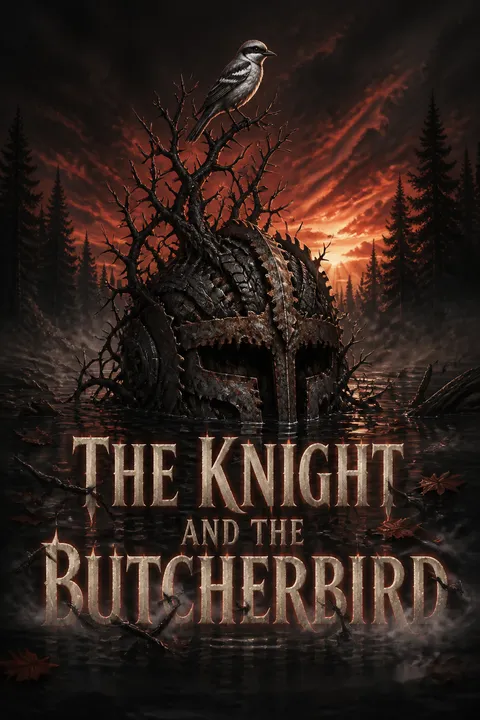
In the sweltering heat of a post-apocalyptic August, the people of Iron Hollow gather to witness the arrival of a legendary knight. His armor is patched from old tires and rusted saw blades, but his presence commands awe. The town's leader, Laurel Boss, welcomes him, hoping he will rid them of a demon that has haunted their valley. Among the crowd stands Shrike, the new Secretary, an outsider even in her own home, carrying the weight of recent loss. The knight, Sir John of Cincinnati, is accompanied by a mysterious hawk and marked by a terrible scar. His reputation precedes him: a demon-slayer driven by personal tragedy. The town's hope and Shrike's secret dread converge as the knight's quest begins.
The Knight's Scarred Past
Sir John's story is known even in distant Iron Hollow: once, he lost his wife and his ear to a demon, vowing to hunt such creatures forever. His hawk, trained to hunt demons, is both companion and symbol of his relentless mission. The townsfolk are awed, but Shrike's reaction is more complicated—her hatred for the knight is personal, rooted in her own grief. Sir John's presence is both a promise of salvation and a threat to secrets best left buried. The knight's old-fashioned speech and mannerisms set him apart, but his pain is universal. Beneath the legend lies a man shaped by loss, driven by a need for answers, and haunted by the memory of love destroyed by monstrous change.
Demon-Hunting Rituals
Demons, in this world, are not horned devils but people transformed by sickness and suffering. The process is secretive and shameful; those afflicted hide their changes until discovery is inevitable. The community's response is swift and brutal—better to kill a demon early than risk disaster. Knights like Sir John are summoned when the transformation is too far gone. Shrike, as Secretary, knows these stories intimately, and her own experience with loss and violence colors her view of the ritual. The hunt is not just for monsters, but for the remnants of humanity within them. The line between victim and threat is blurred, and the rituals of demon-hunting are as much about fear as they are about survival.
Shrike's Secret Grief
Shrike's wife, May, was the demon Iron Hollow fears. Shrike tried to hide May's transformation, shackling her in an abandoned tunnel, but the secret could not last. When May's change became undeniable, the town's response was merciless. Shrike's grief is raw and unresolved, her anger at Sir John a mask for her own guilt. She is young, but loss has aged her. Her role as Secretary—keeper of stories and traditions—conflicts with her personal loyalty to May. The memory of love, betrayal, and violence shapes Shrike's every action. She is torn between duty to her people and the desperate hope that some part of May remains, even in monstrous form.
The Nature of Change
Change is the story's central theme. Demons are not born evil; they are people forced to adapt to a poisoned, dying world. The process is painful and often fatal, but it is also a form of survival. Shrike learns from her mentor, Finch Secretary, that stories of transformation are ancient and universal—people become monsters because they must. The old world's boundaries no longer hold; survival demands new forms, new stories. The wheel turns, and so do the people of Iron Hollow. Shrike's understanding of change is both scientific and mythic, rooted in blood and legend. The lesson is clear: to survive, one must be willing to become something new.
Stalking the Demon
Sir John begins his hunt, moving through the woods with practiced skill. Shrike follows, haunted by memories of May and the places they once shared. The landscape is littered with reminders of love and loss—quarries, berry patches, polluted creeks. The hunt is both literal and symbolic: Shrike is chasing not just May, but the possibility of redemption or closure. Sir John's methods are methodical, but Shrike's motives are tangled with grief and longing. The tension between hunter and hunted, between past and present, drives the narrative forward. The woods become a stage for confrontation, memory, and the hope that something human might yet be saved.
The Encounter at the Creek
At the creek, Shrike and Sir John finally confront each other. Shrike's attempt to kill the knight fails, revealing her desperation and the depth of her pain. Sir John, calm but unyielding, tries to reason with her, urging her to let go of the past. Their standoff is interrupted by May's monstrous arrival—a patchwork of animal forms, barely recognizable as the woman Shrike loved. The encounter is chaotic and violent, but also charged with recognition: May still knows Shrike, even in her altered state. Sir John's hawk intervenes, and the moment passes, but the lines between love, violence, and survival are drawn more sharply than ever.
Stories and Survival
Shrike recalls the lessons of Finch Secretary, who taught her that stories are the true inheritance of the outlands. Stories explain why people change, why they survive. From ancient myths to modern parables, transformation is always a response to threat or loss. Shrike's role as Secretary is to remember and interpret these stories, to find meaning in chaos. The enclave's scientific approach—dissecting dead demons—misses the point: the secret lies in the living, in the will to survive. Shrike's own story is one of adaptation, shaped by hunger, love, and the need to endure. The stories she tells will shape Iron Hollow's future.
The Truth of Transformation
Shrike's investigation reveals that demon transformation is triggered by disease—cancer, specifically. Outlanders, exposed to toxins and hardship, are forced to adapt or die. The enclaves, insulated and privileged, do not face the same pressures. Sir John's quest for understanding is revealed as both noble and tragic: he seeks a cure, a way to reverse the change, but the truth is that change is the only way to survive. The revelation is both scientific and existential. The enclaves' desire to control or eradicate demons is rooted in fear of what they cannot become. Shrike's insight reframes the conflict: the real threat is not the demons, but the refusal to change.
The Knight's Hidden Motive
Sir John's relentless hunt is not just for the king or the enclaves—it is for his own lost wife, now a demon. He has kept her hidden, hunting others in the hope of finding a way to restore her. His questions to dying demons—how did you change?—are desperate attempts to reclaim what he has lost. The revelation of his true motive brings him and Shrike into uneasy alliance: both are driven by love twisted by loss. Sir John's tragedy is that his quest has only brought more death, and the answer he seeks cannot undo what has been done. His story mirrors Shrike's, each a reflection of the other's grief.
The Enclave's Real Threat
The enclaves, with their armies and technology, see the outlands as a dying world to be conquered. The rise of demons—people who have adapted beyond human limits—threatens their dominance. Sir John reveals that the enclaves' interest in demon transformation is not compassion, but control. If they could identify and eliminate potential demons, they would do so without mercy. The true danger is not the monsters in the woods, but the systems of power that fear change. Shrike's decision to withhold the secret of transformation is an act of rebellion, a refusal to let the enclaves dictate the future. The stakes are not just personal, but existential.
The Butcherbird's Bargain
Shrike poisons Sir John, intending to kill him but ultimately sparing his life. She recognizes in him a fellow survivor, someone who has sacrificed everything for love. The encounter is a turning point: Shrike chooses to leave Iron Hollow, abandoning her role as Secretary and her obligations to the town. Her loyalty to May outweighs all other ties. The bargain she strikes—with herself, with Sir John, with the future—is one of survival at any cost. The name "Butcherbird" becomes a symbol of her willingness to do whatever is necessary, even if it means becoming a monster in the eyes of others.
The Demon's True Face
Shrike finds May, transformed beyond recognition, yet still marked by the memory of love. The reunion is brief and bittersweet; May is both familiar and utterly alien. Sir John intervenes, warning Shrike of the danger, but Shrike refuses to abandon hope. The moment is charged with the possibility of reunion or destruction. Ultimately, Shrike must accept that May's transformation is irreversible, that love sometimes means letting go. The encounter is a microcosm of the story's central dilemma: to hold on is to risk destruction, but to let go is to allow for new forms of survival. The past cannot be reclaimed, only mourned.
The Battle of Beasts
A violent confrontation erupts between May and Sir John's demon-wife, each shifting through monstrous forms in a battle for dominance. Sir John and Shrike are caught in the crossfire, each trying to save the one they love. The fight is brutal and unending, a testament to the power and danger of unchecked transformation. In the chaos, Sir John is mortally wounded, sacrificing himself for his wife. The battle is both literal and symbolic: the struggle to survive in a world that punishes difference, the cost of love in a time of monsters. The outcome is uncertain, but the message is clear—survival demands change, and change is never without pain.
Love and Sacrifice
Sir John's death is both an ending and a release. He dies not as a knight or a hunter, but as a man who loved and lost. Shrike mourns him, recognizing in his sacrifice the same impulse that drove her own actions. Love, in this world, is measured by what one is willing to risk or destroy. The story refuses easy answers: love is not redemptive, but it is real. The survivors—human and demon alike—are left to carry the weight of what has been lost. The wheel turns, and the story moves forward, but the scars remain. Sacrifice is the price of survival.
The Wheel Turns
Shrike returns to Iron Hollow, inventing a story that preserves the town's fragile hope. She becomes the Secretary in truth, shaping the narrative that will guide her people. The phrase "the wheel turns" becomes a mantra, a recognition that change is inevitable and necessary. Shrike's own transformation—from orphan to lover to survivor to storyteller—mirrors the cycles of the world around her. The past is honored, but not clung to; the future is uncertain, but not feared. The story's emotional arc is one of acceptance, resilience, and the refusal to be defined by loss alone.
A New Kind of Story
As Secretary, Shrike dedicates herself to teaching Iron Hollow new stories—ones that celebrate adaptation, resilience, and the power of change. She rejects the enclave's narratives of fear and control, offering instead tales of the shrike and the demon bride. The stories become tools of survival, shaping the community's understanding of itself and its place in the world. Shrike's legacy is not just in the stories she tells, but in the example she sets: to survive is to change, to love is to risk, to remember is to hope. The new stories are seeds for a future that is not yet written.
The End and the Beginning
In her final years, Shrike reflects on the lessons of her life. She has taught Iron Hollow to survive, to adapt, to embrace the unknown. The story ends as it began: with the image of transformation, of lovers chasing each other across the sky, shifting forms in the twilight. The apocalypse is not an ending, but a beginning—a chance to become something new. Shrike's hope is that, when her time comes, she will find May waiting for her, and together they will run into whatever future awaits. The story closes on a note of possibility, a recognition that the end of one world is the birth of another.
Analysis
Alix E. Harrow's "The Knight and the Butcherbird" is a profound meditation on change, survival, and the power of stories to shape reality. Set in a world ravaged by apocalypse, the novella rejects simple binaries of good and evil, human and monster. Instead, it explores the ways in which people adapt to impossible circumstances, often at great personal cost. The transformation of loved ones into demons is both literal and metaphorical—a reflection of illness, grief, and the need to become something new in order to endure. The story challenges the authority of tradition and power, embodied by the enclaves, and elevates the voices of those who survive on the margins. Through Shrike's journey, Harrow argues that survival is an act of creativity and courage, and that love, while not redemptive, is a force that compels us to risk, to change, and to remember. The lesson is clear: the end of one world is the beginning of another, and the stories we tell determine how we survive.
Review Summary
Characters
Shrike Secretary
Shrike is the heart of the story—a young woman shaped by loss, love, and the harsh realities of the outlands. Orphaned and feral as a child, she is taken in by Finch Secretary and raised to remember and interpret the stories that define her people. Her marriage to May is both a source of joy and tragedy, as May's transformation into a demon forces Shrike to choose between loyalty and survival. Shrike's psychological complexity lies in her ability to adapt, to make hard choices, and to find meaning in suffering. Her journey from outsider to Secretary mirrors the story's themes of change and resilience. She is both a witness and an agent of transformation, her actions driven by love, guilt, and the need to endure.
Sir John of Cincinnati
Sir John is a legendary demon-slayer, marked by physical and emotional scars. His quest is driven by the loss of his wife to transformation, a wound that never heals. Outwardly stoic and formal, he is inwardly tormented by grief and the burden of his actions. His relationship with Shrike is fraught—part adversary, part ally, both shaped by similar losses. Sir John's psychological depth comes from his inability to let go, his desperate search for a cure, and his eventual recognition that some things cannot be undone. His death is both a sacrifice and a release, a final act of love that mirrors Shrike's own journey.
Mayapple Coal (May)
May is Shrike's wife, the demon at the heart of the story. Her transformation is both a tragedy and a testament to the will to survive. May's presence is felt even when she is absent—her memory haunts Shrike, her monstrous form a constant reminder of what has been lost and what might still be saved. May's ability to recognize Shrike, even in her altered state, is a thread of hope in a world of loss. She embodies the story's central question: what remains of love and identity when everything else has changed? May is both victim and survivor, her fate intertwined with Shrike's.
Finch Secretary
Finch is Shrike's adoptive mother and predecessor as Secretary. She is a repository of wisdom, teaching Shrike the importance of stories and the necessity of adaptation. Finch's death is a pivotal moment, forcing Shrike to step into her role and confront the realities of leadership. Finch's influence endures through the lessons she imparts and the example she sets. Her willingness to sacrifice for Shrike is a measure of her love, even if it is not always expressed in traditional ways. Finch represents the continuity of memory and the power of narrative to shape survival.
Laurel Boss
Laurel is the head of Iron Hollow, responsible for the town's safety and survival. She is practical, decisive, and weary—her authority tested by the demon threat and the loss of trusted advisors. Laurel's relationship with Shrike is complicated by grief and necessity; she relies on Shrike's knowledge but is wary of her secrets. Laurel embodies the challenges of leadership in a world where every decision carries the weight of life and death. Her pragmatism is both a strength and a source of tension, as she navigates the demands of tradition and the need for change.
Sir John's Wife (Lily)
Lily is Sir John's wife, transformed into a demon but still bound to him by love and memory. Her ability to shift forms, to speak and reason, sets her apart from other demons. Lily's relationship with Sir John is marked by longing, resentment, and moments of tenderness. She is both prisoner and partner, her fate tied to his quest for understanding. Lily's presence complicates the narrative of good and evil, challenging the assumptions of both the enclaves and the outlanders. She is a living testament to the story's central theme: love endures, but it cannot prevent change.
The Hawk
The hawk, Sir John's constant companion, is more than a hunting animal—it is a symbol of the knight's quest and the possibility of change. The hawk's ability to shift forms, revealed late in the story, mirrors the transformations of the human characters. It serves as a bridge between worlds, a reminder that survival requires adaptation. The hawk's relationship with Sir John is one of loyalty and mutual dependence, reflecting the complexities of love and loss.
Trillium Butcher
Trillium is a minor but pivotal character, whose loss of livestock to the demon reignites the town's fear and forces a final confrontation. Her practical, no-nonsense attitude highlights the everyday struggles of survival in Iron Hollow. Trillium's actions serve as a reminder that the consequences of transformation are not abstract, but immediate and personal.
Ramp Pharmacist
Ramp is the town's pharmacist, providing both medical care and scientific insight. His analysis of May's blood helps Shrike understand the true nature of demon transformation. Ramp represents the intersection of science and survival, his knowledge a crucial tool in the fight to adapt.
The People of Iron Hollow
The townsfolk are both backdrop and active participants in the story. Their fears, traditions, and responses to crisis shape the narrative's stakes. They are survivors, shaped by hardship and loss, but also capable of change. The community's willingness to accept new stories and adapt to new realities is a measure of hope in a world defined by apocalypse.
Plot Devices
Transformation as Survival
The central plot device is the transformation of humans into demons—not as a punishment, but as a means of survival in a hostile world. This device reframes the traditional monster narrative, making the "demon" a symbol of adaptation rather than evil. The process is triggered by disease and environmental pressure, linking personal suffering to broader themes of evolution and resilience. The device is reinforced by recurring motifs of storytelling, memory, and the wheel of change. Foreshadowing is used throughout—early hints of May's transformation, the knight's scar, the hawk's true nature—building to revelations that recontextualize the characters' actions and choices. The narrative structure is cyclical, mirroring the theme of the wheel turning, and the use of stories within the story provides both exposition and emotional resonance.
About the Author

Download PDF
Download EPUB
.epub digital book format is ideal for reading ebooks on phones, tablets, and e-readers.








































