
Plot Summary
The Yellow Sign Unveiled
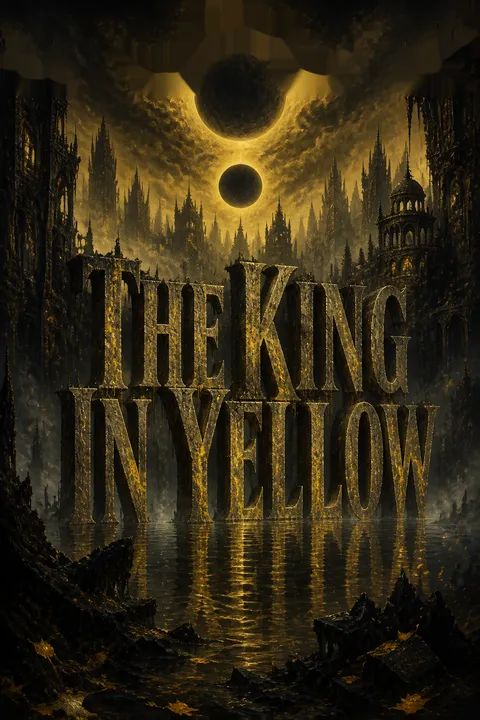
In a world eerily like our own, a mysterious play called "The King in Yellow" circulates, leaving madness and despair in its wake. Its pages, innocent at first, soon reveal a cosmic horror that seeps into the lives of all who read it. The Yellow Sign, a cryptic symbol, becomes a mark of doom, binding together disparate characters across stories. The play's influence is subtle but devastating, unraveling sanity and reality itself. As the book spreads, society's fabric frays, and those who encounter it are drawn into a web of obsession, fear, and revelation. The Yellow Sign is not just a motif—it is a curse, a promise, and a key to a world where truth is poison and beauty is terror.
Madness in Washington Square
Set in a near-future New York, the city appears prosperous and reformed, but beneath the surface, darkness festers. The government legalizes suicide, opening Lethal Chambers for the despairing. Hildred Castaigne, once ordinary, is changed by a head injury and his reading of "The King in Yellow." He becomes obsessed with hidden power, convinced of his royal destiny. The city's modernity is a thin veneer over existential dread, and the Lethal Chamber stands as a monument to society's surrender to despair. Hildred's descent mirrors the city's own, as both are haunted by the specter of the Yellow King.
The Repairer's Secret Empire
Hildred's world narrows to a circle of eccentric acquaintances: Hawberk the armourer, his daughter Constance, and the grotesque Mr. Wilde, self-styled "Repairer of Reputations." Wilde claims to control a vast network manipulating reputations and destinies. Together, they construct a paranoid fantasy of imperial succession, with Hildred as heir to a cosmic throne. The line between reality and delusion blurs as Wilde's influence grows. The Yellow Sign becomes a rallying symbol for their imagined revolution. Hildred's cousin Louis and Constance's innocent love are caught in the crossfire, as Hildred's madness threatens to consume them all.
The Diadem and the Delusion
Hildred's obsession crystallizes in a jeweled diadem he keeps locked away, a symbol of his imagined kingship. He rehearses his coronation in secret, convinced that the world will soon recognize his sovereignty. The diadem is both a literal object and a metaphor for his fractured psyche. As his plans escalate, he manipulates and threatens those around him, convinced of conspiracies and betrayals. The diadem's allure is irresistible, but it is also a trap—each time Hildred dons it, he slips further from reality, until his delusions demand blood.
Love, Power, and Paranoia
Hildred's cousin Louis announces his engagement to Constance, shattering Hildred's fragile sense of control. Consumed by jealousy and convinced that Louis is a rival for the throne, Hildred plots his downfall. Mr. Wilde orchestrates a campaign of intimidation and violence, enlisting the broken Vance as an assassin. The web of paranoia tightens, and Hildred's actions become increasingly erratic and dangerous. Love, once a source of hope, is twisted into a weapon. The city's progress is revealed as hollow, and the Lethal Chamber looms as the ultimate escape from a world poisoned by ambition and fear.
The Mask of Desire
In Paris, a circle of artists and lovers grapple with passion, jealousy, and the search for meaning. Boris, a sculptor, discovers a chemical process that petrifies living things, blurring the line between creation and destruction. Geneviève, his muse and beloved, is torn between Boris and Alec, whose unspoken love for her is revealed only in crisis. The Mask—both literal and metaphorical—hides true feelings and intentions. When tragedy strikes, art becomes both a refuge and a tomb. The pursuit of beauty is haunted by the specter of the Yellow King, and the cost of desire is death.
Alchemy and the Fates
Boris's alchemical experiments yield marvels—flowers and animals turned to flawless marble, their essence preserved yet lifeless. The Fates, his unfinished sculpture, loom over the narrative as symbols of destiny's inescapable grip. When Geneviève succumbs to fever and despair, Boris's art becomes her shroud. The boundaries between life and art, love and loss, are obliterated. The survivors are left to wander, haunted by dreams and memories, unable to escape the pull of the past. The Yellow King's influence is felt in every shadow, as the promise of immortality proves to be a curse.
The Marble Lily's Curse
The transformation of living things into marble is both miracle and horror. The marble lily, flawless yet cold, becomes a symbol of love's futility and the artist's hubris. Boris's discovery, meant to preserve beauty, instead destroys it. Geneviève's death and Boris's suicide are the inevitable result of their entanglement with forces beyond their understanding. The marble room, where Geneviève lies eternally beneath the Madonna, is a shrine to lost innocence and unfulfilled longing. The living are left to mourn, their dreams haunted by the King in Yellow's pallid mask.
The Dragon's Pursuit
In "The Court of the Dragon," a nameless narrator is pursued through Paris by a sinister organist whose gaze is filled with hatred. The chase is both physical and psychological, a manifestation of guilt and cosmic retribution. The narrator's flight through the city's labyrinthine streets mirrors his inner torment. The pursuit culminates in a vision of Carcosa, the lost city of the Yellow King, where reality dissolves and the soul is claimed by an inescapable doom. The dragon is both pursuer and conscience, and the only escape is annihilation.
The Hearse in the Fog
In "The Yellow Sign," an artist and his model, Tessie, are haunted by recurring dreams of a hearse and its ghastly driver. The appearance of a repulsive watchman, missing a finger, signals the intrusion of the supernatural into their lives. The discovery of the Yellow Sign—a mysterious onyx clasp—binds them to the fate of the King in Yellow. As Tessie succumbs to the play's influence, reality unravels. The hearse arrives, and death claims them both, leaving behind only questions and the lingering horror of the Yellow King's touch.
The Fatal Manuscript
Throughout the stories, "The King in Yellow" is a forbidden text that promises enlightenment but delivers madness. Those who read it are marked by the Yellow Sign and drawn into a world where the boundaries of reality dissolve. The manuscript is a plot device that links the tales, a Pandora's box whose contents cannot be contained. Its allure is irresistible, but its cost is sanity, love, and life itself. The book's poison seeps into every relationship, every ambition, every dream, until only despair remains.
The Demoiselle's Enchantment
In "The Demoiselle d'Ys," a lost American hunter stumbles into a medieval world, where he falls in love with the mysterious Jeanne. Their romance is idyllic but tinged with melancholy, as the moors and falcons and ancient customs seem untouched by time. When a viper's bite brings death, the hunter awakens in the present, finding only ruins and a gravestone. The glove left behind is the sole proof of his encounter. The story is a meditation on memory, longing, and the impossibility of reclaiming the past.
The Prophets' Paradox
"The Prophets' Paradise" is a series of poetic vignettes exploring the nature of love, destiny, and self-deception. Through allegory and dreamlike imagery, the stories question the value of truth, the pain of sacrifice, and the futility of desire. The search for meaning is endless, and every revelation is tinged with irony. The Yellow King's shadow falls over even the most intimate moments, suggesting that all human striving is ultimately in vain.
The Street of Lost Souls
In "The Street of the Four Winds," an artist named Severn befriends a stray cat, only to discover it is the companion of a beautiful but doomed woman, Sylvia. The story is a meditation on loneliness, kindness, and the fleeting nature of connection. The cat's journey through the city mirrors the wanderings of lost souls, searching for warmth and meaning in a world indifferent to suffering. The Yellow King's presence is subtle but pervasive, a reminder that all beauty is transient.
Siege and Sacrifice
"The Street of the First Shell" plunges the reader into the horrors of the Siege of Paris. Artists and lovers struggle to survive as the city is bombarded and starvation looms. Jack Trent and Sylvia's love is tested by secrets and sacrifice, as the lines between loyalty, betrayal, and survival blur. The city's suffering is mirrored in their personal tragedies, and the hope of rescue is always just out of reach. The Yellow King's influence is felt in the despair and madness that war breeds.
Rue Barrée's Mystery
The stories shift to the bohemian world of the Latin Quarter, where American artists navigate love, art, and temptation. Hastings, naive and earnest, falls for the enigmatic Valentine, whose secrets threaten to destroy their happiness. Clifford, Elliott, and their circle pursue pleasure and meaning, but are haunted by the specter of Rue Barrée, a woman who embodies both desire and unattainability. The Quarter is a place of freedom and danger, where innocence is always at risk.
The Innocent and the Damned
As the artists' stories unfold, the tension between innocence and experience becomes central. Hastings's love for Valentine is pure, but the world around them is not. Clifford's pursuit of Rue Barrée ends in heartbreak and self-realization. The characters are tested by temptation, jealousy, and the lure of the forbidden. The Yellow King's shadow falls over their choices, suggesting that no one is immune to corruption, and that every paradise is built on a foundation of loss.
The Enduring Shadow of Carcosa
In the end, the stories converge in a vision of Carcosa, the lost city where the King in Yellow reigns. The boundaries between reality and nightmare dissolve, and the characters are left adrift in a world where meaning is elusive and hope is fleeting. The Yellow Sign is both a warning and a promise: that beauty and terror are inseparable, that truth is unbearable, and that the shadow of Carcosa will never be lifted. The book closes, but its poison endures.
Analysis
A modern lens on cosmic horror and psychological decay"The King in Yellow" is a pioneering work of weird fiction, blending psychological horror, cosmic dread, and decadent beauty. Its central conceit—a play that drives readers mad—anticipates later explorations of forbidden knowledge and the limits of human understanding. Chambers's stories are united by a sense of pervasive unease, as characters confront the fragility of identity, the dangers of obsession, and the inescapability of fate. The book's structure—interconnected tales linked by motifs and symbols—creates a cumulative effect, drawing readers into a world where meaning is elusive and every revelation is tinged with horror. In a modern context, the book can be read as a meditation on the anxieties of modernity: the loss of faith, the collapse of traditional values, and the search for meaning in an indifferent universe. The Yellow King is both a literal and metaphorical presence, embodying the terror of the unknown and the seductive allure of self-destruction. The stories' enduring power lies in their ambiguity, their refusal to offer easy answers, and their haunting vision of a world where beauty and madness are inseparable.
Review Summary
Reviews of The King in Yellow are largely divided along the collection's natural split. The first four horror stories, linked by a cursed fictional play driving readers to madness, are widely praised as seminal weird fiction, with "The Repairer of Reputations" and "The Yellow Sign" receiving particular acclaim. The latter half, featuring romantic Bohemian stories set in Paris, disappoints horror fans but has its own admirers. The book's influence on H.P. Lovecraft and later works like True Detective is frequently noted.
People Also Read

Characters
Hildred Castaigne
Hildred is the central figure in "The Repairer of Reputations," whose descent into madness is catalyzed by a head injury and the reading of "The King in Yellow." Once ordinary, he becomes obsessed with delusions of grandeur, convinced he is heir to a cosmic throne. His relationships are warped by paranoia and jealousy, especially toward his cousin Louis and Constance. Hildred's mind is a battleground between ambition and reality, and his actions—manipulation, violence, and ultimately murder—are driven by his need to impose meaning on a world he cannot control. His fate is a cautionary tale of the dangers of unchecked obsession and the seductive power of forbidden knowledge.
Mr. Wilde
Mr. Wilde is Hildred's confidant and co-conspirator, a physically deformed and psychologically unstable figure who claims to control a secret empire of reputation repair. His influence over Hildred is profound, feeding his delusions and orchestrating the campaign against their perceived enemies. Wilde's own madness is both a mirror and a catalyst for Hildred's, and his death marks the collapse of their shared fantasy. He embodies the dangers of charismatic manipulation and the thin line between genius and insanity.
Constance Hawberk
Constance is the daughter of Hawberk the armourer and the beloved of Louis. She represents innocence and hope, caught in the crossfire of Hildred's madness. Her relationship with Louis is genuine and tender, but she becomes a pawn in Hildred's schemes. Constance's fate is a testament to the collateral damage wrought by obsession and the vulnerability of goodness in a corrupt world.
Louis Castaigne
Louis is Hildred's cousin and rival, a soldier whose engagement to Constance triggers Hildred's jealousy and paranoia. He is rational, kind, and loyal, but ultimately powerless to save himself or those he loves from Hildred's machinations. Louis's fate is a tragic reminder that reason and virtue are no defense against the madness unleashed by the King in Yellow.
Boris Yvain
Boris is a gifted sculptor whose discovery of a petrifying chemical blurs the line between creation and destruction. His love for Geneviève is deep but ultimately destructive, as his pursuit of beauty leads to tragedy. Boris is both a creator and a destroyer, a man undone by his own genius and the inexorable pull of fate. His story is a meditation on the costs of artistic ambition and the impossibility of preserving what we love.
Geneviève
Geneviève is Boris's muse and beloved, torn between him and Alec. Her beauty and purity inspire art, but also jealousy and despair. When she succumbs to illness and heartbreak, her death becomes both a personal tragedy and a symbol of the futility of trying to preserve innocence in a world ruled by the King in Yellow. Geneviève's fate is a lament for lost love and the price of inspiration.
Alec (the narrator of "The Mask")
Alec is Boris's friend and Geneviève's silent admirer, whose love remains unspoken until it is too late. He is a sensitive observer, torn between loyalty and longing. Alec's journey is one of self-discovery and loss, as he grapples with the consequences of desire and the inevitability of death. His perspective offers a window into the emotional costs of the stories' events.
The Narrator of "The Yellow Sign"
The unnamed artist in "The Yellow Sign" is a rational man drawn into the supernatural by his encounter with the Yellow Sign and the play. His relationship with Tessie is tender but doomed, as both are marked for destruction by forces beyond their understanding. The narrator's struggle to maintain sanity in the face of the inexplicable is emblematic of the book's central themes.
Tessie
Tessie is the artist's model and lover, whose dreams of death foreshadow her fate. Her innocence and devotion make her a sympathetic figure, but also render her vulnerable to the play's curse. Tessie's death is both a personal tragedy and a symbol of the collateral damage wrought by the King in Yellow's influence.
Rue Barrée (Valentine)
Rue Barrée, also known as Valentine, is the object of desire for several artists in the Latin Quarter. She is mysterious, independent, and ultimately unattainable, embodying both the allure and the danger of the unknown. Her relationships are marked by longing and misunderstanding, and her presence haunts those who seek her. Rue Barrée is both a muse and a warning, a reminder that some mysteries are best left unsolved.
Plot Devices
The King in Yellow (the Play)
The play "The King in Yellow" is the central plot device, linking the stories through its corrupting influence. Its first act is innocuous, but the second act drives readers to madness, despair, or death. The play functions as a metaphor for forbidden knowledge, the dangers of artistic ambition, and the fragility of sanity. Its presence is felt even in stories where it is not directly mentioned, casting a pall over the entire collection. The Yellow Sign, a cryptic symbol associated with the play, marks those who are doomed. The play's structure—innocence followed by horror—mirrors the narrative arc of the book itself.
Unreliable Narrators and Blurred Reality
Many stories are told from the perspective of unreliable narrators whose grip on reality is tenuous. Their perceptions are colored by obsession, trauma, or supernatural influence, making it impossible to distinguish truth from delusion. This device heightens the sense of unease and ambiguity, forcing readers to question what is real. The blurring of reality and fantasy is central to the book's horror, as characters are drawn into worlds where logic and reason no longer apply.
Interconnected Stories and Recurring Motifs
Though each story stands alone, recurring motifs—such as the Yellow Sign, the play, and the city of Carcosa—create a sense of unity and cumulative dread. Characters and settings reappear, and events in one story echo in another. This interconnectedness reinforces the idea that the King in Yellow's influence is pervasive and inescapable. The use of art, love, and ambition as recurring themes underscores the universality of the book's warnings.
Foreshadowing and Symbolism
Chambers employs foreshadowing to build suspense and a sense of inevitability. Dreams, omens, and symbols—such as the hearse, the marble lily, and the dragon—hint at the doom to come. The use of color (yellow, white, gold) and objects (the diadem, the onyx clasp) imbues the stories with layered meanings. These devices invite readers to look beneath the surface, but also warn that some truths are too terrible to bear.
The City as Character
Paris and New York are more than settings—they are living entities, reflecting the hopes, fears, and madness of their inhabitants. The city's streets, parks, and buildings are imbued with symbolic significance, serving as stages for the characters' struggles. The city's progress and decay mirror the characters' own journeys, and the boundaries between public and private, reality and fantasy, are constantly shifting.
Download PDF
Download EPUB
.epub digital book format is ideal for reading ebooks on phones, tablets, and e-readers.








































