

Key Takeaways
When no lawyer will fight for you, become the lawyer
The book's central engine. Calvin Duncan was arrested in 1982 for a New Orleans murder he did not commit, extradited from an Oregon Job Corps camp where he was building a new life. Facing the death penalty at nineteen with a barely-present court-appointed attorney, a fellow death row prisoner named Big Dugger gave him the pivotal advice: put down the Bible, pick up a law book, and if you cannot pay for a real lawyer, become one.
Duncan taught himself to read the law in the Orleans Parish jail, sleeping with a pencil and legal pad under his pillow. Over 23 years at Angola he became its most respected jailhouse lawyer, freeing scores of men while battling for his own freedom.
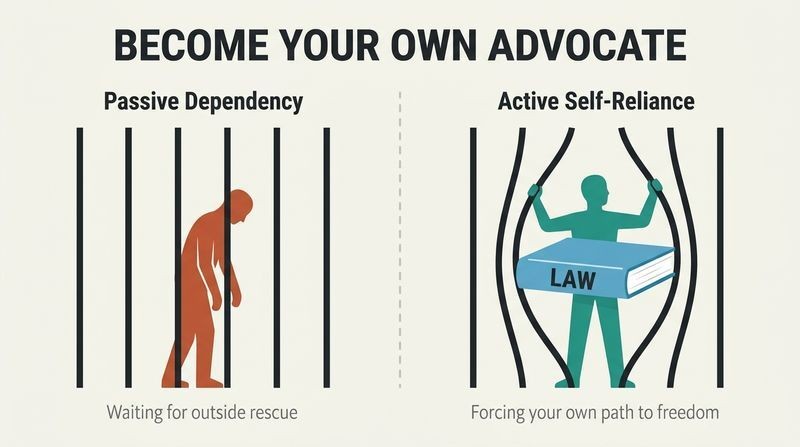
What's striking is how the memoir reframes self-advocacy not as inspiration but as grim necessity in a system where, before AEDPA, noncapital reversal rates in federal court were roughly one in one hundred. Duncan's path echoes a long American tradition of autodidact prisoners, from the 1969 Johnson v. Avery case that legally protected jailhouse lawyers to Malcolm X's prison reading regimen. The deeper claim is sociological: legal representation is a commodity distributed by wealth, and the poor must manufacture their own or drown. It challenges the comfortable fiction that the right to counsel guarantees competent counsel.
Constitutional rights are only what five Supreme Court justices allow
A prisoner named Joe Washington handed Duncan a paperback about the Supreme Court and delivered the lesson that reoriented his entire understanding: there is no such thing as fixed constitutional rights, only a pendulum. In the 1950s and 60s the Warren Court granted Black people, prisoners, and the accused protections they had never had. When Nixon appointed justices like Burger, the pendulum swung back, contracting those same rights.
Duncan came to see the Bill of Rights as never truly designed for people like him. His struggle, he concluded, was not for abstract rights but for survival. Reading The Brethren and Roots together, he mapped how law was built, and for whom, tracing the machinery back to slavery and states' rights doctrine.
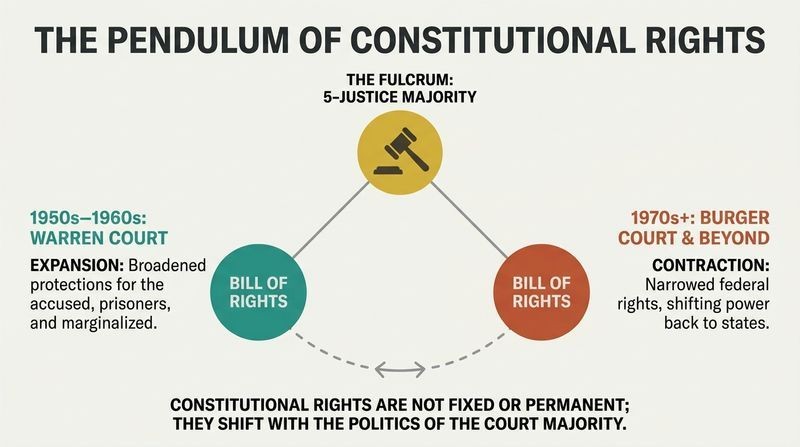
This legal realism is more sophisticated than most law school framings. Duncan intuited what scholars call the countermajoritarian fragility of rights: they are enforced by shifting human institutions, not self-executing text. His timing was prophetic. The 1996 AEDPA and Prison Litigation Reform Act, signed by a Democrat courting law-and-order voters, gutted habeas access precisely as he predicted. The insight travels well beyond prison. Voting rights, reproductive rights, and civil liberties all demonstrate the pendulum dynamic. The sobering corollary: complacency about hard-won rights is dangerous because reversal requires only a change in personnel, not a change in the underlying words.
Defending others is how you rebuild a self the system tried to erase
Prison is engineered to strip identity. To guards, prisoners were children; to lawyers, a means to an end; to the institution, job creation. Duncan found that filing lawsuits for others restored what incarceration stole. His first suit, the Case of the Missing Raisins, won a sick prisoner his prescribed high-fiber diet and $250 in damages, which he spent on a legal dictionary.
He won dentures for toothless elderly men who could not chew, using the Eighth Amendment's cruel-and-unusual clause. Watching them finally eat, he fell in love with the law. Known as the Snickers Lawyer for accepting only candy bars, Duncan discovered that purpose, not release, was what made an unending sentence survivable.
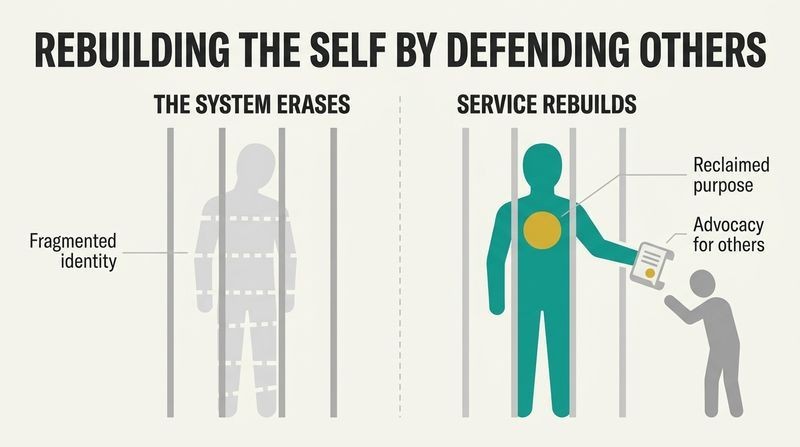
This maps onto Viktor Frankl's logotherapy, which the book explicitly invokes: those who found a why could endure almost any how. Modern psychology calls it the helper's high, and studies on prosocial behavior link it to reduced depression and mortality. What's distinctive here is the setting. In an environment designed for zero-sum predation, where every kindness could be read as weakness, Duncan built meaning through service without expecting reciprocity. The candy-bar-only policy is shrewd: refusing real payment kept him free of the debt-and-obligation economy that entrapped other jailhouse lawyers, protecting both his integrity and his safety.
Louisiana quietly changed the rules so life would truly mean life
A statistical explosion hidden in plain sight. For over fifty years, Louisiana routinely released lifers after about ten and a half years. Then the 1972 death penalty moratorium prompted legislators to make life without parole mandatory for a widening range of crimes. Lifers at Angola ballooned more than fivefold, from 193 in 1972 to 1,084 by 1982. By 1984 Louisiana held one-third of the entire nation's life-sentenced population.
Men sentenced under the old understanding, expecting to go home, now faced death in prison. Angola's Point Lookout cemetery filled at five or six burials a week. Duncan's friend Alvin realized mid-workout that his 33-year sentence for robbing a dice game meant withering away until age 52.
The mechanism deserves attention: sentencing severity ratcheted upward not through a single dramatic law but through incremental legislative moves nobody outside the system tracked. This is how mass incarceration metastasized nationally, and Louisiana became its epicenter, later dubbed the incarceration capital of the world. The racial dimension is stark. Three-quarters of Angola's population was Black, echoing its literal origins as a slave plantation named Angola. The felony murder doctrine, allowing a murder conviction without intent to kill, exemplifies how legal categories expanded to sweep more people into permanent confinement. Duncan's data-driven clarity about this shift makes the memoir double as social history.
A deadline is a deadline: never gamble your freedom on optimism
Duncan's signature strategic principle. When Louisiana imposed Article 930.8, giving prisoners a hard deadline to file post-conviction petitions, many inmate counsels argued the federal courts would never defer to the state rule. Duncan disagreed, insisting everyone treat the worst case as real and file by the deadline no matter what. The counsels mobilized: a prison-wide radio broadcast, 5,000 printed forms, and sixteen-hour days produced over 2,000 petitions.
Years later, when the federal AEDPA imposed a similar one-year clock, the same debate erupted, and Duncan again refused to gamble. Those who trusted the courts to be lenient were, in his grim phrase, headed for a massacre. His rule: if there is a one percent chance of success, tell the client, but never tell a comforting lie.
This is decision-making under deep uncertainty done right, resembling the precautionary principle and minimax regret from game theory: when the downside is catastrophic and irreversible, act to avoid it even if the bad outcome is unlikely. Duncan's colleagues committed a classic cognitive error, motivated reasoning, choosing the interpretation that spared them work over the one that protected clients. The tragedy is that they were arguing about lawful text whose meaning was genuinely contested; conflicting circuit rulings proved the ambiguity was real. Duncan's edge was temperament, not just knowledge: he refused to let hope distort risk assessment, a discipline most people lack when facing frightening deadlines.
Know your own case so well you can direct your own lawyer
The lesson Duncan drilled into his law class. He taught that when a prisoner finally wins a hearing, he is often assigned an overworked, demoralized attorney who may not read the file or speak a word in court. Duncan's friend Raymond Tucker got a lawyer appointed at the very moment he faced the judge, who never consulted him and stayed silent throughout.
The remedy: educate your own lawyer, hand him the issues and the strategy, and if he will not listen, speak directly to the court. Duncan invoked the constitutional right to participate in one's own defense. His mantra, borrowed from Dickens: will I be the hero of my own life, or will that station be held by somebody else?
The counterintuitive wisdom here is that the client, not the credentialed professional, must be the locus of control when the professional is underfunded and disengaged. This inverts the usual power dynamic and applies far beyond law, to medicine, finance, and any domain where you hire an expert whose incentives and attention may not align with your stakes. Behavioral research on patient activation shows engaged patients get better outcomes. Yet the burden is troubling: it works only for the literate, motivated, and lucky. Duncan taught mostly men who could not read, exposing how a right to counsel can become hollow theater when the counsel is a public defender crushed by caseload.
Prosecutors indicted Duncan not to convict him but to squeeze him
The buried truth in the DA file. After nearly a decade of filing court requests, Duncan finally obtained his prosecution file. A handwritten note from an early prosecutor admitted there was little evidence, but recommended indicting him anyway to arrest him and possibly extract a statement, promising to do whatever is necessary to firm up the case. Another memo urged offering a plea because the case stands or falls on one shaky eyewitness, a scared 15-year-old who made a tentative cross-racial identification from a five-year-old mugshot.
The prosecution knew the interrogating Oregon officer was a convicted felon and hid it. They knew the identification was weak. They asked the jury for death anyway.
This exposes a structural pathology criminologists call conviction psychology: once a name enters the system, institutional momentum replaces truth-seeking. Duncan's file revealed classic wrongful-conviction ingredients, all documented by the Innocence Project as leading causes: mistaken cross-racial eyewitness ID, suppressed exculpatory evidence (a Brady violation), and tainted police testimony. Research shows cross-racial identifications are markedly less reliable, and that suggestive procedures like showing a witness a suspect's photo, then his televised perp walk, manufacture false certainty. The New Orleans DA's office under Harry Connick Sr. was later repeatedly rebuked by the Supreme Court for concealing evidence. Duncan's case was not an aberration but a system operating as built.
Tie your hope to something external, or lose your grip on life
Duncan's survival philosophy, forged over 28 years. Drawing on Frankl's Man's Search for Meaning, he concluded that a person robbed of a future purpose stops surviving. His anchor was Mount Hood, the Oregon mountain near Timber Lake where he had first felt free and safe. For decades he clung to the memory, even as doubt crept in and he feared he had invented the place to cope.
When his final appeals collapsed and Judge Parker's ruling procedurally barred him, Duncan assembled a syringe to kill himself. A guard interrupting him with mail, a note from his lawyer begging him to hang on, pulled him back. He chose to see where he would end up.
The psychological research validates Frankl: purpose and future orientation predict resilience under extreme adversity, from POW camps to terminal illness. What deepens Duncan's account is his crisis of memory. When the anchoring image itself began to feel like fantasy, hope nearly dissolved, illustrating how fragile the scaffolding of meaning becomes under prolonged trauma. His eventual return trip to the real Clackamas River, finding it exactly as remembered, is a rare literal validation of an internal survival myth. The near-suicide, interrupted by an act of human connection, underscores a clinical truth: suicidal crises are often acute and interruptible, and belonging can be decisive at the critical moment.
Angola's men helped each other where society expected only violence
The heart of the book's argument. Duncan wanted the world to know that a group of Black men in the incarceration capital of the world rose above their situation to help one another. They taught each other to read and litigate, drafted bills for the legislature, published uncensored journalism in The Angolite, ran reentry programs, and sent money to each other's children.
Mentors like Norris Henderson said the path out was not just legal skill but becoming a leader and role model. The Angola Special Civics Project mobilized prisoners' families and passed real legislation. When men finally won release, they carried the mission outside: voting-rights organizing, community churches, property renovation, and the founding of Innocence Project New Orleans.
This directly counters the dominant cultural narrative of Black male criminality by documenting sustained cooperation, mentorship, and civic engagement inside the harshest of institutions. It aligns with criminologist findings on desistance and the importance of prosocial identity and generativity in rehabilitation. The uncensored prison magazine is genuinely remarkable, a rare institutional protection for truth-telling. What's worth probing is scale: these were exceptional individuals whose gifts flourished despite, not because of, the system. The book quietly asks a devastating question about squandered human capital: if these men accomplished this under conditions designed to destroy them, what does society lose by writing off poor Black children before they start?
Reputation, built over decades, freed Duncan when the law could not
The unexpected key that opened the gate. After 28 years and every legal avenue exhausted, Duncan's release did not come from a winning argument. The district attorney's first assistant called Angola to check his record and found only three write-ups in nearly three decades, plus glowing words from prison staff. He concluded Duncan deserved to get out. The DA offered an Alford plea, letting Duncan maintain innocence while pleading guilty, sentenced to time served.
He walked free in 2011. The lawyer shoes he had saved in his lockerbox for 25 years had crumbled to dry rot, so he limped out holding the fallen sole in his hand. He was exonerated in 2021.
There is a bitter irony worth naming: the legal system that manufactured the wrongful conviction proved nearly incapable of correcting it, and freedom finally hinged on discretionary human judgment about character rather than adjudication of guilt. The Alford plea, requiring an innocent man to say he is guilty, exposes how the system extracts a final indignity even in mercy. Duncan's decades of disciplined conduct functioned as a kind of long-term reputational capital, the same asset that underlies trust in every professional and social domain. The crumbled shoes are an unforgettable image of hope deferred, freedom arriving so late that even the artifacts of anticipation had decayed.
Analysis
The Jailhouse Lawyer is a memoir co-written by Calvin Duncan and Sophie Cull, blending intimate first-person survival narrative with rigorous legal and social history. Its structure follows Duncan chronologically from a 1982 wrongful arrest through 28 years of incarceration to his 2011 release and 2021 exoneration, but its intellectual spine is a self-taught legal education that doubles as an X-ray of American criminal justice. The difficulty in summarizing lies in this dual register: it is simultaneously a page-turning story of one innocent man and a data-rich indictment of an entire regime.
What elevates the book above the crowded wrongful-conviction genre is Duncan's analytical mind. He does not merely suffer the system; he reverse-engineers it. His encounter with legal realism, the recognition that rights are contingent on shifting judicial personnel, is more sophisticated than most formal legal training conveys, and his predictive accuracy about AEDPA's devastation demonstrates it was not hindsight. The memoir functions as an accessible primer on habeas corpus, Brady violations, procedural bars, and the machinery of mass incarceration, all delivered through concrete human stakes rather than abstraction.
The book's most transformative contribution is documentary and moral: it records sustained mutual aid among Black men in the nation's most notorious prison, directly rebutting the criminalizing narratives that justified their confinement. Duncan's insistence on truth over comfort, his refusal to lie to clients or himself, gives the ethical framework teeth. His near-suicide and reliance on Frankl's logotherapy ground the survival lessons in genuine psychological stakes rather than platitude. The recurring motifs, Mount Hood as anchor of hope, the preserved lawyer shoes, the Dickens epigraph about being the hero of one's own life, weave literary coherence through legal grit. Ultimately the book argues that competence, purpose, and community can be forged in the most dehumanizing conditions, while never letting readers forget the systemic cruelty that made such forging necessary.
Glossary
Jailhouse lawyer (inmate counsel substitute)
Prisoner who does legal workAn incarcerated person who researches law and files legal documents for themselves and fellow prisoners. In Louisiana, inmate counsel substitutes were an official role under Angola's Legal Programs, certified through exams and permitted to represent others in disciplinary and civil proceedings. The Supreme Court first protected jailhouse lawyers in 1969, recognizing they safeguard the constitutional rights of the poor who cannot afford attorneys.
Article 930.8
Louisiana post-conviction filing deadlineA 1991 Louisiana law imposing a three-year (later shortened) time limit on filing post-conviction relief petitions after a conviction becomes final. Prisoners already past the window got only one year. It triggered a prison-wide scramble at Angola to file thousands of petitions before the deadline, after which untimely claims were procedurally barred regardless of merit.
AEDPA
Federal law restricting prisoner appealsThe Antiterrorism and Effective Death Penalty Act of 1996. It imposed a one-year deadline on federal habeas corpus petitions, required federal courts to defer heavily to state court rulings, and limited repeat petitions. It drastically reduced the ability of state prisoners, over 90 percent of them unrepresented, to have constitutional claims heard in federal court.
Brady violation
Hidden evidence favoring the defenseA due process violation established in Brady v. Maryland (1963), occurring when prosecutors fail to disclose evidence favorable to the accused. In Duncan's case, the state concealed the eyewitness's tentative identification, the interrogating officer's felony conviction, and other exculpatory material. Courts must decide whether withheld evidence undermines confidence in the verdict enough to warrant a new trial.
Cage instruction
Unconstitutional reasonable-doubt jury wordingA faulty jury instruction defining reasonable doubt, ruled unconstitutional in Cage v. Louisiana (1990) because it lowered the state's burden of proof. Orleans Parish had used it for years, tainting hundreds of convictions. It became a key claim Duncan litigated for himself and many other Angola prisoners.
Multiple bill
Sentence enhancement for prior convictionsA Louisiana sentencing enhancement allowing prosecutors to seek dramatically longer sentences for defendants with prior convictions. The Orleans Parish DA applied it aggressively. Duncan's friend Alvin received 33 years for robbing a dice game largely because a prior shoplifting conviction triggered a multiple bill that tripled his sentence.
Alford plea
Guilty plea without admitting guiltA plea agreement in which a defendant does not admit committing the crime but concedes that pleading guilty serves their best interest, acknowledging the state has enough evidence to convict. Duncan's release was ultimately structured around a plea to time served, letting him maintain his innocence while ending his imprisonment.
Point Lookout
Angola's prison cemeteryThe burial ground at Angola prison where men who die incarcerated are laid to rest, with graveside services managed by incarcerated volunteers. As life-without-parole sentences multiplied, it saw five or six burials a week and filled to capacity, becoming a stark symbol of sentences that truly meant death in prison.
Download PDF
Download EPUB
.epub digital book format is ideal for reading ebooks on phones, tablets, and e-readers.








































