
Key Takeaways
1. The Consultation is a Journey with Five Essential Checkpoints
In general practice, the consultation is a journey, not a destination.
Navigate with purpose. The consultation is a dynamic process, a journey from one state of affairs to another, not a static event with a fixed endpoint. Patients expect progress, and doctors need a clear route to guide this transition. This journey is best navigated by aiming for five distinct "checkpoints" in sequence, ensuring a comprehensive and empathetic approach.
Five guiding posts. These checkpoints serve as temporary pauses and recognizable gathering places, each ideally reached before moving to the next. They provide a simple, memorable framework for the complex interaction:
- Connecting: Establishing rapport and empathy.
- Summarising: Confirming understanding of the patient's concerns.
- Handover: Agreeing on and communicating a management plan.
- Safety-netting: Anticipating future outcomes and planning contingencies.
- Housekeeping: Attending to the doctor's own well-being.
Beyond checklists. This model moves beyond a rigid checklist of tasks, offering a flexible itinerary that allows for individual patient needs while ensuring all crucial aspects of care are addressed. It empowers the doctor to ask, "Where shall we make for next, and how shall we get there?" rather than feeling stuck or overwhelmed.
2. Master Your "Inner Consultation": Harmonize Your Two Minds
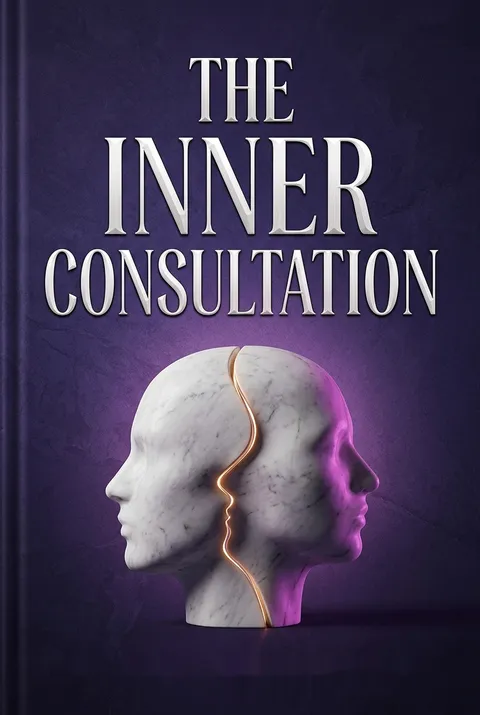
It helps to think of the internal dialogue as being like having a second head on your shoulders, an invisible one that nevertheless whispers in your ear to the real head that talks out loud.
The two-headed doctor. Every consultation involves an "outer" dialogue with the patient and an "inner" dialogue within the doctor's mind. This internal conversation, often a mix of instructions, criticisms, and anxieties, can be distracting and hinder effective patient care. Recognizing this duality is the first step to mastering it.
Meet the Organiser and Responder. The author personifies these internal voices:
- The Organiser: The intellectual, logical, planning part of the mind (often associated with the left cerebral hemisphere). It sets goals, analyzes, and tries to stay in control.
- The Responder: The spontaneous, intuitive, perceptive part (often associated with the right hemisphere and limbic system). It notices everything uncritically, registers feelings, and processes patterns.
Cooperation, not conflict. When these two "heads" squabble for control, performance suffers. The goal is not to eliminate the inner voice, but to encourage cooperation. By understanding what each part is good at, we can train them to work together, allowing the Responder to be present and perceptive, while the Organiser provides structure without interference.
3. Cultivate Rapport by Speaking the Patient's Unspoken Language
Rapport is: the ‘sine qua non’ of effective communication.
Tune into the patient's frequency. Rapport is the fundamental basis of effective communication, akin to two radio-telephones tuning into the same frequency. It's an active process of mutual responsiveness, where the doctor consciously aligns with the patient's unique "language of self-expression." This involves more than just listening to words.
Decoding minimal cues. Patients communicate a wealth of information through "minimal cues"—subtle verbal and non-verbal signals that often operate below conscious awareness. These include:
- Curtain-raisers & Gambits: The patient's initial, often unrehearsed, remarks.
- Representational Systems: Whether they think primarily in visual, auditory, or kinaesthetic terms (e.g., "I see what you mean," "I hear you," "I grasp your feelings").
- Non-verbal signals: Facial expressions, gaze, posture, gestures, muscle tone, breathing, and voice qualities (pace, pitch, volume, rhythm).
Matching for empathy. To build rapport, the doctor learns the patient's "dialect" of self-expression and subtly "matches" it. This isn't mimicry, but a genuine attempt to align verbal and non-verbal behavior with the patient's. This unconscious mirroring makes the patient feel intuitively understood, fostering trust and opening channels for deeper communication.
4. Elicit the Full Story: Understand the Patient's World, Not Just the Illness
The patient usually needs little in the way of encouragement, once the social preliminaries are over and while you are still observing and matching minimal cues to heighten the rapport between you, to embark on a description of the problem in his or her own words.
Beyond the clinical. After connecting, the next checkpoint is Summarising, which means eliciting the full scope of the patient's concerns and demonstrating that understanding. Doctors are bilingual, speaking both "medical" and "vernacular" languages. The challenge is to accurately translate the patient's "vernacular" story into a "medical" framework while acknowledging their unique context.
What to elicit. Effective eliciting goes beyond mere symptoms to uncover the patient's:
- Ideas: What they believe is causing the problem.
- Concerns: What aspects of the problem worry them most.
- Expectations: How they anticipate the problem will be addressed.
- Feelings: Their emotional reactions to the situation.
- Effects: The consequences the problem has on their life.
Recognizing hidden messages. Pay close attention to "speech censoring" (hesitations, vagueness, non sequiturs) and "internal search" (periods of stillness and defocused eyes), as these signal important, often unstated, thoughts or feelings. Addressing "deletions, distortions, and generalizations" in their speech can also reveal deeper meanings. The goal is to understand "What does this problem mean to this person?"
5. Hand Over Solutions with Skill: Negotiate, Influence, and "Gift-Wrap" Your Plan
The meaning of any communication is the effect it produces.
Selling the solution. Once a management plan is formulated, the doctor's task is to "hand over" this plan effectively, ensuring the patient understands, accepts, and complies with it. This isn't about coercion, but about presenting solutions with maximum effectiveness and respect for the patient's autonomy. The doctor must be clear about the desired behavioral outcome.
Three strategies for effective handover:
- Negotiating: Openly discussing options, thinking aloud, stating your position, and giving the patient choices. This ensures shared understanding and agreement.
- Influencing: Gently guiding the patient towards the most beneficial course of action. Techniques include using "shingles" (overlapping ideas for logical flow), positive phrasing ("don't" means "do"), and "my friend John" stories to make suggestions less direct and more palatable.
- Gift-wrapping: Presenting the plan in an attractive, personalized package. This involves clear, concise language, appropriate timing, "chunking" information, pausing for comprehension, and maintaining eye contact.
Respecting the patient's framework. A successful handover aligns the management plan with the patient's existing "framework"—their knowledge, beliefs, attitudes, and self-image. The doctor's skill lies in framing advice to be congruent with the patient's perspective, minimizing "cognitive dissonance" and enhancing self-esteem, rather than provoking resistance.
6. Safety-Netting: Proactively Manage Uncertainty with Foresight
In general practice, the bird chirping on the telephone wire is more likely to be a sparrow than a canary.
The art of managing uncertainty. General practice is inherently unpredictable, and not every diagnosis is certain, nor every treatment guaranteed. Safety-netting is the crucial checkpoint where the doctor proactively anticipates potential outcomes and prepares contingency plans. It's about knowing what to do next if the unexpected occurs, rather than being caught off guard.
Three vital questions: Before the patient leaves, the doctor should mentally (and sometimes explicitly) address:
- If I'm right, what do I expect to happen? This involves predicting the natural history of the condition and the expected response to treatment.
- How will I know if I'm wrong? Identifying warning signs, potential complications, and clear criteria for when the patient should seek further help.
- What would I do then? Formulating backup plans, considering further investigations, referrals, or alternative treatments.
SOAP for clarity. Using the SOAP (Subjective, Objective, Assessment, Plan) format for notes can prompt systematic safety-netting. The "Assessment" includes hunches and alternative diagnoses, while the "Plan" details not just treatment but also follow-up instructions and what to do if the problem persists or worsens. This ensures continuity of care and reduces risk.
7. Housekeeping: Prioritize Your Well-being for Sustained Compassion
A dirty mirror is useless, no matter how humble its owner.
Self-care as professional competence. The final checkpoint, Housekeeping, focuses solely on the doctor's internal experience. Seeing patients is inherently stressful, and unmanaged stress harms both the doctor and the quality of care. A competent doctor recognizes and addresses their own mounting stress, needs, and feelings as diligently as they do their patients'.
Recognizing "Time-stress" and the "Red Light Quarter". Stress manifests in three forms:
- Present stress: Unpleasant thoughts/feelings during the consultation.
- Past stress: Regrets about previous interactions ("if only").
- Future stress: Anxiety about upcoming patients ("what if").
The "red light quarter" refers to the Responder's awareness of the doctor's own needs (physiological, safety, belongingness, esteem, self-actualization) which, if frustrated, cause stress and compete for attention.
Strategies for emotional hygiene. Just as a house needs regular dusting, the doctor's emotional state requires constant attention. Techniques include:
- Long-term: Leisure, discussion groups (Balint seminars), stress-control techniques (meditation, yoga).
- Between patients: Diversionary rituals (coffee, short walk), talking to colleagues, introducing variety into the day, focusing on a calming "icon."
- During consultation: "Here and now" awareness (focusing on breathing), adjusting muscle tone, and recognizing/correcting projections or stereotypes.
8. Unlock Effortless Performance Through "Nowness"
In order to learn, you have to overcome the fear of forgetting.
Beyond "trying" to "allowing." After acquiring a repertoire of consulting skills, the final step to proficiency is not more effort, but rather "improving by allowing." This means trusting your unconscious mind to effortlessly express what it has learned, rather than consciously trying to remember and apply every technique. The key to this effortless performance is cultivating "nowness."
The power of the present moment. "Nowness" is an acute, non-judgmental awareness of the immediate "here and now," where attention is so concentrated on current sensory experience that there's no room for past regrets or future anxieties. This state, akin to Maslow's "peak experiences," allows for optimal functioning, as the distracting internal dialogue subsides.
Distracting the "Organiser." When internal dialogue interferes, the "Inner Consultation" technique involves consciously redirecting attention to specific, neutral aspects of the present moment. This "distracts" the over-analytical Organiser, freeing the intuitive Responder to perform:
- Listening: Watch the patient's minimal cues (facial expressions, gestures, voice).
- Speaking: Observe where your words are "landing" on the patient (their reactions).
- Thinking: Notice your own breathing sensations.
9. Integrate Intellect and Intuition for Profound Practice
It is one of the most beautiful compensations of this life, that no man can sincerely try to help another without helping himself.
The convergence of East and West. Historically, Western thought emphasized rational analysis, while Eastern philosophies like Taoism and Zen prioritized intuition and direct experience. Modern neurology now confirms the distinct yet complementary roles of the brain's hemispheres, suggesting that integrating both logical intellect (Organiser) and spontaneous intuition (Responder) leads to a more holistic and effective approach to life and practice.
Zen in the consulting room. Zen training, with its emphasis on meditation, daily life practice, and transcending intellectual limits, offers a powerful parallel to the Inner Consultation. By cultivating "nowness" and using "distractors," the doctor can quiet the analytical mind, allowing intuition to flourish. This leads to a deeper, more compassionate understanding of both the patient and oneself.
Beyond technique to personal growth. The journey of mastering the Inner Consultation is not just about acquiring skills; it's a path to personal fulfillment. By sincerely striving to help others and becoming more present, perceptive, and self-aware, doctors find that their own lives are enriched. The paradox is that by letting go of rigid control and trusting one's innate capacities, one achieves greater mastery and a profound sense of connection.
Download PDF
Download EPUB
.epub digital book format is ideal for reading ebooks on phones, tablets, and e-readers.








































