


Plot Summary
Escape from Mansarovar
Shiva,1 the twenty-one-year-old chief of the Guna tribe, guards his village near the sacred Mansarovar lake in Tibet, exhausted by endless warfare with rival clans. A stranger named Nandi7 arrives from Meluha, a legendary empire beyond the Himalayas, offering fertile land, comfortable lives, and peace.
Shiva1 hesitates, but a brutal Pakrati ambush that slaughters Guna women and children shatters his indecision. He puts the choice to his people: stay and bleed for a patch of frozen earth, or risk everything on an unknown paradise. The Gunas, bound by tradition and trust in their chief, vow to follow.
Shiva1 spares the captured Pakrati chief Yakhya at Nandi's7 urging, an act of mercy foreign to his brutal homeland. The caravan of two hundred souls heads west, and Shiva1 feels, for the first time in years, the lightness of escape from a land he has come to despise.
The opening establishes Shiva as a pragmatic leader operating in survival mode, his decisions driven less by hope than by the unbearable reality of staying. The democratic gesture of asking his tribe's consent marks him as an unconventional chief, but the shadow of an unspecified past failure (teased through his private guilt) suggests his willingness to leave is also flight from personal demons. Nandi's successful plea for mercy toward prisoners plants the first seed of the idea that different worlds operate by different moral codes, a theme that will grow to dominate the entire trilogy.
The Blue Throat Emerges
On the first night in the Srinagar immigration camp, Shiva1 and his tribe are given a medicinal drink they do not recognize as the legendary Somras. The Gunas collapse with violent fevers. Shiva's1 body, however, undergoes a terrifying metamorphosis.
His frostbitten toe mends completely, his long-dislocated shoulder reengineers itself with a cracking sound, every battle scar vanishes, and his throat turns an eerie, iridescent blue that radiates cold. Doctor Ayurvati,9 summoned for the mass illness, sees the blue throat and collapses to her knees, weeping that the Neelkanth has finally come.
Nandi7 throws himself prostrate at Shiva's1 feet, sobbing with a release that suggests a lifetime of waiting. Shiva1 stares at his reflection, bewildered and increasingly alarmed, demanding explanations no one will yet give.
The blue throat's emergence is bodily transfiguration experienced as violation: Shiva is changed without consent, his flesh becoming a symbol he did not choose. The persistent coldness in his neck becomes a physical reminder of this unwanted mantle. Ayurvati and Nandi's ecstatic collapse reveals Meluha as a civilization so terrified of its own extinction that it pours centuries of desperate hope into a single dermatological anomaly. Shiva's confusion cuts against their joy, establishing the central dramatic irony: while everyone around him weeps with relief, the supposed savior feels only the chill of something taken from him.
A Barbarian Becomes Divine
In the magnificent capital of Devagiri, built on three colossal platforms above the Saraswati river, Emperor Daksha3 reveals the full scope of Meluhan civilization to Shiva.1 The Somras grants near-immortality. Lord Ram's caste system guarantees merit-based social order through the Maika system, which separates newborns from birth-parents and educates all children identically.
But the empire is crumbling: the Saraswati river is dying because the Chandravanshis allegedly diverted its source, Somras production is threatened, and terrorist attacks strike weekly.
Daksha,3 with tears of desperate faith, explains the legend: a foreigner whose throat turns blue from Somras will be the Neelkanth, destroyer of evil, completing Lord Ram's unfinished work. Shiva1 protests that he is only a simple tribal chief, haunted by a past he cannot outrun. General Parvateshwar4 watches with veiled contempt for this untested barbarian elevated by superstition.
Daksha's faith is simultaneously genuine and instrumental: a sincere belief wielded as a political tool. The contrast between his worshipful certainty and Parvateshwar's merit-based skepticism frames the novel's foundational debate about whether authority flows from marks or deeds. Shiva's demand that Meluha stop deceiving immigrants reveals his core value that consent matters even when outcomes are beneficial. This insistence on informed choice, from a man who was not given one, signals that the Neelkanth's true power may lie not in accepting destiny but in questioning the systems that assign it.
The Vikarma Princess
In the royal gardens, Shiva1 discovers Sati,2 the Emperor's daughter, practicing dance with a tutor. Her technique is flawless but emotionally hollow, a performance without feeling. When Shiva1 demonstrates the Nataraj pose and dances with raw, channeled passion, Sati2 is stunned by his ability to access what she cannot.
He learns she is a vikarma: at sixteen, her stillborn child and her husband's same-day drowning branded her a carrier of bad fate for sins in a previous life. She is forbidden from marrying, from touching anyone outside her family, from full participation in society.
When Shiva1 accidentally touches her elbow to correct a dance move, she recoils in horror and begs him to undergo a shudhikaran purification. He refuses. She withdraws into proud silence. He is captivated, bewildered, and utterly unable to walk away.
Sati's hollow dancing mirrors her psychological survival strategy: perform life's prescribed movements perfectly while sealing off authentic emotion to endure her status as an untouchable. Shiva's Nataraj dance, performed for himself rather than any audience, represents the unguarded authenticity that both terrifies and magnetizes her. Her immediate insistence on purification reveals how completely she has internalized her own inferiority. She has built an identity around dignified endurance of her punishment; his impulse to save her from the system feels, to her, like an erasure of the only self she has been allowed to construct.
The Hooded Figure Strikes
Returning from Mount Mandar with the royal family, Shiva's1 convoy is ambushed by a platoon led by a giant hooded figure in a black robe and a featureless Holi mask. His wrist bears a leather bracelet embroidered with a serpent-shaped Aum symbol, an ancient and largely forgotten sign.
The hooded figure fights with terrifying skill, commanding Chandravanshi soldiers in an operation clearly aimed at capturing Sati2 alive and unharmed. Shiva1 leads the defense, even stabbing an enemy in the back to save Nandi,7 which earns Parvateshwar's4 disgust for violating combat ethics.
The attack is repelled, but Shiva1 realizes the hooded figure was no mere henchman: he was the leader. Daksha3 blames the Chandravanshi emperor Dilipa,11 but Shiva1 privately notes the precision of the operation and the leader's reluctance to harm Sati.2 He sketches the serpent Aum symbol and commits it to memory.
The hooded Naga's introduction establishes the novel's most enigmatic antagonist, a figure whose masked face and controlled demeanor suggest hidden connections. The serpent Aum bracelet becomes the key physical clue that will link him to the novel's central crime. Shiva's pragmatic decision to kill an enemy 'dishonorably' to save a friend creates friction with Parvateshwar's rigid ethics, illustrating the gap between battlefield reality and codified honor. The targeting of Sati specifically rather than the Emperor raises questions that Daksha's convenient Chandravanshi-blame narrative cannot answer, planting the first seeds of doubt about the official story.
Blessings of the Impure
In Kotdwaar, a massive crowd surges toward the Neelkanth. A blind vikarma man, desperate for a touch of the divine, tries to reach Shiva's1 feet. His son, horrified, attempts to stop him from polluting the Lord. Instead of recoiling, Shiva1 bends down and touches the old man's feet, asking for his blessing.
The crowd freezes in shock. Parvateshwar4 glares with fury at this brazen defiance of Lord Ram's laws. Later, Shiva1 refuses to undergo the required purification ritual. When Sati2 and Brahaspati5 confront him, he argues that the vikarma law is fundamentally unjust.
Sati's2 face becomes an unreadable mask and she storms out, declaring she does not need his protection and cannot be saved. Shiva1 stands alone, unable to understand why a woman so wronged would defend the system that oppresses her.
This act of public rebellion is the novel's most stunning inversion of hierarchy: the Neelkanth kneels to the untouchable. But Sati's furious response complicates the moral clarity. His chivalrous attempt to rescue her from the vikarma system is, from her perspective, a profound disrespect. She has spent eighty-five years constructing an identity around dignified endurance; his effort to dismantle the framework that defines her feels like an attack on her agency. The scene captures a sophisticated truth about oppression: those who survive it often build their sense of worth precisely on their ability to bear it gracefully, and liberation imposed by others can feel like erasure.
A Theory of Transactions
At the Mohan Jo Daro temple, Shiva1 encounters a Pandit who looks almost identical to one he met earlier at the Brahma temple. The Pandit13 explains the philosophical purpose of the vikarma system: it preserves social stability by convincing the unfortunate that they suffer deservedly, preventing their discontent from becoming rebellion.
When Shiva1 protests the unfairness, the Pandit13 pivots to what truly torments him: Sati.2 Using a theory of interpersonal transactions, he argues that by observing what Sati2 gives to society (dignified acceptance, continued contribution, no guilt-tripping) one can deduce what she wants in return: respect.
When Shiva1 tries to protect her, he inadvertently communicates that he sees her as weak. To win her, he must treat her as an equal who fights her own battles. The insight reshapes everything Shiva1 thought he understood about love.
The Pandit's transactional psychology reframes the entire romantic conflict. Sati is not a passive victim awaiting rescue but an agent who has chosen a particular survival strategy and demands that others honor that choice. The theory operates as a sophisticated character-analysis tool disguised as spiritual wisdom. The scene also advances the novel's philosophical project: systems that appear cruel (like vikarma) may serve functions invisible to outsiders, and reforming them requires understanding those functions first. Shiva leaves not with a plan but with a transformed perspective, ready to approach Sati on her terms rather than his.
Trial by Fire
At a yagna ceremony in Karachapa, an ultra-conservative named Tarak objects to Sati's2 presence on the same city platform as the ritual, citing a strict interpretation of pollution laws. He publicly humiliates her until, when he insults Shiva,1 something inside Sati2 shatters.
She invokes the ancient right of Agnipariksha, a trial by fire duel to the death within a ring of flames. Though Parvateshwar4 and others are terrified for her, Shiva1 declares she can defeat anyone.
In the arena, Sati2 chooses knives and employs a cunning deception: she feigns holding the blade in one hand while concealing it in the other, letting Tarak cut her twice to sell the ruse. When he commits to the wrong side, she drives her knife into his lung. Victory is hers. But instead of the killing stroke, she whispers forgiveness. The stadium explodes in joy.
The Agnipariksha is Sati's psychological rebirth, the moment she transforms from passive sufferer to active agent. Her combat strategy, using expectation against her opponent by feigning weakness to create opportunity, mirrors her life strategy of dignified endurance and suddenly reveals its latent lethality. The choice to forgive rather than kill completes the arc: she has proven her power and now can afford mercy, a generosity her tormentor never extended to her. Shiva's tears in the stands mark the moment his love transcends infatuation and becomes reverence for her spirit rather than her beauty.
The Fire Arrow's Toll
When the convoy encounters a terrorist attack on the village of Koonj, Shiva1 finally embraces his role, ripping off his cravat and roaring his identity as the Neelkanth to rally the soldiers.
During the fierce battle against five Nagas and hundreds of Chandravanshis, a distant Naga archer fires an agnibaan, a legendary fire arrow tipped with poison that burns victims from the inside. Sati2 sees it streaking toward Shiva1 and throws herself into its path. The arrow pierces her left lung. Shiva1 goes berserk, decapitating the archer and hacking the corpse to pieces before Sati's2 faint voice calls him back.
Ayurvati9 declares the wound universally fatal. But Shiva,1 remembering how Somras healed his injuries, insists on a massive dose. Against all medical knowledge, Sati's2 fever breaks. On what she believed was her deathbed, she whispers she loves him.
Sati's self-sacrifice is not a regression to victimhood but a declaration of agency: she chooses whose life to protect and what to risk. The agnibaan as weapon represents the ancient, almost magical violence that the modern world has supposedly left behind, its reappearance signaling a breach in the rational order. Shiva's berserker response reveals how thin the layer of civilization is over his warrior nature. The Somras healing functions as a narrative miracle that transcends the novel's pseudo-scientific framework, suggesting that love and desperate faith can rewrite biological certainties. Sati's confession, delivered when she thought no consequences could follow, cracks her lifelong emotional armor permanently.
Mandar in Ashes
During the wedding celebrations in Devagiri, tremendous explosions echo from Mount Mandar. Shiva1 rides through the night to find the mountain gutted, its research buildings in ruins, and every scientist and guard reduced to unidentifiable body parts.
Brahaspati,5 his dearest friend and intellectual brother who had just returned to conduct experiments, is among the dead. Stumbling through the smoldering wreckage, Shiva1 finds a scorched leather bracelet bearing the serpent Aum symbol, still warm from the blast.
The same hooded Naga6 who attacked Sati2 at the Brahma temple and on the road from Mandar has murdered the one man who treated Shiva1 as an equal rather than a god. Clutching the bracelet until it sears his palm, Shiva1 swears a terrible vengeance against the Naga6 and his entire army of vice. The war council unanimously votes to attack Swadweep.
Mount Mandar's destruction converts Shiva's philosophical journey into a revenge narrative, corrupting the very impartiality the Neelkanth is meant to embody. Brahaspati's death is devastating precisely because he was the one Meluhan who offered friendship without worship, intellectual camaraderie rather than faith. The bracelet functions as classic detective-story physical evidence, but its real narrative power is emotional: a tangible link between the faceless killer and the irreplaceable friend. Shiva's decision to declare war based on this single piece of evidence, without considering alternative explanations for the absence of Chandravanshi bodies at the scene, demonstrates how grief can override judgment and how even the Mahadev can be manipulated into serving one side's agenda.
March to Dharmakhet
With Emperor Dilipa's11 dismissive reply to the extradition demand and Brahaspati's5 death demanding vengeance, the Meluhans prepare for war against an enemy that outnumbers them ten to one.
Shiva1 and Parvateshwar4 develop radical tactics: massed archers firing without aiming, raining five thousand arrows every few seconds on enemy formations, and tortoise squads of twenty-by-twenty men wielding three-pronged trishuls. Drapaku,14 son of the blind vikarma man Shiva1 blessed, volunteers to lead a Vikarma Brigade of five thousand on a suicide mission to hold a northern pass.
The camp watches in awe as these once-shunned soldiers march out wearing the saffron of the final journey. Vidyunmali, a proud Arishtanemi, slices his own thumb and marks Drapaku's14 forehead with his blood, publicly declaring the vikarma the better man. Even Parvateshwar4 is moved.
The war preparations complete the vikarma narrative arc with a stunning symbolic inversion: the untouchable are now the most honored, chosen for the most sacred mission. Vidyunmali's blood ritual directly reverses pollution logic, suggesting that contact with the impure can confer honor rather than contamination. The archer corps and tortoise formations represent Shiva's outsider creativity, innovations possible only because he was never trained in orthodox Meluhan warfare. His tactical genius finally earns Parvateshwar's respect, bridging the gap between the general's merit-based worldview and the faith-based reverence of everyone else.
Har Har Mahadev
On the vast plain of Dharmakhet, the Suryavanshi army of one hundred thousand faces a Chandravanshi force of one million. Shiva1 rides before the ranks and delivers a speech that democratizes divinity: they are not following a god, they are all gods. His battle cry 'Har Har Mahadev' (all of us are Mahadevs) sends primal energy through every soldier.
The massed archers unleash a relentless curtain of arrows that devastates the first three Chandravanshi legions, their bodies piling so high that survivors use corpses as shields. The tortoise formations carve through the enemy center while Shiva1 and Parvateshwar4 lead devastating flank attacks.
By day's end, the Chandravanshi army is comprehensively routed. Drapaku's14 vikarmas, though halved in number and with their leader losing an arm and an eye, held the northern pass. Victory is absolute. But in the silence afterward, Shiva1 notices something deeply unsettling: no Nagas6 fought alongside the Chandravanshis.
The battle's true power is rhetorical rather than military. Shiva's speech transforms the hierarchical worship that has burdened him into collective empowerment, a moment where the man who never wanted to be worshipped gives divinity away to everyone. The absence of Nagas from the battlefield creates a crack in the narrative that will widen into an abyss: if the war was launched to avenge a Naga attack, why were no Nagas defending the supposed ally? The discrepancy exposes the possibility that the entire moral framework of the conflict may be a fabrication, turning the great victory into the prelude to existential crisis.
The Enemy's God
In the aftermath, Emperor Dilipa11 is brought before Daksha3 in chains. Far from the cowering villain expected, Dilipa11 is a rakish, dignified old man who dismisses the accusations with weary contempt. But when he sees Shiva's1 blue throat, his arrogance collapses into devastation.
Later, his daughter Anandmayi,12 kept as hostage, discovers Shiva's1 identity and is shattered. She reveals the Chandravanshis also await the Neelkanth: a foreigner whose throat turns blue from Somras, who will descend to destroy the evil Suryavanshis. The identical legend, word for word, but claimed by the other side.
Shiva,1 already disturbed by the missing Nagas6 and the haunted look in Dilipa's11 eyes, feels the ground of his moral certainty liquefy beneath him. He has led the destruction of people who believe in the same prophecy, who saw in him the same hope. He has become, to them, the destroyer of good.
This revelation detonates the binary good-versus-evil framework that the entire novel has constructed. The legend of the Neelkanth is exposed as a cultural mirror: each side projects its own salvation onto the same empty vessel of prophecy. Shiva's horror is ontological as well as moral. The blue throat, which seemed to mark him as chosen, now appears as a mark of cosmic ambiguity, claimed by both sides, belonging to neither. The scene critiques how righteous narratives are manufactured: Daksha's sincerity and Dilipa's arrogance are both performances shaped by the stories their civilizations tell about themselves.
A Beggar's Dignity
Walking Ayodhya alone, Shiva1 is repulsed by the city's chaos, poverty, and brazen sensuality, everything the Meluhans taught him to despise. Then, on the road to Lord Ram's temple, an emaciated old beggar in a torn jute sack, with festering wounds and barely enough food for himself, notices Shiva1 watching him.
Instead of asking for alms, the old man smiles warmly and offers to share his meager meal. When Shiva1 hesitates, the beggar's feelings are visibly wounded, as if his hospitality has been insulted. Shiva1 sits on the pavement and eats the watery gruel and stale bread, the food slipping down easily but crushing his soul with each swallow.
This starving man, whom the Meluhan system would have classified as a failure deserving of pity or reform, has shown a generosity and dignity that shames everything Shiva1 thought he knew. These people are not evil. They are simply different. And he has helped destroy them.
The beggar scene is the novel's quiet, devastating moral climax, far more powerful than any battle. It weaponizes the book's own critique of Meluhan superiority: order and prosperity do not equal virtue, and chaos is not evil. The old man's dignity in the midst of poverty overturns Shiva's assumption that saving the Chandravanshis through Meluhan reform would be a benevolent act. Freedom, even the freedom to be poor and disorganized, has a value that efficiency cannot account for. Shiva's acceptance of the food is a symbolic act of humility that reverses the earlier scene where he touched the vikarma's feet. But where that earlier transgression was rebellion against an unjust law, this one is repentance for an unjust war.
The Question of Questions
At the Ramjanmabhoomi temple, Shiva1 meets the Pandit13 for the third time and confesses his guilt: hundreds of thousands have died because he was naive, misled by one side's narrative. The Pandit13 reveals the truth the Meluhans never told him: the Neelkanth's job is not to destroy evil, because evil is easily identified and defeated by ordinary people.
The Mahadev's1 real task is far more difficult: to recognize evil in an age so confused that good and evil have become indistinguishable. Even Lord Rudra, the previous Mahadev, nearly annihilated the Asuras before understanding they were simply different, not wicked.
The Pandit13 identifies himself as a Vasudev, part of an order established by each Vishnu to guide the next Mahadev. Shiva1 leaves the temple with his burden no lighter but feeling strong enough to carry it. Outside, he finds Sati2 waiting. And in the trees beyond her, the hooded Naga6 watches, silently retrieving her thrown knife and binding it to his wrist.
The final revelation fundamentally redefines the heroic quest, transforming it from conquest to consciousness. Evil, the Pandit argues, is not a fixed enemy but a question each age must answer anew. The disclosure that Lord Rudra made the same mistake universalizes Shiva's guilt within a cycle of misunderstanding built into civilization itself. The Vasudevs introduce generational guidance as a mythological concept: each Vishnu leaves helpers for the next Mahadev, creating institutional memory across lifetimes. The Naga's silent retrieval of Sati's knife suggests a personal connection that expands the mystery rather than resolving it. Shiva's journey ends not with answers but with the burden of the right question, a weight that finally makes him equal to the title he bears.
Analysis
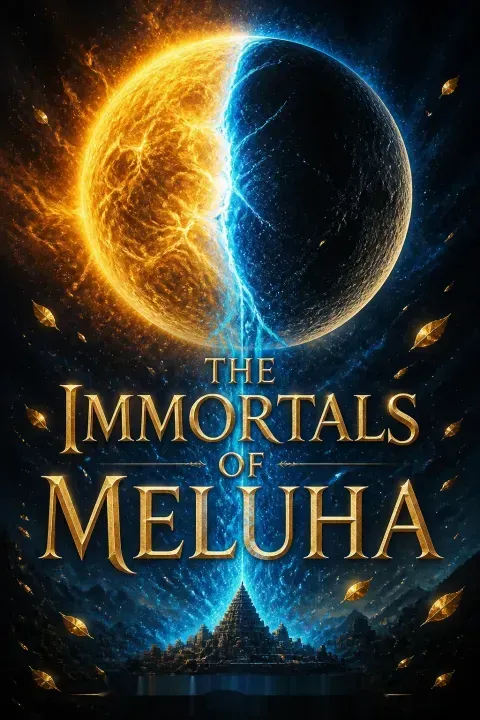
The Immortals of Meluha is a mythological fantasy that uses the framework of the Shiva1 legend to explore how civilizations manufacture moral binaries to justify conflict. The Suryavanshis and Chandravanshis are mirror images: each sees itself as righteous and the other as demonic, yet both await the identical prophesied savior. The novel's structure mirrors its theme by beginning with clear good-and-evil distinctions and methodically dissolving them until the protagonist can no longer tell the difference. The Neelkanth legend functions as a critique of prophetic thinking itself: prophecies are empty vessels into which cultures pour their own fears and aspirations, rendering the divine mark meaningless as a guide to action. Shiva's1 blue throat, seemingly a sign of election, becomes a symbol of cosmic ambiguity.
The vikarma subplot explores how societies maintain order through scapegoating. By convincing the unfortunate that their suffering is deserved karma, Meluha transforms potential rebels into passive penitents. Sati's2 complex psychology, in which she internalizes her own inferiority and resists liberation as a form of disrespect, offers a sophisticated portrait of how oppression shapes identity from within. Her arc suggests that the most durable prisons are the ones victims build for themselves.
The Somras bridges the novel's rational and religious worldviews. Brahaspati5 explains its function through anti-oxidant chemistry, while Daksha3 treats it as a divine gift. The coexistence of scientific and spiritual explanations suggests that the distinction may itself be a matter of perspective. The novel's ultimate argument is that evil is not a fixed category but a question each age must answer anew. The Mahadev's1 task is not to destroy a predetermined enemy but to develop the wisdom to recognize genuine evil when it appears. By reframing the hero's journey from conquest to consciousness, the novel elevates its mythological framework into a meditation on the most urgent challenge of any polarized era: how to think beyond the stories your own side tells about itself.
Review Summary
The Immortals of Meluha receives mixed reviews. Many praise its imaginative retelling of Hindu mythology, portraying Shiva as a relatable human character. Readers appreciate the blend of history, mythology, and contemporary issues. However, some criticize the writing style, modern language usage, and perceived simplification of complex mythological concepts. The book's pacing and character development also draw criticism. Despite these drawbacks, many readers find the story engaging and look forward to continuing the trilogy.
People Also Read








Characters
Shiva
Reluctant Tibetan chief turned prophesied saviorThe twenty-one-year-old chief of the Guna tribe from the mountains of Tibet, a fierce warrior whose scarred body testifies to a lifetime of conflict. He masks deep guilt over a childhood failure (he once fled when a woman cried for help) with marijuana and sardonic humor. Immensely strong yet surprisingly flexible, he is a natural dancer who channels raw passion into movement. His innate sense of fairness makes him question Meluha's caste system and vikarma laws, while his fierce loyalty to those he loves (Brahaspati5, Sati2, Veerbhadra8) drives his most consequential decisions. His greatest flaw is the volatility of his righteous fury: when those he loves are harmed, his capacity for destruction overwhelms his judgment, carrying him into actions he later cannot reconcile with his self-image as a man seeking redemption.
Sati
Vikarma princess, warrior, and Shiva's belovedThe daughter of Emperor Daksha3, declared a vikarma at sixteen after giving birth to a stillborn child and losing her husband to drowning on the same day. For eighty-five years she has lived as an untouchable, forbidden to marry and barred from touching those outside her family. She survived by internalizing her punishment as deserved, constructing a fragile dignity around stoic acceptance. A skilled dancer and formidable warrior with a sword, she channels repressed emotion into technically flawless but spiritually hollow performances. Her defining need is not rescue but respect: she cannot bear to be pitied or protected as weak. Her love for Shiva1, denied until a near-death experience forces confession, both cracks her emotional armor and threatens the identity she has carefully built as a dignified sufferer.
Daksha
Emperor of Meluha, Sati's fatherThe ruler of Meluha, approximately 184 years old but appearing no older than thirty due to the Somras. His chosen-tribe amulet displays a goat, one of the lowest Kshatriya ranks, a mark assigned by his legendary father, Emperor Brahmanayak, with whom he had a strained relationship. He carries both the burden and the chip of perceived inadequacy. His faith in the Neelkanth legend is genuine and fierce, yet tinged with political calculation: he eagerly maneuvers Shiva1 toward marriage with Sati2, seeing both his daughter's happiness and the empire's salvation converging in one man. His childlike enthusiasm masks a pragmatic ruthlessness. He loves Sati2 deeply but cannot perceive that his paternal desire to save her mirrors the condescension she most resents.
Parvateshwar
Meluhan general, Sati's godfatherThe chief of Meluha's armed forces, a towering, immensely muscular man with an intimidating curled moustache and uncompromising eyes. He is Sati's2 godfather and the novel's voice of principled orthodoxy. He believes only earned merit, not birth or divine marks, should determine worth, which makes him initially contemptuous of the unproven Shiva1. His gradual, grudging respect for Shiva's1 courage and tactical brilliance becomes one of the novel's emotional through-lines. He embodies the tension between law and love: he would do anything for Sati2 except break Lord Ram's laws. His family's vow to have no birth-children, maintained for generations in protest of a corrupt legal amendment, reveals his capacity for principled sacrifice that transcends even his rigid rule-following.
Brahaspati
Chief scientist and Shiva's dearest friendThe chief scientist of Meluha, responsible for manufacturing the Somras at Mount Mandar. A swan chosen-tribe Brahmin of medium height with a well-manicured beard and serene expression. Unlike most Meluhans, he treats Shiva1 as an equal from their first meeting, offering genuine intellectual friendship rather than worship. He is a rationalist who believes in science over miracles, yet respects the comfort others find in faith. His warm, teasing relationship with Shiva1 provides the novel's most uncomplicated emotional bond, built on mutual respect rather than obligation. He is willing to sacrifice his reputation, his principles, and even his immortal soul for those he loves, as demonstrated when he offers to assassinate Tarak to protect Sati2 from the Agnipariksha.
The Naga
Masked warrior leading attacks against MeluhaA giant of a man covered head to toe in a black hooded robe, his face hidden behind a Holi festival mask. Only his large, almond-shaped, expressionless eyes and strong, fleshy hands are visible. He wears a leather bracelet bearing the serpent Aum symbol. A brilliant warrior, slow in movement but exceptionally skilled with dual swords, he leads attacks against the Suryavanshis but repeatedly shows unexpected restraint: he commands his men to capture Sati2 unharmed, he saves two drowning women from a crocodile, and his motives remain opaque. When his mask accidentally slips, those who see his face scream 'Naga,' marking him as one of the cursed deformed people. His peculiar focus on Sati2 and his reluctance to harm her suggest connections that the first book leaves unresolved.
Nandi
Devoted captain who discovered the NeelkanthThe Meluhan captain who recruits Shiva's1 tribe from Tibet. Morbidly obese yet physically toned, with a childlike face and unshakeable devotion. He has searched for a hundred years for the Neelkanth, making his discovery of Shiva1 the fulfillment of his life's purpose. He becomes Shiva's1 loyal protector and traveling companion, though his worshipful reverence sometimes strains against Shiva's1 desire to be treated as an equal rather than a god. His guilt over deceiving Shiva1 about the Somras nearly breaks him, but Shiva's1 forgiveness deepens his loyalty into something approaching love.
Veerbhadra
Shiva's childhood friend and brother-in-armsShiva's1 closest friend from the Guna tribe, originally named Bhadra but renamed Veerbhadra after single-handedly killing a tiger during the journey to Devagiri. Once hunchbacked, the Somras heals his deformity. He provides Shiva1 with marijuana and uncomplicated companionship, though tribal tradition prevents him from offering counsel on major decisions. He falls in love with Krittika15, Sati's2 handmaiden, and marries her with Shiva's1 enthusiastic blessing. His steadfast, simple loyalty offers Shiva1 an anchor of normalcy amid the escalating demands of his divine role.
Ayurvati
Empire's greatest doctor, Neelkanth's first witnessThe most renowned physician in Meluha, a petite, shaven-headed Brahmin woman with a knotted tuft of hair at the back. She first dismisses Shiva1 as an uncouth immigrant but becomes his devoted follower after discovering his blue throat, collapsing to her knees as the first person in Meluha to recognize the Neelkanth. She treats Sati2 after the agnibaan wound and supports Shiva's1 decisions with unquestioning faith, even when they conflict with established medical knowledge. Her scientific expertise coexists with her religious devotion, embodying the novel's fusion of rational and spiritual worldviews.
Kanakhala
Prime minister of MeluhaThe empire's chief administrator, a slightly overweight Brahmin of the pigeon chosen-tribe with dark, smooth skin. She manages Meluha's bureaucracy with fierce efficiency and absolute loyalty to Daksha3. She is a fervent believer in the Neelkanth legend and often clashes with Parvateshwar's4 rigid meritocracy, arguing that faith and divine mandate matter as much as earned achievement. Her organizational genius orchestrates Shiva's1 wedding, the war logistics, and the empire's day-to-day functioning.
Dilipa
Emperor of the Chandravanshi realm SwadweepThe aging ruler of Swadweep, a rakishly handsome old man (a rare sight in the Somras-extended world) who wears bright pink dhotis and extravagant gold jewelry. His appearance and manner embody the flamboyant Chandravanshi aesthetic that Meluhans find decadent. Arrogant and dismissive when captured by Daksha3, his composure shatters when he recognizes Shiva's1 blue throat as the mark of the savior his own people await. His genuine bewilderment over being labeled evil, and his devastation at seeing the Neelkanth fight against his people, become pivotal in Shiva's1 moral awakening.
Anandmayi
Swadweep princess held as hostageEmperor Dilipa's11 daughter, voluptuous and provocatively dressed in ways that scandalize the prudish Meluhans. Taller than her father, with deep walnut skin and doe-shaped eyes, she exudes raw, unapologetic sensuality. She is kept as a hostage in the Suryavanshi camp to ensure Swadweepan compliance. Her shock and grief upon discovering that Shiva1 is the Neelkanth (whom the Chandravanshis also await) becomes a crucial moment: she accuses him of being on the wrong side, and her devastation mirrors his own dawning horror at what he has done.
The Vasudev Pandit
Mysterious priest guiding Shiva's spiritual journeyA mysterious figure who appears at three different temples (Brahma temple in Meru, Mohan temple in Mohan Jo Daro, and Ramjanmabhoomi in Ayodhya), always looking almost identical: flowing white beard and mane, saffron robes, and a calm, knowing smile. He speaks in riddles but offers crucial guidance at Shiva's1 moments of greatest confusion. He reveals his order as the Vasudevs, followers of Lord Vasudev, established by each Vishnu to assist the next Mahadev1 in recognizing evil. His philosophical teachings about perspective, duality, and the nature of good and evil provide the novel's intellectual and spiritual framework.
Drapaku
Leader of the Vikarma BrigadeThe son of the blind vikarma man whom Shiva1 blessed in Kotdwaar. A former brigadier declared vikarma after disease killed his wife and unborn child and blinded his father. He volunteers to lead five thousand vikarma soldiers on a suicide mission to hold a northern pass against overwhelming odds, buying time for the main Suryavanshi army. His bravery earns the public respect of even the most prejudiced soldiers, completing the vikarma narrative arc from shame to honor.
Krittika
Sati's devoted companionSati's2 handmaiden and confidante, a widow who lost her husband fifteen years earlier. She frequently acts as a bridge between Sati's2 emotional reserve and Shiva's1 open passion. She falls in love with Veerbhadra8 and marries him. Practical, warm, and observant, she provides Sati2 with the gentle encouragement toward emotional openness that her mistress' pride would never permit her to seek directly.
Plot Devices
Somras
Anti-aging elixir marking the NeelkanthThe legendary drink of the gods, manufactured at Mount Mandar using Saraswati river water and Sanjeevani tree branches. It eliminates oxidants from the body, effectively halting aging and preventing disease, allowing Meluhans to live over two hundred years in youthful health. When consumed for the first time, it triggers latent diseases in a controlled outbreak, then permanently cures them. In Shiva's1 case, it also heals old injuries and turns his throat an iridescent blue, marking him as the prophesied Neelkanth. The toxin-laced sweat it produces necessitates Meluha's obsessive hygiene culture and elaborate drainage systems. Its production depends entirely on the dying Saraswati river, making the water source a matter of civilizational survival.
The Neelkanth Legend
Prophecy driving the entire plotAn ancient prophecy stating that a foreigner from outside the Sapt-Sindhu will arrive, consume Somras, and develop a blue throat. This figure, called the Neelkanth, is destined to be the destroyer of evil. Critically, both the Suryavanshis and the Chandravanshis believe in this identical legend, each interpreting it to mean their own salvation and the other's destruction. Daksha's3 systematic, decades-long search for the Neelkanth drives the immigration programs that bring Shiva1 to Meluha. The legend's dual interpretation becomes the novel's central philosophical crisis when Shiva1 realizes he has been claimed as savior by both sides of a war.
The Serpent Aum Bracelet
Key clue linking the Naga to Mandar's destructionA leather bracelet worn on the right wrist of the hooded Naga6, bearing an embroidered symbol that reimagines the ancient Aum unity emblem (created by King Bharat to represent peace between Suryavanshis and Chandravanshis) as three serpents intertwined. Shiva1 first notices it during the Brahma temple attack. He finds the same bracelet, charred but intact with the serpent Aum unblemished, in the smoldering ruins of Mount Mandar after the explosions that killed Brahaspati5. The bracelet becomes the critical physical evidence that convinces Shiva1 the Naga6 was responsible for the attack, driving his thirst for vengeance and the subsequent war against Swadweep.
The Vikarma System
Social law creating the central romantic conflictA Meluhan religious law declaring that those who suffer severe misfortune (stillborn children, incurable disease, disfiguring accidents) are being punished for sins committed in previous births. Vikarma people cannot marry, cannot touch anyone outside their immediate family, cannot attend certain ceremonies, and face severe social restrictions. The system channels potential social discontent into religious resignation by making suffering seem deserved. Sati's2 status as the most prominent vikarma in the empire, caused by her stillborn child and husband's death on the same day, creates the central barrier to her relationship with Shiva1, who eventually abolishes the entire system by decree after their marriage.
The Saraswati River
Dying water source threatening Somras productionThe sacred river of Meluha, formed from the confluence of the Sutlej and Yamuna rivers in the Himalayas. Its waters are the only source that functions in manufacturing the Somras, for reasons even Meluhan scientists cannot explain. The river has been steadily depleting for fifty years, allegedly because the Chandravanshis diverted the Yamuna eastward to join the Ganga instead. The previous war a century ago, fought by Daksha's3 father Emperor Brahmanayak, restored the Yamuna temporarily, but the Saraswati is dying again. This ecological crisis threatens the foundation of Meluhan civilization by slowly strangling the supply of the immortality-granting elixir, driving the existential desperation that fuels Meluha's search for the Neelkanth.
FAQ
Synopsis & Basic Details
What is The Immortals of Meluha about?
- Tribal leader's journey: The story follows Shiva, a tribal leader from Tibet, as he and his tribe are invited to the prosperous land of Meluha.
- Transformation and prophecy: Shiva's transformation and the Meluhans' belief that he is their prophesied savior, the Neelkanth, sets the stage for his involvement in their conflicts.
- Clash of cultures and ideologies: The novel explores the clash between the Suryavanshis of Meluha and their enemies, the Chandravanshis, delving into their contrasting cultures and beliefs.
Why should I read The Immortals of Meluha?
- Unique blend of mythology: The book offers a fresh interpretation of Hindu mythology, blending it with historical fiction and adventure.
- Exploration of complex themes: It delves into themes of good vs. evil, duty, destiny, and the challenges of leadership, providing food for thought.
- Fast-paced and engaging narrative: The story is gripping and well-paced, keeping readers hooked with its action, love, and adventure.
What is the background of The Immortals of Meluha?
- Ancient India setting: The story is set in 1900 BC in the Indus Valley Civilization, also known as Meluha, a land of prosperity and advanced technology.
- Suryavanshi and Chandravanshi conflict: The political backdrop involves the conflict between the Suryavanshi rulers of Meluha and the Chandravanshis, who represent opposing ideologies and ways of life.
- Mythological and historical elements: The background incorporates elements of Hindu mythology, such as Lord Shiva, the Somras, and the concept of karma, blending them with historical and geographical details of ancient India.
What are the most memorable quotes in The Immortals of Meluha?
- "People do what their society rewards them to do. If the society rewards trust, people will be trusting.": This quote highlights the Meluhan emphasis on trust and its impact on their society, reflecting a key theme of the book.
- "Your destiny is much larger than these massive mountains. But to make it come true, you will have to cross these very same massive mountains.": This quote foreshadows Shiva's journey and the challenges he will face, emphasizing the theme of destiny.
- "A dance without bhav is like a body without a soul.": This quote emphasizes the importance of emotion and passion in art and life, reflecting Shiva's perspective on dance and his connection with Sati.
What writing style, narrative choices, and literary techniques does Amish Tripathi use?
- Blending mythology and fiction: Tripathi seamlessly weaves mythological elements into a fictional narrative, creating a unique and engaging story.
- Simple and accessible language: The writing style is straightforward and easy to understand, making the book accessible to a wide audience.
- Third-person perspective: The story is primarily told from Shiva's point of view, allowing readers to experience his thoughts, emotions, and journey firsthand.
Hidden Details & Subtle Connections
What are some minor details that add significant meaning?
- Color-coded caste system: The differently colored stones covering the underground drains subtly reinforce the rigid caste system in Meluha, where even waste management reflects social hierarchy.
- The significance of the cravat: Shiva's initial discomfort with the cravat foreshadows his eventual acceptance of his role as the Neelkanth and his integration into Meluhan society.
- The description of the huts: The description of Shiva's village huts as luxurious compared to others highlights the relative prosperity of his tribe and his leadership qualities.
What are some subtle foreshadowing and callbacks?
- Nandi's age: Nandi's seemingly throwaway line about searching for the Neelkanth for a hundred years foreshadows his true nature and the long-awaited arrival of the prophesied savior.
- The Aum symbol: The Aum symbol on the hooded figure's bracelet foreshadows the connection between the Nagas and the Chandravanshis, hinting at a deeper conspiracy.
- Shiva's dream: Shiva's recurring dream about the woman in the forest foreshadows his future challenges and the sacrifices he will have to make.
What are some unexpected character connections?
- Ayurvati and Nandi's past: The brief exchange between Ayurvati and Nandi hints at a shared history or respect, suggesting a deeper connection beyond their current roles.
- Jattaa's suspicion: Jattaa's suspicion of Shiva and his knowledge of rumors from Srinagar foreshadows the growing awareness of Shiva's identity and the challenges he will face.
- The Pandit's recognition: The Pandit at the Brahma temple recognizing Shiva as a "karmasaathi" hints at a shared destiny or understanding between them, suggesting a deeper connection beyond their initial encounter.
Who are the most significant supporting characters?
- Veerbhadra: As Shiva's closest friend and advisor, Veerbhadra provides a grounded perspective and unwavering loyalty, serving as a sounding board for Shiva's doubts and fears.
- Nandi: As Shiva's guide and protector, Nandi embodies the Meluhan faith in the Neelkanth prophecy, constantly reminding Shiva of his destiny and the expectations placed upon him.
- Ayurvati: As Shiva's healer and confidante, Ayurvati represents the Meluhan blend of science and spirituality, offering practical assistance and moral support as Shiva navigates his new role.
Psychological, Emotional, & Relational Analysis
What are some unspoken motivations of the characters?
- Daksha's fear of failure: Daksha's desperation to believe in Shiva stems from his fear of failing as a leader and his desire to secure his legacy as the emperor who saved Meluha.
- Sati's desire for acceptance: Sati's adherence to the vikarma law stems from her deep-seated desire for acceptance and her fear of disrupting the social order.
- Parvateshwar's need for order: Parvateshwar's rigid adherence to rules and traditions stems from his need for order and control, reflecting his fear of chaos and instability.
What psychological complexities do the characters exhibit?
- Shiva's imposter syndrome: Despite his growing power and influence, Shiva struggles with feelings of inadequacy and self-doubt, questioning whether he is truly worthy of being the Neelkanth.
- Sati's internal conflict: Sati experiences a constant tension between her duty to uphold societal norms and her growing attraction to Shiva, who challenges those norms.
- Daksha's blind faith: Daksha's unwavering belief in Shiva borders on fanaticism, blinding him to potential dangers and leading him to make questionable decisions.
What are the major emotional turning points?
- Shiva's pity for the Pakrati soldier: Shiva's act of ending the young soldier's suffering marks a turning point in his character, revealing his growing compassion and his rejection of pointless violence.
- Sati's collapse after touching Shiva: Sati's emotional breakdown after touching Shiva reveals the depth of her internal conflict and the weight of societal expectations.
- Shiva's dance at the garden: Shiva's dance at the garden marks a turning point in his relationship with Sati, as she witnesses his passion and talent, leading to a deeper connection between them.
How do relationship dynamics evolve?
- Shiva and Veerbhadra's friendship: Their relationship evolves from one of equals to one where Shiva is the leader and Veerbhadra is the loyal follower, creating tension and distance between them.
- Shiva and Sati's romance: Their relationship evolves from initial attraction to a deep connection based on mutual respect and understanding, challenging societal norms and expectations.
- Shiva and Daksha's alliance: Their relationship evolves from one of mutual respect to one where Daksha places increasing pressure on Shiva to fulfill his destiny, creating tension and conflict between them.
Interpretation & Debate
Which parts of the story remain ambiguous or open-ended?
- The true nature of the Nagas: The novel leaves the true nature and motivations of the Nagas ambiguous, hinting at a more complex story beyond their initial portrayal as villains.
- The long-term consequences of Shiva's actions: The novel leaves the long-term consequences of Shiva's decisions open-ended, raising questions about the future of Meluha and the impact of his leadership.
- The ultimate fate of the Chandravanshis: The novel does not fully resolve the conflict between the Suryavanshis and Chandravanshis, leaving the ultimate fate of their relationship ambiguous and open to interpretation.
What are some debatable, controversial scenes or moments in The Immortals of Meluha?
- Shiva's initial acceptance of the caste system: Shiva's initial acceptance of the caste system, despite its inherent inequalities, can be seen as controversial, raising questions about his understanding of social justice.
- The treatment of the vikarma: The treatment of the vikarma, particularly Sati, raises questions about the fairness and morality of Meluhan society, sparking debate about the balance between tradition and individual rights.
- The violence and warfare: The graphic descriptions of violence and warfare can be seen as controversial, raising questions about the glorification of violence and the justification of war.
The Immortals of Meluha Ending Explained: How It Ends & What It Means
- The battle of Koonj: The battle of Koonj is a turning point, as Shiva's actions lead to Sati's injury, forcing him to confront the consequences of his decisions and the limitations of his power.
- The revelation of the Aum bracelet: The discovery of the Aum bracelet on the Naga's wrist reveals the deeper conspiracy and the hidden forces at play, setting the stage for future conflicts.
- Shiva's acceptance of his destiny: The ending sees Shiva accepting his role as the Neelkanth and committing to fight for Meluha, but with a newfound understanding of the complexities of good and evil, setting the stage for the next book in the trilogy.
Shiva Trilogy Series

About the Author
Other books by Amish Tripathi
Download PDF
Download EPUB
.epub digital book format is ideal for reading ebooks on phones, tablets, and e-readers.








































