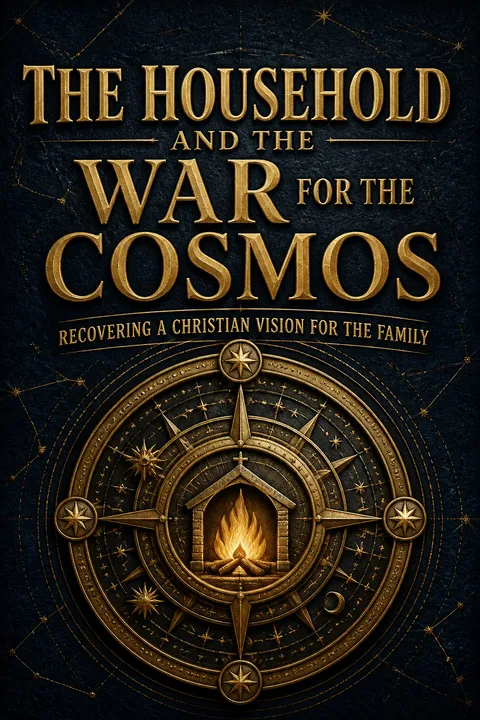

Key Takeaways
1. The industrial revolution stripped the household of its productive power
When household industries were transferred to the new factories, mothers at home were reduced from producers to consumers.
The great economic shift. Before the industrial revolution, the household was the undisputed center of human life, where families worked side-by-side in integrated domestic industries. When economic work migrated to factories and offices, fathers had no choice but to follow, leaving the home empty of its primary economic and educational functions.
Loss of essential functions. As the household lost its productive capacity, other vital social functions were outsourced to external institutions.
- Education was transferred to public schools.
- Care for the sick and elderly was institutionalized.
- Recreation became a commercialized, solitary pursuit.
- Spiritual training was delegated entirely to churches.
The emotional bonding trap. Sociologists falsely claimed that stripping these functions would strengthen families by allowing them to focus solely on emotional bonding. However, a group of people with nothing practical in common cannot sustain coherence on sentimentality alone, leading to skyrocketing rates of divorce and social isolation.
2. Modern "heart religion" has downgraded the heroic, social nature of true piety
What we are left with today is heart religion, because now the heart is the only place Jesus can be publicly acknowledged to live.
The privatization of faith. Modern Christianity has largely reduced the robust, world-shaping concept of piety to private, sentimental "Quiet Times" and emotional self-help. This inward turn, epitomized by the Gnostic-lite undertones of hymns like "In the Garden," encourages believers to withdraw from the physical world rather than engage it.
A historical downgrade. By isolating faith within the subjective realm of the human heart, we have surrendered the public square to secularism.
- "Quiet Time" replaced comprehensive modes of life.
- Subjective feelings replaced objective creeds and confessions.
- Personal relationships eclipsed the corporate reality of the Church.
Reclaiming the public truth. True piety is not a therapeutic escape but a virile, heroic commitment to objective reality. We must move beyond a privatized "Jesus in my heart" theology to recognize Christ as the public, sovereign Lord over all creation.
3. Ancient pietas binds the generations together through duty and gratitude
But the words pius and pietas have in Latin a wider meaning. Perhaps the best English equivalent is something like "dutiful," "mindful of one’s duty"—not only to the gods but also to one’s family and to one’s country.
The heroic duty. The ancient Roman concept of pietas, famously symbolized by the warrior Aeneas carrying his aging father Anchises out of the flames of Troy, represents a profound web of intergenerational responsibility. It stands in stark contrast to modern individualism, which views the self as entirely self-made and free from ancestral debts.
A culture of gratitude. Piety acknowledges that we are born as receivers of gifts we can never fully repay, binding us to those who came before and those who follow.
- Honoring parents preserves historical continuity.
- Keeping promises secures the future for our children.
- Acknowledging ancestral debts fosters cultural stability.
The child-centric illusion. Modernity, influenced by Romantic poets like Wordsworth, falsely asserts that "the Child is father of the Man," celebrating a clean break from the past. To recover a Christian vision of the family, we must reject this self-referential isolation and shoulder the heavy, beautiful weight of filial and cosmic duty.
4. The cosmos is a structured, vertical hierarchy, not a flat void of matter
The cosmos was more than matter in motion for them. It was an ordered thing—the largest order of them all.
The flat universe. Modern secular science, popularized by figures like Carl Sagan, presents the universe as a flat, meaningless expanse of "star stuff" governed by blind physical laws. This view strips reality of any vertical dimension, making it impossible to establish objective values, hierarchies, or spiritual truths.
The layered reality. In contrast, the biblical and classical worldview presents the cosmos as a sacred, layered home with a definite top and bottom.
- Heavenly places house spiritual authorities and the throne of Christ.
- Middle Earth is the contested arena where humans live.
- The Prince of the Power of the Air exerts temporary, rebellious influence.
The language of creation. This vertical cosmos is held together by the Logos, the divine Word that speaks order into existence. By recovering this poetic, layered understanding of reality, we can see that our daily domestic struggles are intimately connected to the cosmic war between Christ and rebellious spiritual powers.
5. A true household is an authority structure and a productive economy
Essentially a household was an authority structure. The reason that authority was essential was because a household was an economy.
The law of the house. The word "economy" originates from the Greek oikos (house) and nomos (law), signifying that the household was originally a self-governing, productive enterprise. It was not a mere residential launching pad for individual careers, but a tightly coordinated unit working toward a common, tangible good.
The role of the father. In this pre-modern structure, the father served as the house steward, representing heavenly authority and directing the household's labor.
- He managed the estate's productive assets.
- He adjudicated internal disputes and defended boundaries.
- He represented the household's interests in the public square.
The modern recreation center. Today, because we have outsourced production to corporations and welfare to the state, the home has been reduced to a recreation center. Without a shared economic mission, paternal authority is viewed as arbitrary tyranny, and the father is downgraded to a mere buddy or second mother.
6. The New Testament household codes are blueprints for cosmic order, not oppressive relics
Our households need to recover what made them strong in the past. And to do this you must have a man of the house and a code to guide him so that he can order his house.
The feminist suspicion. Modern egalitarian and feminist scholars view the household codes in Ephesians and Colossians with deep suspicion, dismissing them as patriarchal, oppressive concessions to ancient culture. This "hermeneutic of suspicion" deliberately takes these texts out of their historical context to justify dismantling traditional family structures.
A high-stakes management. In antiquity, the household codes actually elevated domestic roles, transforming daily chores and relationships into acts of cosmic significance.
- Wives were trained for high-level management of complex estates.
- Husbands were commanded to love self-sacrificially, mirroring Christ.
- Children and servants were integrated into a purposeful, shared economy.
Microcosms of the kingdom. Far from being outdated relics, these codes provide the structural integrity needed for the household to survive cultural decay. When ordered correctly, our homes become small, visible outposts of the Kingdom of God, demonstrating His harmonious rule to a chaotic world.
7. Intergenerational property and inheritance bind families across time
But in old-fashioned households, property bound the generations together.
The proletarian reality. The vast majority of modern families are proletarian, meaning they own no productive property and survive entirely by selling their labor to external employers. Consequently, children are raised to "launch" away from the family, and inheritance is reduced to whatever cash remains after liquidating parental assets.
The power of productive assets. Historically, the family's livelihood—whether a farm, a workshop, or a trade—was a multi-generational asset that required cooperation.
- Children learned the family trade directly from their parents.
- Honoring parents was tied to preserving the family estate.
- Inheritance meant receiving a share in an ongoing, productive enterprise.
Heirs versus slaves. When households lack productive property, they lose their intergenerational glue, leaving individuals dependent on corporate employers and the welfare state. To break this dependency, Christian families must work to acquire productive assets that can be managed and passed down through generations.
8. Marriage is a cosmic mystery reflecting the union of Christ and the Church
This mystery is profound, and I am saying that it refers to Christ and the church.
The ultimate union. Marriage is not merely a private contract designed for personal happiness or emotional satisfaction. According to the Apostle Paul, the physical union of husband and wife is a profound mystery that points directly to the eternal relationship between Christ and His Bride, the Church.
The double imputation. This cosmic reality is beautifully illustrated through the theological concept of double imputation, which operates like a marriage covenant.
- The husband takes on the wife's debts and liabilities.
- The wife receives the husband's status, wealth, and assets.
- Christ takes our sins, while we inherit His righteousness and glory.
The end of the world. While individual human marriages will cease in the resurrection, the institution of marriage itself does not die; rather, it expands to fill the entire cosmos. The history of the world will not end with a whimper, but with the glorious wedding feast of the Lamb, uniting Heaven and Earth forever.
9. Guerrilla piety requires recovering productive property and household proprietorship
For households to recover their culture-making influence there must be a large-scale revival of proprietorship, and that means bringing productive property back home where it belongs.
The strategy of resistance. In a world dominated by centralized states, invasive technology, and progressive corporations, Christians must wage a quiet war of resistance. This "guerrilla piety" does not rely on political takeover, but on building resilient, self-sufficient, and productive households that refuse to conform to the secular age.
Reclaiming the home. To execute this strategy, we must intentionally bring productive work, education, and worship back into the domestic sphere.
- Establish home-based businesses or family-owned enterprises.
- Commit to homeschooling or family-centered education.
- Restore daily family devotions and intergenerational worship.
- Acquire productive property to secure economic independence.
A threat to the powers. A household that is economically productive, educationally independent, and spiritually vibrant is a direct threat to the rebellious principalities of our age. By ordering our homes according to God's cosmic design, we offer the world a tangible, beautiful preview of the coming Kingdom of Christ.
Review Summary
The Household and the War for the Cosmos receives an overall strong reception, with most readers praising Wiley's recovery of classical concepts like "piety" and "household," and his compelling comparison of Aeneas and Abraham. Many appreciate its intellectual depth, weaving together history, philosophy, and Scripture. Common criticisms include the book's brevity, lack of practical application, and potential over-romanticization of pre-industrial family life. Some readers raise concerns about the marginalization of those outside traditional household structures and insufficient treatment of the church's role relative to the family.
Download PDF
Download EPUB
.epub digital book format is ideal for reading ebooks on phones, tablets, and e-readers.








































