

Key Takeaways
Own the racetrack, not just the horse, by buying GP stakes
The wealth is in the asset manager, not the fund. When you invest in a private equity fund as a limited partner (LP), you own a slice of the companies the fund buys. But buying a GP stake means owning a piece of the management company itself (the general partner) that runs those funds. That company collects two revenue streams regardless of any single deal: a management fee (around 2% annually on all capital managed) and carried interest (roughly 20% of profits).
The math is staggering. A firm managing $1 billion earns about $100 million in guaranteed fees over five years, plus $200 million if it doubles the fund. Robbins and co-author Christopher Zook argue this is why private equity founders dominate the Forbes 400, not tech or oil.
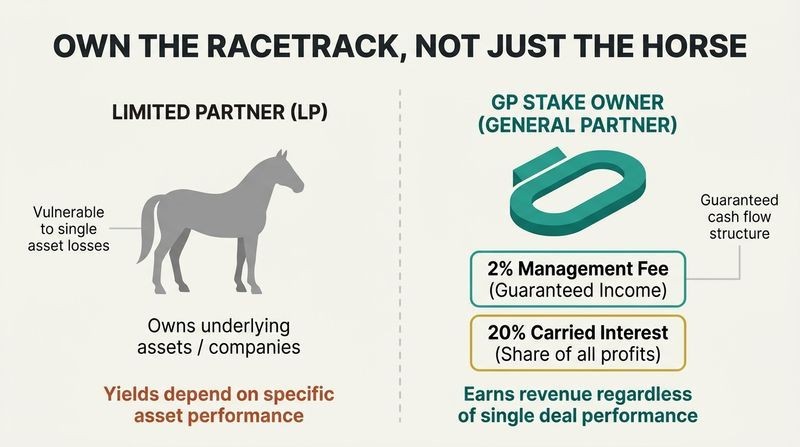
What's striking is how this inverts the usual investor mindset. Most people chase the fund's returns; the GP stake investor collects the toll booth revenue whether individual deals win or lose. It echoes the old gold rush wisdom: sell picks and shovels rather than pan for gold. The model resembles owning an index of a manager's entire future output. One caveat worth noting: the book is transparent that Robbins is a shareholder in CAZ Investments, a major GP stakes player, so the enthusiasm is not disinterested. The strategy is also genuinely rare and largely inaccessible to ordinary investors, a limitation the authors acknowledge repeatedly.
Stack eight to twelve uncorrelated bets to cut risk 80% without losing upside
This is the book's namesake principle. Ray Dalio, founder of the world's largest hedge fund, told Robbins that the single most important investing insight is assembling eight to twelve investments that don't move in lockstep. Do this and you can slash portfolio risk by as much as 80% while keeping the same return potential. The trick: these streams must "zig and zag" independently.
Traditional diversification quietly fails. Most portfolios pile up positively correlated assets that crash together. In 2022, stocks and bonds both fell roughly 22%, the worst year for the classic 60/40 portfolio in a century. REITs showed 80% correlation with the S&P 500 between 2010 and 2020. Bitcoin, marketed as "digital gold," fell 65% alongside stocks. Real diversification requires genuinely alternative return streams.
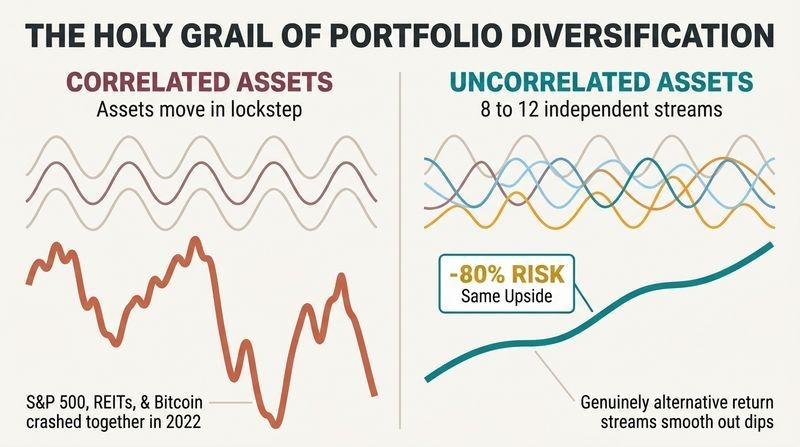
The correlation insight is mathematically sound and underappreciated. Harry Markowitz called diversification "the only free lunch" in finance, and Dalio's framing operationalizes it. But there is a subtle sleight of hand worth flagging: many alternatives appear uncorrelated partly because they are illiquid and infrequently priced, a phenomenon researchers call "volatility laundering." A private asset marked quarterly looks smooth precisely because nobody trades it daily. That does not eliminate underlying risk; it hides it. The genuinely uncorrelated streams the book champions (sports teams, GP stakes) may deliver real diversification, but investors should distinguish true independence from mere measurement lag.
Chase private markets: only 4,400 public U.S. firms remain, versus tens of thousands private
The opportunity set has migrated. The number of publicly traded U.S. companies has fallen roughly by half since its 1996 peak, down to around 4,400. Meanwhile roughly 80% of companies with over $100 million in revenue stay private. Firms no longer need to go public to raise capital, so the fastest-growing businesses increasingly live in private markets.
The returns followed the migration. Between 1986 and 2022, private equity as an asset class returned 14.28% annually versus 9.24% for the S&P 500. A hypothetical $1 million grew to $26 million in the index but $139 million in private equity. Ultra-high-net-worth families (over $30 million) now hold roughly 46% of assets in alternatives and just 29% in public stocks. Private equity also fell less and recovered faster in the 2001, 2008, and 2020 downturns.
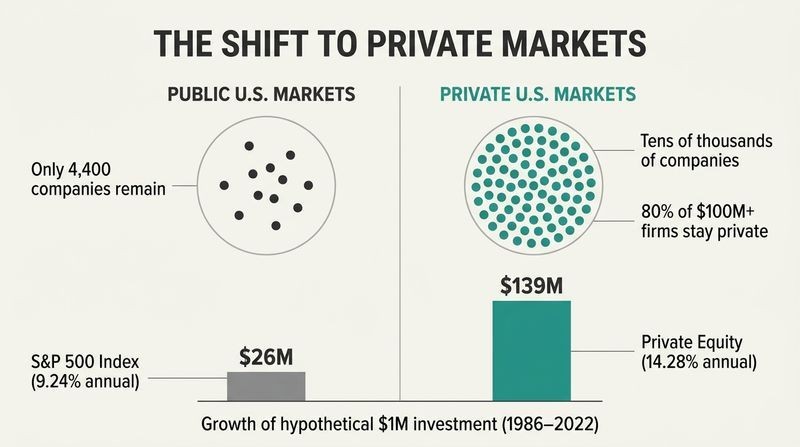
The public-to-private shift is real and consequential, but the performance comparison deserves scrutiny. Private equity returns are reported as internal rates of return, net of fees, which are not directly comparable to the time-weighted returns of a public index, a point the book's own fine print concedes. Academic work by Ludovic Phalippou has argued that after fees, average PE returns roughly match public equity once you adjust for leverage and small-cap tilt. The top-quartile managers genuinely crush the market; the median does not. Access to elite managers, the book's central promise, is therefore the whole ballgame.
Buy pro sports teams: they returned 18% yearly while the S&P did 11%
A legal monopoly with a communal moat. Between 2012 and 2022, the four major North American leagues (NBA, MLB, NFL, NHL) delivered a combined 18% compounded annual return versus 11% for the S&P 500, with correlation to public markets of just 0.14 and almost no leverage allowed by league rules. Each team owns an equal share of its league's global media and sponsorship revenue plus a protected local territory.
Revenue streams multiplied beyond ticket sales. Modern franchises earn from streaming rights (Apple, Amazon, and Netflix covet live sports because 92 of TV's top 100 programs in 2019 were sporting events), real estate around venues, luxury suites, and legalized gambling. A 2019 MLB rule change first opened the door for investment funds to buy minority stakes across multiple teams, a strategy pioneered by Ian Charles at Arctos.
The scarcity argument is compelling: there are only about 30 teams per league, fandom is generational, and customer acquisition cost is effectively zero. Charles makes a sharp point that sports and hydrocarbons were the rare sectors with price-to-earnings compression from 2011 to 2021 because league debt limits blocked the cheap-money valuation inflation that swelled other assets. The vulnerability is that much of the recent return comes from soaring media rights, which assume live sports remains the last mass audience. If cord-cutting eventually fragments even sports viewership, or if regional sports networks keep collapsing, that durable revenue thesis faces its first serious test.
Replace bonds with private credit yielding double what junk bonds pay
Lending without the bank. Private credit means non-bank lenders make loans directly to mid-sized companies (those with $100 million to $3 billion in revenue). For investors, it has generated two to three times the income of traditional bonds. In summer 2021, so-called high-yield junk bonds paid 3.97% while private credit paid around 9%. The asset class exploded from $42 billion in 2000 to over $1.5 trillion, with projections of $2.3 trillion by 2027.
Built-in protections make it resilient. Loans typically carry floating rates, so income rises as interest rates climb (a borrower paying 6% jumped to 11%+ when rates rose). Lenders hold their own loans, enforce strict underwriting, and structure deals as senior secured (first in line if a borrower defaults). From 2004 to 2022, annual loss rates averaged around negative 1%.
The floating-rate feature genuinely shone during the 2022 rate shock, when fixed bonds cratered and private credit income rose. David Golub's framing is useful: this is not lending to your local florist but financing private-equity-backed companies, a symbiotic ecosystem. The concern the book underweights is that private credit has never faced a full default cycle at its current $1.5 trillion scale. The strong loss history spans an era of falling or low rates. As higher rates squeeze borrower margins, the "margin of safety" thins. Golub himself concedes there is a rate level where the balance flips from good to bad for lenders.
Stop calling it energy transition; the world has only added energy, never replaced it
Energy addition, not transition. Quantum Energy's Wil VanLoh reframes the debate: across five historical shifts (wood to coal to oil to gas to nuclear to renewables), no dominant fuel was ever fully displaced. Each new source took about 50 years to reach significant market share and was layered on top of the old. After 13 years and nearly $1 trillion invested, wind and solar still supply only about 4% of global energy; fossil fuels supply roughly 80%.
Underinvestment is setting up a shock. Global fossil fuel reserves deplete 7-8% annually, requiring constant reinvestment. Yet spending on new supply dropped from about $700 billion yearly before 2014 to $300-350 billion after. VanLoh calls the shortfall "the equivalent of needing seven new Saudi Arabias" over 20 years. Add 2 billion more people by 2050 and demand rising 50%, and constrained supply likely means higher prices.
The "addition not transition" framing is empirically grounded and a healthy corrective to breathless clean-energy timelines. VanLoh's investment thesis is coherent: capital fleeing oil and gas for ESG reasons creates scarcity and thus opportunity for those who stay. Yet the book leans heavily on supply-side pessimism and treats demand as near-fixed. It underplays how fast solar, batteries, and EVs are scaling on cost curves, and how China's dominance in those supply chains (60-80% of manufacturing) is precisely a bet that the addition becomes a substitution faster than oil investors expect. The carbon-capture optimism (NetPower, Omnigen) is promising but remains pre-commercial and unproven at scale.
In venture capital, one power-law winner pays for every loser
Nine failures, one moonshot. Roughly one in ten venture bets survives, but a single home run can return an entire fund. Vinod Khosla turned a $4 million investment in Juniper Networks into $7 billion, a 2,500x return. He targets companies that could deliver 10x to 50x, ignoring the guaranteed losses along the way. This is the power law: the best investment in a portfolio generates most of the returns.
Access separates winners from also-rans. Between 2004 and 2016, top-decile VC firms returned 34% annually while the bottom decile lost money. The same elite firms win repeatedly through a "flywheel": their brand attracts the best founders, whose success attracts more founders. In 2022, 73% of new capital went to experienced firms. Top funds are oversubscribed, so most investors can only access them through pooled relationships.
The power-law dynamic, popularized by Peter Thiel and Sebastian Mallaby's research, is one of the most robust findings in venture. The flywheel of proprietary deal flow is a genuine, self-reinforcing moat. What David Sacks adds is a warning about the zero-interest-rate era, when crossover public investors flooded in and inflated valuations by working backward down the funding stack without early-stage expertise. The sobering nuance: median VC returns barely beat the NASDAQ while locking capital for a decade. For most investors, VC is a manager-selection problem disguised as an asset-class decision. Get the manager wrong and illiquidity becomes pure cost.
Buy quality assets at a discount through secondaries when institutions are forced to sell
Somebody else's rebalancing is your bargain. When markets drop, big institutions find their alternatives now represent too large a share of their target allocation, forcing them to sell high-quality private positions to rebalance (or their managers get fired). Since these assets are illiquid, sellers must offer discounts. The buyer of a "secondary" gets three edges:
1. A discount, often paying 70 to 90 cents on the dollar of current value.
2. Shorter timelines, cutting the usual 5-to-10-year wait roughly in half.
3. Visibility, seeing exactly which companies are owned rather than writing a "blank check."
The market exploded. Secondary transaction volume hit $134 billion in 2021, up from $60 billion in 2020, with projections toward $500 billion. GP-led secondaries, where managers move prized companies into "continuation vehicles" rather than sell at a fund's arbitrary 10-year deadline, now make up nearly half the market.
Secondaries embody the value-investing maxim of buying when others are forced to sell, echoing John Templeton's "buy when there is blood in the streets." The structural beauty is that the discount plus reduced J-curve (the early period when private funds show paper losses before gains materialize) improves risk-adjusted returns. The information edge is real: you underwrite a known portfolio, not a promise. The overlooked risk is that secondary pricing depends on the accuracy of the seller's marks. If those net asset values are stale or optimistic, a 20% "discount" may be no discount at all. Diligence quality, not the headline discount, determines the outcome.
Never confuse market luck with skill: don't lose money is rule one
Rising tides flatter everyone. The titans converge on Warren Buffett's first rule: don't lose money. Lose 50% and you need a 100% gain just to break even. The best investors accept they will sometimes be wrong, so they never bet too big on any single position and hunt for asymmetric risk-reward. Paul Tudor Jones only trades when he can risk $1 to make $5, letting him be wrong more often than right and still win.
Isolate and hedge the killers. VanLoh's firm aggressively hedges commodity prices and uses modest leverage, isolating the two variables (price volatility plus debt) that combine to destroy energy investors. Being unhedged and leveraged looks brilliant in a bull market, then wipes you out like a poker player who stayed too long. Real skill shows in down markets, not up ones.
The distinction between alpha (skill) and beta (market exposure) is foundational in finance, and the book's practitioners live it. What elevates this beyond cliche is the specific mechanism: asymmetric bets mean survival does not require being right often. This is Nassim Taleb's convexity in plainer language. The apartment investor Jay Gajavelli, who lost investors 100% by using floating-rate debt to buy 7,000 units before rates spiked, is the cautionary mirror image. His properties were fine; his capital structure was fatal. The lesson generalizes far beyond investing: durable success comes from eliminating ruin scenarios first, then letting upside compound, rather than maximizing returns in the good times.
Bet on people and culture; talent-led firms stall where management-led firms scale
Every titan named the same fulcrum: people. Across thirteen interviews, the pattern held. Robert F. Smith of Vista distinguishes talent-driven shops (built around one star investor) from management-led shops that build systems, teams, and shared economics, which is why some firms leap from $3 billion to over $100 billion while others plateau. Michael Rees notes the winner's curse in GP stakes: the best-performing firms grow fastest and thus need the most growth capital, so quality partners self-select.
Share the economics or lose the bench. Bill Ford of General Atlantic and Wil VanLoh both stress that hoarding profits at the top guarantees your best people leave. Firms that liberally share carried interest build cultures where everyone thinks like an owner. Golub measures success by investor returns, repeat business, and employee retention alike.
This convergence is the anthology's quiet thesis, and it aligns with organizational research showing that founder-dependent firms rarely survive succession. Jim Collins's work on "Level 5 leadership" and building organizations that outlast the leader maps directly onto Smith's systems-over-stars distinction. The economic-sharing point has empirical support: employee ownership correlates with lower turnover and higher productivity. One useful tension: the same book celebrates singular visionaries (Khosla, Musk) whose hands-on genius drove outcomes. The resolution is developmental, not contradictory. Star founders build the initial edge; institutionalized systems and shared economics sustain it. Investors evaluating any manager should therefore probe generational transition, which the book calls the single biggest hidden risk in private markets.
Income is the outcome: build assets that pay you so you never sell at the bottom
You spend cash, not assets. Robbins's mantra is that when markets crash, people become asset-rich and cash-poor, then get forced to sell holdings at the worst possible time. Building a critical mass of assets that generate steady income (private credit yields, real estate cash flow, GP stake distributions) provides the liquidity to survive economic winters without liquidating.
The wealthy go shopping in storms. The titans don't just weather downturns; they treat them as opportunities. Bridgewater gained 9.4% in 2008 while the market fell 37%. GP stakes distribute 5-10% annually starting on day one, effectively eliminating the J-curve wait. This income cushion is what lets sophisticated investors act boldly when everyone else is panic-selling, turning volatility from a threat into a buying signal.
The behavioral core here is sound and underrated. Forced selling, not volatility itself, is what permanently destroys wealth, a point the research on sequence-of-returns risk confirms for retirees especially. The book cites the alarming statistic that a fifth of investors over 85 hold nearly all stocks, a liquidity trap waiting to spring. Reframing income as the goal rather than net-worth maximization is psychologically shrewd: it converts market drops from anxiety into opportunity. The caution is that income-producing alternatives are largely illiquid themselves, so the strategy works only with genuine cash-flow streams, not paper gains. Diversified income sources, not any single yield, provide the real ballast.
Analysis
This is an anthology-style investing book, thesis-driven in Part 1 and interview-driven in Part 2, aimed at accredited and aspiring high-net-worth investors. Its central move is to take Ray Dalio's diversification principle (eight to twelve uncorrelated return streams) and populate it with alternative assets ordinary investors rarely touch: GP stakes, sports teams, private credit, energy, venture, real estate, and secondaries. The difficulty in summarizing it is its dual nature. Half is a coherent argument about market structure; half is thirteen loosely-structured conversations whose value lies in scattered aphorisms rather than systematic frameworks.
The book's greatest strength is access to genuinely elite practitioners and the surfacing of a real structural shift: capital has migrated from public to private markets, and the toll-collector position (owning the asset manager) has minted more billionaires than any operating business. Its most useful reframes are VanLoh's "energy addition," the power-law logic of venture, and the forced-seller dynamic behind secondaries.
The book's weakness is that it is also a marketing document. Robbins discloses his stake in CAZ Investments, which conveniently offers vehicles for nearly every strategy discussed, complete with promotional URLs. The performance comparisons lean on internal-rate-of-return figures that are not cleanly comparable to public index returns, a nuance buried in fine print. Academic skeptics like Ludovic Phalippou would argue that after fees, median private equity roughly matches public markets, making manager access the entire proposition, which the book both acknowledges and exploits.
The deepest tension is between the diversification thesis and the illiquidity of nearly every recommended asset. "Uncorrelated" alternatives partly appear so because they are priced infrequently, smoothing volatility on paper without reducing underlying risk. Read critically, the book is most valuable not as a portfolio blueprint but as an education in how sophisticated capital actually thinks: eliminate ruin, collect fees rather than chase deals, buy from forced sellers, and bet on people who share the upside.
Review Summary
The Holy Grail of Investing receives mixed reviews (3.62/5), with readers consistently noting it targets high-net-worth individuals rather than average investors. Many criticize it as a sales pitch for the author's investment firm, particularly CAZ Investments. Reviewers appreciate the interviews with investment leaders and information on alternative investments like private equity and energy, but find the second half repetitive. The book's core concept—diversifying into 8-12 uncorrelated investments—is deemed inaccessible to most readers. While some praise the financial insights, others recommend Robbins' earlier books for general investors.
People Also Read





Glossary
GP Stakes
Owning part of an asset managerBuying a minority, passive ownership interest in the general partner (the asset management company) that runs private equity, credit, or real estate funds, rather than investing in the funds themselves. Owners collect a share of the firm's management fees (roughly 2% of assets managed) and carried interest (about 20% of profits) across all its funds, past, present, and future.
Holy Grail of Investing
Eight to twelve uncorrelated betsRay Dalio's principle that assembling eight to twelve investments whose returns move independently of each other can reduce portfolio risk by up to 80% while maintaining the same return potential. The key requirement is genuine non-correlation, meaning the assets rise and fall at different times rather than crashing together.
Vintage Diversification
Exposure across many fund yearsThe benefit of owning a GP stake whereby you automatically gain exposure to every fund a firm launches across different years and economic cycles. Since each fund (or "vintage") performs differently depending on when it was raised, owning the manager spreads risk across all vintages rather than betting on one.
Secondaries
Buying existing private positions second-handTransactions where an investor buys another investor's existing stake in a private fund, usually at a discount to current value. LP-led secondaries are initiated by limited partners needing liquidity; GP-led secondaries involve managers moving prized companies into new "continuation vehicles" to extend their ownership beyond a fund's standard ten-year life.
J-Curve
Early paper losses before gainsThe pattern in private equity where investors show early paper losses as capital is deployed into acquisitions and fees are paid, before investments mature and generate returns, tracing a J-shape on a graph. GP stakes and secondaries can reduce or eliminate the J-curve by delivering income sooner.
Energy Addition
New energy layers onto oldWil VanLoh's reframing of "energy transition." Historically, new energy sources (coal, oil, gas, nuclear, renewables) have been added on top of existing ones rather than replacing them. Each took roughly 50 years to gain major market share, implying fossil fuels will persist for decades even as renewables grow.
Insti-vidual
Pooled individuals acting institutionallyA term for a network of high-net-worth families who pool their capital to write a single large check, giving them the collective purchasing power and access of a major institutional investor. This lets individuals negotiate entry into exclusive alternative investments normally reserved for pension funds and endowments.
Accredited Investor
Wealth threshold for private accessAn SEC designation granting access to certain alternative investments, currently requiring $200,000 in annual income or $1 million in net worth excluding one's home. A higher tier, "qualified purchaser," requires $5 million in investments and unlocks the full universe of alternatives.
FAQ
1. What is The Holy Grail of Investing by Tony Robbins about?
- Comprehensive investment wisdom: The book distills insights from the world’s greatest investors, focusing on strategies for achieving financial freedom through a practical 7-step system.
- Emphasis on alternatives: Robbins highlights the importance of alternative investments—such as private equity, private credit, real estate, and professional sports ownership—that have historically outperformed traditional stocks and bonds.
- The “Holy Grail” concept: Inspired by Ray Dalio, the book advocates building a portfolio of 8 to 12 uncorrelated investments to dramatically reduce risk while maintaining strong returns.
- Mindset and values: Beyond technical advice, Robbins explores the mindset, humility, and values—like gratitude and giving—that underpin lasting wealth and fulfillment.
2. Why should I read The Holy Grail of Investing by Tony Robbins?
- Access to elite investor wisdom: The book features exclusive interviews and strategies from legendary investors such as Ray Dalio, Warren Buffett, Paul Tudor Jones, and many more.
- Actionable and empowering: Robbins provides practical advice on asset allocation, risk management, and diversification, making complex concepts accessible to everyday investors.
- Democratizing alternatives: The book explains how recent legislative changes and innovative investment vehicles are opening access to alternative investments for a broader audience.
- Mindset for success: Robbins emphasizes that execution and the right mindset are as important as knowledge, encouraging readers to take action and cultivate leadership qualities.
3. What are the key takeaways from The Holy Grail of Investing by Tony Robbins?
- Diversification is crucial: Building a portfolio of uncorrelated assets can reduce risk by up to 80% without sacrificing returns.
- Alternative investments matter: Private equity, private credit, real estate, and other alternatives offer unique opportunities for growth and income, often outperforming traditional assets.
- Mindset and leadership: Humility, gratitude, continuous learning, and strong culture are essential for long-term investment success.
- Execution over knowledge: Taking action on sound principles is more important than simply acquiring information.
4. What is the “Holy Grail” investing strategy described by Tony Robbins and Ray Dalio?
- Portfolio of uncorrelated assets: The strategy centers on holding 8 to 12 investments that don’t move in tandem, dramatically reducing portfolio volatility.
- Risk reduction: This approach can lower risk by up to 80% while maintaining or even enhancing returns.
- Access challenges: While the concept is simple, finding enough high-quality, uncorrelated investments is difficult, especially for average investors.
- Examples of uncorrelated assets: These include private equity, private credit, venture capital, professional sports ownership, and other alternatives.
5. How does The Holy Grail of Investing by Tony Robbins explain diversification and its importance?
- Risk management: Diversification across asset classes—such as private equity, credit, real estate, and venture capital—reduces overall portfolio risk and volatility.
- Asset-specific benefits: Each alternative asset class offers unique risk-return profiles, income streams, and protection against different market environments.
- Dynamic allocation: Top investors dynamically allocate capital across sectors and time, adapting to changing markets for enhanced diversification.
- Time diversification: Spreading investments over different periods further reduces risk and captures opportunities across cycles.
6. What are the main alternative investment opportunities discussed in The Holy Grail of Investing by Tony Robbins?
- Private equity and GP stakes: Investing in private equity firms and their management companies (GP stakes) provides exposure to steady fee income and profit participation.
- Private credit: Offers higher yields than traditional bonds, floating rates, and lower default rates due to strong lender protections.
- Professional sports ownership: Sports franchises deliver strong, uncorrelated returns with multiple revenue streams and new access opportunities for investors.
- Energy and real estate: The book covers investments in both traditional and clean energy, as well as real estate for income and diversification.
- Venture capital and technology: Focuses on innovation, AI, and disruptive technologies as high-risk, high-reward opportunities.
7. How does Tony Robbins recommend gaining access to alternative investments in The Holy Grail of Investing?
- Accredited and qualified purchaser status: The SEC restricts many alternatives to investors meeting certain income or net worth thresholds.
- Pooling capital through networks: Firms like CAZ Investments aggregate capital from high-net-worth individuals to access exclusive deals.
- GP stakes ownership: Investors can buy minority stakes in asset management firms, sharing in management fees and carried interest.
- New investment vehicles: Legislative changes and innovative funds are making alternatives more accessible to a wider range of investors.
8. What are GP stakes, and why are they important in The Holy Grail of Investing by Tony Robbins?
- Ownership in asset managers: GP stakes represent minority ownership in private equity, credit, or real estate firms, allowing investors to share in management and performance fees.
- Attractive revenue model: These firms earn steady management fees (typically 2%) and performance fees (around 20%), providing predictable cash flow.
- Diversification and growth: GP stakes offer exposure to multiple funds and sectors, and their value grows as the underlying firms increase assets under management.
- Alignment with top managers: Investing in GP stakes aligns investors with the success of leading asset managers.
9. How does The Holy Grail of Investing by Tony Robbins address professional sports ownership as an investment?
- Strong historical returns: Sports franchises have delivered 18% compounded annual returns over a decade, outperforming major stock indices.
- Multiple revenue streams: Teams generate income from media rights, real estate, licensing, luxury suites, and sports gambling.
- Low correlation to markets: Sports ownership offers diversification benefits, as team values and revenues are less tied to public market cycles.
- New access for investors: Recent rule changes allow funds and qualified investors to own diversified portfolios of teams, increasing accessibility.
10. What role does energy investing play in Tony Robbins’ The Holy Grail of Investing strategy?
- Foundation of progress: Energy is essential for economic growth and human development, making it a critical investment sector.
- Balanced energy transition: The book highlights opportunities in both traditional (oil, gas) and renewable energy, as well as emerging technologies like carbon capture and small modular nuclear reactors.
- Supply-demand dynamics: Global energy demand is rising, but underinvestment in oil and gas creates supply shortfalls and price volatility.
- Geopolitical and policy risks: The book discusses the impact of global politics and the need for secure, on-shore supply chains.
11. What mindset and leadership qualities does Tony Robbins emphasize in The Holy Grail of Investing?
- Humility and gratitude: Successful investors and leaders cultivate humility, gratitude, and a spirit of giving, which foster strong relationships and long-term success.
- Continuous improvement: The concept of “kaizen” (continuous learning and innovation) is essential for peak performance.
- Teamwork and culture: Building strong, values-driven cultures and sharing economic rewards within firms attract and retain top talent.
- Long-term focus: Patience, adaptability, and the willingness to make sacrifices are highlighted as keys to enduring investment success.
12. What are the best quotes from The Holy Grail of Investing by Tony Robbins, and what do they mean?
- “Investors are born; great investors are made.” —Michael B. Kim: Investing skill is developed through experience, learning, and perseverance, not just innate talent.
- “The Holy Grail of Investing is finding eight to twelve uncorrelated investments that you can bet on.” —Ray Dalio: Diversification is the most powerful tool for reducing risk and enhancing returns.
- “Execution trumps knowledge every day of the week.” —Tony Robbins: Taking action on what you know is more important than simply acquiring information.
- “If you can embody that concept of jeong and share a piece of your heart with your employees, that’s the way they’re going to follow you.” —Michael B. Kim: Genuine care and emotional connection are essential for inspiring loyalty and performance.
- “It’s not just money that you can donate. You can also give your time, your talent, your love, your compassion, and your heart.” —Tony Robbins: True wealth is about generosity in all forms, enriching both giver and receiver.
About the Author
Other books by Tony Robbins


Download PDF
Download EPUB
.epub digital book format is ideal for reading ebooks on phones, tablets, and e-readers.








































