

Key Takeaways
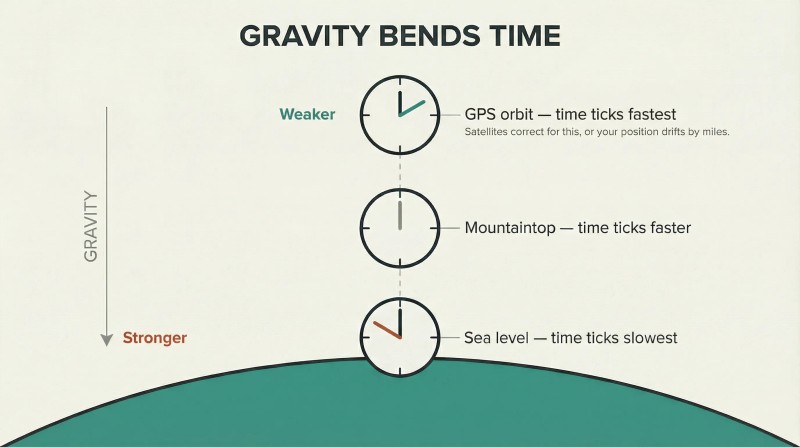
Time runs slower at sea level than on a mountaintop — GPS proves it
Before Einstein, time was universal. Everyone assumed a second was a second for all observers — what Newton and Aristotle called "absolute time." Then in 1905, Einstein showed that since the speed of light is identical for all observers regardless of their motion, something else must give: time itself. Two people moving at different speeds or sitting at different heights in a gravitational field experience time at genuinely different rates.
This isn't philosophy — it's measurable. In 1962, physicists placed precise clocks at the top and bottom of a water tower. The lower clock, closer to Earth's mass, ran measurably slower — exactly as general relativity predicted. Today, GPS satellites must correct for these relativistic time differences; ignoring them would make your calculated position wrong by several miles.
Every distant galaxy is racing away, proving the universe had a beginning
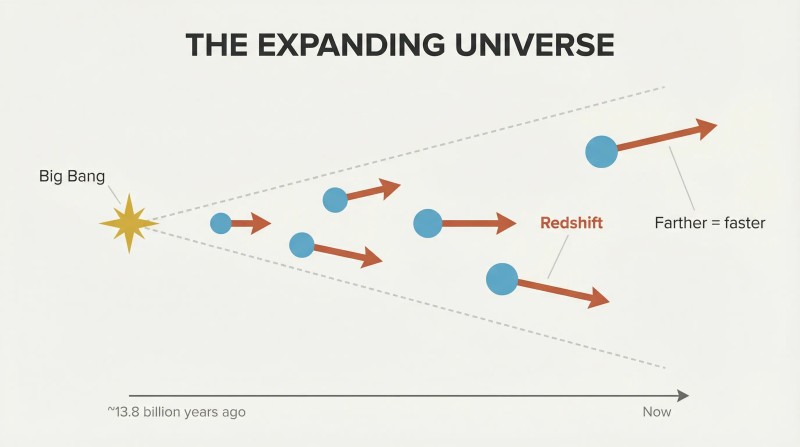
Hawking opens the book with a lady who insists the world rests on "turtles all the way down." Our cosmological picture wasn't much better for millennia: Aristotle placed Earth at the center, Ptolemy refined it, and Copernicus finally dethroned Earth. But the real revolution came in 1929 when Edwin Hubble observed that light from distant galaxies was shifted toward the red end of the spectrum — the Doppler effect proving they were racing away from us.
The farther the galaxy, the faster it fled. Run the expansion backward and everything converges to a single point roughly 10 to 20 billion years ago: the big bang. Even Einstein had resisted this conclusion, adding a "cosmological constant" to keep the universe static — what he later called his biggest mistake.
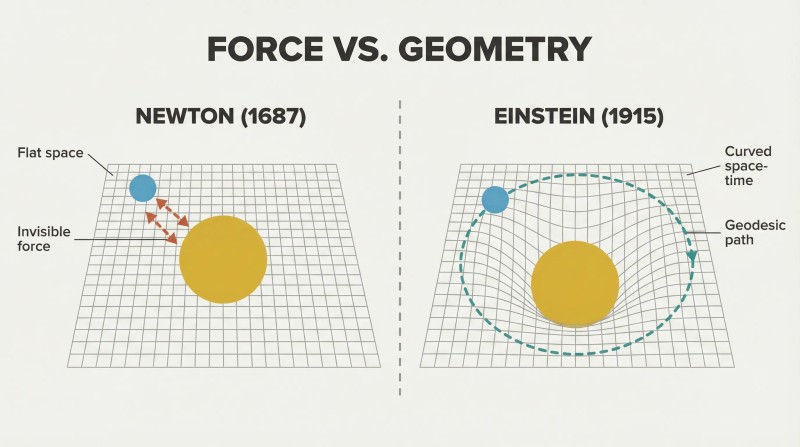
Gravity isn't a force pulling you down — it's curved geometry
Newton described gravity as an invisible force pulling objects toward each other across empty space. Einstein replaced this picture entirely. In his 1915 general theory of relativity, massive objects warp the fabric of space-time, and smaller objects simply follow the straightest possible paths — called geodesics — through that curved landscape.
Think of a bowling ball on a trampoline. A marble nearby rolls toward the bowling ball not because of a "force" but because the surface is curved. Light bends near massive objects too — confirmed during a 1919 solar eclipse when starlight passing near the sun was deflected, making stars appear shifted from their true positions. Einstein's predictions matched the observations; Newton's didn't quite.
Nature sets a hard limit on how precisely you can know anything
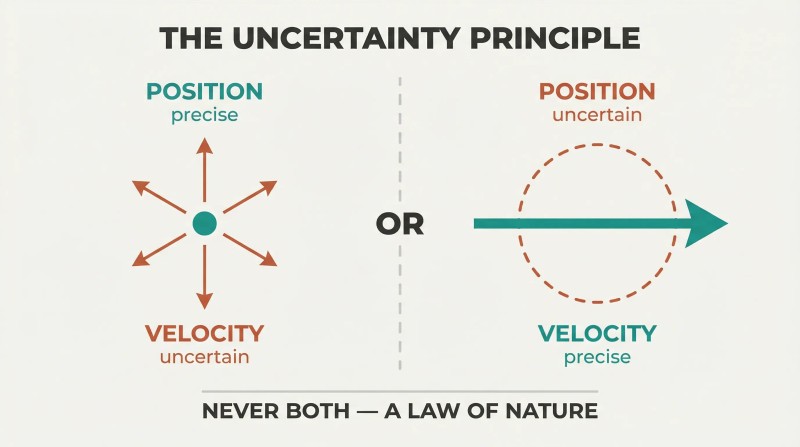
In the early 1800s, Laplace dreamed that knowing the position and speed of every particle in the universe would let you predict the entire future. In 1926, Werner Heisenberg shattered this dream. His uncertainty principle proved that measuring a particle's position precisely disturbs its velocity, and vice versa — not due to clumsy instruments, but as an inescapable law of nature.
Quantum mechanics replaced certainties with probabilities. Instead of predicting exactly where a particle will be, it tells you the likelihood of various outcomes. Einstein protested — "God does not play dice" — yet experiments have confirmed quantum mechanics with extraordinary precision. It underpins transistors, lasers, and all modern electronics. Ironically, Einstein himself won his Nobel Prize for contributing to the quantum theory he distrusted.
Black holes glow like hot objects — and smaller ones burn brighter
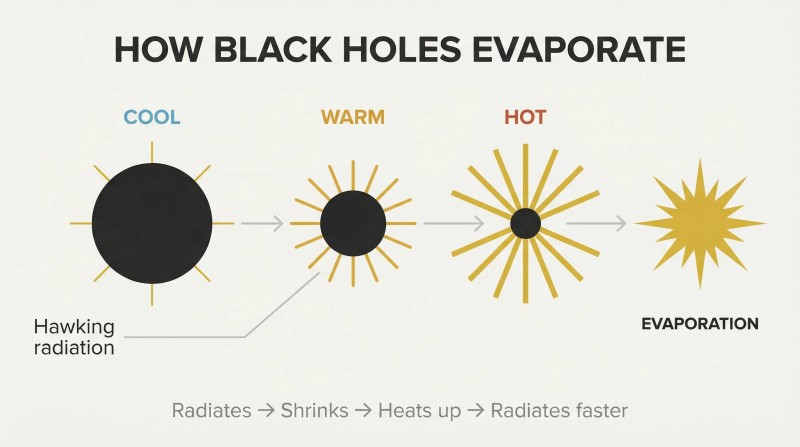
Before Hawking's 1974 calculation, everyone assumed nothing could escape a black hole's event horizon — the boundary beyond which gravity traps even light. But quantum mechanics changes the picture. "Empty" space constantly churns with virtual particle-antiparticle pairs popping in and out of existence. Near a black hole's edge, one particle can fall in with negative energy while its partner escapes as real radiation.
This is Hawking radiation, the book's signature discovery. Counterintuitively, smaller black holes are hotter and radiate faster — a primordial black hole with the mass of a mountain would glow at about ten thousand megawatts, enough to run ten large power stations. As they radiate, they shrink, heat up further, and may eventually explode completely. When Hawking first announced this result, the session chairman declared it "all nonsense."
The universe may be finite yet have no edge or beginning
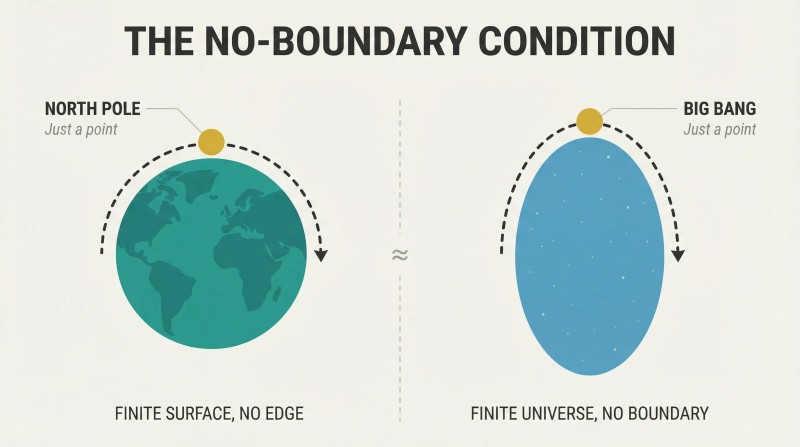
This is the book's most ambitious idea. Working with Jim Hartle, Hawking proposed the no boundary condition: if you describe the universe using imaginary time — a mathematical technique where time behaves like a spatial dimension — then space-time has no boundary or edge, much like Earth's surface is finite but has no cliff to fall from. The North Pole isn't a "beginning" of Earth; it's just a regular point.
Similarly, the big bang wouldn't be a true boundary but a smooth, ordinary point in space-time — no singularity, no moment of "creation" requiring outside intervention. Hawking first proposed this at a conference organized by the Vatican, noting that he was glad the Pope hadn't grasped the implication: that there would be no role for a creator to play.
You remember yesterday because disorder only runs forward
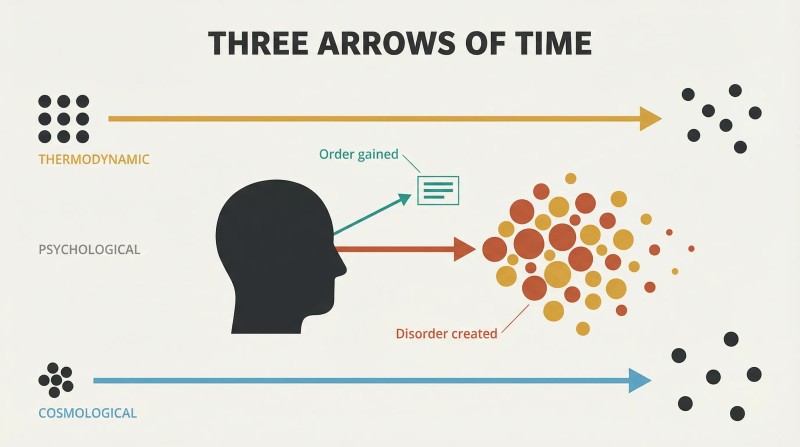
Hawking identifies three arrows of time that all point the same direction:
1. Thermodynamic — entropy (disorder) increases
2. Psychological — we remember the past, not the future
3. Cosmological — the universe expands rather than contracts
The key insight is that memory costs energy. Recording information — in a brain or a computer — requires moving from a disordered state to an ordered one, which expels heat and increases total disorder. Hawking calculates that reading his book converts about a thousand calories into waste heat, increasing universal disorder by roughly twenty million million million million units — about ten million million million times more than the order your brain gained. We define "forward in time" as the direction entropy increases, making the second law of thermodynamics almost tautological.
You exist because of a tiny quark surplus over antiquarks
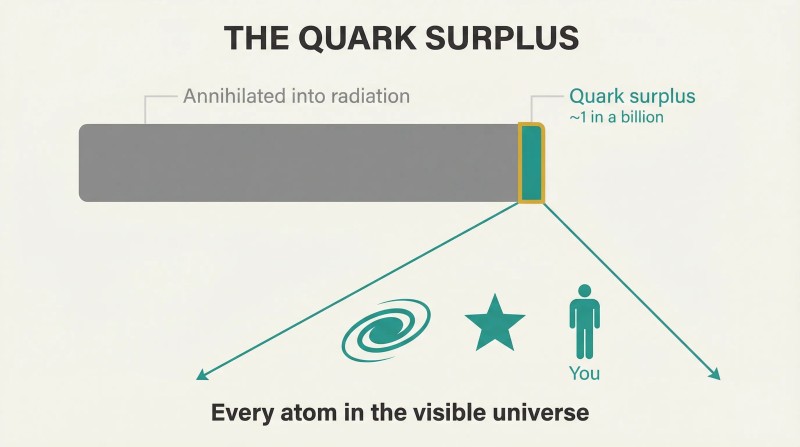
Seconds after the big bang, the universe seethed with equal amounts of matter and antimatter annihilating each other into radiation. Had the balance been perfect, everything would have canceled out — no galaxies, no stars, no you. But the laws of physics aren't perfectly symmetric between matter and antimatter.
In 1964, Cronin and Fitch discovered that certain particle decays violate CP symmetry — the rule that swapping particles for antiparticles and flipping left for right should look identical. This tiny asymmetry meant slightly more quarks than antiquarks survived the great annihilation. That minuscule surplus became every atom in the visible universe. Grand unified theories, which predict quarks can transform into other particles at extreme energies, offer an explanation for how this imbalance arose in the furnace of the early cosmos.
Science advances by killing its best theories, not confirming them
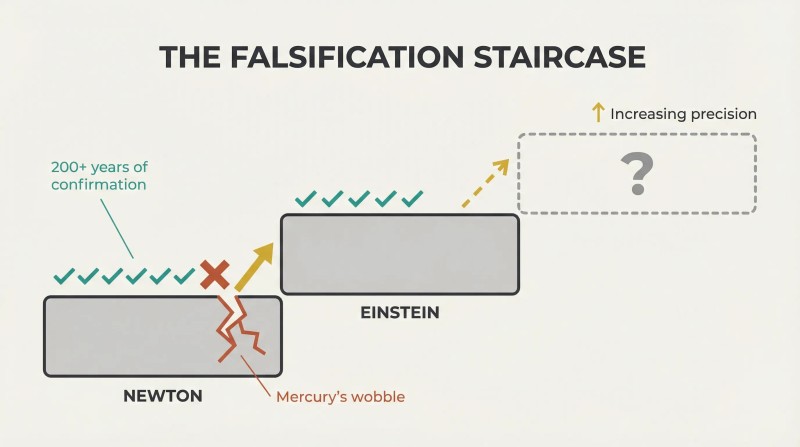
Hawking defines a good theory as one that describes many observations with few assumptions and makes testable predictions. You can test a theory a million times, but you can never prove it — one contradicting observation can kill it. This is Karl Popper's principle of falsifiability: the best theories stick their necks out with predictions that could be wrong.
Newton's gravity reigned for over two centuries until Mercury's orbit revealed a tiny unexplained wobble. Einstein's general relativity explained it perfectly. Yet scientists still use Newton's equations daily because the discrepancy is negligibly small for everyday situations. Science doesn't march toward final truth — it builds successively better approximations, each one surviving only until a more precise theory replaces it.
A unified theory still won't explain why anything exists at all
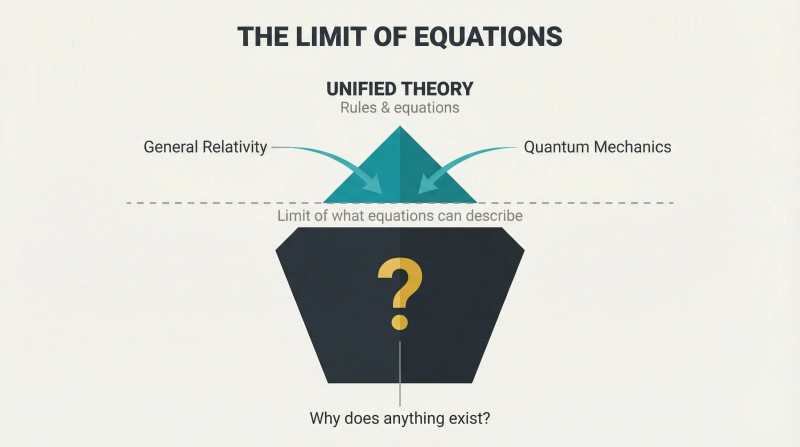
Modern physics rests on two pillars that contradict each other: general relativity governs gravity and the cosmos, while quantum mechanics governs subatomic particles. Unifying them is the defining quest of contemporary physics. String theory — which reimagines particles as vibrations on tiny one-dimensional strings — requires 10 dimensions, with the extra six curled up smaller than an atom. Hawking suspects we may need overlapping theories, like maps covering a globe, rather than one master equation.
But even the complete equations leave a mystery. Hawking asks what "breathes fire" into the equations — why does a universe exist for them to describe? A unified theory would crown humanity's intellectual achievement. Yet whether the universe needs a creator, or simply is, may lie beyond what equations alone can answer.
Analysis
A Brief History of Time occupies a paradoxical place in intellectual culture: over 25 million copies sold, yet notoriously one of the most purchased-but-unfinished books in publishing history. This gap between aspiration and completion mirrors the very physics Hawking describes — partial theories that work brilliantly in limited domains but cannot yet be unified into a complete picture.
Hawking's achievement is less about original physics (most ideas were already in technical journals) than about radical intellectual democratization. He walks a general audience from Aristotle to string theory — spanning Newtonian mechanics, both relativities, quantum mechanics, particle physics, and black hole thermodynamics — without a single equation beyond E=mc². His editor warned each equation would halve sales.
What gives the book lasting power is not the specific physics (much has advanced since 1988 — gravitational waves were detected in 2015, the Higgs boson confirmed in 2012, dark energy discovered in 1998, and the cosmological constant turned out to be nonzero) but its philosophical architecture. Hawking frames physics as the continuation of humanity's oldest questions by other means. When he asks what breathes fire into the equations, he is doing theology with tensor calculus — and that juxtaposition is what makes the book endure.
The no boundary proposal, his central original contribution, remains speculative but influential through the Hartle-Hawking state formalism in quantum cosmology. Its deepest implication — that the universe requires no external cause — is less a proof of atheism than a demonstration that 'what happened before the big bang?' may be as meaningless as 'what is north of the North Pole?' The boundary between physics and metaphysics, Hawking shows, is itself curved.
The book's layered structure embodies its message: each chapter builds on the last, just as partial theories are stepping stones toward unification. You cannot understand Hawking radiation without both general relativity and quantum mechanics. This architecture rewards patience and explains why the book remains the gold standard for popular physics writing over three decades after publication.
Review Summary
A Brief History of Time is a popular science book that explains complex physics concepts like relativity, quantum mechanics, and cosmology to a general audience. While praised for its accessibility, many readers found parts challenging to understand fully. Hawking's clear writing and attempts to address profound questions about the universe were appreciated. The book covers topics like black holes, the Big Bang, and the search for a unified theory of physics. Some criticized Hawking's philosophical speculations, but overall the book was highly influential in popularizing modern physics.
People Also Read





Glossary
No boundary condition
Finite universe without edgesA proposal by Hawking and Jim Hartle that when the universe is described using imaginary time, space-time is finite in extent but has no boundary, edge, or singularity—analogous to Earth's surface being finite but having no edge to fall off. This eliminates the need for initial conditions or a 'moment of creation' at the big bang.
Hawking radiation
Black holes emit particlesRadiation emitted by black holes due to quantum effects near the event horizon. Virtual particle-antiparticle pairs constantly appear near the boundary; one particle can fall in with negative energy while the other escapes as real radiation. This causes the black hole to lose mass over time. Smaller black holes radiate more intensely and are hotter than larger ones.
Event horizon
Black hole's point of no returnThe boundary surrounding a black hole beyond which nothing—not even light—can escape the gravitational pull. It is formed by the paths of light rays that just barely fail to escape. Once anything crosses the event horizon, return to the outside universe is impossible. The area of the event horizon can never decrease, a property reminiscent of entropy.
Singularity
Point of infinite densityA point in space-time where curvature becomes infinite and all known laws of physics break down. In classical general relativity, the big bang is one such singularity and another exists at the center of every black hole. Hawking's no boundary condition and quantum gravity effects may eliminate singularities from a complete description of the universe.
Anthropic principle
We see what permits usThe idea that observed properties of the universe are constrained by the requirement that intelligent observers exist to observe them. The weak version states that conditions for life occur only in certain regions of space and time. The strong version claims the universe's fundamental constants must be compatible with intelligent life, possibly implying many universes with varying laws.
Imaginary time
Time as spatial dimensionA mathematical technique in which time is measured using imaginary numbers (multiples of i, where i² = −1), making the time dimension behave indistinguishably from spatial dimensions. In this Euclidean space-time, the distinction between time and space vanishes. This framework enables the no boundary condition by allowing space-time to be finite without edges or singularities.
Sum over histories
All possible paths contributeRichard Feynman's formulation of quantum mechanics in which a particle does not follow a single path but takes every possible route between two points simultaneously. The probability of any outcome is found by adding up wave contributions from all histories. Most contributions cancel out, leaving only certain dominant paths—corresponding to the classical behavior we observe on large scales.
Chandrasekhar limit
Maximum stable cold-star massThe maximum mass (about 1.5 times the sun's mass) that a cold star can sustain against gravitational collapse through the Pauli exclusion principle repulsion between electrons. Calculated by Subrahmanyan Chandrasekhar during a 1928 voyage to England. Stars exceeding this limit cannot become stable white dwarfs and must collapse further into neutron stars or black holes.
Arrow of time
Direction distinguishing past from futureAny feature of the universe that distinguishes past from future. Hawking identifies three: the thermodynamic arrow (entropy increases), the psychological arrow (we remember the past, not the future), and the cosmological arrow (the universe expands). He argues the psychological arrow is a consequence of the thermodynamic one, and both align with the cosmological arrow during the expanding phase of the universe.
No hair theorem
Black holes have three propertiesThe principle that a black hole in a stationary state is completely characterized by only three externally observable properties: its mass, electric charge, and rate of rotation. All other information about the matter that formed or fell into the black hole is irretrievably lost. Proven through work by Israel, Carter, Robinson, and Hawking between 1967 and 1973.
FAQ
What's "A Brief History of Time" about?
- Exploration of the Universe: "A Brief History of Time" by Stephen Hawking explores the nature of the universe, discussing its origins, structure, and eventual fate.
- Complex Concepts Simplified: The book aims to explain complex scientific concepts like black holes, the big bang, and quantum mechanics in a way that is accessible to non-scientists.
- Unified Theory: Hawking discusses the quest for a unified theory that combines general relativity and quantum mechanics to explain all physical aspects of the universe.
- Philosophical Implications: It also delves into the philosophical implications of scientific discoveries, questioning the role of God and the nature of time.
Why should I read "A Brief History of Time"?
- Understanding the Universe: It provides a comprehensive overview of the universe's workings, making it essential for anyone interested in cosmology and physics.
- Accessible Science: Hawking's ability to simplify complex ideas makes it a great read for those without a scientific background.
- Intellectual Curiosity: The book challenges readers to think about profound questions regarding existence, time, and the universe.
- Cultural Impact: As a bestseller, it has influenced both scientific and popular culture, making it a significant work in modern literature.
What are the key takeaways of "A Brief History of Time"?
- Nature of Time: Time is not absolute and is intertwined with space, forming a four-dimensional space-time continuum.
- Black Holes: Black holes are regions where gravity is so strong that nothing, not even light, can escape, and they can emit radiation.
- Big Bang Theory: The universe began with a big bang, a singularity where all known laws of physics break down.
- Unified Theory: The search for a unified theory that combines general relativity and quantum mechanics is ongoing and crucial for understanding the universe.
What are the best quotes from "A Brief History of Time" and what do they mean?
- "If time travel is possible, where are the tourists from the future?" This quote highlights the paradoxes and challenges associated with the concept of time travel.
- "The universe doesn't allow perfection." It suggests that imperfections and uncertainties are inherent in the universe, aligning with the principles of quantum mechanics.
- "The boundary condition of the universe is that it has no boundary." This reflects Hawking's no-boundary proposal, suggesting the universe is finite but without edges or singularities.
- "We are just an advanced breed of monkeys on a minor planet of a very average star." This quote emphasizes the insignificance of human existence in the vast universe.
How does Stephen Hawking explain black holes in "A Brief History of Time"?
- Definition and Nature: Black holes are regions in space where gravity is so strong that nothing can escape from them, not even light.
- Event Horizon: The boundary around a black hole is called the event horizon, beyond which nothing can return.
- Hawking Radiation: Hawking theorizes that black holes can emit radiation due to quantum effects near the event horizon, leading to their eventual evaporation.
- Singularity: At the center of a black hole lies a singularity, a point of infinite density where the laws of physics as we know them cease to function.
What is the significance of the big bang theory in "A Brief History of Time"?
- Origin of the Universe: The big bang theory posits that the universe began from an extremely hot and dense singularity and has been expanding ever since.
- Cosmic Microwave Background: The theory is supported by the discovery of cosmic microwave background radiation, the afterglow of the big bang.
- Time and Space: It suggests that time and space themselves began with the big bang, challenging the notion of a universe existing eternally.
- Scientific and Philosophical Impact: The big bang theory has profound implications for understanding the universe's origin and the nature of time.
How does "A Brief History of Time" address the concept of time?
- Relative Time: Time is not absolute but relative, varying for different observers depending on their velocity and gravitational field.
- Imaginary Time: Hawking introduces the concept of imaginary time, which is indistinguishable from directions in space and helps in understanding the universe's boundaries.
- Arrow of Time: The book discusses the thermodynamic, psychological, and cosmological arrows of time, explaining why time seems to move in one direction.
- Time's Beginning and End: It explores the idea that time began with the big bang and may end with the big crunch or in black holes.
What is the role of quantum mechanics in "A Brief History of Time"?
- Uncertainty Principle: Quantum mechanics introduces uncertainty, meaning we cannot predict exact outcomes, only probabilities.
- Wave-Particle Duality: Particles can exhibit properties of both waves and particles, challenging classical physics' distinct categories.
- Quantum Gravity: The book discusses the need to unify quantum mechanics with general relativity to form a complete theory of quantum gravity.
- Impact on Cosmology: Quantum mechanics plays a crucial role in understanding the early universe and phenomena like black hole radiation.
How does Stephen Hawking approach the search for a unified theory in "A Brief History of Time"?
- Grand Unified Theories (GUTs): Hawking discusses attempts to unify the electromagnetic, weak, and strong nuclear forces into a single framework.
- Challenges with Gravity: The main challenge is incorporating gravity, described by general relativity, with quantum mechanics.
- String Theory: The book explores string theory as a potential candidate for a unified theory, where particles are one-dimensional strings.
- Ultimate Goal: The search for a unified theory aims to provide a complete understanding of the universe's fundamental forces and particles.
What is the anthropic principle as discussed in "A Brief History of Time"?
- Weak Anthropic Principle: It suggests that the universe's laws appear fine-tuned for life because only in such a universe could observers like us exist.
- Strong Anthropic Principle: This version posits that the universe must have properties that allow life to develop at some stage in its history.
- Role in Cosmology: The anthropic principle is used to explain why the universe has the conditions necessary for life, despite the vast number of possible configurations.
- Philosophical Implications: It raises questions about the role of chance and necessity in the universe's design and our place within it.
How does "A Brief History of Time" address the concept of imaginary time?
- Mathematical Tool: Imaginary time is used as a mathematical tool to simplify calculations in quantum mechanics and cosmology.
- No Boundary Proposal: Hawking's no boundary proposal uses imaginary time to suggest that the universe is finite but without boundaries or singularities.
- Distinction from Real Time: In imaginary time, the distinction between past and future disappears, unlike in real time, where time has a clear direction.
- Implications for the Universe: Imaginary time allows for a universe that is self-contained and without a beginning or end, challenging traditional notions of creation.
What are the philosophical implications of "A Brief History of Time"?
- Role of God: The book questions the necessity of a creator if the universe can be explained by a self-contained set of laws.
- Nature of Reality: It challenges traditional views of reality, suggesting that time and space are not absolute and may have different properties than perceived.
- Human Significance: Hawking emphasizes the insignificance of human life in the vast universe, prompting reflection on our place and purpose.
- Quest for Knowledge: The pursuit of a unified theory represents humanity's ongoing quest to understand the universe and our existence within it.
About the Author

Download PDF
Download EPUB
.epub digital book format is ideal for reading ebooks on phones, tablets, and e-readers.








































