
Key Takeaways
1. The American Dream's Reversal: Post-1973 Decline
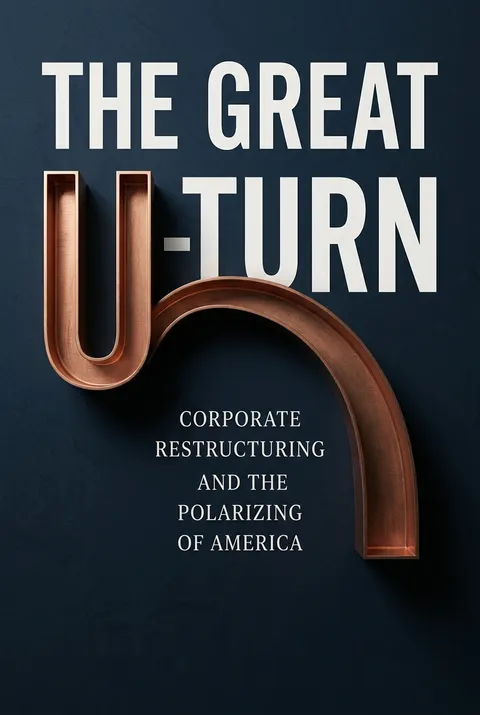
The story is one of a series of changes in direction—reversals in course, great U-turns if you will—in the strategies and policies of both business and the government, and as a consequence, a great U-turn in our material well-being.
A fundamental shift. From the late 1940s to the early 1970s, the American Dream was a reality for many, characterized by steadily rising real family incomes, increasing individual wages, and a reduction in poverty. Americans expected better jobs and a higher standard of living for themselves and their children, fueled by a strong social conscience and a belief in equality of opportunity. This era saw growing social opportunity and a real reduction in poverty, fostering social cohesion despite national challenges.
The unraveling begins. However, around 1973, this trajectory dramatically reversed. Real (inflation-adjusted) individual wages stopped growing, and for the average worker, 1973 marked the peak of material gain. Median annual family income stagnated, even with more family members entering the workforce, and the economic gap between the rich and poor widened significantly, rivaling levels seen during the Great Depression.
Polarization of opportunity. The job market itself underwent a profound polarization. A growing number of Americans were shuffled into low-paying jobs, while a small segment of society accumulated unfathomable wealth. This "Great U-Turn" in wages, incomes, and inequality was not due to bad luck or external forces alone, but rather a fundamental shift in the strategies of American businesses and the policies of the government, primarily driven by a squeeze on corporate profits.
2. Corporate Response: "Zapping Labor" Through Globalization and Hollowing
Instead of pioneering in new products and technologies to boost revenues, U.S. firms overwhelmingly chose to work on the cost side of the profits equation.
Profit squeeze and strategic shift. By the early 1970s, unprecedented global competition and rising costs (including labor demands and social regulations) severely squeezed corporate profits, which had peaked in the mid-1960s. Faced with this crisis, American businesses largely abandoned strategies focused on product innovation and quality improvement. Instead, they adopted a "lean and mean" approach, prioritizing drastic cost reduction, particularly labor costs, over long-term productivity growth.
Globalization and "hollowing." A key strategy was "going global," where U.S. firms increasingly moved operations offshore, outsourced components to foreign manufacturers, and entered joint ventures to leverage cheaper foreign labor. This led to the "hollowing of America," where domestic manufacturing declined significantly as U.S. companies became importers and distributors of foreign-made goods, often selling off fundamental technology and manufacturing expertise in the process.
- Domestic manufacturing employment fell from 27% in 1970 to 19% in 1986.
- Examples: GE selling its TV production to Thomson S.A., IBM PCs using mostly foreign-made components.
Assault on domestic labor. At home, corporations launched a "one-sided class war" against their workforce. They implemented:
- Wage concessions: Freezes, outright pay cuts, and lump-sum payments in lieu of raises.
- Two-tiered wage systems: New hires paid significantly less for the same work.
- Contingent labor: Increased reliance on part-time, temporary, and leased employees, often without benefits.
- Union avoidance: Direct attacks on organized labor, plant closures, and relocation to non-union sites.
These tactics, euphemistically called "increasing labor flexibility," drastically reduced labor costs but came at the expense of job security and living standards for millions of American workers.
3. The Rise of the "Casino Society": Financial Speculation Over Productive Investment
In this turn toward financial speculation and away from productive investment, the federal government, perhaps unwittingly, played an important role.
Shift to financial ventures. The profit squeeze in traditional industrial sectors, such as steel and auto, led corporate financial officers to divert capital away from productive investments in plant and equipment. Instead, they channeled funds into financial speculation, including mergers, acquisitions, and high-stakes trading in commodities and securities. This created a "casino society" where short-term financial gain often overshadowed long-term industrial development.
Debt-fueled acquisitions. The era saw an explosion of debt-financed mergers and hostile takeovers, with firms borrowing enormous sums to acquire other companies rather than investing in new production. The creation of "junk bonds" facilitated these risky ventures, and Wall Street firms reaped billions in commissions. Government tax laws inadvertently encouraged this by allowing companies to "write off" the value of closed plants against other profits, effectively subsidizing the dismantling of productive enterprises.
Urban revitalization and polarization. This financialization also reshaped urban landscapes, leading to "urban revitalization" projects like new office towers and hotels. While these created jobs, they were overwhelmingly polarized:
- Upper tier: High-paid white-collar professionals (information brokers, financial specialists).
- Lower tier: Poorly paid service workers (chambermaids, waiters, janitors).
This dual structure, often with racial and gender divisions, exacerbated social and economic inequality within major cities, further contributing to the "hourglass economy" with a shrinking middle class.
4. Government's U-Turn: Laissez-Faire Policies Reinforce Corporate Restructuring
Laissez-faire was back in fashion, having lain dormant since the days of Herbert Hoover.
Policy shift to laissez-faire. The federal government, initially under President Carter and then dramatically under President Reagan, made a "Great U-Turn" in economic policy. Abandoning the Keynesian demand-side approach, Washington embraced a conservative, supply-side ideology that blamed "big government" for economic woes. The new policy aimed to restore corporate profits by reducing government "interference" in markets.
Engineered recessions and tax cuts. The government deliberately engineered two deep recessions (1980, 1981-82) through tight monetary policy and cuts in social programs. This created mass unemployment, weakening labor's bargaining power and forcing wage concessions. Simultaneously, deep tax cuts were enacted for individuals and corporations, with the explicit goal of spurring work, savings, and investment, and further reducing the government's revenue from businesses.
- Federal spending on employment and training programs declined by 64% between 1978 and 1983.
- Corporate tax rates were significantly reduced, and depreciation allowances liberalized.
Deregulation and union-bashing. Widespread deregulation of industries like airlines, trucking, and telecommunications intensified competition, forcing firms to cut costs, often by revising wages and work rules. The government also actively undermined organized labor, exemplified by President Reagan's firing of striking air-traffic controllers and the National Labor Relations Board's rulings that favored management.
- "Privatization" of public services (e.g., Conrail, government databases) further shifted work to private, often lower-wage, non-union sectors.
- Social regulations (environmental, health, safety) were softened, reducing costs for businesses but increasing risks for workers and the public.
5. The Crisis of Quality Jobs: Stagnation and Polarization of American Incomes
The old adage seems to be true yet again: the rich are getting richer while the poor get poorer.
Profits up, wages down. While corporate profits rebounded significantly in the 1980s, the economic recovery came at a steep cost for American workers and families. Real average weekly wages continued to fall or stagnate after 1973, buying nearly 14% less in 1986 than thirteen years prior. This disconnect between rising profits and falling wages highlights a fundamental shift in the distribution of economic gains.
Polarization of the job market. The "Great American Jobs Machine" created millions of new jobs, but their quality deteriorated dramatically. The job market became increasingly polarized, with a mushrooming proportion of low-paying jobs and an expansion of high-paying jobs, leading to a shrinking middle.
- Between 1979 and 1986, the percentage of year-round, full-time (YRFT) workers earning low wages (under $11,103 in 1986 dollars) rose from 12.4% to 17.2%.
- The proportion of net new jobs in the middle-income bracket (between $11,104 and $44,412) plummeted from nearly 90% (1963-1973) to only 50% (1979-1986).
Beyond conventional explanations. This growing inequality cannot be adequately explained by business cycles or demographic shifts like the baby boom or increased female labor force participation. Statistical analysis shows that:
- Productivity declines and deindustrialization are significant factors.
- The shift from higher-paying manufacturing to lower-paying service industries accounts for about a fifth of the increase in wage inequality.
- The majority of the increase in inequality occurred within age, race, and sex groups, not between them, indicating a widespread "democratization of polarization."
6. An Illusion of Growth: Debt and Military Spending Fuel a Fragile Recovery
Instead of exchanging short-term sacrifice for long-term prosperity and more equality, America has been doing just the opposite: buying short-term economic recovery at the exorbitant price of forfeiting long-term social and economic security.
A recovery built on sand. The economic recovery of the 1980s, while impressive in terms of GNP and job creation, was fundamentally unsustainable. Reaganomics failed to deliver on its promise of increased savings, investment, and productivity. Instead, the recovery was primarily fueled by an unprecedented surge in debt across all sectors and a massive increase in military spending.
- The personal savings rate plummeted after 1981, reaching its lowest level since 1939.
- Business investment in new productive equipment was anemic and short-lived.
- Labor productivity for the economy as a whole never rebounded, and even turned negative in late 1986.
The debt-driven "Ponzi scheme." The federal government doubled military spending (from $134 billion in 1980 to $282 billion in 1987) while enacting deep tax cuts, leading to triple-digit deficits and a national debt that ballooned by $1.3 trillion. Consumers, facing stagnant wages, went deeper into debt to maintain living standards, with total consumer debt nearly doubling between 1981 and 1986.
- The combined new consumer and federal debt since 1982 was 25% higher than the total net growth in GNP.
- This reliance on borrowed funds created a "Ponzi scheme," where future income is mortgaged to sustain current consumption and growth.
Crisis of international debt and deregulation's fallout. The high interest rates resulting from tight monetary policy attracted foreign capital, driving up the dollar's value and making U.S. exports expensive while imports became cheaper. This led to massive trade deficits, transforming the U.S. from the world's leading creditor to its largest debtor nation by 1985.
- Deregulation, while intended to spur competition, led to financial instability (e.g., stock market crash of 1987), higher real interest rates, and a stifling of competition in many industries.
- Social deregulation resulted in increased workplace injuries and a decline in the quality of public services.
These policies, while boosting short-term profits, created profound long-term vulnerabilities and exacerbated income inequality.
7. The Failures of Extremes: A Call for Progressive, Planned Economic Renewal
What people want is both economic growth and a modicum of economic security.
Beyond the failed experiments. Neither the welfare state model of the mid-20th century nor the laissez-faire approach of the Reagan era delivered sustainable, equitable economic growth. The welfare state ran out of steam when growth stagnated, and laissez-faire created excessive personal insecurity and economic instability, leading to a demand for a new balance between competition and social planning. The "competitive solution" failed because human beings are risk-averse and seek collective action to establish rules and security.
A revenue-side alternative. A progressive path forward requires a "revenue-side" alternative that prioritizes increasing output and demand, rather than solely cutting costs. This necessitates global reflation and a renewed focus on boosting domestic productivity. Key components of this strategy include:
- Industrial Policy: Government, business, and labor collaborating on long-term strategies for innovation, R&D, and conditional assistance to industries, moving beyond ad-hoc bailouts.
- Workplace Democracy: Expanding workers' and unions' roles in decision-making beyond wages to include technology, investment, and product design, fostering genuine cooperation.
- Organizing the Unorganized: Unions must adapt to organize workers in the service and high-tech sectors to ensure fair wage distribution from productivity gains.
Rebuilding foundations and managing trade. Further elements crucial for equitable growth include:
- Public Infrastructure: Massive investment in roads, bridges, water systems, and especially education and training, which are vital for long-term productivity and competitiveness.
- Social-Welfare Programs: Rebuilding the social safety net with universal benefits like national health insurance, expanded childcare, a higher minimum wage, and equal benefits for part-time workers.
- Managed International Trade: Restructuring global trade rules (e.g., GATT) to allow for "time-delimited vanishing tariffs" and other managed arrangements that balance free trade benefits with domestic economic security and industrial revitalization.
This comprehensive approach aims to reverse the "Great U-Turn" by fostering growth that is both robust and equitably shared, addressing the deep structural issues that have undermined the American Dream.

Download PDF
Download EPUB
.epub digital book format is ideal for reading ebooks on phones, tablets, and e-readers.








































