
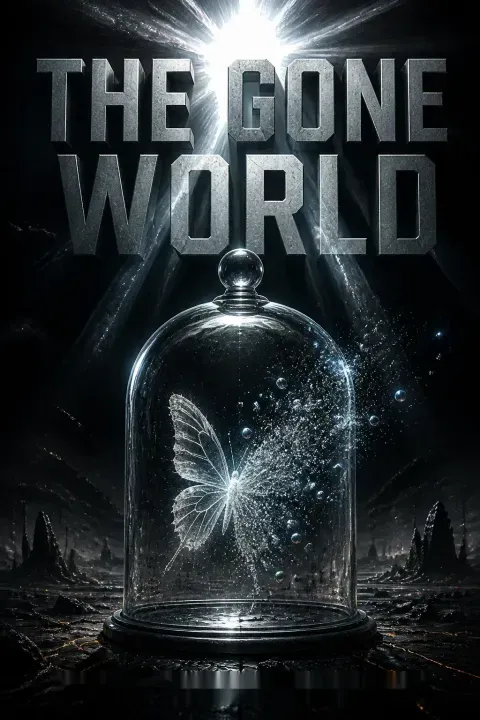


Plot Summary
Prologue
In 2199, a trainee1 in an orange space suit struggles through a dead winter forest in what was once West Virginia. She comes to a black river where a woman hangs crucified upside down in midair, flames at her wrists and ankles. The face is her own. She collapses. A Quad-lander lands, but the crew rescues the crucified woman, not her.
Back aboard the ship, she learns she is both the rescued and the one left behind. Her instructor explains that quantum-tunneling nanoparticles, QTNs, are in her blood, that they cause the cataclysmic Terminus. Her feet are black with gangrene. She loses her leg. She is Shannon Moss.1
This opening establishes the novel's core paradox: the self is not singular. Moss witnesses her own crucifixion and rescue simultaneously, an immediate experience of the echo phenomenon that defines the narrative. The prolonged detail of her blackened feet and the clinical explanation of QTNs transform the body into a site of cosmic violation. The prologue functions as a miniature of the entire plot, a loop of suffering and salvation where the saved and the abandoned are the same person, foreshadowing Moss's eventual discovery that she herself is an echo from a timeline that never was.
The Slaughter on Cricketwood Court
A call at 2 a.m. wakens NCIS Special Agent Shannon Moss.1 FBI agent Philip Nestor2 reports a triple homicide on Cricketwood Court in Canonsburg, the very street where Moss's1 best friend Courtney Gimm8 once lived. The victims are the family of Patrick Mursult,14 a Navy SEAL: his wife and two young children bludgeoned with an ax, their fingernails meticulously removed.
His teenage daughter Marian7 is missing. When Moss1 enters the house, she is seized by ghostly recognition: this is Courtney's8 old home. In the master bedroom where she spent childhood sleepovers, the body of a seven-year-old girl lies butchered. The suspect, Mursult,14 is identified as a sailor assigned to the USS Libra, a ship lost to the secretive Deep Waters program.
This inciting incident fuses Moss's personal loss with her professional mission. The removal of fingernails introduces the ritualistic violence of Hyldekrugger's cult, while the location superimposes the dead friend onto the missing girl. Moss's emotional wobble in Courtney's room shows a professional agent briefly undone by memory. The revelation of Mursult's connection to the lost Libra elevates a brutal family annihilation into a matter of cosmic significance, setting the stage for a case that will unravel the fabric of time.
Fleece's Cathedral of Bones
A neighbor's tip about a red pickup truck leads Moss1 and Nestor2 to the remote West Virginia property of Elric Fleece,12 a Vietnam veteran and former electrician's mate on the Libra. The house erupts with the stench of rotting bear.
Walls are covered in animal pelts stitched into mountain murals, Nazi flags drape the ceiling, and a hallway of mirrors leads to a master bedroom where a tree sculpted from bones and copper wire stands. From its branches hangs Fleece's12 bloated corpse.
In a spare room, they find Mursult's14 duffel bag containing cash, a pager, and explicit Polaroids of a black woman. An enlarged photograph of a swift boat is coated in fingernail clippings, labeled THE SHIP OF NAILS THAT WILL CARRY THE BODIES OF THE DEAD. The room is an exact recreation of the Terminus landscape.
Fleece's suicide is a tableau of theological horror. The 'Ship of Nails' explicitly invokes Naglfar, the Viking vessel of the dead, and becomes the narrative's dominant symbol. The fact that Fleece, a former NSC sailor, chose to hang himself inside a representation of the Terminus suggests that for those who witness the end, death is not an escape but an entry into an eternal loop. The room of mirrors, where Moss sees herself infinitely repeated, literalizes the echo phenomenon and foreshadows her own identity crisis.
The Execution at Cabin 22
Using the pager's records, Moss1 drives to the Blackwater Falls Lodge. The night clerk, a blue-haired girl named Petal,15 helps her sift through handwritten receipts until they find a match: the alias Patrick Gannon,14 renting Cabin 22. When they open the door, the smell of blood assaults them. Mursult14 is on his knees, wrists bound behind him, shot through the back of the head.
The execution-style killing confirms he was a victim, not a perpetrator. The lodge's license plate records lead FBI agent Nestor2 to identify the woman in the Polaroids as Nicole Onyongo,4 a nurse at a nearby hospice who had been having a years-long affair with Mursult.14 A Navy service weapon, a Beretta M9, is recovered at the scene.
The discovery of Mursult's body transforms the investigation from a manhunt to a conspiracy thriller. The execution-style killing indicates professional discipline, while the Beretta M9 becomes the first 'echoed' object, a gun that will fire identical bullets across multiple timelines. Cabin 22, with its dust and silence, becomes a sacred site of betrayal. Nicole Onyongo's introduction as the unnamed woman in the photographs humanizes the victim and plants the first seed of the vast Libra conspiracy.
A Ghost in the Future
Under orders, Moss1 launches in her Cormorant, the Grey Dove, and travels nineteen years into an Inadmissible Future Trajectory. In September 2015, the aged Dr. Wally Njoku6 hands her case files. The files reveal that Marian Mursult's7 remains were found in 2004, buried in the Blackwater Gorge, and that in 1998 a domestic terrorist will bomb the CJIS facility where Moss1 works, killing over a thousand including Brock's5 wife and daughters.
Using the alias Courtney Gimm,8 Moss1 infiltrates a dive bar to befriend Nicole Onyongo,4 now a weathered addict. She also tracks down Nestor,2 who has left the FBI after killing a man and now sells Nazi memorabilia at gun shows. In Buckhannon, his farmhouse overlooks acres of wildflowers. They become lovers.
This temporal displacement illustrates the novel's brutal emotional physics: Moss lives months while seconds pass in 1997, and she returns aged. The CJIS bombing, a predetermined tragedy she is powerless to prevent, haunts her interactions with Brock. Her adoption of Courtney's name as an alias is a psychological regression and a ghosting. The relationship with Nestor, built on her false identity and his own concealed trauma, is a study in the loneliness of the time traveler, who can never truly be known.
The Photograph Over the Mantel
In Nestor's2 farmhouse, beneath a painting of the dead Christ that he cannot bring himself to remove, they become lovers. He confesses that during his FBI tenure he shot and killed a man named Dr. Peter Driscoll,11 an engineer at Phasal Systems, an act that shattered his faith and his career.
More strangely, he describes how a new national ballistics database matched the bullets from his service weapon to multiple other shootings, including Patrick Mursult's14 murder.
The same Beretta M9 appears to have been used in killings years apart and miles distant. Nestor2 assumes it is a database error, but Moss1 realizes the gun and its bullets are echoes, identical objects pulled from different IFTs through the Vardogger, a signature of Hyldekrugger's3 network.
The ballistics ghost traces a pattern invisible to conventional investigation, a fractal signature of time travel. Nestor's confession reveals him as both a perpetrator and a victim of the conspiracy: he killed Driscoll, one of the 'chain' of scientists, but did so out of self-defense, unaware of the larger stakes. The painting of the dead Christ, a body awaiting a resurrection that will never come, externalizes Nestor's spiritual collapse and becomes a symbol of the novel's nihilistic theology.
The Flowers of Esperance
One intoxicated night, Nicole4 tells Moss1 the origin story. She was a medical student in a far-future Kenya when Commander Elizabeth Remarque9 accepted her aboard the USS Libra. The ship sailed to the Sunflower Galaxy and discovered Esperance, a planet with a black ocean and crystalline leviathans.
When the three moons aligned, a gravitational flux caused the alien flora to bloom, releasing spores that dissected the landing party. Only SEALs Cobb10 and Mursult14 remained functional. Libra fled, but the White Hole followed.
In a future Earth, Remarque9 ordered a mass suicide to erase the discovery. Celestial navigator Karl Hyldekrugger3 refused and led a mutiny, slitting Remarque's9 throat and crashing the ship in a thin space. Nicole4 claims she hid during the slaughter.
This monologue is the book's Genesis and Revelation simultaneously. The alien autopsy on Esperance is a scene of sublime body horror, a fractal dissection that prefigures every future crucifixion. Hyldekrugger's refusal to die is not cowardice but a metaphysical rebellion against erasure; his subsequent terrorism is a consequence of Remarque's utilitarian calculus. Nicole's claim of innocence, undermined by her complicity and her subsequent relationship with Nestor, introduces a moral ambiguity that pervades the entire narrative.
Blood in the Apple Orchard
Moss1 accompanies Nicole4 to a memorial at her mother-in-law's orchard. The giant Charles Cobb10 is there. At dusk, an undercover FBI agent named Vivian Lincoln15 (Petal) warns Moss1 that her alias has been identified. That night, Cobb10 ambushes Moss1 in the orchard. Pinned and beaten, she manages to pull his own knife and slash his throat.
FBI agents Egan and Zwerger then take her, intending to imprison her as a 'butterfly in a bell jar' because they understand her departure would erase their timeline. William Brock5 intercepts them, shoots both agents, and drives Moss1 away. In a gas station, after learning that she cannot erase his wife's death in the CJIS bombing, Brock5 puts his gun in his mouth and fires.
This sequence accelerates the violence and underscores the moral chaos of a universe where timelines are disposable. Moss's killing of Cobb is a raw, desperate act. Brock's execution of the FBI agents and his subsequent suicide crystallize the novel's darkest theme: the knowledge of alternate lives is a poison. The 'butterfly in a bell jar' is a perfect metaphor for the trapped time traveler, whose existence threatens to annihilate entire realities.
The Yellow Ryder Truck
Back in 1997, Moss1 directs Brock's5 team to a house in Buckhannon, the same acreage where she will one day live with Nestor.2 She finds Miss Ashleigh Bietak and Richard Harrier in the living room. The basement is a blood-soaked prison.
Outside, Jared Bietak opens fire from a Winnebago, wounding Nestor2 before being killed. In the barn, she discovers a Ryder truck outfitted as a mobile gas chamber, its cargo hold filled with six chemically burned bodies, including a girl who appears to be Marian.7
The barn itself is a sarin-production laboratory, and mass graves in the yard yield twenty-two more victims. Among the documents are blueprints for CJIS, NASA facilities, and other federal targets. Hyldekrugger's3 network is a domestic terror cell preparing a nationwide attack.
The Buckhannon raid delivers the physical evidence that transforms the investigation from a single family's murder into a sprawling conspiracy. The Ryder truck gas chamber, with its echoes of the Holocaust and the Tokyo subway attacks, grounds Hyldekrugger's apocalyptic mysticism in real-world atrocity. The fact that Moss will one day make love with Nestor on this same blood-soaked property creates a sickening irony. The false Marian among the bodies introduces the central puzzle of echoes that will soon overtake the investigation.
The Girl Who Swam to Life
After attending the funeral for the Mursult family, Moss1 receives an improbable call: search teams found a second Marian Mursult7 alive in the same forest. The girl is pale, frostbitten, but lucid.
She tells Moss1 that Elric Fleece12 kidnapped her, bound her wrists with twine, and tied her to a white tree in a place her father called the Vardogger. She worked free, waded across a freezing river, and stumbled upon her mirror self, an identical girl tied with wire to the same tree. The other Marian7 could not escape.
This survivor describes seeing the sky open into a kaleidoscope of reflections and a skinned man hanging inverted. Moss1 understands the Vardogger is a thin space, a door between IFTs, and that the girl's survival is a matter of twine versus wire.
The living Marian is the most hopeful figure in the novel and its greatest philosophical challenge. Her existence proves that minor variations (twine versus wire) create separate IFTs where one self lives and another dies. Her description of the Vardogger as a place where 'God' appears as a parasite aligns the Christian imagery of crucifixion with the alien horror of QTNs. For Moss, this girl is a second chance, a parallel to Courtney, and her rescue temporarily restores a sense of purpose.
The Bomber Inside the Building
Moss1 and Brock5 visit Ryan Wrigley Torgersen, an FBI employee whose body was also found in the Ryder truck. The living Torgersen is an echo, placed by Hyldekrugger3 as a sleeper. His wife reveals he moved them to West Virginia after claiming men broke into their home and decapitated her in another timeline; he believed only relocation could save her.
When Moss1 and Brock5 press him, Torgersen detonates a bomb sewn inside his body, shredding the house. Brock5 is killed instantly, his legs torn away. Moss1 loses her prosthesis in the blast and suffers a perforated eardrum. The attack demonstrates that Hyldekrugger's3 network is embedded throughout the government, using trauma-programmed echoes as suicide bombers ready to be activated.
Torgersen's bombing is a tragedy of love weaponized. His genuine desire to protect his wife is twisted by the memory of her murder in another IFT. The echo network operates as a distributed existential threat: any person could be a duplicate planted to destroy critical infrastructure. Brock's death, after we have witnessed his suicide in an IFT, is a brutal demonstration that even foreknowledge cannot prevent loss.
The Simulation's Bargain
In a second IFT, Moss1 works with FBI agent Nestor2 and Vivian Lincoln.15 They track a ballistics match to the 1997 murder of Carla Durr,13 a lawyer shot at Tysons Corner mall. Durr13 was meeting Dr. Peter Driscoll,11 a physicist from Phasal Systems. That night, in Moss's1 hotel room, the ambient nanotech activates and a simulation of Driscoll11 appears, speaking through the image of Courtney's8 corpse.
The simulation explains that the real Driscoll11 was working with NSC and Phasal to reverse-engineer QTNs, seeking to transfer human consciousness into light and achieve immortality. Hyldekrugger3 has been systematically killing everyone in the 'chain' that could lead back to Esperance. The simulation pleads with Moss1 to protect Driscoll11 in 1997.
The Driscoll simulation reframes the entire conflict. Hyldekrugger is not merely a murderer but a radical preventing humanity from reaching a technological singularity that might doom them. The chain of information is a causal pathway where each death severs a link. The simulation's choice of Courtney's body as its avatar is a deliberate cruelty, reminding Moss that her identity is built on borrowed names and borrowed lives.
Betrayal by Moonlight
Nestor2 drives Moss1 and Vivian15 into the Monongahela National Forest. At the Vardogger's fence, he draws his weapon and shoots Vivian15 in the head without warning. He kicks Moss's1 prosthetic knee, toppling her, and drags her to the white tree.
There, he handcuffs her arms around the trunk. He explains that years ago, after interviewing Nicole Onyongo,4 she became his lover and showed him the Terminus. The vision broke his faith and revealed God as a parasite. He now serves Hyldekrugger3 to prevent the rediscovery of Esperance.
He leaves her for the arriving Cobb,10 who smashes her face with his fists, breaking her nose and knocking out teeth. Hyldekrugger3 arrives, orders them to stop, and takes a lock of her hair. He leads her across the river into the Terminus winter.
Nestor's betrayal is the novel's emotional nadir. The man Moss loved across timelines is not a victim but a willing participant in the cult. His theological inversion, where the crucified Christ is replaced by an upside-down corpse, marks his complete moral disintegration. The handcuffing to the white tree is a symbolic crucifixion, and Cobb's savage beating permanently disfigures Moss, an external mark of her internal destruction.
Mursult's Last Testament
Returning to 1997, Moss1 discovers her attempt to save Carla Durr13 failed: the Navy had already arrested her, and she sold Mursult's14 information to Senator Charley and Admiral Annesley. The Cormorant Onyx launched to Esperance and brought back the White Hole.
Moss1 boards the adrift Onyx in space, finding the crew butchered by one another, infected by QTNs. In Durr's13 luggage, she finds a letter from Mursult.14 He confesses he was selling Esperance to the Navy for money and a pardon, and that he abandoned his family to be murdered as a diversion.
He believed he could walk the Vardogger to another timeline where they still lived. He describes Hyldekrugger3 as a death-worshipper who collects fingernails as relics. Moss1 realizes her own intervention, saving Durr's13 life, directly caused this.
This is the cruelest revelation: Moss's heroism is the cause of the apocalypse. By doing her job, protecting an innocent lawyer, she preserved the chain of information that led the Navy to Esperance. Mursult's letter reveals him not as a decent man forced into evil but as a selfish man who rationalized familial sacrifice through a twisted understanding of the multiverse. His belief that he could simply walk to a new timeline and find his family alive is the same error Hyldekrugger makes, treating other timelines as resources rather than realities.
The Black Hole's Mending
With the White Hole visible in the sky and Operation Saigon evacuating the chosen, Moss1 fights through snow and fire to return to the Vardogger. She follows the burning path of trees to the crashed Libra, past a dying Hyldekrugger3 whose mouth fills with silver.
Climbing the stairs painted with blood and fingernails, she enters the ship during the mutiny. Guided by a young Nicole,4 she finds Commander Remarque9 barricaded in the wardroom. Moss1 convinces her to complete the B-L cascade failure.
In the engine room, as Hyldekrugger's3 men attack, Remarque9 triggers the collapse. The B-L drive flares into a black hole. Shot multiple times, Moss1 watches time smear. She dies as the singularity expands, erasing Libra's discovery. The timeline resets to November 1985.
The climax is a sacrificial palindrome. Moss, an echo from a discarded timeline, returns to the origin point to close the loop. Her death inside the black hole is not an ending but a mending, collapsing the fractal of possible futures back to a single point before the sin. The image of Hyldekrugger, silver-mouthed and dying, strips him of his mythic power. The cascade failure finally accomplishes what Remarque intended, and Moss's final act redeems her earlier culpability.
Epilogue
January 1986. Shannon Moss,1 a high school sophomore, walks through the snow with her best friend Courtney Gimm,8 who survived a throat-slashing and now wears the scar openly. Courtney8 laughs, throws snow, and cadges free cigarettes by showing the wound. At a convenience store, Shannon1 buys a pregnancy test.
Later, lying on Courtney's8 floor as AC/DC spins on the turntable, she looks out at the snow-covered yard and sees a perfect circle of footsteps with no tracks leading to or from it, as if someone dropped from the sky and vanished. She rests her hand on her stomach and dreams of Davy Gimm, plotting how to tell him, imagining a future where she names a star for him and he sails home to her.
The epilogue's gentle domesticity is a radical contrast to the preceding apocalypse. It reveals that young Shannon, before she ever lost a leg or traveled in time, was already touched by the Vardogger's echoes, the circle of footsteps a ghostly signature from the future. The scarred Courtney, alive and irreverent, is the most profound evidence that the timeline has been reset. Shannon's pregnancy, her naive hope, and her ritual of naming a star are an anchoring mortal intimacy, a promise that the gone world can return. The final image of footprints without origin suggests that the loops may not be fully closed, but the horror has receded.
Analysis
The Gone World is a labyrinth of nested trauma, where the personal and the cosmic are revealed to share the same wound. At its core, it is a detective story about a woman investigating the murder of a family that turns out to be her own surrogate family, the ghost of her dead best friend,8 and ultimately herself. The novel suggests that identity is not singular but a fractal of possible selves, and that the moral weight of a decision cannot be measured by its outcome in one timeline alone.
The time travel mechanics serve less as a plot gimmick than as a metaphor for grief. Moss1 travels to the future and finds only ever-shifting versions of her own losses: Courtney's8 house repurposed for slaughter, her childhood boyfriend's sister dead in a dozen configurations. The Terminus, a second sun that infects humanity with a vision of the crucifixion, is simultaneously a biological apocalypse and a psychological revelation: the end we all fear is not oblivion but the inescapable image of our own suffering, looped forever.
Hyldekrugger's3 Norse eschatology, with its ship of fingernails and Black Sun, is a primitive attempt to narrativize cosmic horror. His network of echoes and chemical weapons is a desperate, monstrous effort to break a chain of causality that leads inexorably to annihilation. The novel's terrible irony is that Moss,1 the protector, becomes the key link in that chain when she saves an innocent lawyer's13 life. The universe punishes virtue with catastrophe.
Yet the ending offers a kind of grace. By sacrificing herself inside the Libra's cascade failure, Moss1 collapses the wave function of all tragic futures into a single moment of hope. The epilogue's young Shannon,1 pregnant and dreaming of stars, is the inheritor of that grace. The circle of footsteps in the snow remains, a reminder that time is never truly linear and that the gone world, with all its love and all its loss, is never quite gone.
Review Summary
The Gone World receives mostly positive reviews for its mind-bending blend of science fiction, thriller, and horror elements. Readers praise the intricate plot involving time travel, parallel universes, and an impending apocalypse. Many find the story complex but engrossing, with well-developed characters and a unique take on time travel. Some criticize the violence and gore, while others struggle with the convoluted narrative. Overall, reviewers appreciate the book's originality, thought-provoking concepts, and skillful execution, despite its challenging nature.
People Also Read





Characters
Shannon Moss
NCIS special agent, time travelerA leg amputee who uses an advanced prosthetic, Moss is relentless in her pursuit of justice, driven by the unresolved murder of her best friend Courtney8. She volunteers for dangerous missions into Inadmissible Future Trajectories, aging decades while only days pass in 1997. Her emotional armor is cracked by the horrors she witnesses, and her identity becomes increasingly fragile as she discovers the nature of echoes. She moves through the world with a fierce independence, but her vulnerability surfaces in moments of intimacy and loss, making her a deeply empathetic protagonist.
Philip Nestor
FBI agent turned broken manInitially a compassionate and handsome agent with a talent for photography and a deep, if fragile, Christian faith. Across different timelines, his exposure to the Terminus and his relationship with Nicole Onyongo4 fractures his psyche, leading him down a path of violence and fanaticism. He becomes a mirror of Moss's1 own trajectory, capable of both profound tenderness and chilling betrayal. His inherited farmhouse in Buckhannon becomes a site of nested horror and intimacy.
Karl Hyldekrugger
Mutineer and cult leaderA celestial navigator on the USS Libra with a master's degree studying Viking death cults. Refusing Commander Remarque's9 order for mass suicide, he leads a bloody mutiny and becomes the charismatic leader of the 'river rats.' He believes the Terminus is a holy return of a second sun, Santur, and uses ritual murder and the removal of fingernails to build a spiritual ship. His network of echoes wages an asymmetric war against anyone who might rediscover the alien planet Esperance.
Nicole Onyongo
Nurse, stowaway, informantA Kenyan woman who was smuggled aboard the Libra by Commander Remarque9. She harbors immense guilt over her survival of the mutiny and seeks solace in drugs and alcohol. Her testimony is the key to unlocking the Libra mystery, but her loyalties are divided between her late husband's accomplices and her desire for redemption. Her nickname 'Cole' becomes a recurring refrain in Moss's1 memories.
William Brock
FBI Special Agent in ChargeA formidable and imposing agent who leads the Mursult14 investigation. He is a family man, deeply in love with his wife Rashonda and their two young daughters. The foreknowledge that his family could die in the CJIS bombing in a potential future drives him to extreme acts in the IFTs, culminating in a tragic confrontation with the nature of reality. He chews black licorice gum as a nervous habit.
Wally Njoku
Physicist and NCIS agentA philosophical scientist who studies thin spaces and echoes. He is a gentle guide for Moss1 in the IFTs, providing case files and explaining the physics of the B-L drive. He holds a poetic view of existence, believing that every version of a life exists simultaneously like a 'falling star' bloom. He speaks of a future wife, Jayla, a saxophonist, whom he has not yet met in 1997.
Marian Mursult
Missing teenager and echoThe seventeen-year-old daughter of Patrick Mursult14. Resourceful and brave, she survives her abduction and escapes the Vardogger, providing Moss1 with the first coherent description of the thin space and the concept of the 'mirror girl.' Her existence as a living echo is the proof that timelines can branch and offer second chances. She has long dark hair, much like Courtney's8.
Courtney Gimm
Moss's murdered best friendMoss's1 inseparable childhood friend, murdered at sixteen in a random parking-lot robbery behind a Pizza Hut. Her death is the foundational trauma of Moss's1 life and her motivation for joining law enforcement. Her image and her name are borrowed by Moss1 throughout the investigation, creating a ghostly presence that haunts every timeline. In the reset epilogue, she is alive, laughing about her scar.
Commander Elizabeth Remarque
Captain of USS LibraThe brilliant and determined commander of the USS Libra. After discovering Esperance, she makes the agonizing decision to scuttle the ship and commit mass suicide to prevent the Terminus from reaching Earth. She is betrayed by Hyldekrugger3 during the mutiny, but her final plan for a cascade failure remains the key to undoing the catastrophe.
Charles Cobb
SEAL and enforcerA physically massive Navy SEAL who served on the Libra. During the mutiny, he becomes one of Hyldekrugger's3 most brutal followers. His confrontations with Moss1 across multiple timelines are characterized by savage physical abuse, including smashing her face during his second attack.
Dr. Peter Driscoll
Phasal Systems scientistA lead engineer at Phasal Systems who studies QTNs and works on transhumanist immortality. He is targeted for assassination by Hyldekrugger's3 network as part of the 'chain' of information leading back to Esperance. His simulations, stored in nanotech, continue to exist and communicate after his death.
Elric Fleece
Broken electrician's mateA former sailor on the Libra who witnessed the Terminus and went insane. He constructs an elaborate shrine to the apocalypse, including a tree made of bones, and eventually hangs himself. His property is the first link between the Mursult14 murders and Deep Time.
Carla Durr
Lawyer and leverageA Canonsburg attorney hired by Patrick Mursult14 to broker the sale of classified information about Esperance to the Navy. Her lunch meeting with Dr. Driscoll11 at Tysons Corner makes her a target for Hyldekrugger3, and her survival becomes a pivotal moment for the fate of the world.
Patrick Mursult
Missing SEAL and traitorA Navy SEAL and sailor on the Libra. After the mutiny, he attempts to leverage the location of Esperance for a pardon and a new identity, betraying Hyldekrugger3. He is executed for this betrayal, and his family is massacred. His belief that he could walk the Vardogger to an alternate, happier timeline underscores the novel's moral complexity.
Vivian Lincoln (Petal/Shauna)
Undercover FBI agentA young clerk at the Blackwater Falls Lodge in one timeline (where she uses the name Petal), later an undercover FBI agent with the alias Shauna. She saves Moss's1 life at the orchard, warning her of the coming attack. Across multiple IFTs, she is a recurring ally whose career path was inspired by a brief encounter with Moss1.
Plot Devices
Quantum Foam / B-L Drive
Enables time travel to IFTsEnables time travel to IFTs: The Brandt-Lomonaco Quantum-Foam Macro-Field Generator allows Naval Space Command ships to traverse wormholes and enter Inadmissible Future Trajectories, possible futures that branch from the present. These futures are mercurial and legally inadmissible, yet provide critical intelligence. The drive also creates residual spacetime knots called thin spaces, and a deliberate cascade failure can generate a black hole that erases a timeline from existence.
The Vardogger (Thin Space)
Spacetime knot with intersecting timelinesA B-L knot located in the Monongahela National Forest near the Red Run, marked by a burnt white tree. The Vardogger exists outside linear time, causing the forest to loop and reflect infinite recursive versions of itself. It functions as a gateway between IFTs, through which echoes can cross into terra firma. The crashed USS Libra is trapped inside the knot, cycling through its own destruction and mutiny in an endless Gödel curve.
Echoes
Duplicate individuals from alternate IFTsPeople who cross the Vardogger's river or are transported by B-L misfires can exist as duplicates in terra firma. These echoes are physically identical and share the same memories, but they are ontologically distinct. Hyldekrugger3 exploits this by harvesting echoes to serve as sleeper agents, suicide bombers, and replacements for those who die. Shannon Moss1 herself is eventually revealed to be an echo of an agent who died on a Terminus Earth.
The Terminus / White Hole / QTNs
The apocalyptic end of humanityA second sun, the White Hole, appears in the sky, raining quantum-tunneling nanoparticles into the atmosphere. These QTNs infiltrate human cells, specifically the microtubules of the brain, and hijack consciousness, causing victims to run mindlessly to the sea, stand with mouths full of silvery liquid, or be crucified midair in an eternal, living death. The Terminus moves closer with each IFT observed, eventually arriving in 1997 after the Onyx's voyage.
Esperance
Alien planet where QTNs originatedA small planet in the Sunflower Galaxy with a methane atmosphere, binary suns, and three moons that cause extreme gravitational fluxes. Its ocean is populated by crystal leviathans, and its shore blooms with bioluminescent flora. When the flowers open during a lunar conjunction, their spores dissect living organisms into displayed anatomical components. The Libra's landing and retrieval of these spores introduced the Terminus pathogen to Earth's future IFTs.
Download PDF
Download EPUB
.epub digital book format is ideal for reading ebooks on phones, tablets, and e-readers.








































