
Key Takeaways
1. The Cyclical Nature of Speculation and Crash
The visible parallels to 1929, in the business and financial spheres, were enough to make a man agree not merely with Santayana, who said that those who forget history are condemned to repeat it, but with Proust, whose whole great book, read one way, seems to say that man’s apparent capacity to learn from experience is an illusion.
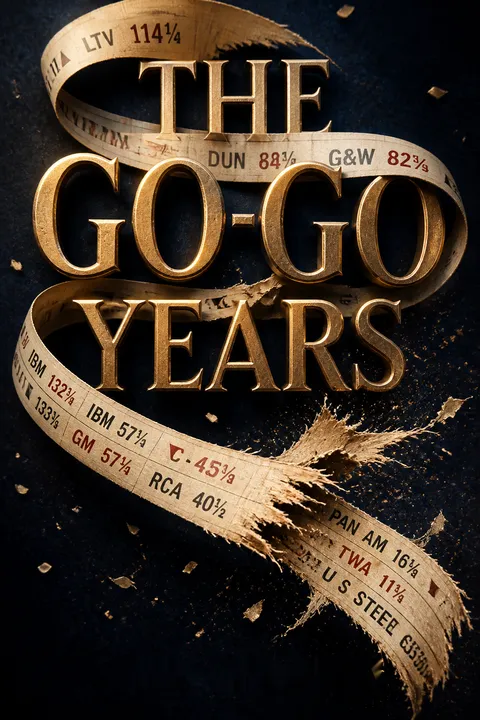
History repeats itself. The 1960s bull market, culminating in the 1970 crash, mirrored the 1929 boom and bust in unsettling ways, despite assurances that such a disaster could never happen again due to new regulations. Both periods saw:
- Progressively unfettered speculation
- Huge, shaky financial pyramids (investment trusts/holding companies in 20s, conglomerates in 60s)
- Star market operators (Jesse Livermore in 20s, Gerald Tsai in 60s)
- Insider manipulation and slack ethics moving from fringes to the center of Wall Street.
Market's detachment. The market often seemed to operate in a euphoric bubble, detached from underlying economic realities or national crises. In 1968, as the nation faced assassinations, riots, and war, the market "heedlessly soaring upward as if everything were O.K." This detachment highlighted a fundamental lack of "human soul" in market behavior, prioritizing profit over peace or social stability.
Consequences of forgetfulness. The repeated patterns underscored a tragic human tendency to ignore historical lessons, especially when the lure of easy money is strong. Each boom fostered a belief in a "new economic era" where old rules no longer applied, only to be met with a painful return to reality.
2. Wall Street's Shifting Identity: From Club to Public Arena
Wall Street as a social context—a place to have one’s being half of one’s waking weekday hours—had changed in a generation probably more than it had ever previously changed in a lifetime; but it had not had its real revolution.
Erosion of the Old Establishment. The 1960s marked a significant shift from Wall Street's traditional image as an exclusive "private club" dominated by Protestant gentlemen. The exposure of figures like Richard Whitney and the Amex scandal revealed the moral decay within this old guard, paving the way for new entrants and a more performance-driven culture.
Democratization and diversity. While still far from equitable, the decade saw cracks in the old prejudices against women and minorities.
- Muriel Siebert became the first woman NYSE member.
- Shearson Hammill opened a Harlem office, channeling institutional business to a black community.
- Joseph Louis Searles III became the first black NYSE member.
These were initial steps towards a more inclusive, albeit still challenging, environment.
New power dynamics. The rise of institutional investors like mutual funds transformed the market from one driven by individual emotions to one dominated by large entities. This shift, paradoxically, brought back the "star system" for individual portfolio managers, but also created new problems of scale and influence.
3. The Rise of Go-Go Investing and Performance Culture
The term “go-go” came to designate a method of operating in the stock market—a method that was, to be sure, free, fast, and lively, and certainly in some cases attended by joy, merriment, and hubbub.
Birth of "Go-Go". Originating in Boston, the "go-go" investment style, characterized by rapid, high-volume trading for quick profits, revolutionized mutual fund management. This aggressive approach, pioneered by figures like Edward Crosby Johnson II and Gerald Tsai, Jr., broke from conservative trustee traditions.
Tsai's meteoric rise. Gerald Tsai, a Chinese immigrant, became the era's first "money magician," known for his "catlike quickness" in market timing and concentrating investments in speculative growth stocks. His success with Fidelity Capital Fund, achieving nearly 50% annual returns, made him a national celebrity and a "stock manipulator in spite of himself" as investors blindly followed his moves.
Hedge funds emerge. Parallel to public mutual funds, private "hedge funds" like A.W. Jones and Company catered exclusively to the rich. These funds, exempt from public regulation, used aggressive strategies like margin trading and short selling to maximize returns, often outperforming the broader market significantly. They represented the "parlor cars of the new gravy train," offering exclusivity and high returns to their affluent partners.
4. Conglomerates and Creative Accounting: Illusions of Growth
The simple mathematical fact is that any time a company with a high multiple buys one with a lower multiple, a kind of magic comes into play.
The conglomerate craze. The mid-1960s saw the explosive growth of conglomerates like Ling-Temco-Vought, Rapid-American, and Gulf and Western, which diversified rapidly through mergers across unrelated industries. This trend was fueled by:
- Corporate affluence and a decline in the "stick-to-your-last" philosophy.
- Business schools promoting management as an absolute, transferable skill.
- Antitrust laws encouraging "exogamous" mergers.
Accounting as "creative art." A key driver of conglomerate growth was "creative accounting," which allowed companies to artificially inflate reported earnings per share. By acquiring companies with lower price-to-earnings multiples, conglomerates could show immediate, illusory earnings growth without actually increasing business. Accountants, under pressure, often chose methods that presented the most favorable financial picture, misleading naive investors focused solely on the "bottom line."
Pyramiding and deception. The conglomerate game became a form of pyramiding, where apparent earnings growth drove up stock prices, enabling further acquisitions and more "creative" reporting. This system, often involving "funny money" like convertible debentures and warrants, diluted existing equity and confused investors. The profession of accountancy, once seen as a bastion of probity, "lost its soul" by becoming complicit in these deceptive practices, failing to protect the public.
5. The Paperwork Crisis and Back-Office Breakdown
It was the year Wall Street nearly committed suicide by swallowing too much business, and by compounding its own near-fatal folly by simultaneously encouraging more of the same.
Overwhelmed infrastructure. The speculative frenzy of 1968 led to unprecedented trading volumes, pushing Wall Street's antiquated back-office operations to the brink of collapse. The system, designed for a smaller, less active market, simply could not process the sheer volume of transactions.
"Fails" and "D.K.s". The crisis manifested in massive "fails" (failure to deliver stock certificates on time) and "Don't Knows" (rejected deliveries due to record discrepancies).
- NYSE fails reached $4.12 billion by December 1968.
- 25-40% of all broker deliveries to banks were rejected.
This chaos led to millions of dollars in stolen securities and a complete breakdown of trust in record-keeping.
Human element and complacency. The back offices were staffed by young, low-paid, and often demoralized employees who found their routine jobs unfulfilling. Wall Street's leadership, driven by greed for commissions, was slow to implement drastic solutions, preferring "timid" measures like early closings over fundamental reforms. The lure of "potsfull of short-term money" overshadowed the need for long-term order, illustrating a systemic failure of self-regulation.
6. Challenging the Establishment: Takeovers and Political Pressure
In that takeover contest, the roles of Goliath and David were played, with exceptional spirit, by William Shryock Renchard of the Chemical and Saul Phillip Steinberg of Leasco.
David vs. Goliath. The era was marked by audacious takeover attempts where young, fast-growing companies challenged venerable, established institutions. The most famous was Saul Steinberg's Leasco Data Processing Equipment Corporation (assets $400 million) attempting to acquire the Chemical Bank New York Trust Company (assets $9 billion).
Steinberg's strategy. Steinberg, a Wharton graduate and pioneer of computer leasing, aimed to leverage Leasco's high stock multiple and the "redundant capital" of financial institutions. His successful acquisition of Reliance Insurance Company, a firm ten times Leasco's size, demonstrated his aggressive, innovative approach.
Establishment's defense. Chemical Bank, led by William Renchard, mounted a fierce defense, mobilizing its vast network of influence. This included:
- Leaking information to the press to force Leasco's hand.
- Pressuring Leasco's investment bankers to withdraw support.
- Lobbying state and federal legislators to introduce anti-takeover bills.
- Allegedly orchestrating a "bear raid" on Leasco's stock, causing its price to plummet.
The power of the old guard. Despite Steinberg's initial confidence and strategic brilliance, the combined forces of the banking establishment and government proved too formidable. Steinberg's eventual withdrawal, though framed as a voluntary decision, underscored the enduring power of the "Establishment" when its core institutions were threatened.
7. Moral Compromises and Regulatory Lapses
The evidence is that, as such things go, he had not. E.D.S., in issuing such a small number of shares to the public, had indeed, it appears in retrospect, subjected the public to a considerable degree of risk.
Erosion of ethics. The pursuit of quick profits led to widespread moral compromises across Wall Street. Brokers engaged in "churning" (excessive trading to generate commissions), mutual funds inflated asset values with "letter stock" (unregistered, illiquid shares), and underwriters peddled "garbage stocks" with flimsy "stories."
Regulatory complacency. The S.E.C., under Nixon's administration, adopted a "passive and permissive" stance, leading to a "demoralization unequalled since the Eisenhower administration." This hands-off approach, despite clear warnings of speculative excess, allowed abuses to flourish.
- S.E.C. chairman Hamer Budge's flirtation with a high-paying industry job while in office exemplified the lax ethical climate.
- The S.E.C.'s accounting department failed to curb "creative accounting" practices until it was too late.
The Wall Street Ministry. Amidst the moral decay, the Wall Street Ministry, led by Francis C. Huntington, emerged as a "still, small voice" attempting to address the "gutsy problems" and "spiritual malaise" among financial professionals. Their work revealed widespread guilt and frustration among brokers pressured to prioritize profit over customer interest.
8. The 1970 Crash: A Middle-Class Calamity Averted
What resulted, in fact, was a middle-class crash, productive of severe discomfort rather than disaster.
The market's descent. The 1970 crash, though less dramatic in Dow terms than 1929, was far more widespread in its impact. While the Dow dropped 36%, a "neo-Dow" of glamour stocks (conglomerates, computer, technology) plummeted an average of 81%, comparable to 1929.
Wider investor base. The number of American stock owners had swelled from 4-5 million in 1929 to 31 million in 1970. This meant the $300 billion in paper losses (ten times the 1929 figure) affected a much larger segment of the population, particularly the middle class who had entered the market during the boom.
Regulation's saving grace. Crucially, the 1970 crash did not lead to the widespread personal tragedies and suicides of 1929. This was largely due to New Deal reforms, particularly the Federal Reserve's margin requirements (80% cash in 1970). This regulation prevented investors from being wiped out entirely, turning a potential catastrophe into "severe discomfort." The Penn Central bankruptcy, a major corporate failure, was also contained by swift Federal Reserve action, preventing a systemic financial collapse.
9. The Heroic Rescue of Wall Street's Infrastructure
If you had once lost your nerve, we would have gone down with all hands lost.
Brokerage capital crisis. The simultaneous decline in stock prices and trading volume in 1969-1970 exposed the "unsafe and unsound" capital structure of Wall Street brokerage firms. Many firms relied on "phantom capital" (securities loans, subordinated notes) that evaporated in a downturn, leading to widespread insolvencies.
The Crisis Committee. Faced with a cascade of failures, the New York Stock Exchange formed a "Surveillance Committee" (Crisis Committee) led by Bernard "Bunny" Lasker and Felix Rohatyn. This unlikely duo, a conservative floor trader and a liberal investment banker, worked tirelessly to prevent a total collapse.
Desperate measures. The committee undertook heroic, often controversial, actions:
- Doubled the Exchange's Special Trust Fund by diverting building funds.
- Lent $5 million to Hayden, Stone, a failing firm, to keep it afloat.
- Orchestrated mergers, such as Merrill Lynch's acquisition of Goodbody, by offering substantial indemnities.
- Persuaded Ross Perot to inject $55 million into F.I. du Pont, effectively buying control of the venerable firm.
Averted catastrophe. These desperate, round-the-clock efforts, often involving political pressure and personal appeals, prevented a systemic collapse of the American securities market. The alternative was a "panic the likes of which we have never seen," with millions of investors wiped out and a government takeover of Wall Street.
10. Enduring Lessons: The Illusion of Expertise and the Need for Reform
The conclusion is inescapable that almost 11 million persons invested in the stock market for the first time between 1965, when the Dow stood just under 1,000, and mid-1970, when it stood at around 650.
Investor gullibility. The go-go years demonstrated that even sophisticated investors and institutions could be swayed by speculative madness and "fool's gold." The Wharton School study concluded that random stock selection would have yielded better returns than expert mutual fund management in the 1960s, highlighting the "fantasy born of mass hysteria."
Limits of disclosure. While federal regulations mandated "full disclosure," this proved "largely a failure" in protecting the small investor. Complex accounting tricks and the sheer volume of information meant that "truthful disclosure could be made to tell lies to the untutored and the unwary." Investors were often unable to understand the true risks, relying instead on the compromised judgment of brokers and fund managers.
Perpetual need for reform. The crisis led to significant reforms, including the creation of the Securities Investor Protection Corporation (Sipic) and the democratization of the NYSE's governing structure. However, the underlying human tendencies of greed and gullibility remain constant. As Bunny Lasker presciently warned in 1972, "I can feel it coming, S.E.C. or not, a whole new round of disastrous speculation... and, damn it, I don’t know what to do about it." The best protection for the amateur investor, perhaps, lies in understanding this inherent disadvantage.
Review Summary
The Go-Go Years receives mixed reviews averaging 3.82/5. Readers appreciate its historical relevance to today's markets, witty writing style, and insights into 1960s Wall Street culture, boom, and subsequent crash. Warren Buffett recommends it. However, critics find it dated, published in 1973 without updates, overly dense with biographical details, lacking cohesion, and sometimes boring. Many note it's less polished than modern financial histories like Michael Lewis's work, though some value it as a time capsule showing recurring market patterns of speculation, regulation failures, and euphoria preceding crashes.
People Also Read




About the Author
Other books by John Brooks
Download PDF
Download EPUB
.epub digital book format is ideal for reading ebooks on phones, tablets, and e-readers.








































