

Key Takeaways
You might be an otrovert: popular yet permanently outside the group
Non-belonging is a personality trait, not a disorder. Psychiatrist Rami Kaminski coined "otrovert" from the Spanish "otro" (other) and "vert" (direction): one who faces a different way than everyone else. Unlike introverts (who face inward) or extroverts (who face outward), otroverts stand inside any group yet never feel part of its shared identity. They can be charming, funny, and well-liked, which makes their isolation invisible even to themselves.
The tell is emotional, not behavioral. Kaminski's patient A, a straight-A high schooler invited to every party, skipped most of them without distress. He felt lonely in crowds but content one-on-one or alone. No autism, no anxiety, no depression. Just an innate inability to feel belonging. Kaminski estimates otroverts are a small minority, present across every culture, race, and gender.
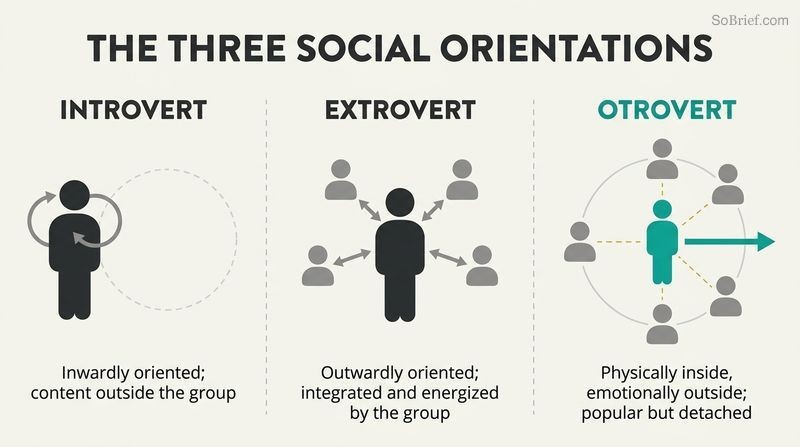
What's striking is how Kaminski carves a new category out of terrain long claimed by introversion. Susan Cain's "Quiet" made introverts legible; Kaminski argues a subset of "loners" were misfiled. The distinction holds up phenomenologically: energy drain (introversion) differs from group-identity blindness (otroversion). Still, the binary claim (you either are or aren't) invites scrutiny. Personality traits typically distribute along continua, and belonging itself is context-dependent. A skeptic might ask whether "otrovert" describes a stable type or a self-recognition that reframes ordinary difference. Yet the reframe has clear therapeutic value: naming an experience often dissolves the shame attached to it.
Connection and belonging are different; you can have one without the other
Society conflates two separate things. Belonging means feeling at one with a group. Connection means genuine closeness with an individual. Kaminski insists you do not need the first to have the second. Otroverts prove it: they cannot bond with a group as a unit yet form intense one-on-one relationships with each person inside it.
This distinction reframes the loneliness epidemic. The US Surgeon General and countless thinkers prescribe more community, more social networks, more local involvement. Yet society keeps getting lonelier and more divided. Kaminski's diagnosis: we keep pushing belonging (tribalism) when what people actually crave is connection. He points to polarized politics as proof that tribal identity breeds hostility, not safety. An otrovert on a cruise returns feeling more alone; a communal person makes friends by the time the ship docks.
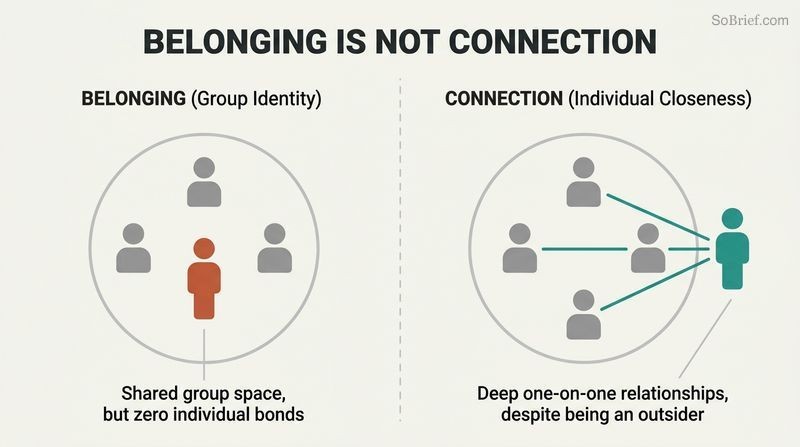
This separation is the book's most transferable idea, and it lands beyond otroverts. Robert Putnam's "Bowling Alone" documented collapsing civic membership, but Kaminski suggests the metric was wrong: we counted group affiliations, not intimate bonds. Research on social health supports him. Studies consistently find that a few high-quality relationships predict wellbeing better than a large network. The nuance worth adding: belonging and connection often reinforce each other for communal people, and shared group ritual can be a scaffold on which individual bonds grow. Kaminski treats them as cleanly separable, which is true for otroverts but perhaps overstated as a universal prescription.
Stop trying to fix the outsider inside you; belonging is optional
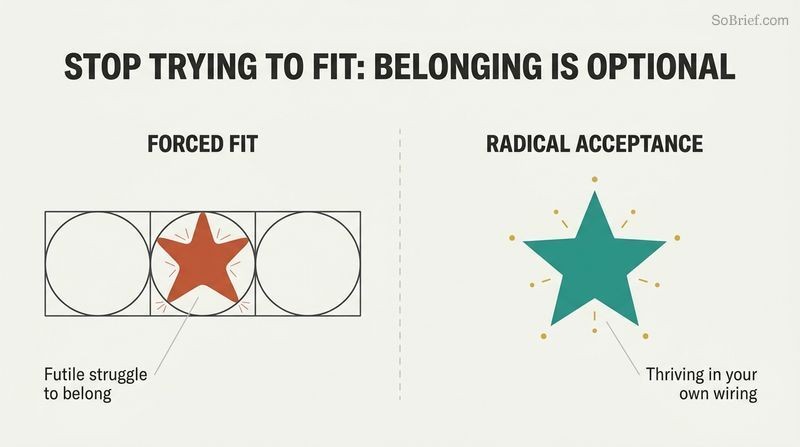
Trying to belong is futile for otroverts, so quit. Kaminski compares otroversion to left-handedness: a hardwired cognitive feature, not a defect to correct. For centuries teachers forced left-handed children to switch hands, causing needless suffering. Forcing otroverts to "be team players" does the same.
Liberation comes from acceptance, not adaptation. Kaminski's patient T, bedridden for two years and diagnosed with a parade of disorders, was not mentally ill: she was an otrovert crushed by a rigid family. Once she accepted her non-belonging as wiring rather than failing, she moved to a Caribbean island and became a diving instructor. The therapeutic goal Kaminski sets for every patient: end treatment happy to be who they are. For otroverts, that means the opposite of the usual advice to socialize more.
There is genuine clinical courage in Kaminski tapering an eighteen-year-old off antipsychotics because the schizophrenia diagnosis never fit (patient E). It echoes a broader critique in psychiatry, associated with figures like Thomas Szasz and the antipsychiatry tradition, that the field sometimes pathologizes deviation from social norms. Kaminski avoids their extremism; he still treats real illness. The caution: "you are wired this way, stop trying" is empowering but risks becoming an excuse to avoid all discomfort. Exposure therapy works precisely because some avoidance is maladaptive. The art, which Kaminski captures, is distinguishing an innate trait from a treatable fear.
Skip the events you dread; almost nobody will actually notice
Separate necessary from unnecessary obligations. Kaminski's patient J, drowning in family events, flew across the country for a second cousin's wedding he dreaded. Together they sorted his commitments: necessary ones (career, immediate family) versus unnecessary ones done purely from social pressure (multiday wedding weekends, happy hours). Most of what drained J was unnecessary.
The feared social penalty is largely imaginary. When J started declining, nothing happened. People who liked him kept liking him; people who did not kept not caring. Because otroverts are hyperaware of individuals, they wrongly assume everyone is tracking their absence. In reality, communal people focus on the group, not any single missing member. Kaminski confesses his own comedy of ducking into a far bathroom repeatedly at his daughter's school reception, concluding he should have simply stayed home.
This is cognitive behavioral therapy in disguise. The "spotlight effect," documented by psychologist Thomas Gilovich, shows people systematically overestimate how much others notice them; in one experiment, students wearing an embarrassing shirt guessed twice as many peers noticed as actually did. Kaminski's advice operationalizes that finding: audit obligations, decline the discretionary ones, watch the sky not fall. The permission-to-leave framing is liberating and low-risk. A fair pushback: reciprocity is real currency in relationships and careers, and repeatedly skipping shared rituals can quietly erode goodwill in ways that surface only years later. The trick is spending social capital deliberately, not spending it on autopilot.
Give yourself a role and any crowd becomes bearable
A defined role dissolves group discomfort. Many otroverts are what Kaminski calls "pseudo extroverts": awkward in unstructured crowds but charming when handed a task that sets them apart. The mechanism is simple. A role (host, DJ, keynote speaker, coach) creates a socially acceptable boundary between the otrovert and everyone else, aligning their outer experience with their inner sense of difference.
Kaminski lived this at fourteen. Volunteering at a hospital, he wheeled a candy cart room to room and wore a white coat, imagining patients mistook him for a prodigy doctor. He hid the embroidered word "volunteer" with his hand to protect the illusion. His patient DC, paralyzed by anxiety in crowds, had zero stage fright at a podium, because public speaking is the ultimate assigned role. A teenager Kaminski knows attends parties only as the DJ.
The insight reframes stage fright counterintuitively: the podium, which terrifies most people, can calm the otrovert because it converts an ambiguous social swarm into a clear script. This dovetails with sociologist Erving Goffman's dramaturgical theory, where all social life is performance, but Kaminski adds a twist. For otroverts, an explicit role reduces load rather than adding it, because the exhausting part was never performing; it was the choreography of undefined belonging. Practically, this is gold for anyone socially drained: volunteer to run the grill, take photos, manage the playlist. The boundary the task provides is protective, not antisocial.
True empathy imagines their shoes, not yours in their shoes
The Golden Rule has a hidden flaw. "Do unto others as you would be done to" assumes everyone wants the same treatment. Communal empathy asks: what would I do in your situation? That inserts your values between you and the other person, which is really judgment in disguise. Otroverts instead imagine what you would do, seeing your circumstances through your eyes.
This stems from a compensation. Kaminski describes the "Bluetooth phenomenon," the automatic passive signal communal people use to read a room and feel less alone in a crowd. Otroverts lack it, so a room of strangers feels overwhelmingly lonely. To compensate, they pay granular attention to each individual. That same burdensome habit becomes their gift one-on-one: bespoke, nonjudgmental empathy. As a boy, Kaminski involuntarily "read" everyone he passed on the street.
Kaminski is drawing a distinction psychologists formalize as the gap between projection and perspective-taking. Nicholas Epley's research on "mind-reading" shows people are surprisingly bad at inferring others' thoughts precisely because they anchor on their own. The otrovert's edge, if real, is decoupling from that anchor. It resembles what Carl Rogers called unconditional positive regard, the therapist's suspension of judgment. One caveat: truly reading another's inner world without projecting is extraordinarily hard, and Kaminski offers clinical intuition rather than data. Still, the practical reframe is sharp. Ask what this person, given their history and values, actually needs, not what you would want in their place.
We are all born otroverts, then trained out of it
Belonging is taught, not innate. Kaminski challenges the standard evolutionary story that humans are hardwired to belong. He distinguishes the attachment impulse (a genuine survival instinct binding infants to caregivers) from the desire to belong to groups (learned). Infants are pure solipsists who know only themselves. Around age three, caregivers begin drilling "share," "wait your turn," rewarding communal behavior with hugs and praise.
Most children absorb this; otroverts cannot. No cognitive conditioning happens on so universal a scale, Kaminski argues. Parallel play gives way to interactive play, and the self-centered toddler is "railroaded" into communality. Otroverts are the exception who never subordinate their inner world. Kaminski recalls reciting the Israeli Scout pledge at ten and feeling, for the first time, profoundly foreign among his own friends, watching the ritual as if from a distance.
The nature-nurture wrinkle here is provocative and only partly settled. Developmental psychology broadly agrees that prosocial norms are scaffolded through socialization, yet infant research (Paul Bloom's work at Yale) suggests babies show rudimentary preferences for helpers over hinderers before language, hinting the social impulse has innate roots too. Kaminski's split between attachment and belonging is cleaner than the evidence. But his deeper point stands, and it is bracing. The universal childhood project of trading self-centeredness for approval is so normalized we never question its cost. That so many adults cannot locate their own desires beneath group expectations suggests the training sometimes overshoots.
Original breakthroughs come from single minds resisting the hive
The collective never invents; it only expands. Kaminski argues true creativity, the act of making something that never existed, starts in one mind unencumbered by what the group considers "good." Otroverts are natural originators for two reasons: they are impervious to collective opinion about quality, and they need no one's approval, so they create without inhibition or fear of judgment.
History rewards this, brutally and belatedly. Dr. Ignaz Semmelweis observed that doctors who washed hands after autopsies before deliveries cut maternal death from 18% to 2%. Unable to explain why (germs were unknown), he was shunned, fired, committed to an asylum, and died of sepsis at forty-seven. Kaminski's own "Second Chance Program" reexamined psychiatric patients labeled non-responders, discovering many were misdiagnosed or not ill at all, and returned hundreds to the community.
Kaminski joins a long line, from John Stuart Mill to Thomas Kuhn, arguing that dissent is the engine of progress and consensus its brake. Kuhn's "paradigm shift" describes exactly the Semmelweis tragedy: a discovery that violates the reigning framework gets rejected regardless of evidence. What Kaminski adds is a psychological mechanism, that immunity to social proof is a prerequisite for the insight itself. The romance of the lone genius deserves a check, though. Modern science is overwhelmingly collaborative, and even Einstein built on Lorentz and Poincare. The steelman: origination and elaboration are different acts, and Kaminski claims otroverts excel at the first, not that they work alone forever.
Your inner world is the one place immune to social rules
Police your actions, never your thoughts. Most people, fearing exposure, apply society's rules to their own minds, feeling guilty for petty envy or jealousy they cannot control. Kaminski calls this a trap. Otroverts maintain a hard boundary between inner and outer worlds: they indulge every covetous or unattractive instinct privately, without shame, because thoughts cannot be right or wrong if you do not act on them.
Neglecting the inner world backfires. When we suppress private thoughts to align with the hive, we lose access to our instincts, our "gut feeling" for big decisions. Kaminski argues burnout, midlife crisis, and depression can stem from closing ourselves off to our own dreams and desires. Otroverts, tuned to their rich inner lives, reach psychedelic depths of imagination without drugs, treating memory in unspeakable feelings rather than tidy words.
The claim that mental freedom requires abandoning self-censorship of thought aligns with a robust finding in clinical psychology: thought suppression rebounds. Daniel Wegner's "white bear" experiments showed that trying not to think something makes it more intrusive. Acceptance and Commitment Therapy builds on this, teaching patients to let thoughts pass without judgment, exactly Kaminski's prescription. The distinction between having a feeling and enacting it is also the bedrock of moral maturity. Where Kaminski romanticizes, perhaps, is the assumption that a vivid inner life is inherently superior to communal engagement. Rumination, after all, is also an inner life, and for many the outer world is a healthy corrective to a mind left alone too long.
Match your career to your wiring: soloists cannot play in orchestras
Work is the obligation otroverts cannot opt out of, so choose it carefully. Kaminski's patient D, a talented HR manager, kept flaming out: fresh energy, then fatigue, then depression, on repeat. Nothing bad happened at work; the workplace itself drained her. The culprit was not HR but the corporate environment of meetings, office politics, and consensus. She opened her own consultancy and, eight years on, looks forward to Mondays.
Design around your comfort zone. Kaminski's ideal otrovert job includes:
1. Nonconventional thinking as a core requirement
2. Balance of solitude and contact, never an open-plan "always on" setting
3. A clearly defined, differentiating role
4. A path toward self-employment or leadership
5. Creative work with a predictable routine
Einstein conceived relativity as a patent clerk: enough structure to anchor his days, enough solitude to think.
This is vocational psychology with a sharp edge. The person-environment fit literature (John Holland's theory) has long argued satisfaction depends on matching traits to settings, but Kaminski personalizes it for the non-belonger. His observation that otroverts cannot barter (good pay and long vacations will not compensate for daily drudgery) reflects research on intrinsic versus extrinsic motivation: Deci and Ryan's self-determination theory shows autonomy is a non-negotiable psychological need, more so for some. The rise of remote and freelance work validates Kaminski's prescription in real time. The limitation is privilege. Not everyone can quit for consultancy, and "design your ideal environment" assumes economic latitude many workers lack.
Mixed otrovert-communal couples succeed by confronting differences early
Two otroverts bond fast and clean. They respect boundaries, feel no jealousy over each other's achievements, and carry none of the identity baggage (religion, class, ethnicity) that fuels conflict in communal couples, because they feel no allegiance to those categories anyway.
Mixed couples must work harder, which is a feature, not a bug. The otrovert's aloofness, ritual-resistance, and group awkwardness surface early and starkly, forcing the couple to negotiate differences most partners paper over. Practical solutions abound: the social spouse attends parties solo without resentment; couples set a predetermined exit time and cover story so the otrovert is not silently desperate to leave while the partner enjoys friends. Kaminski's core reassurance to R, a single otrovert who feared she needed another non-belonger: an otrovert needs to be accepted, not necessarily understood.
The counterintuitive claim, that a relationship's obvious early friction predicts strength, has empirical backing. John Gottman's decades of marriage research found that couples who engage conflict constructively fare better than those who avoid it, and that most perpetual disagreements are managed, not solved, exactly Kaminski's "matter of degree" framing. The exit-strategy tactic is a small masterpiece of relational engineering, converting a source of resentment into a pre-negotiated contract. Where Kaminski is optimistic: he assumes the communal partner will extend acceptance without full understanding, which demands unusual emotional generosity. Many partners experience persistent ritual-avoidance not as charming difference but as rejection of shared life.
The only thing you truly own is your mind and your memories
Belonging is a fiction; memory is the one secure asset. Kaminski argues nothing truly belongs to us, not possessions, not even our bodies, which we lease for eight or nine decades. Friendships and relationships can be lost too. But memories are stored where no one can take them, making every investment in creating good ones a secure deposit.
This shapes how otroverts die. Kaminski's patient U, whom he treated from ages ninety-three to ninety-eight, faced death without fear: "I lived my personal life, and I will die my personal death." Communal people, he observes, often reach the end saddled with regret, discovering that togetherness was an illusion precisely when they face the solitary exit no group can join. Otroverts, having lived a solitary journey all along, arrive cheerful. The practical lesson for everyone: curate memories deliberately, and learn to be at peace with yourself.
Kaminski's closing turns Stoic. Epictetus drew the same line between what we control (our judgments, our inner life) and what we do not (possessions, reputation, the body), locating freedom entirely in the former. The claim that death exposes belonging as illusion is bracing but contestable. Palliative care research (Atul Gawande's "Being Mortal") finds that connection and being known often ease dying rather than reveal its futility, and hospice patients frequently draw comfort from family presence. Kaminski's U may be exceptional rather than representative. Yet the actionable core, that a strong relationship with yourself is the one asset that compounds and never gets repossessed, is wisdom regardless of temperament.
Analysis
"The Gift of Not Belonging" is a hybrid: part clinical memoir, part personality taxonomy, part self-help manifesto, built around a single coined term. Rami Kaminski, a psychiatrist of four decades, argues that a small, unrecognized minority (otroverts) are wired to observe groups without ever feeling part of them, and that this trait, misread as pathology, is actually a source of empathy, originality, and contentment. The book's structure moves from definition, through misdiagnosis, to virtues, to life stages, ending at death.
The intellectual move worth noticing is boundary-drawing. Kaminski's real contribution is not discovering a new kind of person so much as disaggregating experiences we lump together: introversion from otroversion, connection from belonging, attachment from the communal impulse, thought from action. Each distinction has therapeutic payoff, and the strongest, connection versus belonging, deserves a wider audience than the otrovert niche. It reframes the loneliness epidemic as a category error: we prescribe more group membership when people hunger for individual intimacy.
The book's vulnerability is its binary insistence. Personality science overwhelmingly favors continua over types, and "you either are or are not" sits uneasily beside that consensus. The evidence is clinical anecdote, not data, and the otroverts profiled are conspicuously gifted (a future PhD, an emerita professor, Einstein, Kafka, Frida Kahlo), which risks conflating a temperament with talent and privilege. Skeptics will note that self-recognition in a flattering category is itself a powerful, unfalsifiable draw.
Yet the pragmatic core is sturdy and humane. Kaminski's clinical instinct, tapering a misdiagnosed patient off antipsychotics, launching a Second Chance Program for warehoused "non-responders," reflects a career spent resisting diagnostic groupthink, which lends his thesis lived authority. Whether or not "otrovert" survives as a category, the book delivers a durable message: stop performing belonging you do not feel, and build a life around the one relationship that never ends, the one with yourself.
Review Summary
The Gift of Not Belonging introduces the concept of "otroverts" - individuals who feel like outsiders and don't conform to social norms. Reviews are mixed, with some readers feeling deeply understood and others criticizing the lack of scientific evidence. Many appreciate Kaminski's insights on embracing uniqueness, while others find the theory poorly supported. Some reviewers relate strongly to the otrovert description, while others see it as a repackaging of existing personality types. The book's anecdotal approach and lack of citations are common criticisms, though many find the ideas thought-provoking.
People Also Read




FAQ
1. What is "The Gift of Not Belonging" by Rami Kaminski about?
- Explores the concept of otroverts: The book introduces and defines "otroverts," individuals who inherently lack the communal impulse to belong to groups, yet are empathetic, friendly, and often mistaken for introverts or outsiders.
- Challenges societal norms: Kaminski examines how society is structured for joiners and how those who don't fit in are often misunderstood or pathologized.
- Offers a new perspective: The book reframes non-belonging as a gift, highlighting the strengths, virtues, and unique contributions of otroverts to society.
- Blends personal and clinical insight: Drawing from his own life and decades as a psychiatrist, Kaminski uses stories, patient cases, and psychological theory to illustrate the otrovert experience.
2. Why should I read "The Gift of Not Belonging" by Rami Kaminski?
- Validation for outsiders: If you've ever felt like you don't fit in, the book offers understanding, reassurance, and a positive reframe of your experience.
- Insight for friends and family: It helps readers better understand and support the otroverts in their lives, whether children, partners, or colleagues.
- Practical advice: Kaminski provides actionable strategies for embracing non-belonging, navigating social pressures, and building a fulfilling life as an otrovert.
- Broader societal relevance: The book challenges the cultural obsession with belonging, offering a fresh lens on individuality, empathy, and creativity.
3. What is an "otrovert" according to Rami Kaminski?
- Definition of otrovert: An otrovert is someone who remains an eternal outsider in a communal world, not due to shyness, anxiety, or neurodivergence, but because of an innate lack of the communal impulse.
- Distinct from introverts and outsiders: Otroverts are often friendly, empathetic, and even popular, but never feel like true participants in groups, preferring one-on-one connections or solitude.
- Binary trait: Kaminski argues that otroversion is not a spectrum; you either are or are not an otrovert, much like being left-handed.
- Core qualities: Otroverts are non-joiners, observers rather than participants, nonconformists, independent thinkers, and emotionally self-sufficient.
4. How does "The Gift of Not Belonging" by Rami Kaminski distinguish otroverts from introverts, nonconformists, and neurodivergent individuals?
- Not introversion: Unlike introverts, otroverts are not shy or withdrawn; they are often outgoing and enjoy deep one-on-one connections but dislike group dynamics.
- Not just nonconformists: Nonconformists may still crave group belonging or rebel for attention, while otroverts are individualists by default, not by choice or philosophy.
- Not neurodivergent: Otroverts do not display the social or cognitive traits associated with autism or ADHD; their non-belonging is internal and not due to behavioral differences.
- Not marginalized outsiders: Otroverts are not excluded by others; they are often welcomed but simply do not feel a sense of belonging, regardless of social acceptance.
5. What are the main qualities and strengths of otroverts as described in "The Gift of Not Belonging"?
- Lack of communal impulse: Otroverts prefer solo activities, avoid group celebrations, and are uncomfortable in crowds or group settings.
- Observer mindset: They feel like outsiders even when included, rarely identify with group identities, and prefer not to mix different social circles.
- Nonconformity and originality: Otroverts are independent thinkers, often uninterested in popular culture, and confident in their unique perspectives.
- Emotional self-sufficiency: They do not seek validation from groups, are content with solitude, and possess strong self-awareness and self-reliance.
- Deep empathy and connection: Otroverts excel at one-on-one relationships, are highly empathetic, and can connect deeply without needing group affiliation.
6. How does Rami Kaminski explain the challenges otroverts face in a world made for joiners?
- Cultural pressure to belong: Society rewards joining and conformity from early childhood, making non-belonging seem abnormal or problematic.
- Misunderstanding and misdiagnosis: Otroverts are often mistaken for being shy, anxious, or suffering from a disorder, leading to ineffective interventions.
- Social exhaustion: Attempts to fit in or mask their true nature can lead to emotional fatigue, anxiety, or even depression.
- Difficulty in adolescence and work: The pressure to join is most intense during teenage years and in collaborative work environments, making these periods especially challenging for otroverts.
7. What practical advice does "The Gift of Not Belonging" offer for otroverts and their families?
- Embrace non-belonging: Accept and value your otrovert traits rather than trying to force yourself to fit in.
- Set boundaries: Learn to distinguish between necessary and unnecessary social obligations, and give yourself permission to decline group activities that drain you.
- Parenting otrovert children: Recognize and support their need for solitude and one-on-one friendships, avoid pushing them into group activities, and trust their instincts.
- Career choices: Seek work environments that allow for independence, creativity, and minimal group collaboration, and avoid roles that require constant teamwork or socializing.
8. How does "The Gift of Not Belonging" redefine empathy and connection for otroverts?
- Bespoke empathy: Otroverts don't assume others feel as they do; instead, they imagine what others experience from the other's perspective, leading to radical nonjudgmental empathy.
- One-on-one depth: They form deep, meaningful connections with individuals rather than groups, valuing quality over quantity in relationships.
- Dislike of small talk: Otroverts prefer genuine, substantive conversations and often find small talk or group rituals meaningless or irritating.
- Empathy as a strength: Their outsider perspective allows them to see individuals clearly, fostering authentic connection and understanding.
9. What are the virtues and benefits of being an otrovert, according to Rami Kaminski?
- Emotional self-sufficiency: Otroverts are comfortable with solitude, trust their instincts, and are less susceptible to peer pressure or groupthink.
- Originality and creativity: Their independence from the hive mind enables them to think outside the box and make unique contributions in art, science, and problem-solving.
- Contentment and confidence: Otroverts are less likely to experience FOMO, envy, or status anxiety, and are generally content with their choices and lifestyle.
- Rich inner life: They maintain a vibrant internal world, which provides fulfillment, resilience, and a source of creativity and self-renewal.
10. How does "The Gift of Not Belonging" address romantic relationships and work life for otroverts?
- Romantic compatibility: Otroverts thrive in relationships with partners who respect their need for solitude and individuality, whether or not the partner is also an otrovert.
- Communication and boundaries: Successful relationships require mutual understanding, clear boundaries, and acceptance of differences in social needs.
- Work environment fit: Otroverts excel in roles that allow for autonomy, creativity, and minimal group interaction, such as consulting, freelancing, or leadership positions with clear boundaries.
- Avoiding burnout: Recognizing and honoring their own needs helps otroverts avoid emotional exhaustion and find fulfillment in both personal and professional life.
11. What are the key takeaways from "The Gift of Not Belonging" by Rami Kaminski?
- Non-belonging is a gift: Otroverts' outsider status is not a flaw but a source of strength, creativity, and empathy.
- Society needs otroverts: Their independent thinking and empathy enrich collective wisdom and drive progress.
- Self-acceptance is crucial: Embracing one's otrovert nature leads to greater happiness, fulfillment, and authentic relationships.
- Redefining success: True success for otroverts is living in alignment with their own values and needs, not conforming to societal expectations.
12. What are the best quotes from "The Gift of Not Belonging" and what do they mean?
- "You are the captain, and this is your ship." – Kaminski emphasizes personal agency and the importance of charting your own course in life.
- "I was not an ugly duckling, nor was I a swan. I was another kind of bird altogether." – This highlights the uniqueness of otroverts and the value of embracing one's true nature.
- "The individual has always had to struggle to keep from being overwhelmed by the tribe." (Kipling) – Used to illustrate the challenge and necessity of maintaining individuality in a conformist world.
- "There is no gate, no lock, no bolt that you can set upon the freedom of my mind." (Virginia Woolf) – Celebrates the otrovert's inner freedom and independence of thought.
- "Freedom is the will to be responsible for ourselves." (Nietzsche) – Underscores the book's central message of self-ownership and the liberation that comes from accepting one's own path.
Download PDF
Download EPUB
.epub digital book format is ideal for reading ebooks on phones, tablets, and e-readers.








































