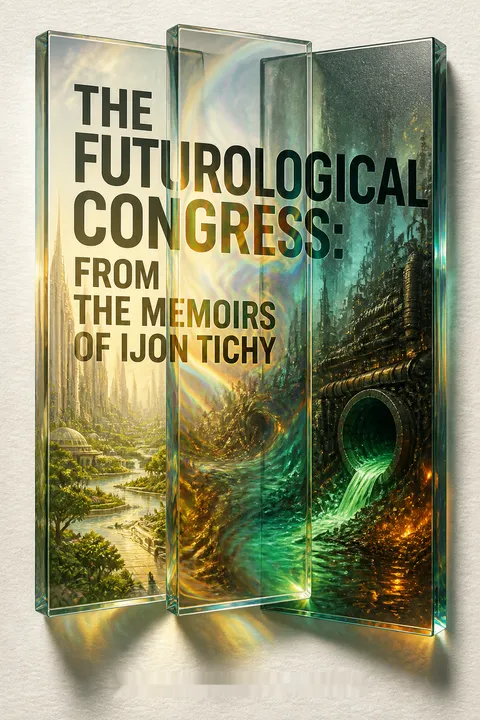

Plot Summary
Arrival at the Edge
Ijon Tichy, a seasoned space traveler, is persuaded by Professor Tarantoga to attend the Eighth World Futurological Congress in Costa Rica. The world is teetering on the brink of disaster—overpopulation, political unrest, and environmental collapse. The Hilton hotel, a fortress of modern excess, is filled with futurologists, journalists, and revolutionaries. Tichy, bemused and out of place, navigates a surreal landscape of security measures, bizarre amenities, and a society on the verge of chaos. The congress is meant to address humanity's gravest crises, but the atmosphere is one of denial and distraction, with the real world's problems seeping in through news of kidnappings, bomb threats, and political violence. Tichy's sense of reality begins to fray as he is swept into the tumultuous events that follow.
Congress of Catastrophe
The congress opens with a farcical display of scientific bureaucracy: hundreds of papers, each speaker allotted mere minutes, and discussions reduced to numerical codes. The topics—urban crisis, ecological collapse, energy shortages, and famine—are debated with a sense of impotence and absurdity. Proposals range from mass celibacy to architectural monstrosities, all failing to address the root causes of humanity's predicament. Outside, the city teeters on the edge of revolution, but inside, the congress is insulated by privilege and denial. Tichy observes the disconnect between the intellectual elite and the suffering masses, sensing that the solutions offered are as artificial as the hotel's comforts.
Chemical Utopia Unveiled
Tichy's reality is upended when he drinks the hotel's water, unknowingly dosed with powerful psychotropic drugs. He is overcome by waves of euphoria, love, and self-sacrifice, unable to feel anger or fear. The benignimizers in the water are part of a government experiment to pacify the population and quell unrest. Tichy's struggle to resist the chemical onslaught is both comic and tragic, as he battles himself to regain control. The episode reveals the fragility of free will in a society where emotions and perceptions can be chemically manipulated, foreshadowing the deeper dystopia to come.
Riot, Ruin, and Revelry
As the congress continues, violence breaks out in the city. Protesters, police, and military forces clash, and the hotel becomes a battleground. Chemical pacification agents are deployed, causing mass outbreaks of love and remorse among the authorities, while the revolutionaries and guests descend into orgiastic confusion. Tichy and a group of survivors, including Professor Trottelreiner, seek refuge in the hotel's sewers, donning oxygen masks to escape the psychotropic aerosols. The world above collapses into madness, and the boundaries between reality and hallucination blur as Tichy's ordeal intensifies.
Love Thy Neighbor Bombs
The government's attempt to suppress the uprising with "Love Thy Neighbor" bombs—airborne psychotropics—results in mass hysteria. Police and soldiers, overwhelmed by chemically induced love and guilt, abandon their posts, beg forgiveness, and even commit suicide. The revolution spirals out of control, and the city is plunged into anarchy. Tichy witnesses the grotesque consequences of chemical governance: self-flagellating publishers, penitent informers, and a society unable to distinguish between genuine emotion and pharmacological compulsion. The collapse of order is both farcical and horrifying, exposing the dangers of a society that seeks to engineer happiness.
Sewer Sanctuary
Tichy and his companions endure a nightmarish existence in the sewers beneath the ruined hotel. They draw lots for reclining chairs, ration oxygen, and fend off hallucinations induced by lingering chemicals. The boundaries between self and other, human and animal, blur as Tichy imagines himself turning into a tree, rats walk upright, and reality becomes increasingly unstable. The sewer becomes a symbol of refuge and despair—a place where the last vestiges of sanity are preserved, even as the world above succumbs to chaos and illusion.
Hallucination or Reality?
After a series of explosions and medical emergencies, Tichy awakens in a hospital, only to discover that his body has been replaced, his identity fragmented. He cycles through a series of bodies and hallucinations, never certain what is real. The world becomes a kaleidoscope of shifting forms and meanings, with Tichy's sense of self dissolving amid the chaos. The narrative fractures, mirroring Tichy's psychological disintegration and the collapse of objective reality in a world saturated with drugs and illusions.
Awakening in a New World
Tichy is eventually "defrosted" decades later in the year 2039, in a world transformed by technological and chemical advances. He is introduced to a society that has achieved peace and prosperity through universal disarmament and the pervasive use of "psychem"—psychoactive chemicals that regulate every aspect of life. The city is a garden, the air is clean, and people are perpetually cheerful. Yet Tichy senses something uncanny beneath the surface: language has changed, customs are bizarre, and reality feels artificial. He struggles to adapt, haunted by doubts about the authenticity of this utopia.
The Psychem Society
Tichy explores the intricacies of the psychemized world: emotions, knowledge, and even morality are regulated by drugs. People eat books, ingest opinions, and alter their personalities at will. Crime, love, and even religious experience are mediated by chemistry. The boundaries between reality and fiction, self and other, are blurred by the omnipresence of artificial experiences. Tichy is both fascinated and repelled by the society's reliance on pharmacological solutions, sensing that beneath the surface harmony lies a profound loss of freedom and authenticity.
The Masked Paradise
Tichy discovers that the apparent prosperity of the future is a carefully maintained illusion, sustained by "mascons"—drugs that mask the true state of the world. With the help of Professor Trottelreiner, Tichy uses an antidote to glimpse the reality behind the veil: poverty, overcrowding, and decay. The beautiful city is revealed as a squalid ruin, its inhabitants deformed and suffering, their misery hidden by layers of chemical deception. The revelation is shattering, exposing the moral and existential cost of a society that chooses illusion over truth.
The Art of Evil
Tichy encounters Symington, a designer at Procrustics, Inc., who explains the new art of "therapeutic evil." In a world where all desires can be fulfilled chemically, even malice and cruelty are commodified, safely channeled into harmless fantasies. The company manufactures experiences of evil, allowing people to indulge their darkest impulses without consequence. Tichy is horrified by the cynicism and moral bankruptcy of this system, which reduces virtue and vice alike to products for consumption. The conversation reveals the ultimate emptiness of a society that has abolished genuine moral struggle.
The Truth Behind the Veil
Professor Trottelreiner reveals the full extent of the mascon conspiracy: the entire society is kept docile and content through a complex regime of chemical illusions. Even the so-called "soothseers," tasked with perceiving reality, are deceived by counterfeit antidotes. The real world is one of scarcity, suffering, and impending ecological collapse, hidden beneath layers of pharmacological artifice. Tichy's attempts to pierce the illusion only lead to deeper layers of deception, as each antidote reveals a new, grimmer reality. The search for truth becomes a descent into madness.
The Soothseer's Dilemma
Tichy confronts Symington, now revealed as one of the elite "soothseers" who maintain the system of deception. Symington defends the necessity of the illusion, arguing that the masses cannot bear the truth and that the soothseers' sacrifice is a final act of compassion. Tichy rejects this rationalization, recognizing it as a self-serving justification for complicity in a monstrous lie. The confrontation escalates into violence, and Tichy flees, desperate to escape both the illusion and the reality it conceals.
The Collapse of Illusion
In a climactic act of rebellion, Tichy leaps from a window with Symington, plunging into the sewer below. The act is both literal and symbolic—a rejection of the false paradise and a return to the raw, unvarnished reality of suffering and struggle. The narrative loops back to the beginning, as Tichy finds himself once again in the sewer, surrounded by the survivors of the congress. The cycle of illusion and disillusionment is unbroken, and the future remains uncertain.
The Last Samaritans
The soothseers, the last custodians of truth, rationalize their role as necessary for the survival of civilization. They see themselves as the final Samaritans, bearing the burden of knowledge so that the masses may live in blissful ignorance. The moral ambiguity of their position is laid bare: is it better to live a happy lie or a painful truth? Tichy's refusal to accept either option leaves him isolated, a witness to the tragedy of a world that has sacrificed reality for comfort.
Return to the Sewer
The story closes with Tichy back in the sewer, the only place where reality, however grim, is unmasked. The congress resumes, the future remains unresolved, and Tichy's quest for truth is both futile and essential. The cycle of illusion and awakening continues, a testament to the enduring human struggle to reconcile hope and despair, freedom and security, truth and happiness.
Analysis
A prescient satire of engineered happiness and the loss of authenticityStanisław Lem's The Futurological Congress is a dazzling, disorienting exploration of a future where humanity's deepest problems—overpopulation, environmental collapse, and social unrest—are not solved, but chemically masked. Through the journey of Ijon Tichy, Lem exposes the dangers of a society that chooses comfort over truth, engineering emotions and perceptions to maintain order at the cost of freedom and authenticity. The novel's recursive structure and hallucinatory style mirror the instability of a world where reality is endlessly deferred, and identity is fluid. Lem's satire is both hilarious and chilling, skewering the pretensions of technocratic elites, the commodification of vice, and the seductive power of illusion. The ultimate lesson is a warning: the pursuit of happiness through artificial means may lead not to utopia, but to a nightmare of self-deception and moral bankruptcy. In an age of increasing technological mediation, The Futurological Congress remains a vital, unsettling meditation on the meaning of reality, the limits of control, and the irreducible complexity of the human condition.
Review Summary
Reviews for The Futurological Congress are overwhelmingly positive, averaging 4.17/5. Readers praise Lem's satirical brilliance, inventive neologisms, and prophetic vision of a drug-controlled dystopia. Many compare it favorably to Philip K. Dick and Aldous Huxley's Brave New World, noting its uncanny relevance today. The book's reality-bending narrative, dark humor, and philosophical depth captivate most readers, though some find the hallucinatory sequences confusing and the plot incoherent. Its brevity—roughly 130 pages—is frequently cited as a strength, delivering extraordinary density of ideas in compact form.
People Also Read


Characters
Ijon Tichy
Ijon Tichy is the protagonist and narrator, a space traveler and reluctant futurologist. His role is that of the bewildered everyman, thrust into a world he cannot control or fully comprehend. Tichy's psychological journey is one of increasing alienation: he is both participant and observer, never fully at home in any reality he encounters. His skepticism, humor, and stubborn refusal to accept easy answers drive the narrative. Tichy's relationships—with Tarantoga, Trottelreiner, Symington, and others—are marked by a mixture of camaraderie and distance. He is a vessel for the reader's own doubts and anxieties, embodying the existential crisis of a world where truth is elusive and identity is unstable. Tichy's development is a descent from naïve optimism to bitter disillusionment, tempered by a persistent, if futile, hope for authenticity.
Professor Trottelreiner
Trottelreiner is a Swiss futurologist and expert in psychotropic pharmacology. He serves as Tichy's guide and confidant, providing both comic relief and philosophical depth. Trottelreiner is deeply enmeshed in the system he critiques, oscillating between resignation and rebellion. His psychoanalytic insight and scientific expertise make him both a source of revelation and a symbol of the limits of knowledge. Trottelreiner's own identity is unstable—he is transplanted, rejuvenated, and ultimately reduced to a grotesque parody of himself. His relationship with Tichy is one of mutual dependence and rivalry, reflecting the broader tension between complicity and resistance in the face of systemic deception.
Professor Tarantoga
Tarantoga is the figure who persuades Tichy to attend the congress, setting the narrative in motion. He represents the rational, scientific approach to the world's problems, but is ultimately powerless to effect real change. Tarantoga's presence is felt more as an influence than as an active participant; he embodies the limitations of intellectual solutions in a world governed by irrational forces. His relationship with Tichy is paternal, urging him to confront uncomfortable truths, but he remains a distant, almost mythic figure.
George P. Symington
Symington is a pivotal figure in the latter half of the novel, representing the commodification of vice and the rationalization of systemic deception. As a designer at Procrustics, Inc., he creates experiences of evil for therapeutic consumption. Later revealed as a soothseer, Symington embodies the moral ambiguity of those who maintain the illusion for the supposed good of society. His relationship with Tichy is adversarial, a battle of philosophies and wills. Symington's psychological complexity lies in his ability to justify his actions while remaining haunted by doubt and guilt.
Aileen Rogers
Aileen is Tichy's nurse and guide in the future society. She represents the new humanity: cheerful, adaptable, and thoroughly psychemized. Her relationship with Tichy is affectionate but ultimately superficial, as she is unable to comprehend his existential anxieties. Aileen's willingness to mediate all emotions and decisions through chemistry highlights the loss of spontaneity and authenticity in the new world. She serves as both a comfort and a reminder of what has been lost.
Jim Stantor
Stantor is a reporter who moves through the narrative as an observer and commentator. He represents the media's role in both documenting and shaping reality. Stantor's cynicism and resourcefulness make him a survivor, but he is ultimately swept along by events beyond his control. His interactions with Tichy provide moments of clarity and dark humor, underscoring the absurdity of the world they inhabit.
Professor Dringenbaum
Dringenbaum is a Swiss futurologist whose bleak predictions about cannibalism and societal collapse serve as a counterpoint to the congress's empty optimism. He is methodical, detached, and resigned to humanity's fate. Dringenbaum's presence in the sewer, calmly editing his papers amid chaos, symbolizes the impotence of intellectual analysis in the face of overwhelming disaster.
Hotel Management
The Hilton managers, encountered in the sewer with their inflatable chairs and picnic supplies, represent the bureaucratic elite's ability to insulate themselves from catastrophe. Their focus on comfort and procedure, even in the midst of apocalypse, is both comic and tragic. They are survivors not through wisdom or courage, but through privilege and adaptability.
The Revolutionaries
The various revolutionaries, guerrillas, and protesters who disrupt the congress are less individual characters than embodiments of the forces of unrest and transformation. They serve to expose the fragility of the existing order and the inadequacy of the solutions proposed by the futurologists. Their actions drive the narrative into deeper levels of crisis and hallucination.
The Soothseers
The soothseers are the elite few who are permitted to perceive reality, tasked with maintaining the system of deception. They are both privileged and cursed, bearing the burden of knowledge that isolates them from the rest of humanity. Their psychological torment and rationalizations reflect the moral ambiguity at the heart of the novel.
Plot Devices
Hallucinogenic Reality
The central plot device is the pervasive use of psychotropic chemicals—benignimizers, mascons, and psychem—that alter perception, emotion, and even memory. This device allows Lem to explore the philosophical and ethical implications of a society where reality itself is subject to manipulation. The narrative structure mirrors this instability, with frequent shifts between hallucination and reality, unreliable narration, and recursive loops. Foreshadowing is used extensively: early episodes of chemical euphoria prefigure the later revelation of mass deception. The use of antidotes and counter-antidotes creates a hall of mirrors, where each layer of reality conceals another, more disturbing truth. The device serves both as a metaphor for ideological manipulation and as a literal mechanism of control.
Satirical Extrapolation
Lem employs satire and exaggeration to highlight the absurdities of modern life: bureaucratic futurology, commodified evil, and the reduction of all experience to consumption. The narrative is structured as a series of escalating crises, each more surreal than the last, culminating in the revelation that the entire society is built on illusion. The use of invented jargon, neologisms, and linguistic playfulness both disorients the reader and underscores the mutability of meaning in a world without stable reference points.
Recursive Narrative
The story is structured as a series of nested hallucinations and awakenings, with Tichy repeatedly questioning the reality of his experiences. This recursive structure reflects the central theme of epistemological uncertainty: how can one know what is real in a world where perception is endlessly mediated? The narrative's refusal to provide closure or certainty leaves the reader, like Tichy, suspended between hope and despair.
Ijon Tichy Series
About the Author
Other books by Stanisław Lem



Download PDF
Download EPUB
.epub digital book format is ideal for reading ebooks on phones, tablets, and e-readers.








































