

Key Takeaways
Two men born thirteen years apart decided who would own a continent
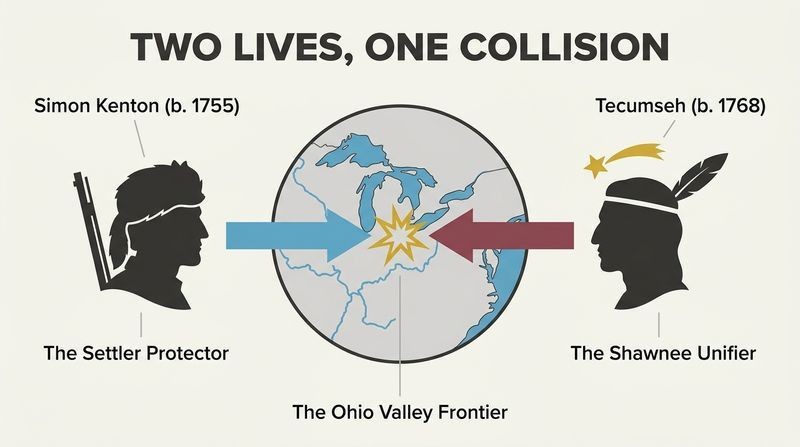
The book is a dual biography. Eckert braids two lives that never truly met until one identified the other's corpse. Simon Kenton, born 1755 in Virginia, fled west at sixteen believing he had killed a rival over a girl, reinvented himself as "Simon Butler," and became the Ohio Valley's most feared scout, land-claimer, and settler-protector. Tecumseh, born 1768 under a shooting star the Shawnee called The Panther Passing Across, grew into the visionary chief who nearly united every tribe east of the Rockies against white expansion.
Their arcs mirror each other. Both were physically magnificent, courageous, and beloved by their people. Both watched the world they knew dissolve. The frontier was not a place but a collision, and these two men were its opposing faces.
What's striking is Eckert's choice to humanize both sides equally, unusual for 1967 popular history. By granting Tecumseh the same interior life, eloquence, and moral seriousness as Kenton, the narrative resists the era's cowboy mythology. The technique echoes Plutarch's Parallel Lives, pairing adversaries to illuminate character through contrast. A caution for readers: Eckert reconstructs dialogue and inner thoughts from the Draper manuscripts, blending documented fact with novelistic license. The emotional truth is reliable; specific quoted lines should be read as informed reconstruction, not courtroom transcript.
Every "final" treaty was just the next line the whites would cross
Dispossession worked as a ratchet. Fort Stanwix, Camp Charlotte, Fort McIntosh, Fort Finney, Greenville: each treaty was sold to the tribes as the boundary that would hold forever, and each simply moved the line westward before the ink dried. Tecumseh saw the pattern with brutal clarity: peace treaties opened the floodgates rather than closing them, because settlers poured across any agreed border and the government followed to protect them.
The mechanism was legal theft. Chief Black Fish told surveyor Bullitt in 1773 that no tribe could sell Kentucky because it belonged to ancestral ghosts. Later, Harrison bought vast tracts from a handful of compliant chiefs who did not own or occupy the land, then defended the purchase "by the sword." The Shawnee learned that a signed paper meant nothing.
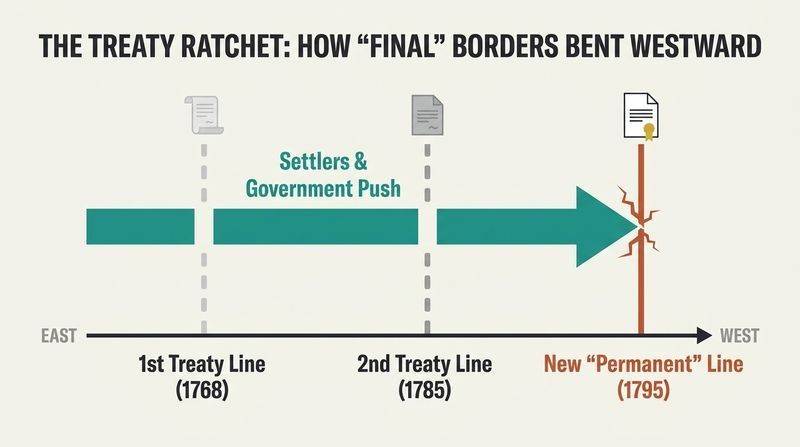
This is the book's grimmest structural insight, and it holds up against modern scholarship on settler colonialism. Historian Patrick Wolfe's framing, that settler colonialism is "a structure, not an event," describes exactly Eckert's ratchet: dispossession was not a series of accidents but a self-reinforcing system. The land-cession treaties functioned like predatory contracts signed under duress by parties without authority to sign. Tecumseh's counterargument, that no single tribe could cede land held in common by all, was a genuine legal and philosophical innovation, anticipating later doctrines of collective and inalienable indigenous title.
Tecumseh's genius: forge one people, not a coalition of tribes
Amalgamation, not confederacy. Earlier leaders like Pontiac and Little Turtle built alliances that dissolved once their charismatic center weakened or old tribal rivalries resurfaced. Tecumseh aimed higher: to erase tribal identity itself in favor of a single Indian nationhood, where the good of one tribe became the good of all and land could never again be sold piecemeal. He traveled thousands of miles, from Florida Seminoles to Missouri Sioux, arguing this vision.
His metaphor made it memorable. A single horsehair snaps easily, he told listeners, but a rope woven of many cannot be broken by the strongest man or wildest stallion. He demanded tribes bury ancient feuds, forbid alcohol, refuse alliance with any white faction, and wait for one coordinated signal rather than striking piecemeal.
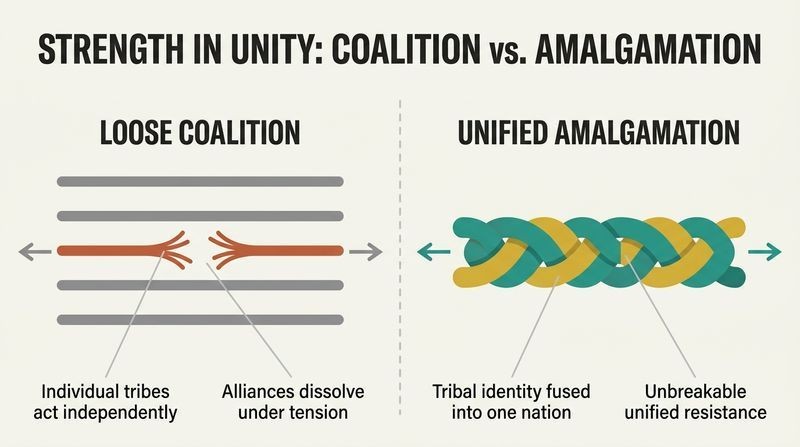
Tecumseh essentially proposed pan-Indian nationalism decades before nationalism became the organizing force of the nineteenth century. The parallel to contemporaneous European nation-building is exact: turning Bavarians and Prussians into "Germans," or Shawnee and Seminole into "Indians," required subordinating local identity to an imagined larger community, precisely the process Benedict Anderson later described. The strategic logic was sound; the obstacle was time and coordination across a continent without writing or fast communication. That Tecumseh got as far as he did, with only runners, wampum belts, and his own voice, marks him as one of history's great political organizers working under impossible logistical constraints.
A movement built over a decade can collapse in one reckless afternoon
Charisma without discipline destroyed everything. Tecumseh's brother Tenskwatawa, the Prophet, was the movement's spiritual engine, drawing thousands to Prophet's Town with predictions (including a famously accurate 1806 solar eclipse) and fiery sermons against whiskey and witchcraft. But he was vain, ambitious, and militarily incompetent. Tecumseh's entire strategy depended on avoiding open war until the amalgamation was complete.
Then came Tippecanoe, 1811. With Tecumseh away recruiting southern tribes, the Prophet ignored explicit orders, promised his warriors the whites' bullets would bounce off them, and provoked a battle with Harrison's army. The defeat was modest in casualties but catastrophic in meaning. Warriors from dozens of tribes concluded that a leader who could not control his own brother could not lead a nation. The coalition began dissolving overnight.
The Prophet is a case study in how founders' brothers, or any undisciplined lieutenant, can wreck an organization by acting during the principal's absence. Modern management literature calls this key-person risk and single-point-of-failure risk; Tecumseh had built both into his movement by leaving a jealous incompetent in charge. There is also a lesson about prophecy as a strategic liability: predictions that confer power (the eclipse) also create falsifiable promises that shatter credibility when broken (the bulletproof warriors). Eckert may overstate Tippecanoe's decisiveness, since the War of 1812 revived the coalition, but the erosion of trust he describes was real and permanent.
Kenton claimed a fortune in land and died broke because he couldn't read
Wilderness mastery didn't transfer to the courtroom. Simon Kenton claimed settlement rights to roughly 400,000 acres in Kentucky and a quarter-million more in the Symmes Purchase, making him a "capital landholder" several times over. He marked corners with his tomahawk and remembered every spring, tree, and ridge with photographic precision. Yet he could barely scratch out his own name.
Paper beat memory every time. Virginia issued land warrants with no coherent survey system, so claims overlapped like shingles and generated endless litigation. Sharp, literate landgrabbers preyed on illiterate pioneers. Kenton lost tract after tract in court, was jailed for debt in a county where he was so beloved they elected him his own jailer, and died in a small cabin, "Full of Honors, Full of Years," but poor.
Kenton's ruin is a parable about how institutions reward a different skill set than frontiers do. The man who could survive nine gauntlets and outrun war parties was defenseless against a system of written titles and lawyers. Economists would frame this as the shift from a personal-exchange economy, where reputation and memory governed, to an impersonal rules-based one, where documentation is power. The same transition stranded countless practical experts throughout history. There is bitter irony that Kenton spent his life opening land for a civilization whose legal machinery then stripped him of his own claims.
Frontier atrocity was a cycle: each massacre manufactured the next
Vengeance was the engine of the whole war. In 1774 the drunkard Jacob Greathouse lured Chief Logan's family across a river and butchered them, disemboweling his pregnant sister. Logan, a lifelong friend to whites, took thirty scalps in revenge and ignited Lord Dunmore's War. Years later, warriors who recognized Greathouse gave him a slow death that mirrored exactly what he had done to Logan's sister.
The 1782 Gnadenhutten massacre echoed for decades. American militia methodically bludgeoned to death ninety-six unarmed Christian Moravian Indians, mostly women and children, using a cooper's mallet. The memory fueled Indian fury for a generation and was consciously avenged in the Raisin River massacre of 1813. Torture, scalping, and gauntlets flowed both directions, each side citing the other's cruelty as justification.
Eckert refuses to flinch from mutual barbarity, and refuses the comforting fiction that either side held a monopoly on savagery. This maps onto modern conflict research on cycles of reciprocal violence, where each atrocity resets the moral ledger and licenses the next. The Gnadenhutten killings are historically documented and remain one of the darkest episodes in American frontier history. What Eckert captures well is the intergenerational memory: violence stored as grievance, withdrawn with interest years later. The uncomfortable takeaway for readers is that the romantic frontier was, in practice, closer to a decades-long revenge feud than to any noble contest.
Identity was chosen, not born: white captives became Shawnee war chiefs
Adoption remade people completely. Marmaduke Van Swearingen, a Virginia teenager who idolized Indians, was captured in 1771, ran a brutal gauntlet, and was ceremonially adopted, every drop of white blood declared washed from his veins. As Blue Jacket he rose to become a Shawnee war chief and eventually commander-in-chief of the allied tribes against Wayne. At St. Clair's defeat he unknowingly killed his own brother Charley in hand-to-hand combat, then mourned in secret.
He was not alone. White Wolf was born John Ward, captured as a boy, and fought whites so completely committed that he shot his own father at Point Pleasant. Simon Girty, raised by Senecas, became the frontier's most hated "renegade." Kenton himself was adopted and named Great White Wolf. Culture, not blood, determined loyalty.
These stories detonate the era's obsession with racial essentialism. If a Virginia farm boy could become a Shawnee war chief within a year, and an Indian-raised white could kill his own father in battle, then "race" as destiny collapses. Anthropologists have long noted that captive-adoption was central to Eastern Woodland societies, which absorbed outsiders to replace war dead, a practice called mourning-war. The tragedy of Blue Jacket killing Charley crystallizes the point: the categories "white" and "Indian" were so porous that the war was, at moments, literally fratricidal. Belonging was a matter of ceremony, language, and allegiance, not ancestry.
Command competence, not numbers, decided the frontier's battles
Bad generals lost with overwhelming force. In 1791 Arthur St. Clair marched an ill-supplied, poorly disciplined army north and camped without fortifications. The result was the worst defeat U.S. forces ever suffered against Indians: of 920 men engaged, 632 were killed and only 24 walked away unhurt, against 66 Indian dead. Hull surrendered Detroit in 1812 without firing a defensive shot. Harmar bungled his campaign into disgrace.
Then "Mad" Anthony Wayne showed the alternative. He spent a full year drilling, disciplining, and supplying his men, built forts as he advanced, listened to scouts, and refused to move until conditions favored him. At Fallen Timbers in 1794 he broke the tribes decisively. The Indians themselves said Wayne was "the chief who never sleeps."
The contrast between St. Clair and Wayne is a textbook on operational leadership. St. Clair violated nearly every principle of war: no reconnaissance, no fortification, exhausted troops, broken supply lines. Wayne understood that battles are won in the months of preparation before contact, a lesson armies keep relearning. There is also a sobering demographic subtext: the tribes could win spectacular tactical victories yet never replace their losses, while the United States could absorb a St. Clair catastrophe and simply send a Wayne. Against an opponent with vastly deeper reserves, the Indian confederacy needed to win every time; the Americans needed to win only once.
Tecumseh treated mercy toward prisoners as proof of strength, not softness
He broke publicly with his own culture's cruelty. As a young warrior, after his first battle, Tecumseh watched a captive burned alive and was so sickened that he denounced torture before his elders, vowing never again to take part in the killing of a bound or helpless person. Remarkably, veteran warriors including his brother Chiksika agreed and swore the same oath.
He kept the vow even in defeat. After the capture of Detroit and at Fort Meigs, when his warriors and the British began massacring surrendered Americans, Tecumseh physically intervened, killing one of his own men to stop the slaughter and denouncing General Proctor as unfit to command, telling him to go put on petticoats. His humanity toward the enemy became legend among the very people he was fighting.
Tecumseh's stance is morally arresting precisely because it cost him tactically: his warriors prized the terror that torture inflicted, and mercy toward prisoners undercut a weapon. He reframed restraint as the mark of a superior man, an ethic closer to later codified laws of war than to the practice of either side around him. There is a leadership lesson embedded here about setting a moral standard higher than your followers' instincts and enforcing it personally, at risk to yourself. Eckert clearly admires him, and the admiration is earned; few commanders on any frontier protected their enemies as consistently.
Tecumseh predicted an earthquake to summon a continent to war
Prophecy was his rallying technology. Unable to coordinate scattered tribes across thousands of miles, Tecumseh gave each a bundle of red sticks and promised a great sign: the earth itself would shake, trees would fall in still air, and rivers would run backward. When it came, they were to burn their last stick and march to join him near Detroit.
In December 1811, the New Madrid earthquake struck, the most violent seismic event in recorded eastern North American history, in a region with no history of quakes. It swallowed land, created Reelfoot Lake, and briefly reversed the Mississippi. Warriors who had scattered after Tippecanoe now grabbed their weapons and rode to Tecumseh, convinced the Great Spirit walked with him after all.
Whether Tecumseh genuinely foresaw the quake or made a sweeping prediction that history obligingly confirmed, the episode shows how catastrophic natural events acquire political meaning through interpretation. The New Madrid earthquakes of 1811 to 1812 were real and enormous, felt from Canada to the Gulf. Charismatic movements across cultures, from millenarian cults to revolutionary vanguards, have long harnessed comets, eclipses, and disasters as legitimating signs. The deeper point is epistemic: in a preliterate, sign-reading world, the leader who correctly stakes his authority on a rare cosmic event gains near-supernatural credibility, a currency Tecumseh spent brilliantly, and one that the Prophet had already partly squandered.
Analysis
Eckert's The Frontiersmen is narrative history operating as tragedy. Its structure, two parallel biographies (Kenton and Tecumseh) advancing through dated, scene-based entries from 1755 to 1836, lets readers feel the Ohio Valley's conquest as lived experience rather than abstraction. The book's enduring value is its refusal of the frontier's dominant myth. Where earlier popular histories cast Indians as obstacles and settlers as heroes, Eckert grants Tecumseh the intellect, eloquence, and moral gravity usually reserved for founding fathers, and shows white "renegades," drunkards, and land sharks alongside the courageous. The result reads less like Manifest Destiny and more like a slow-motion catastrophe with sympathetic actors on both sides.
The central argument, largely implicit, is that the destruction of the Old Northwest tribes was systematic rather than accidental: a ratchet of treaties designed to be broken, powered by demographic pressure the tribes could never match. Tecumseh's response, pan-Indian amalgamation, was the only strategy with a theoretical chance, and its defeat turned less on any single battle than on time, coordination, and his brother's fatal recklessness at Tippecanoe.
The book demands a critical reader. Eckert reconstructs interior monologue and dialogue from the Draper manuscripts, applying novelistic techniques to documented events. He states that every incident and date is accurate and every quotation traceable, but the seamless dramatization can blur where evidence ends and inference begins. Modern scholars have questioned some particulars, and his romantic framing of Tecumseh occasionally tips toward hagiography. Read as rigorous chronicle of events and honest emotional truth, it is superb; read as verbatim record, it overreaches. Its greatest gift is empathy across the frontier's dividing line, making a reader mourn a world's ending from both sides at once.
Review Summary
The Frontiersmen is a highly-rated historical narrative about the settlement of the American frontier, focusing on Simon Kenton and Tecumseh. Readers praise Eckert's immersive storytelling and extensive research, though some question the book's historical accuracy. The vivid depictions of frontier life and conflicts between settlers and Native Americans are both engaging and disturbing. While some find the dialogue and level of detail fictional, many appreciate the book's ability to bring history to life and shed light on lesser-known historical figures.
Download PDF
Download EPUB
.epub digital book format is ideal for reading ebooks on phones, tablets, and e-readers.








































