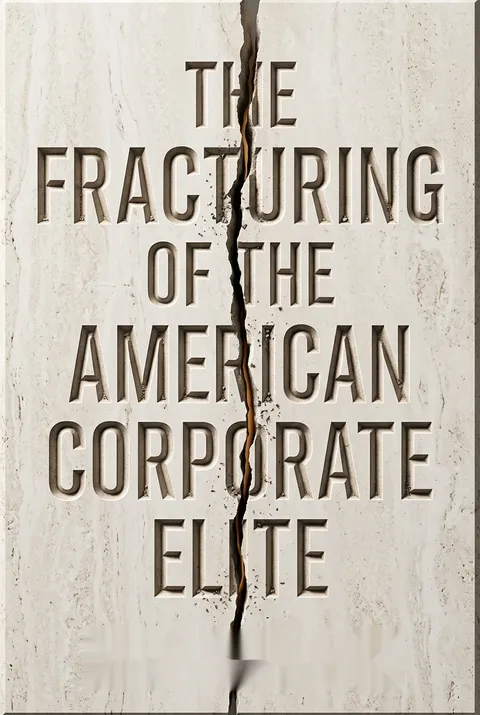

Key Takeaways
1. The Postwar Corporate Elite: Pragmatic Leaders for a Flourishing Society
Yet for all its problems, the postwar United States had a number of qualities that are lacking today: an expanding economy with a high level of upward mobility, declining inequality, a relatively high level of security, a well-functioning political system, and a widespread belief that problems were solvable.
A unique era. From 1945 to roughly 1973, a distinct American corporate elite emerged, characterized by moderation and pragmatism. Unlike their predecessors or successors, these leaders of large corporations looked beyond immediate firm interests, actively engaging in national problem-solving and maintaining a moderate stance in politics. This group, epitomized by organizations like the Committee for Economic Development (CED), believed that a stable and prosperous society was essential for their own long-term success.
Enlightened self-interest. This elite was not altruistic but driven by an "enlightened self-interest," recognizing that their privileges were secure only if society rested on a strong foundation. This meant supporting policies for:
- Full employment and economic growth
- Sufficient purchasing power for consumers
- Protections against economic downturns and old age
- Concern for vulnerable societal members
A constructive role. Despite their flaws, this postwar elite played a constructive role in presenting solutions to national problems and fostering a moderate political climate. Their engagement helped the U.S. flourish economically and politically, a stark contrast to the disarray observed in later decades.
2. The State: A Legitimizing Force for Corporate Moderation
The growing legitimacy of the state’s role in the economy—the idea that government had an obligation to manage the business cycle, to provide employment, and to protect the poor and underprivileged—was a new force with which business had to contend.
Government's expanded role. Post-New Deal and World War II, the American state gained unprecedented legitimacy and power, becoming a permanent fixture in economic policymaking. This included managing the business cycle, ensuring employment, and providing a social safety net. The corporate elite, particularly the CED, pragmatically accepted this enlarged government role, choosing to influence its character rather than resist it entirely.
Keynesian consensus. The enormous success of the American economy during the postwar period fostered a Keynesian consensus among political and economic policymakers. This consensus, which advocated government intervention to stimulate demand and manage economic fluctuations, was largely accepted by the corporate elite. They even supported deficit spending when deemed necessary, a significant ideological shift from earlier laissez-faire views.
Support for social policies. The elite's moderation extended to social policies, including:
- The Employment Act of 1946 (affirming full employment as a goal)
- The Marshall Plan (massive aid to Europe)
- Increased federal funding for education (post-Sputnik)
- Elements of Lyndon Johnson's Great Society programs (e.g., Demonstration Cities Act for urban renewal)
This engagement demonstrated a commitment to broader societal well-being, even if it meant compromising traditional business principles.
3. Labor: An Uneasy Partner Compelling Corporate Accommodation
The fact that these businessmen were willing to accept, however grudgingly, the existence of collective bargaining, the fact that they were able to see the potential value of unions for disciplining their workforces, and the fact that they were willing to acknowledge the legitimacy of unions in the first place represented a major change relative to the situation at the end of World War I.
A necessary evil. While most American businesses initially opposed the Wagner Act and unionization, the postwar corporate elite, facing labor's growing power and legitimacy, adopted a pragmatic "realism." They grudgingly accepted unions as a permanent feature of industrial life, recognizing their potential to stabilize the workforce and moderate industrial conflict. This was a significant departure from the fierce anti-unionism of earlier decades.
The "Treaty of Detroit." The 1950 agreement between the UAW and General Motors symbolized the "capital-labor accord," where corporations accepted unions and provided rising wages/benefits in exchange for:
- Labor peace and disciplined workforces
- Management control over production, technology, and investment
- Union focus on economic interests rather than challenging corporate control
Institutionalization of conflict. Despite ongoing conflicts and strikes, labor-management relations became increasingly routinized and institutionalized. Unions, though often frustrated in their broader social democratic goals, secured substantial gains for their members, becoming a recognized, albeit often adversarial, institution in American life. This accommodation, born of necessity, was a key constraint on the corporate elite's actions.
4. Banks: Central Mediators Fostering Elite Cohesion and Broad Outlook
The boards of the leading banks now functioned as arenas in which the chief executives of the largest nonfinancial corporations, representing a broad range of industries, had an opportunity to discuss the status of various industries, the business world in general, and the larger society.
Beyond control, to mediation. In the postwar era, major commercial banks played a crucial, though often overlooked, role in fostering corporate elite cohesion. While not typically "controlling" nonfinancial corporations as in the early 20th century, banks occupied a central position in the intercorporate network. Their boards of directors became vital meeting places for CEOs from diverse industries.
Three key roles: This centrality allowed banks to perform three critical functions for the corporate elite:
- Information exchange: Bank boards facilitated the transmission of broad business intelligence and insights into national and global trends, enhancing individual executives' "business scan."
- Normative consensus: They helped forge shared understandings and diffuse common practices, even sanctioning "deviant" behavior (e.g., Howard Hughes, Saul Steinberg) to maintain collective norms.
- Cognitive range: Exposure to diverse perspectives on bank boards fostered a broader, more cosmopolitan outlook among corporate leaders, contributing to their moderate and pragmatic political orientation.
A unique position. Banks, with their universal resource (capital) and interest in the overall economy, served as neutral arbiters, integrating the corporate community. This mediating role was a significant, albeit indirect, constraint, encouraging a collective, long-term view that transcended narrow firm-specific interests.
5. The 1970s: A Perfect Storm Shatters the Postwar Consensus
With the economy in serious trouble, with American companies facing increasingly severe foreign competition, with business legitimacy at an apparent all-time low, and with government and labor creating further constraints, it is not difficult to see why corporations began to see themselves as under siege.
Economic turmoil. The 1970s brought a series of severe economic shocks that undermined the postwar Keynesian consensus. High inflation, rising unemployment (stagflation), and increasing foreign competition challenged American industrial dominance. The 1973 energy crisis further exacerbated these difficulties, creating a sense of vulnerability among businesses.
Crisis of legitimacy. Concurrently, public trust in major American institutions, including government (post-Watergate) and business, plummeted. Anti-business sentiment grew, fueled by:
- Radical critiques of capitalism
- Concerns about corporate power and ethics
- Environmental and consumer movements
Regulatory backlash. While initially accepting new social regulations like the EPA and OSHA, businesses soon viewed them as arbitrary, costly burdens. This led to widespread complaints about "excessive government regulation," particularly from small businesses, but increasingly from large corporations as well.
A counteroffensive begins. Faced with these converging crises, the corporate elite began to abandon its strategy of accommodation. Influential figures like Lewis Powell called for an organized, aggressive defense of the free enterprise system. This period saw the rise of conservative think tanks (AEI, Heritage Foundation) and foundations, laying the groundwork for a concerted business counteroffensive.
6. The Business Roundtable: A Shift from National Interest to Corporate Lobbying
Unlike the CED, which viewed itself as a policy-planning organization whose suggestions were made in the national interest, the Roundtable was a lobbying group, explicitly devoted to advancing the interests of business.
A new organizational form. Formed in 1973 from a merger of several business groups, the Business Roundtable emerged as a powerful new voice for the corporate elite. Unlike the CED, which aimed for non-ideological, national-interest policy planning, the Roundtable was explicitly a lobbying organization, focused on advancing the specific interests of big business. Its membership was exclusive, limited to CEOs of Fortune 500 firms.
Direct lobbying strategy. The Roundtable adopted a unique political strategy: direct lobbying by CEOs themselves. This approach leveraged the stature of top executives, ensuring greater attention from legislators who might otherwise dismiss traditional lobbyists. This marked a shift from the CED's emphasis on research and intellectual influence to direct political advocacy.
Conservative agenda. The Roundtable quickly aligned with the burgeoning conservative movement, prioritizing:
- Reducing government regulation of business
- Limiting the power of labor unions
- Reforming the corporate tax code
Its early successes included defeating a Consumer Protection Agency and an amendment to antitrust laws, demonstrating its immediate political clout.
Cracking the consensus. The Roundtable's aggressive opposition to labor law reform in the late 1970s, despite internal divisions, signaled a major departure from the postwar capital-labor accord. This action, seen by labor leaders as a "one-sided class war," marked a significant step in the breakdown of the moderate consensus.
7. Reagan Era: Victory Over Constraints Leads to Elite Fragmentation
The corporate elite’s victory over the forces that had constrained it had the paradoxical effect of leading to its undoing.
Unleashing business. The Reagan administration, starting in 1981, delivered on the corporate elite's agenda:
- Tax cuts: Significant reductions in individual and corporate taxes, driven by supply-side economics.
- Deregulation: Weakened enforcement of environmental and workplace safety regulations (EPA, OSHA), with critics of regulation appointed to lead agencies.
- Anti-labor stance: The PATCO strike and a pro-management NLRB dealt a near-death blow to organized labor, drastically reducing strike activity and union power.
The paradox of success. With government and labor no longer effective constraints, the need for a united corporate front diminished. The elite's hard-won victories inadvertently removed the external pressures that had fostered its cohesion and moderation. This led to a gradual fragmentation, as individual firms increasingly pursued their narrow interests without the unifying force of a collective threat.
Early signs of disunity. The 1982 tax increase debate exposed cracks within the corporate elite. While some favored tax increases to address soaring deficits, others prioritized maintaining business tax cuts. The Business Roundtable, despite its earlier unity, struggled to forge a consensus, foreshadowing its later decline in influence.
8. The Takeover Wave: Shareholder Value Erodes Managerial Autonomy
The CEOs of the largest companies were no longer able to run their firms, insulated from their owners (or from the capital market in general), confident in the knowledge that they were secure in their positions.
The "revolt of the owners." The 1980s witnessed a dramatic shift in corporate governance, as the "managerial revolution" gave way to the "revolt of the owners." Undervalued conglomerates, a permissive antitrust environment under Reagan, and new capital sources (junk bonds, deregulated S&Ls, mutual funds) fueled an unprecedented wave of hostile takeovers and leveraged buyouts (LBOs).
Agency theory and shareholder value. This era saw the rise of "agency theory," which viewed managers as mere agents of shareholders, whose primary duty was to maximize "shareholder value." This contrasted sharply with the earlier view of the firm as an institution with broader responsibilities. Managers, once insulated, now faced intense pressure from:
- Corporate raiders (e.g., T. Boone Pickens, Carl Icahn)
- Increasingly active institutional investors
- The threat of hostile takeovers, leading to job losses and restructuring
Precarious leadership. CEO tenure declined significantly, reflecting a more volatile and demanding environment. The image of the "faceless bureaucrat" gave way to the "brash, swashbuckling celebrity" CEO, focused on short-term stock performance. This external pressure further eroded managerial autonomy and the capacity for long-term, collective thinking.
9. The Decline of Banks: A Lost Anchor for Corporate Unity
In becoming more like investment banks, the commercial banks abdicated their role as the arbiters of the corporate community, the actors that helped forge a consensus among the nation’s leading firms.
Erosion of centrality. The 1980s saw a significant decline in the centrality of commercial banks within the intercorporate network. This was driven by:
- Alternative capital sources: Nonfinancial firms increasingly relied on commercial paper and Eurobonds, reducing their dependence on traditional bank lending.
- Deregulation and competition: Banks faced new competition for deposits and lending, pressuring profit margins.
- Shift to fee-based services: Commercial banks moved towards investment bank-like activities (currency swaps, securities underwriting), reducing their focus on traditional lending relationships.
Fragmentation of the elite. As banks became less central, their boards of directors ceased to be the crucial meeting places for diverse corporate leaders. This inadvertently dismantled a key mechanism for fostering information exchange, normative consensus, and a broad "cognitive range" within the corporate elite. The network became less dense and more fragmented.
Loss of collective capacity. The declining influence of banks meant the corporate elite lost a vital institutional anchor for unity. Without this mediating force, the ability of leading firms to generate a consensus of ideas or coordinate collective action on broader issues diminished significantly, contributing to the elite's overall disarray.
10. The Ineffectual Elite: Private Gains, Collective Paralysis
The American corporate elite, although increasingly adept at lobbying for specific favors, is increasingly incapable of solving problems that concern not only the larger society from which its privileges derive but even its own collective interests.
Power without efficacy. The contemporary corporate elite, while possessing immense resources and political skill, has become "ineffectual" in addressing collective problems. They are highly proficient at securing "private goods" for individual firms through lobbying and campaign contributions, but incapable of achieving "collective goods" for the broader business community or society.
Retreat from responsibility. This is evident in their response to major national crises:
- Tax policy: Unlike earlier decades, the elite has been unwilling to advocate for tax increases to address soaring national deficits, even when it would be in their long-term interest. The Business Roundtable, once a proponent of such measures, remained silent during the Bush II and Obama eras.
- Healthcare reform: Despite escalating costs threatening their own bottom lines, the corporate elite failed to unite behind a coherent solution during the Clinton and Obama administrations, often succumbing to ideological opposition or narrow provider interests.
Political paralysis. The elite's fragmentation and narrow self-interest contribute to political gridlock. Instead of acting as a moderating force, they are often "bullied and cowed" by extremist elements, unable to provide the leadership needed to tackle complex national challenges.
11. The Peril of Narrow Self-Interest: Echoes of Declining Empires
The current American corporate elite seems to be leading us toward the fate of the earlier Roman, Dutch, and Habsburg Spanish empires, starving the treasury and accumulating vast resources for itself.
A troubling parallel. The current behavior of the American corporate elite—hoarding resources, resisting taxation, and neglecting public infrastructure and social welfare—draws parallels to the decline of historical empires. These empires often fell because their elites prioritized private accumulation over contributing to the collective good and maintaining state capacity.
Neglect of public goods. While individual philanthropic efforts exist, they are piecemeal and not a substitute for systemic, government-directed solutions. The elite's unwillingness to support public investment in:
- Education and scientific research
- Infrastructure (roads, bridges, rail)
- Public health and poverty alleviation
threatens the long-term strength and competitiveness of the nation.
A call for renewed responsibility. The book argues that a return to "enlightened self-interest" is crucial. The postwar elite understood that their prosperity was tied to a flourishing society. The current elite's failure to act collectively on critical issues like climate change, inequality, and national debt risks undermining the very system from which their privileges derive, making them "first class passengers on a sinking ship."
Download PDF
Download EPUB
.epub digital book format is ideal for reading ebooks on phones, tablets, and e-readers.








































