


Key Takeaways
Your marriage has a translation problem, not a love problem
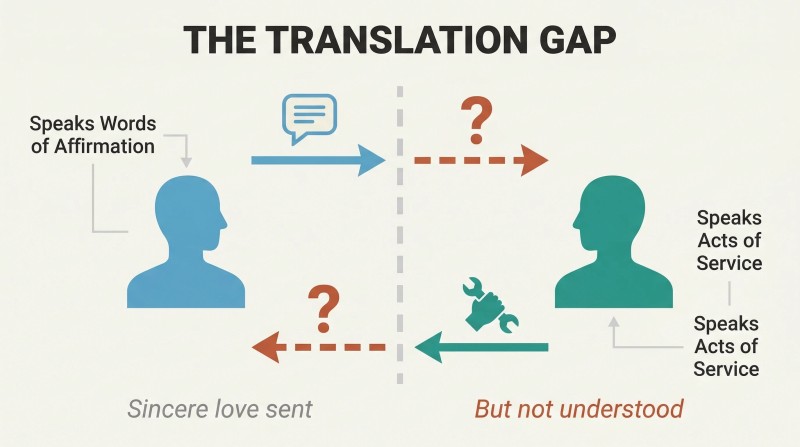
Chapman identifies five emotional love languages from thirty years of counseling: Words of Affirmation, Quality Time, Receiving Gifts, Acts of Service, and Physical Touch. Every person has a primary language through which they most deeply feel loved. Spouses rarely share the same one — which means both partners can be sincerely expressing love yet neither feels loved.
A man on a plane perfectly illustrates this. Married three times, he told his third wife constantly how beautiful she was and how proud he was of her — classic Words of Affirmation. She became increasingly negative and critical. She likely craved a different language entirely. He was sincere. He just wasn't speaking her language.
Every person has an emotional love tank only a spouse can fill
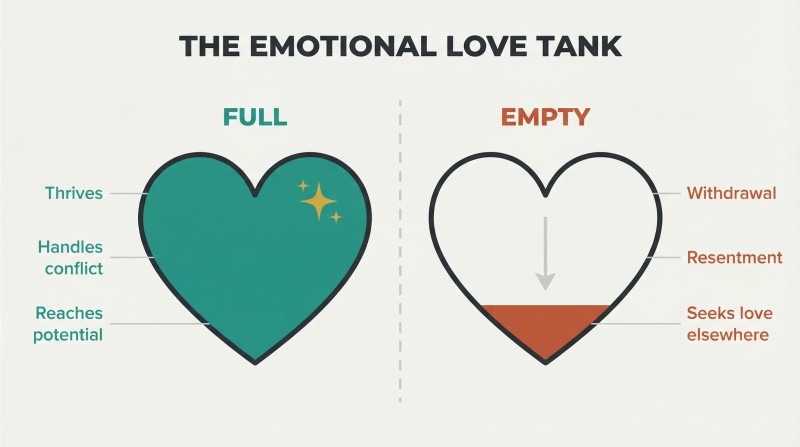
Chapman borrows a metaphor from child psychiatrist Ross Campbell: inside every person is an invisible emotional love tank. When full — when someone feels genuinely loved — they handle conflict well, thrive, and reach their potential. When empty, withdrawal, resentment, and misbehavior take over.
This isn't just about children. A thirteen-year-old named Ashley contracted an STD after her parents' divorce left her love tank bone-dry; she sought love from an older boy at school. Adults do the same thing differently — they grow cold, become hostile, or seek connection outside the marriage. The love tank concept explains why some couples look perfect on paper yet feel profoundly empty inside.
Stop chasing the 'in love' high — it has a two-year shelf life
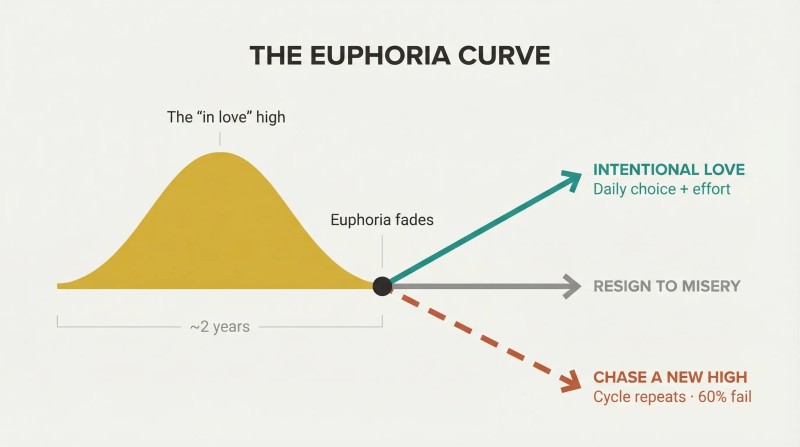
The euphoria expires. Psychologist Dorothy Tennov studied scores of couples and found the average "in love" obsession lasts about two years. During this phase, your partner seems perfect, sacrifice feels effortless, and problems appear trivial. But it's a temporary emotional high — the introduction to the textbook of marriage, not the book itself.
When the high fades, couples face three paths: resign to misery, divorce and chase a new high, or learn to love intentionally. The divorce rate for second marriages is at least 60%, suggesting that simply finding someone new doesn't fix the underlying problem. Real love is volitional — a daily choice requiring effort, discipline, and knowledge of your spouse's love language.
One sincere compliment outperforms nine months of nagging
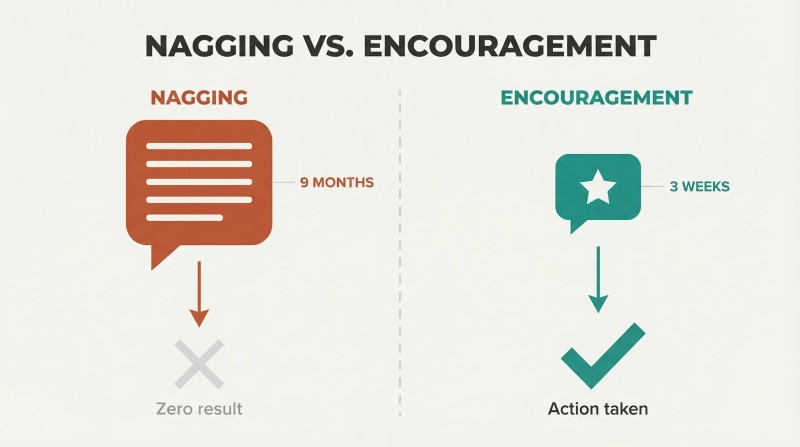
Words of Affirmation is the love language spoken through verbal compliments, encouragement, and kind speech. A wife nagged her husband Dan to paint their bedroom for nine months — nothing worked. Chapman's advice: stop mentioning the paint entirely and instead compliment Dan whenever he did anything good. Three weeks later, she reported it worked. Praise motivated where nagging never could.
Encouragement unlocks hidden potential. Allison had writing talent but no confidence after an early rejection. When her husband Keith read her article and enthusiastically told her she was an excellent writer, she started submitting again — and eventually landed a book contract. The right encouraging words at the right moment changed the trajectory of her career.
Give undivided attention, not just shared square footage
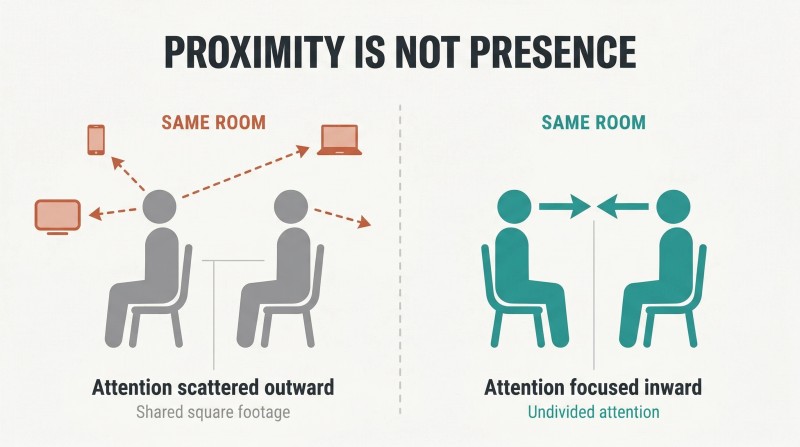
Quality Time means focused presence — not watching TV in the same room. Betty Jo's husband Bill was an excellent provider, but she was starving for his attention. Bill's language was Words of Affirmation; Betty Jo's was Quality Time. When Chapman initially prescribed the same remedy for both, it worked for Bill but left Betty Jo unchanged. Only when Bill began spending focused, device-free time with her did things shift.
Listening trumps advising. Patrick spent seventeen years giving his wife advice about work problems when all she wanted was empathy. Quality Conversation — sympathetic dialogue, not problem-solving — is a key dialect of this language. Research shows the average person interrupts after just seventeen seconds.
For some spouses, a one-dollar gift speaks louder than words
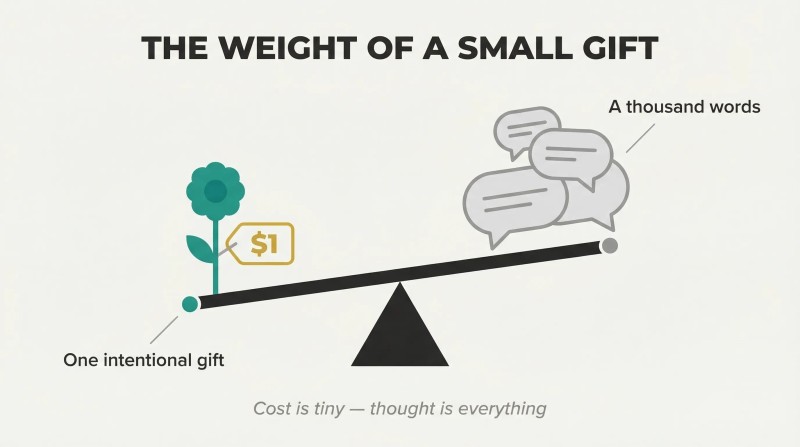
Receiving Gifts is a universal love language. Chapman's anthropological research found gift-giving embedded in the love-marriage process of every culture he studied — from Carib Indians to Eskimos. Gifts are visual symbols of love; cost matters far less than intentionality. A flower picked from the yard or a handmade card fills a love tank just as well.
Doug and Kate's transformation is the book's most dramatic gift story. Doug had never given Kate a flower since their wedding. After a seminar, he gave her a gift every day for one week — a rose, pizza, a potted plant, a card, cookies. Kate was stunned. He continued weekly for three years. Their children started calling them "lovebirds."
Do the specific chores your spouse requests, not your defaults
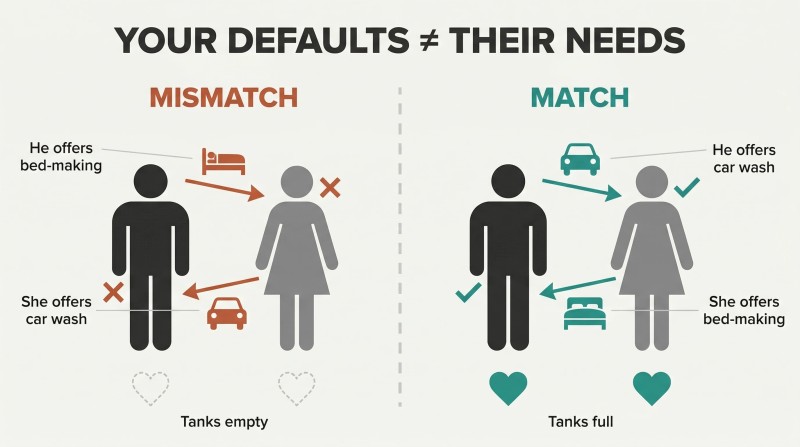
Acts of Service means doing things your spouse would like done — cooking, cleaning, fixing — as expressions of love. Mark and Mary in China Grove, North Carolina, both spoke this language but in different dialects. He wanted the bed made and dinner started; she wanted the car washed and the grass mowed. Neither was doing what the other actually needed. Once they swapped specific request lists, their tanks filled quickly.
The trap is inherited defaults. After marriage, most people unconsciously replicate their parents' household roles. Mark expected Mary to handle everything like his mother did. Chapman's principle: requests give direction to love, but demands suffocate it. A humble request creates the possibility for a genuine act of love; a demand produces only compliance or resentment.
Touch is its own love language, separate from sexual desire
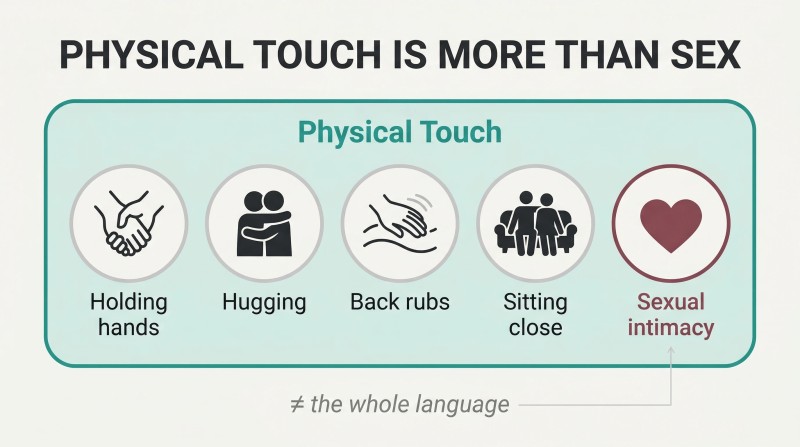
Physical Touch encompasses holding hands, back rubs, hugging, sitting close, and sexual intimacy — but it's not reducible to sex. Chapman warns that many men confuse intense sexual desire with having Physical Touch as their primary language. Marcus assumed touch was his until Chapman asked: if your wife met your sexual needs but constantly criticized you, would you feel loved? Marcus said no — his real language was Words of Affirmation.
Pete nearly lost his marriage over this mismatch. After the wedding, his wife Patsy stopped initiating physical contact. Pete waited six weeks without being touched and withdrew emotionally, while Patsy — whose language was Quality Time — felt ignored by his long work hours. Only after counseling revealed the disconnect did both tanks begin to fill.
Decode love languages by listening to complaints, not compliments
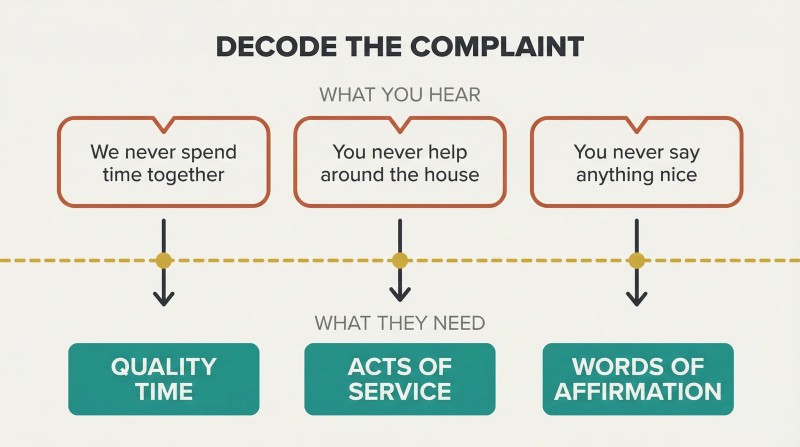
Your spouse's nagging is diagnostic data. "We never spend time together" signals Quality Time. "You never help around the house" points to Acts of Service. "You never say anything nice" reveals Words of Affirmation. Rather than getting defensive, treat these complaints as coordinates pointing to your spouse's deepest need.
Chapman recommends three discovery methods:
1. What does your spouse do or fail to do that hurts you most? The opposite reveals your language.
2. What have you most often requested? Requests cluster around your primary language.
3. How do you naturally express love? You tend to give love in the language you most want to receive.
The Tank Check game accelerates discovery: ask your spouse to rate their love tank zero to ten, then ask what would raise it.
Love is a verb — choose to speak it even when feelings are gone
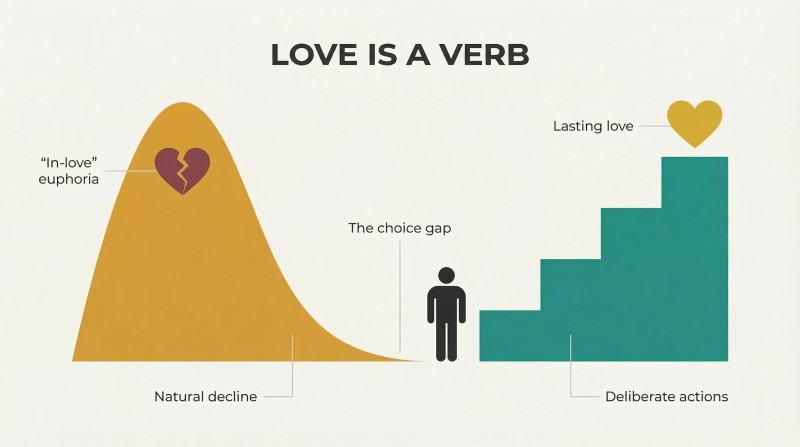
Real love begins where 'in love' ends. Brent told his wife he no longer loved her and was already seeing someone else. When that new relationship also lost its euphoria, Brent returned devastated. Nine months of counseling — learning to speak each other's love languages — rebuilt a marriage that had seemed dead. Chapman's point: the in-love obsession is instinct, but choosing to love afterward is the real thing.
Actions precede emotions. Chapman vacuums floors for his wife despite hating it since childhood — because Acts of Service is her language. John and Susan lived as "roommates" for thirty-five years until discovering his language was Acts of Service and hers was Quality Time. John's response: "Why didn't somebody tell me this thirty years ago?"
Analysis
Chapman's framework functions as a Rosetta Stone for romantic relationships — reducing marital unhappiness to a single, diagnosable mismatch. Its enduring commercial success (over five million English-language copies, 38+ translations) stems not from empirical novelty but from Occam's Razor elegance: one concept, five categories, immediate applicability without a therapist.
Theoretically, the love languages map loosely onto attachment theory without ever invoking it. Where Bowlby and Ainsworth theorized about secure versus insecure attachment styles, Chapman operationalizes the question differently: not 'how do you attach?' but 'through what channel do you feel attached?' This reframe is his genius move. It depathologizes marital distress — you're not dysfunctional, you're miscommunicating — which dramatically lowers the emotional barrier to change.
Compared to Gottman's empirically validated 'Four Horsemen' or Sue Johnson's Emotionally Focused Therapy, Chapman's model lacks controlled research. He draws from thirty years of clinical observation — respectable but anecdotal. What he sacrifices in rigor he gains in cultural penetration, primarily because his framework requires no professional intermediary.
Chapman's most underappreciated contribution is his theory of unilateral change. Ann's six-month experiment — loving a hostile husband without reciprocation — is a one-sided intervention with built-in feedback loops: monthly check-ins, gradual requests after positive responses, and a defined time horizon. Modern perspectives might flag codependency risk; Chapman frames it as strategic love with an exit ramp.
The book's quiet radicalism lies not in the five languages but in redefining love as volitional action rather than sustained feeling. By exposing the 'in love' phase as neurochemical weather with a two-year forecast, Chapman undermines Western culture's most destructive romantic myth. The framework's blind spot remains power asymmetry: where 'speaking someone's love language despite indifference' ends and enabling begins remains insufficiently explored. Readers in genuinely abusive situations should supplement Chapman's insights with boundaries literature.
Review Summary
The Five Love Languages receives mixed reviews. Many readers find it insightful and helpful for understanding relationship dynamics, praising its practical advice on expressing love. The concept of five distinct love languages resonates with many. However, some criticize its simplistic approach, heteronormative focus, and religious undertones. Critics also note problematic advice in certain examples. Despite these issues, many readers appreciate the book's emphasis on conscious effort in maintaining relationships and find value in identifying their own and their partner's love languages.
People Also Read






Glossary
Emotional Love Tank
Internal reservoir of feeling lovedChapman's central metaphor, borrowed from child psychiatrist Ross Campbell. An invisible emotional reservoir inside every person that is filled when they receive love in their primary love language. When the tank is full, a person feels secure, handles conflict maturely, and thrives. When empty, they withdraw, resent, misbehave, or seek love elsewhere. The concept applies equally to children and adults.
Words of Affirmation
Love through verbal encouragementOne of the five love languages, expressed through verbal compliments, encouraging words, kind tone of voice, and humble requests rather than demands. Dialects include direct praise ('You look great'), encouragement of potential ('You should submit that article'), and forgiveness. For people with this primary language, critical or harsh words cut deeper than for others.
Quality Time
Love through undivided attentionOne of the five love languages, expressed by giving someone focused, uninterrupted attention. Not merely occupying the same room but actively engaging together. Key dialects include Quality Conversation (sympathetic listening without rushing to advise) and Quality Activities (shared experiences where the togetherness matters more than the activity itself).
Quality Conversation
Sympathetic dialogue without advisingA dialect of Quality Time involving sympathetic dialogue where two people share experiences, thoughts, feelings, and desires in a friendly, uninterrupted context. The focus is on listening and understanding rather than problem-solving. Chapman distinguishes it from Words of Affirmation: affirmation focuses on what you say, while Quality Conversation focuses on what you hear.
Receiving Gifts
Love through tangible tokensOne of the five love languages, expressed through giving visual symbols of love—purchased, found, or handmade objects. Cost is largely irrelevant; what matters is the thought and intentionality. Includes the concept of 'Gift of Presence'—being physically present during important moments like births, funerals, or crises, which for this language type speaks louder than any purchased item.
Acts of Service
Love through helpful actionsOne of the five love languages, expressed by doing things your spouse would like you to do—cooking, cleaning, running errands, fixing things. Must be freely chosen, not coerced through guilt or demands. Chapman emphasizes that specific dialects vary between individuals: one person may value a clean kitchen while another values yard work. Requests give direction to this language; demands kill it.
Physical Touch
Love through physical contactOne of the five love languages, expressed through holding hands, hugging, kissing, back rubs, sitting close, and sexual intimacy. Chapman distinguishes this from biologically driven sexual desire: a man may intensely want sex without Physical Touch being his primary love language. Encompasses both explicit touches (massage, intercourse) and implicit touches (a hand on the shoulder, a brief hug in passing).
Tank Check
Love-tank rating gameA practical technique Chapman recommends for couples. One spouse asks, 'On a scale of zero to ten, how is your love tank tonight?' After receiving a number, they ask, 'What could I do to help fill it?' The other spouse makes a specific suggestion. Both partners take turns. Played three times weekly for three weeks, it helps couples identify each other's love languages through the pattern of requests.
Dead Sea and Babbling Brook
Communication personality typesChapman's metaphor for two communication styles. A 'Dead Sea' personality absorbs experiences, emotions, and thoughts throughout the day without needing to verbalize them—content in silence. A 'Babbling Brook' externalizes everything almost immediately, talking constantly. These types often attract each other while dating but frustrate each other in marriage, particularly when Quality Conversation is one partner's love language.
FAQ
What's "The 5 Love Languages: The Secret to Love That Lasts" about?
- Core Concept: The book by Gary Chapman explores the idea that people express and receive love in five different ways, which he calls "love languages."
- Purpose: It aims to help couples understand each other's emotional needs and improve their relationships by learning to speak each other's primary love language.
- Structure: The book is divided into chapters that detail each of the five love languages, providing examples and practical advice for applying them in daily life.
- Goal: The ultimate goal is to fill each other's "emotional love tank," leading to a more fulfilling and lasting relationship.
Why should I read "The 5 Love Languages"?
- Improved Relationships: Understanding love languages can significantly enhance your relationship by meeting your partner's emotional needs.
- Practical Advice: The book offers actionable steps and real-life examples to help you apply the concepts effectively.
- Universal Application: While focused on romantic relationships, the principles can be applied to friendships, family, and even workplace interactions.
- Self-Discovery: It helps you understand your own emotional needs and how you express love, leading to personal growth.
What are the key takeaways of "The 5 Love Languages"?
- Five Love Languages: Words of Affirmation, Quality Time, Receiving Gifts, Acts of Service, and Physical Touch are the five ways people express and receive love.
- Primary Love Language: Each person has a primary love language that, when spoken, makes them feel most loved.
- Emotional Love Tank: Keeping your partner's love tank full by speaking their love language is crucial for a healthy relationship.
- Love is a Choice: Love is not just a feeling but a choice that requires effort and understanding.
How can I discover my primary love language according to Gary Chapman?
- Reflect on Complaints: Consider what you complain about most often; it often reveals your primary love language.
- Requests and Actions: Think about what you most often request from your partner and how you express love to others.
- Emotional Reactions: Notice what actions or words from your partner make you feel most loved or hurt.
- Profile Assessment: Use the Love Languages Profile provided in the book to identify your primary love language.
What are the five love languages described by Gary Chapman?
- Words of Affirmation: Verbal compliments and words of appreciation that express love.
- Quality Time: Giving someone your undivided attention and spending meaningful time together.
- Receiving Gifts: Thoughtful gifts that show you were thinking of the other person.
- Acts of Service: Doing things you know your partner would like you to do, such as chores or errands.
- Physical Touch: Physical expressions of love, such as hugs, kisses, and holding hands.
How can I apply the love languages in my relationship?
- Identify Love Languages: Determine both your and your partner's primary love languages.
- Speak Their Language: Make a conscious effort to express love in your partner's primary love language.
- Regular Check-ins: Use the "Tank Check" game to assess how loved your partner feels and adjust your actions accordingly.
- Be Consistent: Regularly practice speaking your partner's love language to maintain a healthy emotional connection.
What are some challenges in applying the love languages?
- Different Languages: Couples often have different primary love languages, which can lead to misunderstandings.
- Learning Curve: It may take time and effort to learn and consistently speak your partner's love language.
- Emotional Barriers: Past hurts and emotional baggage can make it difficult to express love freely.
- Resistance to Change: One partner may be resistant to change or skeptical about the effectiveness of the love languages.
How does "The 5 Love Languages" address conflicts in marriage?
- Emotional Climate: A full love tank creates a positive emotional climate, making it easier to resolve conflicts.
- Understanding Needs: Knowing each other's love languages helps partners understand and meet each other's emotional needs.
- Constructive Communication: The book encourages expressing frustrations constructively and making specific requests.
- Long-term Solutions: It provides a framework for ongoing emotional support, reducing the likelihood of recurring conflicts.
What are the best quotes from "The 5 Love Languages" and what do they mean?
- "Love is a choice." This emphasizes that love requires intentional actions and decisions, not just feelings.
- "We must be willing to learn our spouse’s primary love language if we are to be effective communicators of love." It highlights the importance of understanding and speaking your partner's love language.
- "Inside every child is an ‘emotional tank’ waiting to be filled with love." This quote underscores the universal need for love and its impact on emotional well-being.
- "The object of love is not getting something you want but doing something for the well-being of the one you love." It shifts the focus from self-centered desires to selfless actions.
How does Gary Chapman suggest handling a spouse who refuses to speak your love language?
- Patience and Persistence: Continue to speak their love language consistently, even if they don't reciprocate immediately.
- Positive Reinforcement: Use positive feedback and appreciation when they do speak your love language.
- Open Communication: Discuss your needs openly and make specific, non-demanding requests.
- Seek Understanding: Try to understand any barriers or fears they may have about expressing love in your language.
Can the love languages be applied to children and teenagers?
- Children's Love Languages: The concept applies to children, helping parents meet their emotional needs effectively.
- Teen Adaptation: Teenagers may require different expressions of the same love language as they grow older.
- Family Dynamics: Understanding each family member's love language can improve overall family relationships.
- Emotional Health: Speaking a child's love language contributes to their emotional stability and development.
What if my spouse's love language is difficult for me to express?
- Small Steps: Start with small actions and gradually build your comfort level in expressing their love language.
- Practice and Patience: Consistent practice will make it easier over time, even if it feels unnatural initially.
- Seek Guidance: Use resources like books or counseling to learn how to express their love language effectively.
- Focus on Benefits: Remember the positive impact on your relationship as motivation to continue learning.
About the Author
Other books by Gary Chapman






Download PDF
Download EPUB
.epub digital book format is ideal for reading ebooks on phones, tablets, and e-readers.








































