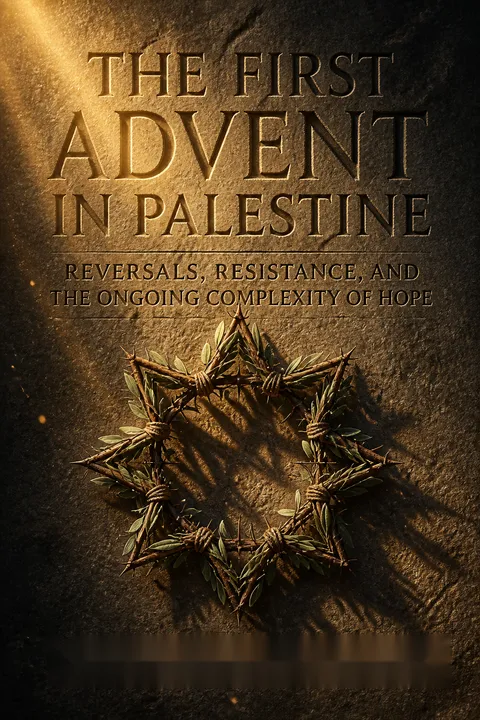

Key Takeaways
1. Reclaiming Advent's Gravity: Beyond Sentimentality to Suffering
If you are wearied by or bored with the sentimentality and careless religious nostalgia of American Advent and Christmas, this is the book for you.
Beyond sentimentality. The traditional Western understanding of Advent often reduces it to twinkling lights, carols, and seasonal pleasures, missing its profound original gravity. This superficial approach overlooks the deep suffering and complex political realities into which God's arrival, or incarnation, truly occurred. To genuinely grapple with Advent's meaning, one must confront the dark edges of human experience and the historical context of woe.
God's arrival matters. Understanding how and where God chose to enter the world is crucial for grasping the full significance of Advent. It's not merely a seasonal message but an orientation toward a lifetime of faithfulness to a God of liberation, love, and peace. The narratives surrounding Jesus's birth reveal a deep theology for troubled times, then and now, by paying attention to the people, places, and politics awaiting God's arrival.
Hope through darkness. The path to recognizing hope in Advent lies through acknowledging the darkness of suffering and the struggle of long waiting. If God can speak comfort and joy into ancient trauma, then hope is available even in our "feral world." This perspective challenges readers to engage with new and raw paths, moving beyond careless religious nostalgia to genuinely grapple with deliverance, peace, justice, and hope.
2. The "Silent Years" Were Loud with Jewish Suffering and Resistance
What was left out was the truth of Jewish suffering during those dark centuries.
Unveiling hidden history. The period between the Old and New Testaments, often called "The Silent Years" in some Christian traditions, was anything but silent. It was a time of intense Jewish suffering under successive empires—Greeks, Egyptians, and Seleucids—marked by invasions, enslavement, crucifixions, and desecration of holy places. These four centuries of continuous oppression form the honest, traumatic prologue to the first Advent.
Maccabean resistance. The books of 1 and 2 Maccabees detail this devastation, particularly the Seleucid Empire's violence and economic exploitation. The story of Mattathias and his sons, the Maccabees, highlights their struggle against Antiochus Epiphanes, who famously desecrated the Temple. Their revolt, though violent and short-lived, was a desperate fight for survival and religious freedom, culminating in the rededication of the Temple, commemorated by Hanukkah.
Lament as prelude to hope. The suffering of these centuries, echoed in the book of Lamentations, reveals that wrestling with pain is a prerequisite for God's deliverance. Mattathias's laments, like those of his ancestors, planted seeds of hope, reminding that "The steadfast love of the Lord never ceases." This period teaches that even in profound darkness, a faint light of hope persists, pushing against despair and preparing the soil for Advent's promise.
3. God's Peace Campaign Subverts Imperial Power
Perhaps, I thought, the first advent was God’s critique of what the world called peace.
Critique of Pax Romana. The first Advent occurred during the Pax Romana, a period of "peace" inaugurated by Caesar Augustus through military victory and maintained by violence and economic exploitation. This imperial peace benefited the few while crushing the many through heavy taxation, land confiscation, and debt, creating widespread economic stress and a different form of violence. God's arrival was a direct challenge to this oppressive system.
A counter-campaign. God initiated a counter-campaign for peace, one that rejected violence and exploitation. This divine initiative offered a vision of peace that would:
- Not evict families from their ancestral land.
- Be "good news to the poor."
- Cause anxiety for kings and power brokers.
- Invert the imperial order, much like the ancient concept of Jubilee.
Zechariah's pivotal role. God's peace campaign began not with an emperor or high priest, but with an ordinary, aging priest named Zechariah in the Judean hills. Despite his righteousness, he and his wife Elizabeth were barren, a paradox in a culture that valued fertility. His prayers, shaped by the economic inequity and suffering of his village, became the conduit for an angelic announcement, signaling that God was listening to the cries of the marginalized and initiating a grand reversal.
4. Ordinary People Lead God's Reversals
God has never been deterred by the ordinariness of people.
God's unexpected choices. God's Advent strategy consistently bypassed centers of power and propriety, choosing instead ordinary, often marginalized individuals to lead a new kind of peace campaign. This began with Zechariah, an ordinary priest, and continued with Mary, a young girl from Galilee, a region often looked down upon by Judeans and known for its resistance and trauma.
Mary's courageous "Behold!". Mary, a girl from Nazareth, a small and "inconsequential" village, was chosen to be the locus of incarnation. Despite her lowly position, her gender in a patriarchal society, and potentially a history of trauma in a turbulent region, Gabriel declared her "favored." Her "Behold! I am the Lord's servant" was an act of profound courage, trusting God with her body and future, and agreeing to birth a rival to Caesar.
Shepherds as first witnesses. God's reach extended even further into the social fray to a band of shepherds, considered uncouth and nearly invisible by elites. These low-wage earners, often seen as trespassers and potential troublemakers, were the first to receive the angelic birth announcement. Their inclusion made them early prototypes of disciples and evangelists, emboldened to share the good news, making the invisible central to God's vision of peace.
5. Mothers of Advent: Women's Theological Leadership and Resistance
In their flourishing friendship, they collaborated to create and embody novel paradigms.
Elizabeth's prophetic affirmation. Mary, pregnant and unwed, hurried to her elder relative Elizabeth in Ein Kerem, seeking companionship and understanding. Elizabeth's Spirit-filled greeting, "Blessed are you among women," echoed praises for valiant women like Deborah and Judith, but with a crucial twist: Mary would embody nonviolent participation in God's peace. This encounter affirmed Mary's unique role and the new direction of deliverance.
Mary's Magnificat: An anthem of reversal. Mary's Advent song, the Magnificat, composed in solidarity with Elizabeth, was a powerful act of resistance. It braided ancient songs of liberation with her new understanding of God's work, declaring a radical social reversal:
- The proud would be confused, the mighty dethroned.
- The humble would be elevated.
- The hungry would be fed, the rich sent away empty.
This anthem set a trajectory for Jesus's future ministry, challenging unjust structures not with revenge, but with restoration.
Theological collaboration. Elizabeth and Mary, two women with seemingly little influence, engaged in profound theological reflection, gestating God's peace. Their conversations, rooted in shared belief and trust, explored the possibilities and limitations of God's action in troubled landscapes. Their flourishing friendship and shared conviction about God's coming deliverance laid the infrastructure for a new kind of peace, one that would mother peacemakers and revolutionaries for millennia.
6. Hospitality and Economic Justice as Acts of Resistance
Hospitality is how people honor the humanity of one another on the underside of the empire.
Bethlehem's true welcome. The traditional narrative often misrepresents Bethlehem's innkeepers as inhospitable. However, Luke's account suggests a full house, where Joseph and Mary were welcomed by family into a crowded compound, finding space in the stall area. This reflects the deep-rooted Abrahamic tradition of hospitality, where mutual survival among the downtrodden was, and still is, a method of resistance against imperial pressures.
Census and economic hardship. Luke frames the Advent story with Caesar's census, a clear economic marker designed to inventory wealth and increase taxation. This was "bad news for the poor," including Joseph and Mary, who were forced to travel while heavily pregnant. This backdrop highlights that God's salvation addresses tangible realities like:
- Hunger for daily bread
- Fear of land loss
- Search for work
- Burden of indebtedness
God's deliverance is deeply concerned with economic justice.
Modern echoes of hospitality. Today, Bethlehem's Palestinian residents, like tea vendor Sami or Chef Fadi Kattan, continue to embody this spirit of hospitality. Despite the economic strangulation caused by the separation wall and checkpoints, they welcome visitors, sharing stories and their beloved town. This welcome is not just about livelihood; it's an act of resistance, a way to remain visible and infuse hope into a struggling economy, demonstrating that God's economy values human connection over imperial extraction.
7. The Visible and Invisible: Shepherds and the Unseen
Once invisible, they were chosen to be among the first to witness God’s work.
Shepherds: The marginalized made central. In ancient Palestine, shepherds were often considered uncouth, dangerous, and nearly invisible by society's elites. Their work was low-wage, tedious, and often put them at odds with landowners. Yet, God chose these "essential workers" of Bethlehem's meat industry to be the first to receive the angelic birth announcement. This choice underscored God's preference for the marginalized and challenged societal norms of respectability.
Nightfall and peril. For shepherds, nightfall was not calm but thick with jeopardy, increasing the threat of poachers, predators, or Roman soldiers. Their hushed conversations around fires reflected a constant vigilance against danger and the fear of imperial retribution for any perceived dissent. Into this perilous darkness, angels appeared, transforming a place of potential trauma into one of stunning revelation and bolstering hope.
Emboldened evangelists. The angelic proclamation of a savior, a rival to Caesar, was a politically provocative message. The shepherds, initially terrified, were given a familiar sign—a child in a manger—and were emboldened by their inclusion in God's peace plan. They became early evangelists, sharing the good news with everyone they met, no longer speaking in hushed tones but praising God for the new peace underway, making the unseen visible and central to God's work.
8. Advent's Aftermath: Trauma, Refugees, and Ongoing Injustice
Even after God arrived, there remained reason to lament, as another massacre occurred, another traumatic event visited upon the landscape and upon the families who called Judea home.
Flight to Egypt: Jesus the refugee. Despite the birth of the Prince of Peace, political tensions and economic hardship persisted. An angel warned Joseph in a dream of Herod's impending rampage, forcing the Holy Family to flee immediately to Egypt. Jesus, as a refugee, relied on Egyptian hospitality for safety, embedding the experience of displacement and seeking sanctuary into God's own human story.
Herod's massacre of the innocents. Herod, paranoid about a rival king, ordered the murder of all male children under two in Bethlehem and surrounding regions. This atrocity, far from a precise mission, left the area awash in blood, claiming innocent lives, including possibly Zechariah, who tradition says died protecting his son John. This event highlights that God's arrival did not immediately erase suffering or injustice; rather, it brought God into direct experience of human trauma.
Lament and enduring hope. Matthew's narrative, written after the destruction of Jerusalem, acknowledges that the world remained harsh even after Jesus's birth, necessitating lament. By invoking Mother Rachel's weeping for her children (Jeremiah 31:15), Matthew connects the Bethlehem massacre to a long history of Jewish suffering, but also subtly points to "The Little Book of Consolation" within Jeremiah, promising a future return from captivity and a reversal of devastation. This suggests that even in profound grief, hope for God's future restoration endures.
9. The Meek Shall Inherit the Land: A Generational Hope
The meek outlasted empires time and time again.
Jesus's ancient promise. Jesus, teaching on a Galilean hillside, reactivated an ancient hope by quoting Psalm 37: "the meek will inherit the land." This promise, made to a people enduring Roman occupation, acknowledged their long history of surviving brutal empires. The "meek" were not merely gentle people, but the survivors of imperial violence and economic exploitation—those left behind, with no resources to relocate, who steadfastly remained on their ancestral land.
Enduring through empires. The psalmist's words, and Jesus's reiteration, offered assurance that empires like Assyria, Babylon, Persia, and Rome would eventually wither and fade like grass. The meek, those with deep roots coiled into the soil of Palestine, would outlast them all. This long view of history provides a profound sense of generational hope, suggesting that persistence and commitment to the land are forms of resistance against transient imperial powers.
Palestinian steadfastness. Contemporary Palestinian theologians like Mitri Raheb, whose father survived four empires without ever leaving Palestine, embody this "meekness." Their continued presence and commitment to their homeland, despite ongoing occupation, indebtedness, and dispossession, confound modern empires. This enduring steadfastness is a living testament to the promise that the land will ultimately be the inheritance of those who remain, cultivating a peace rooted in justice.
10. Peacemaking as a Slow, Embodied, and Nonviolent Practice
Holding to a hopeful vision in the context of war gives hope a new meaning. It is no longer something we see but rather something we practice, something we live, something we advocate, something we plant.
God's slow peace. Advent reveals that God's peace is not an immediate, quick fix, but a slow, generational process, like yeast permeating dough. Jesus's life, marked by confrontation, abandonment, and crucifixion, demonstrated that embodying God's peace agenda as a counter-testimony to Caesar's peace is hard work. It requires patience and active engagement, knowing that peace may not be fully realized in one's lifetime.
Nonviolence as a practical tool. Peacemakers like Nafez Assaily in Palestine exemplify this slow, embodied practice. Inspired by Gandhi, Assaily teaches nonviolence as a practical tool for daily life, from managing family conflicts to navigating checkpoints. His "Library on Wheels for Non-violence and Peace" distributes books to children and commuters, cultivating new ideas and responses to frustration, demonstrating that disarming violent tendencies begins within and extends outward.
Connecting people: An act of hope. Sami Awad, a Palestinian Christian peacemaker, emphasizes that in a politically intractable situation, "connecting people" is a vital act of hope and resistance. Each connection across fractured lines—between Israeli and Palestinian youth, or people of different faiths—is a seeding of the soil for a different future. This practice, rooted in hospitality and solidarity, follows the Advent trajectory, preparing the ground for God's peace to break the imperial cycle, one connection at a time.
Review Summary
Reviews for The First Advent in Palestine are largely positive, averaging 4.29/5. Many readers praise Nikondeha's fresh, contextual approach to the Advent narrative, weaving together first-century Palestine and modern Palestinian life under occupation. Enthusiasts appreciate her liberation theology lens and storytelling ability. Critics, however, note excessive speculation presented as fact, insufficient biblical grounding, and lack of textual support for claims. Some take issue with specific assertions, such as implications about Mary's virginity, while others flag occasional conflation of Jewish and Israeli identity.
People Also Read



Download PDF
Download EPUB
.epub digital book format is ideal for reading ebooks on phones, tablets, and e-readers.








































