

Key Takeaways
Twenty focused hours takes you from clueless to genuinely competent
The core promise. Kaufman argues that roughly twenty hours of concentrated, strategic practice is enough to break through what he calls the frustration barrier: the miserable early stretch when you know you are terrible. That is about 45 minutes a day for a month, or 90 minutes daily if you want it faster. You will not reach mastery, but you will perform noticeably well and, more importantly, start enjoying the activity.
Proof by doing. He tests this on six unrelated skills in a single year: a home yoga practice, coding a working web app in Ruby, relearning to touch type, playing Go, strumming the ukulele, and windsurfing. A busy father with a business and roughly 25 work hours a week, he had no special talent, just a repeatable method.
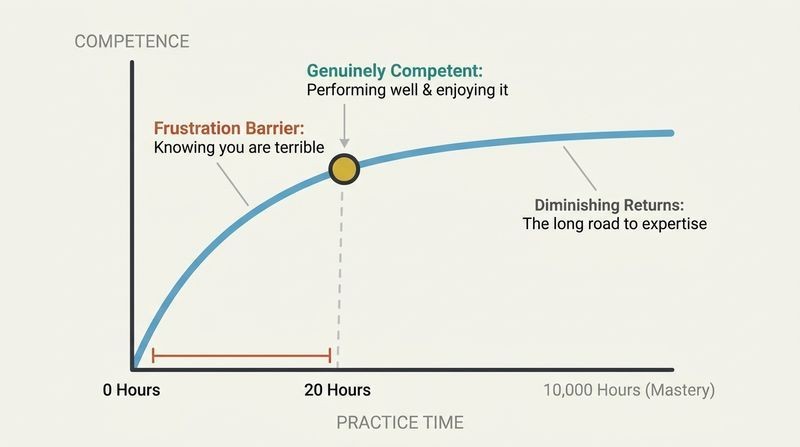
What's compelling is the reframe from outcome to threshold. Most people abandon skills in the first few hours precisely because incompetence feels intolerable, so twenty hours is less a magic number than a psychological commitment device. The claim aligns with the well-documented steep early portion of the learning curve, where returns per hour are highest. A fair caution: twenty hours buys competence in skills with clear feedback and modular structure. Fields with long feedback delays or heavy prerequisite knowledge (medicine, advanced mathematics) resist this compression. The honest reading is that Kaufman targets recreational and functional competence, not professional standing, which is exactly what most aspiring learners actually want.
The 10,000-hour rule is for world champions, not weekend golfers
A widespread misreading. Gladwell popularized the finding that expert performance takes about 10,000 hours of deliberate practice, drawn from Anders Ericsson's research. Kaufman points out the crucial fine print: it studies elite, world-class performers. Ten thousand hours is roughly a full-time job for five years, and even top athletes can only sustain about three and a half hours of true deliberate practice daily.
Redefine your goal. If your aim is to win the PGA Tour, yes, prepare for a decade. If your aim is to play a decent round without embarrassing yourself, that is a completely different investment. Kaufman calls this embracing sufficiency: choosing capacity over mastery and tackling only the steep, high-return part of the learning curve.
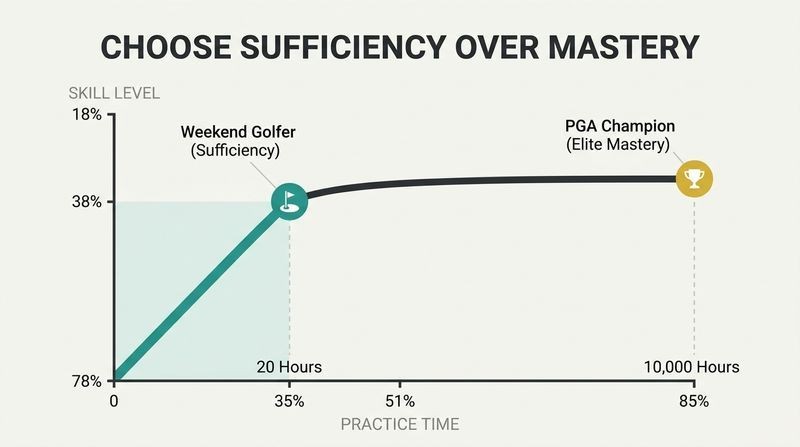
This distinction rescues the discouraged. Ericsson himself later objected that Gladwell blurred the number into a false average and downplayed the role of structured, coached practice over raw hours. Kaufman's move is subtler than either: he separates the goal of world dominance from the goal of personal usefulness. Behavioral economists would note the framing effect at work. Presenting a skill as a 10,000-hour mountain triggers avoidance, while presenting it as a 20-hour hill triggers action. The deeper lesson is that most life satisfaction comes not from being elite at one thing but from being passably good at many, a portfolio strategy for a finite lifespan.
Practicing a skill is not the same as studying it
Four things people confuse. Kaufman separates skill acquisition from learning, training, and credentialing. He aced four years of high school Spanish yet cannot hold a conversation, while his friend Carlos learned fluent English by simply talking to native speakers on Skype, never studying grammar. Skill acquisition requires practicing the skill in context. Learning (facts, vocabulary, theory) merely helps you self-correct while practicing, what linguist Stephen Krashen calls the monitor hypothesis.
Where school fails. Training is refining a skill you already have, like conditioning for a marathon. Credentialing mostly certifies compliance with arbitrary standards. A four-year computer science degree can leave a graduate no closer to shipping a useful program. Kaufman skipped business school, built companies instead, and saved over $150,000.
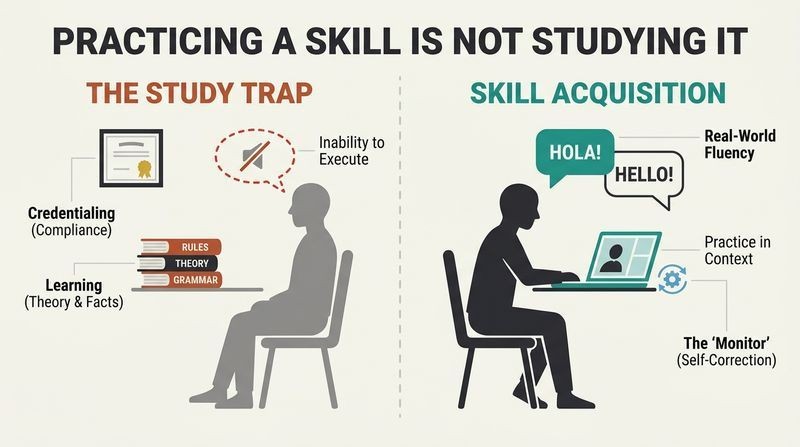
The Spanish-versus-Carlos contrast lands hard because nearly everyone has a dead language rotting in their memory. The underlying principle echoes research on transfer and situated cognition: knowledge encoded in classroom conditions often fails to activate in real performance contexts. Krashen's acquisition-versus-learning theory remains contested among linguists, but the practical takeaway is robust across domains. Reading about swimming does not make you float. The sharper edge here is Kaufman's critique of credentialing as opportunity cost. That is bracing but incomplete. Credentials still function as trust signals and gatekeepers in regulated fields, so the smart reader treats his advice as a bias correction, not a blanket license to skip formal education.
Break the skill apart and drill the vital few pieces first
Most skills are bundles. What looks like one ability is really many subskills. Kaufman's method: deconstruct the skill into its smallest parts, then identify the handful that deliver most of the results. Golf includes driving, putting, bunker shots, and club selection. You do not practice them all at once.
Case studies in decomposition. For programming, he reduced the intimidating word coding into input, process, and output, then a short list including variables, conditionals, databases, and cookies. For yoga he discovered the Sun Salutation is minimum viable asana, a single sequence hitting every major muscle group. For ukulele, the Axis of Awesome Four Chord Song revealed that four chords (G, D, Em, C) power a huge share of pop hits. The power law rules: a minority of components produces the majority of value.
Deconstruction is the intellectual heart of the book and its most transferable tool. It mirrors the Pareto principle and the engineering habit of decomposing systems into modules. The ukulele example is quietly profound. Discovering the hidden four-chord skeleton of popular music is a form of pattern extraction that dramatically shrinks the problem space, exactly what expert chunking does in chess and Go. One nuance worth adding: correctly identifying the vital few requires enough domain knowledge to know what matters, which is why Kaufman pairs deconstruction with fast preliminary research and talking to practitioners. Beginners often optimize the wrong subskill, polishing a bubble sort no professional ever uses.
Write one sentence defining what good enough looks like
Aim before you fire. A target performance level is a specific, single-sentence description of the competence you want. Kaufman quotes inventor Charles Kettering: a problem well stated is half solved. For yoga, his target was practicing a safe 20 to 30 minute sequence from memory at home. For touch typing, it was regaining his old 60 words-per-minute speed on a new keyboard, not exceeding it.
Looser is faster. The more relaxed and precise your target, the quicker you reach it. This can feel like lowering the bar to win, and Kaufman cheerfully agrees. Since you are pursuing sufficiency, not perfection, define the minimum level that will actually satisfy you, include any safety requirements, and stop optimizing everything else.
Defining good enough is an underrated antidote to perfectionism paralysis. It functions like a project scope statement, preventing the endless gold-plating that stalls beginners. Goal-setting research supports specificity, but Kaufman adds a twist that most productivity literature misses: deliberately choosing a lower ceiling. This is strategic satisficing, Herbert Simon's insight that bounded rationality often makes good enough more rational than optimal. The risk is undershooting a target so trivial it fails to motivate. Kaufman hedges by saying the best targets sit just out of reach, which is essentially the flow-channel principle: challenge calibrated slightly above current ability sustains engagement better than either boredom or overwhelm.
Your real obstacle is feeling stupid, not lacking talent
The barrier is emotional. Kaufman insists the main thing blocking rapid learning is not physical or intellectual difficulty but the discomfort of being bad at something in front of yourself and others. When he switched to the Colemak keyboard, his typing collapsed from 61 words per minute to 5, and he nearly quit ten times in twenty minutes, convinced his career was over. That catastrophic feeling was false but overpowering.
Lean into confusion. During early research he advises deliberately jumping in over your head. If you are not confused by at least half of what you encounter, you are moving too slowly. Krashen calls this comprehensible input: material that only becomes clear once you have practiced. Yoga teacher Desikachar put it well, that recognizing confusion is itself a form of clarity.
This is the book's most humane insight. Our brains treat present incompetence as permanent, a cognitive distortion psychologists call affective forecasting error, systematically overestimating how long bad feelings will last. Naming the frustration barrier gives learners a mental model to override the quit impulse. It connects to Carol Dweck's growth mindset and to research on productive struggle in education, where confusion, if tolerated, drives deeper encoding. The practical genius is normalizing the awful early hours as a predictable phase rather than a verdict on ability. Anyone who has watched a toddler learn to walk knows humans are built to fail repeatedly without shame; adults simply forget the permission.
Precommit to 20 hours and practice by the clock in short bursts
Grit through the dip. Because the early hours feel harder than they are, Kaufman insists you precommit to twenty full hours before starting. If you are not willing to invest that much, pick a different skill. This turns the inevitable moment of I want to quit into a rule you already agreed to, not a fresh decision.
The stopwatch trick. Our minds are terrible at judging elapsed time, and it drags when we are incompetent. His fix: set a countdown timer for 20 minutes and practice until it rings, no exceptions. Stack three to five such sessions a day. Time is never found, only made, so he recommends logging your hours and cutting low-value activities. To learn Go, he deleted World of Warcraft entirely.
Precommitment is a classic self-control device, the same mechanism Odysseus used lashing himself to the mast. By converting a future weak moment into a binding present rule, Kaufman removes willpower from the critical path, which matters because willpower is a depletable and unreliable resource. The timer tactic exploits a known quirk: the Zeigarnik effect and time distortion under stress make sessions feel longer than they are. Deleting the video game is environment design in disguise, raising the friction of the competing behavior. One extension worth noting: the twenty-hour commitment also creates sunk-cost momentum, which is usually a bias but here is deployed constructively to keep beginners in the game.
Build feedback loops so fast you cannot ignore your mistakes
Speed of feedback sets speed of learning. The sooner you know whether an action worked, the faster you connect cause to correction. Kaufman notes programming can become addictive precisely because the computer tells you in milliseconds if your code crashed. Cheese making is the opposite: waiting six months to taste the result makes the skill nearly impossible to acquire quickly.
Engineer the loop. Sources of fast feedback include coaches, video recording, and software. Learning the Colemak keyboard, Kaufman used a training program called Keyzen that clacked for correct keys and buzzed for errors, then automatically reintroduced characters he kept missing. For Go, a tablet app gave instant right-or-wrong verdicts on ranked puzzles, far faster than checking a printed answer key by hand.
This principle is the operational core of deliberate practice, which Ericsson defined by immediate, informative feedback plus targeted repetition. Kaufman's contribution is practical: most skills do not come with feedback built in, so the learner must install it. Surgeon and writer Atul Gawande made a parallel argument about why even elite performers benefit from coaches, external eyes that shorten the feedback delay. The cybernetics framing is apt. A system without rapid error signals cannot self-correct. A subtle risk is optimizing for the feedback metric rather than the real goal, like a typist who chases test speed instead of writing fluency, so choose feedback that actually tracks what you care about.
Chase volume over perfection; theory alone produces dead clay
Quantity teaches faster. Early on, aim for as many repetitions as you can while keeping form merely good enough, rather than agonizing over flawless execution. Kaufman retells the ceramics class parable from the book Art and Fear: one group was graded purely on the weight of pots produced, the other on a single perfect pot. The quantity group made the best work, because while they churned out pots and learned from failures, the quality group sat theorizing and had little to show but grand ideas and a lump of dead clay.
Form still matters. This is not license to practice sloppily. Once your technique is good enough to hit your target roughly 80 to 90 percent of the time, crank up the speed and volume for the fastest gains.
The pottery parable has become a self-help staple, and its appeal is that it inverts the perfectionist intuition most schools instill. Skill emerges from a high-bandwidth loop of attempt, error, and adjustment, and volume simply feeds that loop more data. This dovetails with modern research on generative practice and desirable difficulties: struggling through many varied attempts builds more durable and flexible skill than cautious, polished repetition. The caveat Kaufman rightly flags is that mindless repetition of bad form entrenches errors, the reason golfers and musicians can practice for years without improving. The reconciliation is deliberate volume: many reps, but each with attention and self-correction, not autopilot.
Redesign your environment so practice happens without willpower
Windsurfing humbled him. Kaufman's windsurfing chapter is the exception that proves a rule: he logged only nine hours, not twenty, because the wind on his Colorado lake was unpredictable. His conclusion was blunt: environment matters, and no amount of desire makes the wind blow. He adapted by buying a paddleboard for calm days and studying safety to avoid drowning and hypothermia.
Two levers you control. First, remove barriers to starting: misplaced tools, borrowed equipment, distractions, and setup friction. He converted his laptop keys physically to Colemak so the layout was always ready. Second, honor your biology. Motor skills consolidate during sleep, so he practiced typing right before bed and hit 60 words per minute. When he stopped deliberate practice for 30 days and relied only on ambient typing, his speed improved by exactly zero.
The zero-improvement finding is the chapter's quiet bombshell. Merely doing a thing, without focused intent to improve, plateaus you, which explains why decades of casual driving or typing rarely make anyone excellent. This distinguishes deliberate from mere experience, a distinction Ericsson stressed and one that dismantles the assumption that time-on-task equals skill. The sleep angle rests on solid neuroscience: studies show motor memory consolidation during sleep, with a critical window in the first hours after practice. Environment design also echoes behavioral research showing that reducing friction beats relying on motivation. The windsurfing humility is refreshingly honest, a reminder that some constraints are external and the wise learner adapts the goal rather than the physics.
Analysis
The First 20 Hours is a framework-driven self-help book wrapped in memoir. Its structure is deliberate: three chapters of method, then six autobiographical case studies that stress-test the method against wildly different domains. This design is both its strength and its summarizing challenge, because the principles are simple to the point of feeling obvious, while the value lives in watching them applied under real constraints, complete with failures like the lost eyeglasses on the lake and the collapse to five words per minute.
Kaufman's genuine intellectual contribution is not any single principle but the reframing of the entire learning question. By surgically separating competence from mastery, and skill acquisition from learning, training, and credentialing, he dissolves the paralysis that Gladwell's 10,000-hour meme inadvertently created. The book is best read as a permission slip backed by a checklist. Its two ten-item lists overlap heavily and could be compressed to perhaps six real ideas: deconstruct, define good enough, remove friction, get fast feedback, commit to focused hours, and tolerate early confusion.
The weaknesses are worth naming. The twenty-hour figure is more rhetorical anchor than empirical constant; Kaufman himself blows past it in some chapters and undershoots in windsurfing. The method suits modular, feedback-rich, individually practicable skills and says little about skills requiring institutional access, teammates, or long maturation. And the relentless do-it-yourself ethos, while inspiring, underweights the leverage of good coaching, which Ericsson's own research places at the center of expertise.
Still, the book endures because it is psychologically shrewd. It correctly diagnoses that the binding constraint on adult learning is emotional discomfort, not aptitude or even time, and it engineers small structural workarounds rather than demanding heroic motivation. In an age of infinite tutorials and zero follow-through, its most radical instruction is also its simplest: stop researching, set a timer, and begin.
Review Summary
The First 20 Hours receives mixed reviews. Some praise its practical approach to rapid skill acquisition, offering a framework for learning new skills in 20 hours. Critics argue the book is padded with unnecessary details and personal anecdotes. Many find the first few chapters valuable but consider the rest repetitive. Readers appreciate the concept but feel it could have been condensed into a shorter format. Some find the author's examples interesting, while others view them as irrelevant or boring.
People Also Read







Glossary
Rapid skill acquisition
Strategic fast-track to basic competenceKaufman's core method for learning a skill as quickly as possible. It has four steps: deconstruct the skill into its smallest subskills, learn enough about each to practice intelligently and self-correct, remove physical, mental, and emotional barriers to practice, and then practice the most important subskills for at least twenty hours. It targets functional competence, not world-class mastery.
Frustration barrier
Miserable early incompetence phaseThe initial stretch of learning any skill during which you perform badly and are painfully aware of it. Kaufman argues this barrier is primarily emotional rather than intellectual, and that it is deceptively easy to break through, typically dissolving within the first ten to twenty hours of focused practice.
Target performance level
One-sentence definition of good enoughA specific, single-sentence statement describing exactly how well you want to perform a skill and what you will be able to do when finished. Defining it clearly makes the path obvious, and choosing a relaxed but precise level (including any safety requirements) speeds acquisition because you pursue sufficiency rather than perfection.
Deliberate practice
Focused, corrective, intentional repetitionA term from Anders Ericsson's research meaning intentional, systematic practice aimed at improving a specific skill, characterized by focused attention and immediate feedback. Kaufman contrasts it with ambient practice, showing that thirty days of casual, unfocused typing produced zero improvement while focused sessions rapidly raised his speed.
Power law of practice
Fast early gains, then diminishingA well-replicated finding that performance improves dramatically in the early stages of practice and then slows, producing the familiar learning curve. It implies the steepest, highest-return gains come first, which is why twenty concentrated hours yields disproportionate competence.
Monitor hypothesis
Learning helps you self-correctStephen Krashen's idea, adopted by Kaufman, that studied knowledge (grammar rules, vocabulary, theory) functions mainly to help you plan, edit, and correct yourself while practicing. Learning enhances practice but never replaces it; performance still requires practicing the skill in context.
Comprehensible input
Confusing material clarified by practiceKrashen's term for new information that only becomes meaningful once you have relevant experience. Kaufman uses it to justify jumping in over your head: early research will be confusing, but that confusion becomes clarity through practice, and recognizing what confuses you helps direct what to learn next.
Three-stage model of skill acquisition
Cognitive, associative, autonomous phasesThe academic framework describing how skills develop: the cognitive stage (understanding and breaking down the task), the associative stage (practicing and adjusting to feedback), and the autonomous stage (performing efficiently without conscious thought). It applies to both physical and mental skills as the brain's neural wiring reorganizes with practice.
Minimum viable asana
Smallest effective yoga practice unitKaufman's playful label for the Sun Salutation sequence, a single flow of poses that engages all major muscle groups and blends strength and flexibility. It illustrates the power law in physical skills: one high-value sequence can constitute an entire effective practice, sparing beginners the need to learn dozens of poses.
Inversion
Study the worst-case outcomeA problem-solving technique of imagining everything going wrong to reveal what actually matters. Kaufman applies it to white-water kayaking by listing every disaster (flipping, losing the paddle, hitting rocks), which surfaces the critical safety subskills and gear he would otherwise overlook.
FAQ
What's The First 20 Hours about?
- Learning New Skills Quickly: The book focuses on rapid skill acquisition, suggesting that about twenty hours of focused practice can lead to proficiency in a new skill.
- Systematic Approach: Author Josh Kaufman outlines a method for breaking down skills into smaller subskills, setting performance targets, and practicing deliberately.
- Personal Experience: Kaufman shares his journey of learning various skills, such as yoga, programming, and playing the ukulele, to demonstrate the effectiveness of his approach.
Why should I read The First 20 Hours?
- Overcome Frustration Barriers: The book provides strategies to break through the initial frustration that often accompanies learning new skills.
- Practical Framework: It offers a clear framework for skill acquisition, making it easier to start and maintain motivation throughout the learning process.
- Inspiration to Act: Kaufman encourages readers to pursue their interests without fear of failure, motivating them to take action on their "want to do" lists.
What are the key takeaways of The First 20 Hours?
- Ten Principles of Rapid Skill Acquisition: Kaufman outlines principles like focusing on one skill at a time and defining a target performance level.
- Effective Learning Techniques: The book emphasizes the importance of research and feedback in mastering new skills.
- Mindset Matters: A growth mindset is crucial; Kaufman stresses that anyone can improve their skills with practice and persistence.
What is the 20-hour rule mentioned in The First 20 Hours?
- Time Commitment: The rule suggests that dedicating twenty hours of focused practice can lead to significant proficiency in a new skill.
- Structured Learning: Kaufman encourages planning practice sessions to ensure they are efficient and targeted toward specific subskills.
- Realistic Expectations: This rule sets a realistic expectation for learners, making skill acquisition less daunting and more attainable.
How does Kaufman suggest overcoming the frustration barrier in The First 20 Hours?
- Invest Time Wisely: He suggests that around twenty hours of focused practice can help move past initial learning difficulties.
- Practice Intelligently: By breaking down skills into smaller subskills, you can focus on critical components first, making learning less overwhelming.
- Emphasize Quantity Over Perfection: Early practice should prioritize quantity and speed rather than perfection, allowing for faster skill acquisition.
What are the ten principles of rapid skill acquisition in The First 20 Hours?
- Choose a Lovable Project: Select a skill that genuinely excites you to maintain motivation throughout the learning process.
- Focus on One Skill: Concentrate efforts on mastering one skill at a time to achieve noticeable progress.
- Define Your Target Performance Level: Clearly articulate what "good enough" looks like for your skill to guide your practice effectively.
What are the ten principles of effective learning in The First 20 Hours?
- Research the Skill: Spend time gathering information about the skill and related topics to prepare for practice.
- Jump in Over Your Head: Embrace confusion as a natural part of learning; it indicates you're pushing your boundaries.
- Create Scaffolds and Checklists: Use tools like checklists to streamline practice and ensure all necessary steps are covered.
How does Kaufman apply the concept of deconstruction in The First 20 Hours?
- Breaking Down Skills: Deconstruction involves analyzing a skill and breaking it down into its fundamental components, making it easier to learn.
- Identifying Key Subskills: Focus on the most important subskills that will yield the greatest results, rather than trying to learn everything at once.
- Creating a Learning Plan: By deconstructing skills, learners can create a structured plan that prioritizes practice on the most impactful elements.
What is the importance of fast feedback loops in skill acquisition according to The First 20 Hours?
- Immediate Correction: Fast feedback loops allow learners to receive immediate responses to their actions, helping them identify and correct mistakes quickly.
- Enhanced Learning: This immediate feedback accelerates learning by reinforcing correct techniques and discouraging incorrect ones.
- Motivation Boost: Seeing quick improvements can motivate learners to continue practicing, as they can track their progress in real-time.
What is the lovable project concept in The First 20 Hours?
- Choosing a Skill: A lovable project refers to selecting a skill or activity that genuinely excites and motivates the learner, making practice feel less like a chore.
- Increased Engagement: When learners are passionate about their chosen skill, they are more likely to commit time and effort to practice, leading to better outcomes.
- Sustained Interest: This concept encourages individuals to pursue skills that align with their interests, ensuring they remain engaged throughout the learning process.
How does Kaufman apply these principles in real life?
- Personal Examples: Kaufman shares his experiences learning skills like yoga and programming, detailing how he applied the principles to achieve proficiency.
- Structured Practice: He emphasizes the importance of structured practice sessions, often dedicating specific time blocks to focus on each skill.
- Feedback Loops: Kaufman incorporates fast feedback loops into his practice, allowing him to adjust and improve quickly based on his performance.
What are some memorable quotes from The First 20 Hours and what do they mean?
- "The lyf so short, the craft so longe to lerne.": This quote from Geoffrey Chaucer highlights the importance of seizing the opportunity to learn new skills despite time constraints.
- "You can improve any skill, provided you’re willing to practice.": This emphasizes the growth mindset and the belief that anyone can learn and improve with effort.
- "Work smarter, not harder.": This encapsulates Kaufman's approach to skill acquisition, focusing on strategic practice rather than sheer volume of time spent.
About the Author


Download PDF
Download EPUB
.epub digital book format is ideal for reading ebooks on phones, tablets, and e-readers.








































