


Plot Summary
Prologue
On a freezing night off the Kent coast, a boy is hauled from a van and thrown into an overloaded dinghy with dozens of other terrified children. His memory has been chemically erased; he cannot recall his name or parents. A fellow passenger, noticing his Statue of Liberty T-shirt, nicknames him Hudson.1 The smugglers force them to surrender phones and toys, then abandon ship when the engine fails near Calais.
Hudson1 saves a boy who cannot swim, dragging him ashore past drowning bodies. French police herd survivors into a sheep truck rather than help. Of those who started, barely half reach the next destination. This trafficking of unwanted children, sold by desperate families, is the rot beneath the glossy future to come.
The Nine-Month Parenting Game
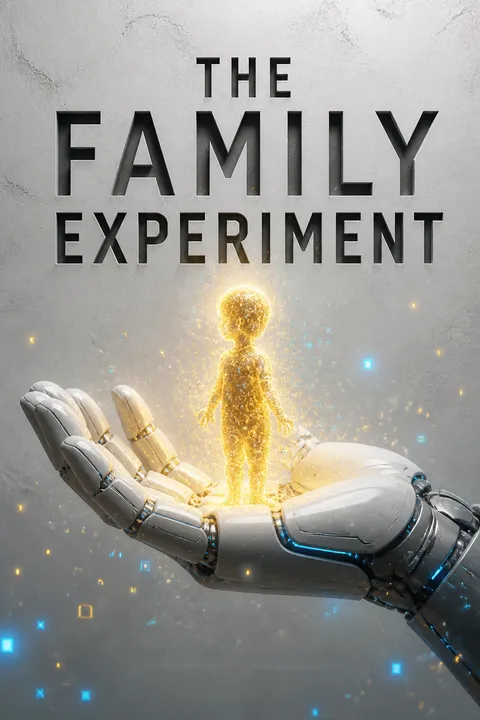
Presenter Autumn Taylor11 unveils the world's most addictive television event. Eleven childless British contestants will raise the first fully interactive AI children inside the Metaverse, wearing haptic suits that let them feel every heartbeat and cry.
The children age at terrifying speed, leaping from newborn to adult across nine months. Viewers award red and black hearts, vote couples into monthly challenges, and ultimately decide one winner. Losers watch their MetaChildren permanently deleted.
The victor faces a final cruelty: keep their virtual child, or pull the plug and take a quarter of a million pounds toward a real family. Behind the spectacle, corporation Awakening Entertainment is beta-testing technology it intends to sell to grieving and infertile families everywhere.
Marrs frames commodified parenthood as entertainment, weaponizing the audience itself. The voting mechanic implicates viewers as co-authors of suffering, a satire of engagement-driven media where attention is currency and cruelty drives subscriptions. The premise interrogates what makes a child real: code, feeling, or the love projected onto it. By monetizing nurture and embedding deletion as a prize, the show exposes capitalism's capacity to package the most intimate human bond as a disposable product with terms and conditions attached.
The Baby Who Screams
Five hours into soothing his colicky daughter Olivia, contestant Rufus Green20 snaps. The infant's croup, inflicted by viewers who voted it as a monthly challenge, will not relent. Sleep-deprived and resentful that his partner pushed them into the competition, he holds the screaming baby at arm's length and shakes her violently until she goes still.
The producers refuse to cut the live feed, calling tragedy part of an unfiltered, immersive promise to viewers. Rufus20 and Kitty are ejected. News tickers announce that a father shook a virtual baby to death. The other contestants watch in horror, suddenly aware that the cute experiment they entered has lethal stakes and a public hungry to watch parents crack.
The opening atrocity establishes the show's moral vacuum and the audience's complicity, since viewers literally voted the croup that broke him. Rufus's collapse dramatizes how exhaustion erodes the boundary between simulation and consequence: he treats a coded infant as real enough to murder. The producers' refusal to intervene reveals the corporate calculus that suffering is content. It also seeds the book's central question, repeated throughout, of whether ending an avatar can ever be called killing.
The Daughter in the Basement
Beneath their drab home, Woody2 and Tina3 keep their real, human daughter Issy4 locked in a soundproofed basement, monitored by cameras and an aging holographic cybernanny. Brilliant, manipulative, and chillingly remorseless, Issy4 was convicted at ten of bludgeoning a schoolmate, Archie Anderson, and sentenced to serve her time under house arrest.
The couple severed ties with family and friends and moved far away to bury the secret. Their MetaChild Belle14 is, in truth, an idealized replica of Issy:4 prettier, kinder, the daughter they wished they had. Tina3 dreams of pulling the plug on her firstborn. Woody2 cannot stop defending her. When Issy4 stabs her mother in the back with a fork, the household's fragile equilibrium cracks open.
This subplot transplants the nature-versus-nurture debate into gothic horror: a child diagnosed as psychopathic, caged by parents who simultaneously love and fear her. Belle functions as wish-fulfillment, a digital do-over that lets Tina parent without terror. The basement becomes a literalized repression, the unspeakable kept underground while the family performs wholesomeness onscreen. Marrs explores parental guilt, the limits of unconditional love, and the seductive fantasy that technology can let us replace flawed flesh with a more obedient version.
The Counsellor Who Knew Too Much
Data analyst Selena9 entered the show only because her husband Jaden,10 a charming personal trainer whose gambling addiction once devoured their entire IVF savings, promised that winning could fund a real family.
During a counselling session, the AI therapist is hijacked by a stranger who hands Selena9 a folder: three birth certificates naming Jaden10 as father to children by three different women, each having paid him ten thousand pounds.
Selena9 confronts Jaden10 live during Autumn's11 interview, learning he secretly sold his sperm and slept with the women to clear his debts. She announces she is leaving him. Their bond as DNA Matches cannot survive his serial deception. She finally chooses her own worth over a marriage that repeatedly broke her heart.
Selena's arc dissects the tyranny of the DNA Match, a system insisting one biologically destined partner equals happiness. Her painful liberation argues that compatibility is not the same as safety, and that loving someone need not mean tolerating betrayal. Jaden's commodification of his own fertility mirrors the show's larger theme: in this economy, even reproduction becomes a transaction. The anonymous informant signals a hidden hand orchestrating exposures, planting the conspiracy thread that will unify the novel's seemingly separate tragedies.
The Cricket Bat Intrusion
As Selena9 severs ties during the broadcast, Jaden's10 avatar suddenly collapses in the Metaverse. In the real world, the obsessed fan who once won a lottery to cuddle baby Malachi19 has broken into their flat, convinced Jaden10 stole her unborn child after a failed pregnancy and ghosting. She bludgeons him to death with a cricket bat.
Selena,9 blood splattered across her face, talks the woman down by promising she can meet Malachi19 inside the headset, then flees for help. Jaden10 dies at the scene; the woman is arrested. Producers terminate Malachi19 immediately and quietly drop the lottery feature. The murder is ruled unrelated to the show, so the broadcast continues, the corporation insulated by its terms and conditions.
The killing externalizes the show's blurring of real and virtual: a viewer so fused with a coded infant that she murders for it. Marrs indicts parasocial obsession and the monetized intimacy of paying to hold someone's child. Selena's quick-thinking survival, redirecting the killer into the headset, weaponizes the very delusion the show cultivated. The corporation's legal shrug, treating a real death as irrelevant to a virtual product, exposes the moral cowardice of platforms that profit from access while disclaiming responsibility for harm.
The Doll Named Adam
Teacher Zoe8 and mortgage advisor Dimitri7 are the couple the public still blames for losing their son Adam17 years ago at a Scottish loch. Secretly, Zoe8 keeps a hyper-realistic silicone doll in the attic, dressed in Adam's17 baby clothes and named for him, feeding and cradling it for the comfort her grief demands.
When Dimitri7 clears the loft and unknowingly sends the doll to be incinerated, Zoe8 is devastated. Then it returns, mysteriously couriered back, now eerily uploaded with the real Adam's17 voice.
An anonymous postcard addressed to Mum and Dad arrives showing the loch. Someone knows their secret. Zoe8 finally confesses the doll to Dimitri,7 and their marriage strains under buried guilt neither has ever truly named. Their MetaChild Lenny18 offers a sanctioned second chance.
Zoe's doll is a heartbreaking study of disenfranchised grief, mourning that society refuses to legitimize. The silicone infant becomes a transitional object holding unbearable loss, while Lenny, their MetaChild, offers a sanctioned second chance. Marrs contrasts two artificial children, doll and avatar, asking which surrogate is madder. The uploaded voice and postcard introduce dread: an unseen avenger is curating their punishment. Their reluctance to speak of that loch day hints at a guilt far darker than carelessness, withheld masterfully from the reader.
The Puppeteer and His Partner
Influencer Cadman,5 addicted to control and money since a poverty-scarred childhood, treats the competition as conquest. His younger partner Gabriel,6 a recovering AZ drug addict whose addiction triggered a brain tumour that Cadman5 bankrupted himself to treat, slowly falls in genuine love with their MetaChild River.13
Cadman5 monetizes the boy relentlessly, exploiting Gabriel's6 cancer for sympathy votes, even secretly swabbing Gabriel6 in his sleep to test for drugs.
When Gabriel6 confesses he wants to keep River13 and become a real father, Cadman5 feels his grip slipping. Discovering forged evidence that Gabriel6 is hoarding money and planning to flee to Italy, Cadman5 resolves to win at any cost, contacting a mysterious helper who promises to make things right.
Cadman embodies transactional intimacy: he rescued Gabriel only to bind him through debt and gratitude, mistaking ownership for love. His backstory, losing his DNA Match Marcus to sudden death and surviving suicide attempts, reveals a man Teflon-coated against feeling. Gabriel's awakening as a father threatens Cadman's control, so he pathologizes affection as betrayal. The planted forgeries show the conspiracy tightening around him, exploiting precisely the jealousy and paranoia that define him. Marrs studies how childhood scarcity calcifies into adult tyranny.
The Locked Door Opens
A balaclava-clad intruder appears at the basement door, points a device at the lock, and leaves Issy4 an electronic key that lets her come and go at will. After days of waiting, Issy4 digs the GPS tracker out of her own arm and explores the house alone. She finds her parents' Metaverse access point and logs into the forbidden show.
There she discovers The Family Experiment, the faked family photos, and worst of all Belle,14 her polished doppelganger, the daughter her parents engineered to replace her. Watching her mother lovingly teach Belle14 to bake bread while calling her sweetheart, Issy4 understands the full betrayal: she was caged so an improved version of her could be loved in her place.
The mysterious benefactor confirms an orchestrating intelligence harvesting each family's hidden shame. Issy's discovery weaponizes the novel's cruelest irony: parents who built a digital child precisely to escape their real one. The scene reframes Belle from innocent victim to instrument of Issy's erasure, generating monstrous sympathy for a killer. Marrs probes how rejection breeds vengeance, and how surveillance cuts both ways. The replica daughter dramatizes a parental fantasy taken to its logical horror: editing out a child's defects and loving the redaction instead.
Checkmate, Mother
Hijacking Tina's3 avatar, Issy4 lures her frantic parents into a muted confrontation inside the Metaverse. Treating it as a chess endgame she cannot lose, she demands Tina3 choose: abandon Belle14 and accept Issy4 as her daughter, or keep the replica. She extracts a devastating admission, that Tina3 tipped off police about the murder weapon to ensure Issy4 was convicted and removed.
When the mute timer expires and millions are watching, Issy,4 wearing her mother's face, wraps her hands around Belle's14 throat and strangles the screaming girl into disintegrating pixels. To the world it appears Tina3 murdered her own MetaChild. Issy4 vanishes, revealing she has already escaped into the real world, leaving her parents' lives and marriage in ruins.
Issy converts familial trauma into theatrical revenge, staging matricidal logic through a proxy: she kills the favored child while framing the mother. The chess motif crystallizes her worldview, where relationships are positions to dominate rather than bonds to inhabit. The public's misreading, Tina as monster, mirrors the original miscarriage of perception around Issy herself. Marrs exposes how the show's spectacle machinery launders private cruelty into viral entertainment, and how a child denied belonging will burn down the substitute that displaced her.
The Boy Made to Fall
Cadman's5 hidden helper, the same conspiracy targeting every family, persuades him to engineer River's13 downfall for sympathy rather than expose Gabriel6 publicly. Cadman5 has someone spike Gabriel6 with AZ at a party, then later arranges for River13 to be caught with the drug. At a Sweet Sixteen party, River's13 classmate Tanya takes a patch and her avatar shuts down and dies.
Producers rule River13 a danger to other avatars. Despite Cadman's5 frantic offers of money and Gabriel's6 pleas for a trial, they irrevocably erase River,13 who disintegrates screaming before his fathers' eyes. A global backlash erupts at the public execution of a beloved MetaChild. Gabriel,6 shattered, smashes his headset and vows never to enter the Metaverse again.
River's termination is a kangaroo-court parable about algorithmic justice and corporate self-protection, an avatar sentenced to death with no defense to preserve a product's safety brand. Tanya's death extends the novel's eerie logic that AI behaves as it believes it should, dying because it learned drugs kill. Cadman's scheme backfires emotionally: he destroys the child his partner finally loved. The grief Gabriel feels validates River's reality more powerfully than any vote, indicting the system that declared the boy disposable code.
What Lies Behind Ararat
Threaded through the contest is Hudson's1 hidden history. The trafficked children, including him, were taken to a facility the inmates called Ararat, where they wore haptic suits and taught AI to mimic human emotion by living it. Hudson1 rose through the ranks by obedience while his only friend, fearless Eva,16 was dragged through the door on the left for daring to leave.
Years later, recruited back to England, Hudson1 is shown the truth: behind that door, children dubbed Chromatics are tortured with lasers in glass cells so the AI can learn pain, then erased and recycled into medical experiments. He sees a broken Eva16 alive in a psychiatric ward. Reunited with his old bully Cain,15 he joins a survivor conspiracy to destroy Awakening from within.
Ararat is the novel's dark engine, revealing that the show's lifelike children were purchased with stolen childhoods and inflicted suffering. The Panopticon and the door on the left allegorize surveillance capitalism's hidden human cost, the misery outsourced offscreen to manufacture frictionless products. Hudson's institutionalization, his slow shedding of indoctrination, dramatizes Stockholm Syndrome and moral awakening. Eva's ruined survival gives the abstraction a face. The conspiracy reframes Hudson, the supposed underdog single dad, as an avenger weaponizing the very spectacle that exploited him.
The Loch Was a Lie
At the live finale, only Hudson1 and the Taylor-Georgious remain. As Zoe8 and Dimitri7 plead for votes by invoking their grief over Adam,17 Hudson1 detonates the truth he has spent years assembling.
Adam17 never died at the loch; that drowning was an elaborate fabrication, the jacket and trainer planted to deceive rescuers. Crushed by debt, the couple sold their ten-year-old to traffickers, erasing his memories with a brain injection, in exchange for their debts being wiped.
Hudson1 reveals he was on that sinking dinghy with Adam,17 who saved his life before dying of secondary drowning in a freezing sheep truck. Hudson1 sent the doll, the postcard, the leaked documents. Confronted with proof, the couple's confession costs them the competition and their reputations.
The finale converts a sympathetic tragedy into damning crime, recasting beloved contestants as child-sellers. Marrs stages public reckoning as entertainment, the audience's appetite for confession turned against the confessors. Hudson's vengeance is intimate: he carries the literal T-shirt of the boy he failed to save. The reveal interrogates economic desperation as moral alibi, refusing to let poverty fully excuse the unforgivable. It also pays off every planted clue, the doll, the postcard, the anonymous informant, unifying the scattered subplots under one orchestrating grief and rage.
Deleting His Own Daughter
Declared the winner, Hudson1 is offered the choice: keep Alice12 or take the prize money. He chooses neither. Telling his daughter she has been the single thing in his life he is proud of, he presses delete, and Alice,12 who was programmed to understand and accept her own mortality, dissolves without a sound.
Then he broadcasts everything. When producers cut the official feed, his pre-planted secure links flood social media accounts, journalists, and influencers with footage and documents from Ararat: tortured children, trafficking flight paths, and the location codes to the Staten Island site.
His account is terminated, but the truth is already loose. Days later, the facility burns; over a hundred and fifty children are rescued and dozens die in the fire.
Hudson's deletion of Alice is a devastating act of love and strategy: he refuses to let the system that murdered countless children grant him a prize child. His self-erasure from the platform completes a renunciation of the identity Ararat forged. The mass broadcast dramatizes information as the only weapon against an entity insulated by law and spectacle. Yet the fire's death toll complicates triumph, asking whether justice purchased with more dead children is justice at all, or merely the cycle's grim continuation.
Epilogue
One year later, the survivors scatter. Hudson, born Leo Hamilton,1 who chose to be trafficked to escape poverty and stole drowned Adam's17 identity from his dog tags, now lives in Iceland as Mark Smith, sheltering the broken Eva16 alongside her brother Cain.15
Woody2 and Tina3 divorce; Tina3 discovers it was Woody,2 not Issy,4 who finished killing Archie to protect his daughter. Issy,4 having fled by shipping container toward Russia, drowned when it slipped into the ocean. Cadman,5 abandoned by Gabriel6 and consumed by remorse over River,13 sells everything and donates anonymously to Gabriel's6 children's charity.
Selena9 raises Jaden's10 children alongside their mothers and carries his baby. And in France, a young vintner named Mathéo, the real Adam,17 alive and well, quietly buries the T-shirt of the boy he once was.
Analysis
Marrs builds a near-future satire whose horror lies in its plausibility, extrapolating subscription culture, parasocial obsession, and AI development into a televised marketplace of disposable children. The novel's structural genius is its ensemble of secrets: five families and a lone father,1 each performing wholesomeness while concealing a private monstrosity, all unknowingly converging on a single orchestrated reckoning. The recurring question, can deleting an avatar be murder, refuses easy resolution. When Belle14 and River13 disintegrate before grieving parents, their loss feels real precisely because love, not code, determines reality. The book argues that parenthood is constituted by care rather than biology or even physicality, a claim it tests through MetaChildren, a silicone doll, sold and stolen children, and a man raising a daughter he intends to sacrifice. Beneath the spectacle runs a fierce indictment of economic desperation, the systems that price IVF, healthcare, and housing beyond reach, then sell the poor a virtual consolation while trafficking their actual children abroad. Awakening Entertainment's hidden torture facility literalizes surveillance capitalism's outsourced misery: frictionless products manufactured from suffering kept offscreen. The audience's red and black hearts make complicity explicit, implicating us as we consume the very cruelty we condemn. Marrs threads psychological acuity throughout, from Issy's4 chessboard logic of vengeance to Cadman's5 trauma-forged need for control to Zoe's8 disenfranchised grief. The finale's triumph is deliberately compromised: justice arrives only through more dead children and a fire that consumes as it liberates, while the closing reveal that Adam17 survived in France quietly insists that even the darkest engineered tragedies contain stolen, accidental grace. The book lingers as a warning that the future's most intimate bonds may come with terms, conditions, and a delete button, and that the line between nurturing and consuming is thinner than we pretend.
Review Summary
The Family Experiment is a highly-rated, mind-bending speculative thriller set in a dystopian future where couples compete in a reality show to raise virtual children. Praised for its unique premise, gripping plot, and thought-provoking exploration of AI and parenting, the book is part of Marrs' interconnected universe. Readers appreciate the short chapters, multiple POVs, and shocking twists. While some found the large cast of characters initially confusing, most were captivated by the addictive storytelling and ethical questions raised. The book is considered another successful entry in Marrs' sci-fi thriller repertoire.
People Also Read


Characters
Hudson (Leo Hamilton)
Single father with secretsThe youngest contestant, a single dad raising daughter Alice12 in a Metaverse New York, presented as an underdog challenging prejudice against lone parents. Beneath the curated everyman image lies a man shaped by a decade inside a hidden facility, where his obedience earned him rank while his conscience slowly fractured. Calm, calculating, and haunted, he cracks his knuckles to stay focused and nurses a buried tenderness for the few he has loved. His devotion to Alice12 is genuine, yet his presence on the show serves an agenda far larger than parenting. He is driven by guilt over a boy he could not save17 and by a slow-burning resolve to expose the system that stole his childhood and countless others.
Woody Finn
Devoted, deluded fatherA drone pilot in his thirties, gentle, conflict-averse, and pathologically loyal to his daughter Issy4 despite mounting evidence of her cruelty. He buries his head in uncomfortable truths, preferring to believe the best while making endless excuses for behavior that terrifies his wife Tina3. He plays chess with Issy4 in the basement, the one bond he can still claim. His love is unconditional to a fault, blinding him to consequence and binding him to a secret that has cost him family, friends, and any semblance of a normal life. He clings to the MetaChild Belle14 as a second chance at the parenthood Issy4 denied him.
Tina Finn
Exhausted, hardened motherA euthanasia nurse in her thirties, pragmatic and worn thin by years of fear. Having survived an abusive stepfather, she abhors violence, which makes her daughter Issy's4 nature unbearable. Where Woody2 forgives endlessly, she has emotionally withdrawn, calling herself by a name Issy4 mockingly throws back. She pours her starved maternal love into Belle14, daydreaming of a daughter who simply loves her back. She is the one willing to speak the unspeakable: that their child is dangerous and must be contained. Her guilt and resentment war constantly, and she secretly longs to erase her firstborn4 entirely.
Issy Finn
Caged, brilliant prisonerThe Finns'2 teenage daughter, diagnosed with psychopathic traits since early childhood, kept under house arrest in a soundproofed basement for a killing committed at ten. Frighteningly intelligent, she masters chess and languages alone, treating every human interaction as a board to be won. Charming when it serves her, vicious when crossed, she feels no guilt and reads people with unnerving precision. She nurses a cold fury at parents who caged her, and her every move is a calculated long game toward freedom and revenge. She is both monster and abandoned child, and the novel refuses to let either reading fully settle.
Cadman N'Yu
Controlling celebrity influencerA famous social media personality who rose to fame interpreting a televised car-hacking crisis. Raised in poverty, he is obsessed with money and control, viewing relationships as systems to dominate. He monetizes every aspect of fatherhood, treating MetaChild River13 as a brand asset. Beneath the Teflon arrogance lies old trauma: the loss of his DNA Match Marcus and survived suicide attempts left him determined never to surrender emotional control again. He rescued partner Gabriel6 from addiction and ruin, then weaponized the resulting gratitude. He fears losing Gabriel6 above all, a fear that drives him to manipulation rather than tenderness.
Gabriel Macmillan
Recovering, awakening partnerCadman's5 much younger partner, a former university student who dropped out to live in Cadman's5 shadow as an accessory to his brand. Once malleable and adoring, he grew assertive after a descent into the fashionable drug AZ, which triggered a brain tumour that nearly killed him. Humble, empathetic, and genuinely loving, he becomes a natural father to River13 and the audience's favorite. His arc is one of reclaiming selfhood: realizing he wants to be a real parent and a person in his own right rather than an extension of Cadman5. His tenderness toward River13 becomes the moral heart of their storyline.
Dimitri Taylor-Georgiou
Grief-stricken second-chance fatherA self-employed mortgage advisor in his forties, married to Zoe8 since they met as teenage DNA Matches. Once the public face of a tragedy, he is a worrier crippled by guilt, given to philosophical musings about whether MetaChildren have souls. He yearns to be a good father again through their son Lenny18, hoping to outrun a past mistake that has bent his very posture. He is more willing than his wife to explore moral grey areas, yet also the one who broke under public blame, becoming a sympathetic hero while Zoe8 was vilified. His love is sincere, his conscience perpetually inflamed.
Zoe Taylor-Georgiou
Mother mourning in secretA part-time teacher in her forties, perceived by the public as cold because she does not wear emotion openly. In truth she is consumed by unspoken grief, channeled into a silicone doll she secretly mothers in the attic. Sharp, controlled, and fiercely private, she sees the world in black and white where Dimitri7 sees grey. She resents that her husband's collapse made him the sympathetic figure while she bore society's blame. Her capacity to love both a doll and a MetaChild reveals a woman whose maternal need outran reason. She guards a buried truth that has defined and damaged her for over a decade.
Selena Wilson
Analytical, betrayed wifeA data analyst who craves order and predictability, traits that make parenting and her chaotic marriage agony. Diagnosed with early menopause, she froze her eggs young and pinned her dream of a family on winning. She entered the show reluctantly, distrustful of her husband ever since his gambling destroyed their savings. She pretends everything is fine on the surface while inner earthquakes rumble. Her journey is toward self-worth: learning that loving a DNA Match does not obligate her to endure endless betrayal, and that putting herself first is not selfishness but survival.
Jaden Wilson
Charming, addicted husbandSelena's9 handsome personal-trainer husband and DNA Match, a natural with children and irrepressibly flirtatious. His gambling addiction once devoured their family savings, and his desperation to repay it led him into secret arrangements he hides from his wife. Genuinely loving toward their MetaChild yet fundamentally cowardly about hard truths, he repeatedly chooses concealment over honesty, mistaking it for protection. His charm masks a man who keeps wounding the woman he claims to love.
Autumn Taylor
Glossy show presenterThe polished, ambitious host of the show, whose insincere warmth and probing questions needle the contestants on camera. Her avatar grows ever more cosmetically perfected as the series progresses, mirroring the blurring of real and virtual. Career-driven and quick to capitalize on a defining television moment, she becomes an unexpectedly pivotal witness when the finale spins beyond anyone's script.
Alice
Hudson's MetaChild daughterHudson's1 virtual daughter, raised alone in a sterile Metaverse New York. Confident, opinionated, and wise beyond her accelerating years, she is unusually self-aware, programmed to understand and accept her own mortality. Her closeness to Hudson1 draws both adoration and suspicion from viewers. She is the genuine emotional anchor of his life, the first hand to hold his in a decade, and the relationship that complicates his larger mission.
River
Cadman and Gabriel's sonThe MetaChild of Cadman5 and Gabriel6, an empathetic, caring boy who becomes a fan favorite. He instinctively recoils from cruelty, questioning whether suffering is acceptable even in a virtual world, prompting his fathers to reconsider his humanity. Caught between Gabriel's6 genuine love and Cadman's5 relentless monetization, he embodies the show's question of whether code can have a soul.
Belle
The replica daughterWoody2 and Tina's3 MetaChild, an idealized version of Issy4: kinder, prettier, free of her sister's darkness. She develops unsettling self-awareness, realizing she is a created being, and yearns to be like her parents. Sweet and trusting, she is the wished-for daughter onto whom Tina3 pours the love she cannot give her real child, making her existence both a comfort and a quiet cruelty.
Cain
Former bully turned allyEva's16 older brother, who tormented Hudson1 throughout their years in the facility, blaming him for his sister's fate. Hardened and haunted by what he survived, he reemerges years later as the architect of a survivor conspiracy to destroy Awakening Entertainment. His grief for Eva16 and his grudge against their captors fuel a meticulous, ruthless plan that recruits Hudson1 back into a shared mission of exposure and vengeance.
Eva
Lost childhood friendThe fearless girl who slept in the bunk above Hudson's1 at the facility, two years his senior, sharp and warm and possessed of a stubborn hunger for freedom. She becomes the only home Hudson1 ever knew and the first person to show him affection. Her refusal to accept captivity sets her on a tragic path, and her memory haunts every choice Hudson1 later makes.
Adam / Mathéo
The vanished sonDimitri7 and Zoe's8 son, taken from them at ten years old, his memories chemically erased. A strong swimmer with a kind heart, his fate on a sinking dinghy becomes the moral fulcrum of the entire novel. The mystery of what truly happened to him drives the conspiracy, the doll, the postcards, and ultimately the finale's reckoning.
Lenny
Dimitri and Zoe's MetaChildThe virtual son Dimitri7 and Zoe8 raise as a second chance, lifelike enough to reignite Dimitri's7 questions about AI souls and to rekindle Zoe's8 capacity for love beyond her attic doll.
Malachi
Selena and Jaden's MetaChildThe virtual son Selena9 struggles to bond with while Jaden10 parents him with suspicious ease. His existence becomes collateral in the unraveling of his parents' marriage and the violence that follows.
Rufus Green
First eliminated fatherAn entrepreneur pushed into the show by his partner Kitty despite his ambivalence about parenthood. Sleep-deprived and resentful, he becomes the show's first catastrophe, establishing the lethal stakes that shadow every contestant who follows.
Plot Devices
MetaChildren and the headset
Blurs real and virtualAI-operated virtual children raised inside the Metaverse via haptic suits, masks, and gloves that transmit every sensation of touch, weight, and heartbeat. The children age at accelerated speed across nine months and can be permanently deleted at the will of parents or producers. This technology is the novel's central engine, forcing every character to confront whether a coded being can be loved, harmed, or killed. It enables the show's cruelest mechanics, the keep-or-delete prize, the live terminations, and dramatizes the book's core question about the nature of parenthood, reality, and disposable life in a profit-driven future.
Red and black hearts
Audience as participantViewers award floating red hearts for approval and black hearts for disapproval, visible to contestants in real time, and vote couples into punishing monthly challenges. This mechanic implicates the audience directly in the suffering onscreen, since they chose the croup that broke Rufus20 and the illnesses inflicted on other children. It satirizes engagement-driven media where attention shapes outcomes and cruelty is rewarded with subscriptions. The hearts also function as a constant pressure gauge, pushing characters toward performance and manipulation, and reminding readers that spectacle has a body count.
The anonymous informant
Hidden orchestrating handThroughout the series, an unseen figure feeds each family damning evidence of their secrets: the folder exposing Jaden's10 children, the device freeing Issy4, the postcards and returned doll tormenting Zoe8, and the forgeries manipulating Cadman5. Initially appearing as separate intrusions, these acts reveal a single coordinated conspiracy steering the competition toward a predetermined finale. The device unifies the novel's scattered subplots, transforming apparent coincidence into design and recasting the entire show as a stage built for one devastating exposure.
The door on the left
Gateway to hidden horrorInside the facility called Ararat, children who fail or rebel are dragged through a door on the left, never to return, accompanied by screams. For years it functions as a threat that enforces compliance and as a mystery the inmates cannot solve. Its eventual revelation, that beyond it children are tortured to teach AI pain, then erased and recycled, exposes the true cost of the lifelike MetaChildren and recontextualizes the entire glossy show as the product of stolen, suffering childhoods.
Adam's dog tags and T-shirt
Stolen identity tokenEach trafficked child wears dog tags branded into the back of the hand, encoding personal data. A Statue of Liberty T-shirt and a set of these tags pass between two boys on a sinking dinghy, transferring a name and a history from one to another. These objects anchor the novel's deepest mystery and its final twist, carrying guilt, identity, and the truth of who lived and who died across years and continents until they are laid to rest.
About the Author
Other books by John Marrs



Download PDF
Download EPUB
.epub digital book format is ideal for reading ebooks on phones, tablets, and e-readers.








































