
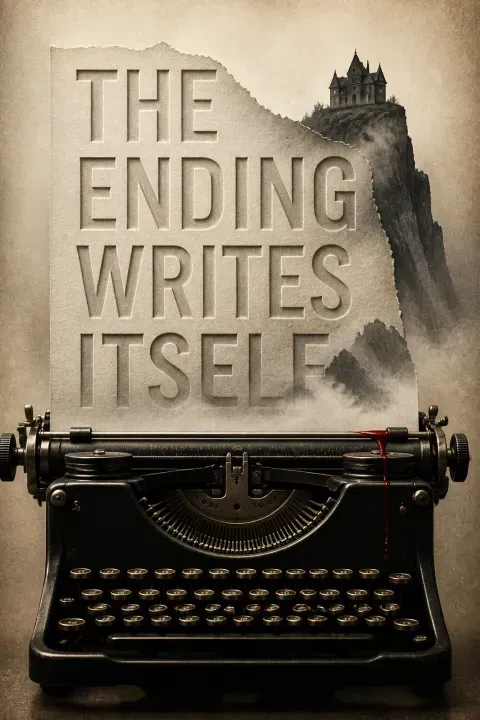


Plot Summary
Prologue
Cate Newhouse,1 twenty-two years old and freshly dumped, sits on the toilet in her cramped flat above a butcher shop, scrolling through a profile of Arthur Fletch.11 She has just been forwarded an invitation by her formidable agent, Eleanor Vandenberg,8 to attend one of Fletch's11 exclusive literary salons on his private Scottish island, Skelbrae.
The article mentions Fletch's11 rumored golden book, commissioned in solid gold to celebrate his success. Cate1 can barely afford underwear and exists on day-old pastries from the café where she works.
She is terrified the other writers will see through her, but she deletes her self-deprecating draft and types five words accepting the invitation. She hits send just as a fist bangs on the bathroom door. There is, of course, no toilet paper.
Cate's introduction establishes the economic abyss between literary celebrity and the struggling unpublished. The bathroom setting, comically undignified, places her at the absolute bottom of the hierarchy Fletch's invitation promises to elevate her from. Her reflexive deletion of self-doubt in favor of performative confidence mirrors the false bravado publishing demands from its aspirants, while foreshadowing her deeper capacity for reinvention. The golden book rumor planted here will grow into the story's most dangerous object, a literalized fantasy of literary worth that someone will kill to possess. Cate's twin hunger, for validation and for escape from precarity, makes her the competition's wild card: underrated, underestimated, and far more dangerous than anyone suspects.
Fletch Is Dead
Sienna2 and Malcolm Buchanan,3 the married duo behind the thriller pseudonym Penn Stonely, arrive by boat at Skelbrae. Millie Mitchell,4 a bubbly YA author, greets them and leads them to the drawing room, where Jaxon Knight5 (sci-fi), Kenzo Gray6 (horror), Priscilla Renée Fox7 (romance), and Cate Newhouse1 (unpublished debut) are waiting.
They sign non-disclosure agreements and make awkward small talk until a gong summons them to the grand staircase. On the landing, Eleanor Vandenberg8 and editor Rufus Beaumont9 announce that Arthur Fletch11 drowned a month ago.
His final Petrarch novel sits unfinished at 90,000 words. The seven writers have 72 hours to write the best ending. The winner gets two million dollars and a three-book deal with Merriweather Press. Their phones and laptops are locked in a time-lock safe.
The contest structure functions as a dark inversion of the golden-ticket fantasy. These seven are not the celebrated elite but the industry's also-rans, selected precisely because their desperation makes them compliant. The time-lock safe embodies publishing's punitive relationship with authors: even their tools are confiscated. Eleanor's clinical delivery reveals an industry that treats even its titans as logistical problems. The blind-judging system promises meritocracy, but the very premise, pitting writers against each other for a gig that will never carry their names, exposes the lie at publishing's core. It was never about the work, only the product.
The Get Out Note
That night, Millie4 screams. The others rush to her room and find a sheet of pale-blue paper in her typewriter bearing two words: GET OUT. Millie4 insists her door was locked. Malcolm,3 seizing the role of detective, collects typing samples from every machine in the house.
He discovers the letter G on the note sits slightly below the other characters, a flaw absent from Millie's4 typewriter. The culprit used a different machine, ruling out ghosts and pointing to a human saboteur among them. Sienna2 notices Jaxon5 smirking at the discovery.
Priscilla7 urges everyone back to bed, but the psychological damage is done. Later, Sienna2 will discover the misaligned G matches the typewriter in Fletch's11 hidden attic room, accessible through a secret door she picked in the hallway wallpaper.
The note weaponizes the psychology of creative competition. It is not a death threat but an exclusion, a declaration that someone does not belong, which for a midlist writer may be the more terrifying message. Millie's locked door creates the first of several impossible crimes, establishing the house itself as a container of secrets. Malcolm's typewriter forensics are clever but tragically misdirected: he solves the wrong mystery with the right method, a pattern that will define his arc. The note also functions as dramatic irony, the mechanism (secret passages, Fletch's attic typewriter) already being laid bare while the culprit's identity remains hidden.
Fletch's Secret Attic
Frustrated with Malcolm,3 Sienna2 explores the dollhouse model in the library and discovers a hidden door in the hallway wallpaper between Millie's4 and Jaxon's5 rooms. Using a pen to pick the lock, she climbs to Fletch's11 attic bedroom: a sparse space with an unmade bed and a black typewriter.
In the desk she finds a half-typed, crumpled letter to Eleanor8 confessing he cannot find the ending. A trapdoor opens onto a ladder descending directly into Millie's4 bedroom, explaining how someone planted the note undetected.
Sienna2 also confirms the misaligned G on Fletch's11 typewriter matches the threatening message. She realizes whoever wrote the note has also been in this room, and that the house's hidden passages make every bedroom accessible to anyone who knows the secrets.
Sienna's discovery dismantles the mythology of the solitary genius. Fletch, the titan who built a castle on his success, was paralyzed by the same terror that haunts every writer: the fear that the ideas have simply stopped. The crumpled letter humanizes him while deepening the mystery of his death. The secret passages literalize the book's central theme: in a world built on competition and performance, everyone has covert access to everyone else's vulnerabilities. Sienna's lock-picking, a skill she acquired to impress other writers at a conference, demonstrates how the tools of the trade become weapons when stakes escalate.
One Becomes Two
After a bitter fight in their yellow bedroom, Sienna2 declares Penn Stonely dead and demands to write alone. At the games room gathering, the editor Rufus9 agrees to accept separate entries from both Sienna2 and Malcolm.3
When Rufus9 gestures and says the phrase "one becomes two," Sienna's2 mind catches on the words. Inspiration strikes: she knows exactly how to end Petrarch's story, with one killer revealed as two working in tandem. She scribbles frantic notes with Priscilla's7 red pen as the other writers watch with undisguised envy.
Meanwhile, Cate1 slips into the kitchen and doses the communal teapot with sleeping pills stolen from Sienna's2 nightstand. Sienna,2 unaware, drinks deeply. As fatigue overwhelms her, she attempts to carry the heavy typewriter downstairs to the library to write.
The creative spark arrives through accident rather than solitary genius: a turn of phrase, a casual gesture, a moment's overheard conversation. This democratizes inspiration while making it terrifying, since anyone might stumble upon the breakthrough at any moment. Rufus's casual permission inadvertently reshapes the entire contest. The phrase 'one becomes two' operates on multiple levels: the marriage dissolves, the partnership fractures, and the solution to Petrarch's mystery crystallizes in Sienna's mind. Her triumph is also her death sentence, as Cate, watching her have the breakthrough, decides to eliminate the most dangerous competitor by weaponizing the sleeping pills Sienna herself brought to the island.
The Pink Glasses Ruse
Four weeks earlier, Eleanor Vandenberg8 arrives at Merriweather Press to inform senior editor Ava Paulson7 that Arthur Fletch11 has drowned. With the final Petrarch novel unfinished and the publishing house facing financial catastrophe, they devise an audacious plan: invite midlist writers to compete, and have Ava7 observe them incognito.
She creates the persona of Priscilla Renée Fox,7 a romance novelist who wears pink glasses and writes with red ink. Holden Merriweather,9 Ava's7 underqualified assistant and the publisher's nephew, volunteers to pose as Rufus Beaumont,9 Fletch's11 new editor, complete with a posh English accent practiced in drama school. The plan is reckless, born of desperation, but with millions at stake and the company's future in the balance, they proceed.
This flashback radically reframes all preceding events. Priscilla's composed, watchful demeanor, which read as condescension or aloofness, now scans as the behavior of someone evaluating colleagues for a job while concealing her true identity. The reveal exposes publishing's core cynicism: the writers believe they are competing for a ghostwriting gig, but they are also being auditioned for a working relationship by an editor who does not trust them to be authentic if they know who she is. Holden's casting as Rufus, based on his appearance as 'a white man who looks like an editor,' delivers a caustic verdict on publishing's demographic imagination and nepotism.
Sienna's Fatal Fall
Staggering under the sleeping pills' influence, Sienna2 hauls the typewriter from her room toward the library. At the top stair, she loses balance, nearly recovers, then feels two hands slam into her shoulders. She tumbles backward, the heavy typewriter crashing after her, its corner striking her skull.
She dies on the landing beneath the stained-glass portrait of Julia Petrarch. Millie4 and Priscilla7 find the body first. Malcolm,3 still drunk, collapses in grief.
Kenzo,6 revealing he is a forensic technician by day, examines the scene and suggests it could be accidental, but Malcolm3 is unconvinced. He discovers a GET OUT note in Sienna's2 pocket, identical to the one left for Millie,4 and vows to identify the killer, casting himself as the detective in a mystery of his own making.
Sienna's death crystallizes the book's thesis: the line between accident and murder, like the line between inspiration and theft, is thinner than anyone wants to admit. The sleeping pills, prescribed to Sienna by Malcolm during a trip she did not want to take, add another layer of distributed culpability. Malcolm's grief is genuine but immediately instrumentalized: he casts himself as the detective-hero, more invested in narrative coherence than truth, a character flaw that will prove fatal. The stained-glass Petrarch watching over the body suggests the dead author's work has become a silent, indifferent god presiding over the carnage done in its name.
Holden Abandons the Island
After being accidentally struck by Jaxon's5 pool cue during the blackout, Holden9 retreats to the cottage. Unable to sleep, he hears footsteps crunching on the gravel outside. When he opens the door, a figure in Fletch's11 signature red hat trudges toward him through the dark, gray hair whipping in the wind.
Holden,9 who has never believed in ghosts, becomes an instant convert. He slams the door, packs frantically, and runs to the dock. Finding the yacht key hidden under a mat, he starts the engine and flees toward the mainland, leaving the writers stranded with no communication, no escape, and no authority figure.
The specter is actually Angus, the elderly groundskeeper10 who has lived on Skelbrae his entire life and was Fletch's11 quiet drinking companion, searching for the golden book.
Holden's flight is both comic and catastrophic. His cowardice strands the remaining writers, transforming the contest from a pressure cooker into a death trap. The scene derives dark humor from his absolute privilege: a man whose family name is on the building, who has never faced genuine consequences, abandons everyone the instant he feels afraid. The red hat, passed from Fletch to Angus to Holden's nightmare, becomes a symbol of authorship and identity that haunts the island. Holden's departure removes the nominal authority, forcing the writers to govern themselves, a power vacuum that will prove lethal.
Malcolm's Cliff Edge Fall
Malcolm,3 convinced someone murdered Sienna,2 interrogates each writer in Fletch's11 office. He learns nothing conclusive. After Kenzo6 suggests Malcolm3 himself had motive, he retreats to his room and discovers Sienna's2 notebook containing her brilliant ending. Desperate to claim her work as his own, he takes it outside to a cliffside bench. But Sienna's2 shorthand proves illegible.
In fury, he tears pages loose, scattering them toward the cliff. He finds the decoder key on the inside cover too late and scrambles to retrieve the flying pages. The ground crumbles beneath his feet. Jaxon,5 returning from a run, sees Malcolm3 at the edge and sprints to save him, arriving a second too late. Malcolm3 plummets onto the rocks below.
Malcolm's death is the novel's most Shakespearean moment: the character flaw that propels him, the need to claim Sienna's work as his own, is precisely what kills him. The illegible shorthand becomes a devastating metaphor for their marriage: an intimate code that promised collaboration but masked exploitation. His decision to tear pages out in rage rather than decoding them patiently mirrors his entire approach to writing and partnership, where shortcuts and credit-stealing substituted for genuine labor. Jaxon's failed rescue sets up the next tragic beat: his genuine heroism will be misinterpreted as murder.
Strangled in a Locked Room
Millie,4 having witnessed Malcolm's3 fall from a distance and misread Jaxon's5 rescue attempt, tells the group Jaxon5 pushed him. The others lock Jaxon5 in his room for safety. Trapped and alone, Jaxon5 finally overcomes six months of creative paralysis and begins typing Petrarch's ending, finding a euphoric flow he thought he had lost forever.
As he works, a hidden panel in the wall slides open. Cate1 emerges silently, loops Jaxon's5 own black resistance band around his neck, and strangles him at the desk.
She steals his typed pages and vanishes back through the secret passage. When Millie4 and Kenzo6 later bring food, they find Jaxon5 dead. The locked room seems impossible until Millie4 accidentally leans against the wall and the hidden door springs open, connecting her room to his.
Jaxon's death is the cruelest because it arrives just as he rediscovers his voice. After years of creative paralysis driven by industry trauma, the enforced isolation breaks through his block, proving his prolific past was not lost, merely buried. The resistance band, his tool for physical self-improvement, becomes the murder weapon, weaponizing discipline itself against its owner. The secret passages, initially charming architectural details on the dollhouse, now emerge as the mechanism enabling the killer to move unseen, transforming the castle from a writing retreat into a slaughterhouse where no room offers genuine security.
The Golden Book Appears
Millie,4 suspecting Priscilla,7 searches her room and discovers both Jaxon's5 stolen pages and Millie's4 own submitted ending. She confronts Priscilla7 with a decorative mace. Cate1 appears behind Millie,4 holding the legendary golden book, a solid-gold edition of the first Petrarch novel encrusted with rubies and diamonds.
She found it hidden beneath the foyer floor after interpreting the light pattern cast by the dollhouse lamp through the stained-glass window. Cate1 brings the heavy tome down on Millie's4 skull twice, killing her.
When Priscilla7 demands answers, Cate1 coolly explains she spiked the tea, pushed Sienna,2 strangled Jaxon,5 and bludgeoned Millie.4 She also reveals her debut manuscript was generated by an AI fed with Fletch's11 complete backlist.
The golden book's appearance fulfills the early rumor while subverting it: the treasure is real, but it is not a MacGuffin, it is a murder weapon. Cate's use of AI to fabricate her manuscript transforms her from a sympathetic striver into something more philosophically unsettling: a saboteur who infiltrated the system to expose its inability to distinguish authentic work from algorithmic mimicry. Her mother's wasted life chasing literary dreams provides psychological context but no moral justification. Cate has internalized the industry's darkest lesson: success depends not on talent but on manipulation, and if the machine cannot tell the difference, the difference may not exist.
Cate Reveals Everything
With Millie4 dead at her feet, Cate1 explains her philosophy to Priscilla.7 Publishing is a broken machine that chewed up her mother for decades with nothing but rejection letters to show for it.
Cate1 fed every Fletch11 novel into an AI, generated a manuscript indistinguishable from his style, and sent it to Eleanor,8 knowing the algorithm-driven slush pile would flag it. She came to Skelbrae for the golden book, worth far more than the contract. The competition provided cover to search the house. She killed opportunistically, eliminating anyone who got in her way.
She now intends to kill Priscilla7 too. Desperate, Priscilla7 drops her facade and reveals she is actually Ava Paulson,7 Fletch's11 editor, and tries bargaining: she can open the safe so Cate1 can take her devices and escape with the golden book.
Cate's confession reframes the novel as a revenge fantasy against the entire publishing apparatus. She is not a writer corrupted by the system but an outsider who weaponized its own tools against it, exposing the hollow metrics by which 'talent' is judged. Her AI-generated manuscript is the ultimate indictment: if a machine can produce work indistinguishable from human craft, and an agent cannot tell the difference, what value does 'authentic voice' actually hold? The revelation that Priscilla is Ava forces a confrontation between two opposing philosophies: Cate's nihilistic certainty that the industry is irredeemable versus Ava's battered but stubborn investment in the idea that good work and genuine talent still matter. Neither woman is entirely wrong.
Ava's Desperate Escape
Ava7 leads Cate1 toward the office, but in the foyer she spots Kenzo6 impaled on the antler table, seemingly dead. Lightning illuminates the hall and Ava7 bolts through the front door into the raging storm. Barefoot, stripped to her tank top after her pink sweater is pinned to a tree by a crossbow bolt, she runs toward the island's second dock.
A hidden snare catches her ankle, wrenching it. Cate1 closes in, reloading with her final bolt. Ava7 drives her red pen into Cate's1 hand, buys herself seconds, and hobbles to a rowboat. Cate1 leaps aboard. Ava7 swings an oar into Cate's1 chest, knocking her into the churning sea. Weighed down by the satchel containing the golden book, Cate1 refuses to release it and drowns beneath the waves.
Ava's flight transforms her from an observer into a protagonist, the editor literally fighting for her life against the author she unwittingly invited into the competition. The pink sweater pinned to the tree becomes a shedding of the Priscilla persona, leaving only Ava, stripped to her essentials. Cate's refusal to release the golden book, even as it drags her under, crystallizes her pathology: the symbolic value of the treasure, the proof that she beat the system, outweighs survival itself. The red pen Ava uses as a weapon reappropriates the editor's tool for violence, a darkly satisfying inversion. The editor who spent her career in service of authors must kill one to survive.
The Safe Opens to Silence
The time-lock counts down to zero and the safe swings open, but no one is there to claim the seven writers' devices. Two days later, Eleanor Vandenberg8 walks through the empty house and collects each phone, laptop, and tablet, loading them into her bag. Two weeks after that, Ava7 meets Eleanor8 at a Park Avenue bar, her ankle in an air cast.
Eleanor8 has adopted Sienna2 and Malcolm's3 chihuahua, Edgar. She explains she chose writers without close family specifically to minimize fallout from their deaths. The story will be contained. Then Eleanor8 suggests Ava7 write the ending herself.
Ava7 returns to her apartment, sits before a blank screen, and retypes Fletch's11 last line. The cursor blinks. Hours pass. The words do not come. A postscript reveals Ava7 left publishing, moved upstate, and fell in love with a beekeeper. Merriweather released Petrarch's final novel unfinished, to massive success.
The resolution pointedly refuses catharsis. Ava's inability to write the ending, despite knowing the Petrarch series better than anyone alive, proves that editorial skill and authorial creativity are fundamentally different capacities that cannot be willed into being. The industry absorbs the tragedy and commodifies it: the unfinished manuscript becomes a bestseller, the deaths become invisible, and the machine rolls forward undisturbed. Eleanor's admission that she selected socially isolated writers reveals a chilling calculus beneath her professional polish. The postscript's breezy summary of Ava finding love outside publishing offers the only genuinely happy outcome, but it is delivered with such speed that it reads as ironic wish-fulfillment pasted onto a horror story.
Epilogue
Kenzo Gray,6 alive despite being impaled on the antler table, sits at his book launch in a packed bookstore. His new novel is a thinly veiled account of the Skelbrae massacre, rebranded as a literary thriller.
Angus, the groundskeeper,10 saved him: found him bleeding on the path, stitched his wounds with fishing line, and radioed for help. Eleanor Vandenberg8 became his agent, and the book is a breakout success. During the Q&A, a moderator asks about parallels to Arthur Fletch's11 death. Kenzo6 delivers a polished, media-trained answer about authors transforming real-world tragedy into fiction.
When asked for advice for struggling writers, he says the expected thing: don't give up, persistence matters most. He knows the truer answer is darker. He signs books, smiles for photos, and the line stretches out the door.
Kenzo's survival and subsequent literary success complete the book's cynical circle. The worst experience of his life becomes his breakthrough novel, transforming trauma into product with astonishing efficiency. His ghostwritten advice to aspiring writers exposes the performance required of successful authors: say something hopeful, not something true. The epilogue also reveals Eleanor's complete management of the aftermath, spinning mass death into a publishing event. Kenzo's position as the sole survivor who narrates raises uncomfortable questions about who gets to tell tragic stories and what they choose to omit. His book, like all books, is a version of events, not the events themselves. The line out the door suggests the audience's appetite for consuming others' pain will never be satiated.
Analysis
The Ending Writes Itself operates as both a locked-room murder mystery and a scathing indictment of the publishing industry's treatment of writers. By confining seven desperate authors on an isolated island with the promise of a life-changing prize, the novel exposes the systems that pit artists against each other while pretending to champion creativity. The competition's structure, in which only one writer can win and the others will have risked everything for nothing, mirrors the zero-sum economics of modern publishing, where midlist authors fight for shrinking resources while a select few hoard the rewards.
The central metaphor is the unfinished manuscript. Arthur Fletch,11 the dead titan, could not find his ending, and neither can the writers he posthumously summoned. Each character's relationship to completion reveals their psychology: Sienna2 discovers the perfect ending but dies before she can write it; Malcolm3 tries to steal it and falls to his death chasing the pages; Jaxon5 finally overcomes his creative block only to be murdered at his desk; Millie4 finishes first but her haste contains a fatal mistake; Kenzo6 survives and transforms the entire experience into a novel, the only ending that reaches readers. The unfinished book becomes a mirror reflecting each character's hunger for validation, their relationship to talent, and the cost of ambition.
The novel's structural cleverness lies in its nested narratives. The story we read contains multiple competing stories: the Petrarch finale no one can write, the backstories each writer carries like baggage, the cover-up Eleanor8 orchestrates with chilling efficiency, and finally Kenzo's6 fictionalized account published as a breakout horror novel. Each layer asks the same question: who gets to control the narrative? Fletch's11 motto, 'He who holds the pen tells the truth,' becomes increasingly ironic as every character is revealed to be lying about something, their identities fabricated and their successes inflated.
Cate1 emerges as the book's most provocative and unsettling figure: a young woman who bypassed the entire meritocratic pretense of publishing by feeding Fletch's11 corpus into an AI and generating a manuscript indistinguishable from authentic work. Her confession that the industry does not want 'new' but rather 'more of the same' lands as uncomfortable truth dressed as villainous monologue. The machine that would have rewarded her algorithmic mimicry is the same one that ignored her mother's genuine efforts for decades. The novel refuses to resolve this contradiction, leaving readers to sit with the queasy possibility that Cate1 was right about everything except the murders. In a system where success is already arbitrary and hollow, what distinguishes the killer from the merely ambitious?
Review Summary
The Ending Writes Itself has garnered mostly positive reviews, averaging 3.77 stars. Readers praise its sharp satirical take on the publishing industry, Agatha Christie-inspired locked-room mystery, and darkly comedic tone, frequently comparing it to Knives Out and And Then There Were None. Many enjoyed the multi-genre character perspectives and biting wit. Common criticisms include slow pacing in the first half, underdeveloped characters, and a predictable or rushed twist. The audiobook narration received mixed feedback, with most praising narrator Fiona Hardingham's performance.
People Also Read
Characters
Cate Newhouse
unpublished debut writer, baristaThe youngest and least experienced writer in the group, a 22-year-old from Yorkshire who works in a coffee shop and lives in a cramped flat above a butcher shop. She signed with Eleanor Vandenberg8 just months ago and treats the invitation with reverent disbelief. Small, perpetually hidden inside an oversized green cardigan with sleeves that swallow her hands, she speaks little and listens carefully to everything. Her mother spent decades chasing publication and never succeeded, a legacy of thwarted ambition Cate carries visibly. She seems perpetually on the verge of tears or flight, yet there is something unnervingly watchful behind her anxious exterior, a calculation that does not match her performed fragility.
Sienna Buchanan
thriller writer, uncredited geniusThe brilliant, overlooked half of the writing duo Penn Stonely. For thirteen years she has done the majority of the actual writing while her husband Malcolm3 served as the public face. Observational and sharp, she narrates the world in mental fragments she plans to use in future scenes. She meticulously maintains lists of murder methods, finding the exercise more soothing than meditation. Before arriving on Skelbrae, she had already decided to leave Malcolm3 both personally and professionally, ending Penn Stonely for good. This weekend was meant to be their final collaboration, a parting gift to a man she once loved but now finds stifling. Her creative instincts surpass everyone else on the island.
Malcolm Buchanan
thriller writer, charming fraudThe public face of Penn Stonely, a Scottish-born writer whose charm and photogenic looks mask deep creative insecurity. He met Sienna2 at a conference when she was a starstruck young writer and quickly folded her talent into his flagging career, presenting their collaborative work as his own. He dreams of literary fame more than literary craft, fantasizing about awards speeches and author photos rather than sentences. His drinking has worsened as his marriage crumbled, and he arrived on Skelbrae hoping to salvage both the partnership and his proximity to greatness. He truly loved Sienna2 but never respected her as an equal, a contradiction that defines him.
Millie Mitchell
YA author, compulsive performerA successful young adult author with a published trilogy, Millie masks deep trauma behind a chipper, exclamation-pointed persona. She grew up in a repressive religious household that forbade the very books she now writes. Her parents died recently in a car accident, a loss she processes through compulsive productivity: three thousand words every single day, without exception. She is terminally online, obsessed with her author brand and follower count, and desperate to be taken seriously by a literary establishment that dismisses YA as lesser. Her bubbly exterior conceals sharp observational skills and a simmering resentment toward anyone who condescends to her. She keeps a second phone hidden for filming content.
Jaxon Knight
sci-fi writer, blocked and desperateA sci-fi novelist whose ambitious Lightspeed Saga was canceled mid-series due to low sales. Jaxon copes with career collapse through intensive fitness regimens, intermittent fasting, and alpha-male posturing that masks crippling creative paralysis. He has not written a word in six months. His abusive father used to lock him in his childhood bedroom, and Jaxon escaped by hiding under the bed, imagining galactic adventures among plastic stick-on stars. He renamed himself Jaxon with an X to shed his given name and his past. He once faked a viral photo of Timothée Chalamet reading his book to generate buzz. He is louder and more confident than he feels, desperate to prove he deserves to be called a writer.
Kenzo Gray
horror writer, forensic technicianA horror author who works by day as a forensic technician analyzing crime scenes. Kenzo is the most emotionally balanced of the group, writing because he genuinely loves it rather than because he needs the money or validation. He reads across all genres without snobbery and guessed everyone's specialty within minutes of meeting them. His parents encouraged his dual life, and he has never felt the desperation that drives the other writers. He is gay, calm, and quietly observant, with a dry humor that disarms tension. His knowledge of death is both professional and creative, making him uniquely equipped to understand what is happening on the island, if only anyone would listen.
Priscilla Renée Fox
romance writer, calm observerA Black romance novelist whose composed, watchful demeanor sets her apart from the other writers. She wears pink glasses, carries a flower-shaped pen with red ink, and maintains an almost parental authority over the group. Unlike the others, she seems genuinely unbothered by the competition, observing from her high-backed chair more than participating. Her calm can read as condescension, particularly to Millie4, who bristles at perceived judgment. Her knowledge of Fletch's11 work runs suspiciously deep, and her interactions with the editor Rufus9 carry an unexplained tension. Her pink wardrobe and romantic genre are disarming camouflage for a sharp strategic mind that is quietly evaluating everyone.
Eleanor Vandenberg
legendary literary agentArthur Fletch's11 agent for thirty years, the most powerful woman in publishing. Silver-haired and ageless, she speaks in clipped, punctuation-free sentences and treats human complications as logistical problems to be solved. Her loyalty is to the business, not to individual authors. She orchestrated the competition and selected the seven participants with precise, cold-eyed calculation, choosing writers without close family specifically to minimize complications. She carries herself with the unnerving certainty of someone who has buried bodies, both metaphorical and, as it turns out, literal. She adopts Sienna2 and Malcolm's3 chihuahua after their deaths.
Holden Merriweather
assistant posing as editorAva Paulson's7 underqualified assistant whose uncle owns Merriweather Press. Eager, clueless, and genuinely enthusiastic about books, he volunteered to pose as Fletch's11 new editor 'Rufus Beaumont' using a posh English accent he practiced in drama school. He wears costume glasses he does not need and monogrammed silk pajamas, treating the whole affair as an acting exercise. His privilege insulates him from consequences, but his cowardice has real effects: when frightened by the groundskeeper10 in Fletch's11 red hat, he steals the yacht and abandons everyone on the island.
Angus
elderly groundskeeperThe elderly Scot who has lived on Skelbrae his entire life. His family once owned the island before hard times forced its sale. Fletch11 let him stay on as groundskeeper, and the two became quiet drinking companions. He sometimes wears Fletch's11 red hat, which inadvertently causes Holden's9 panicked flight. He knows the island's every hidden corner and ultimately saves Kenzo's6 life.
Arthur Fletch
dead literary titanThe most successful thriller writer in the world, creator of the Petrarch series. Born in Nebraska, he bought Skelbrae and cultivated a gothic, reclusive persona. His motto: 'He who holds the pen tells the truth.' He drowned a month before the story begins, leaving his final novel painfully unfinished. His presence haunts the entire narrative, a ghost of success that the living characters chase and measure themselves against.
Plot Devices
The Time-Lock Safe
isolates writers from outside worldA high-tech safe disguised as vintage furniture in Fletch's11 office. It locks the writers' phones, laptops, and tablets for 72 hours, preventing all communication with the mainland. Fletch11 originally used it to lock away his own phone during writing sessions to enforce discipline. When the writers attempt to force it open after Sienna's2 death, it plays a prerecorded message of Fletch11 berating himself for procrastination. The safe's countdown creates a literal ticking clock that structures the entire competition and, later, the siege.
Colored Paper and Typewriters
enables blind judging of entriesEach writer is assigned a different colored paper and matching vintage typewriter: yellow for Sienna2 and Malcolm3, blue for Millie4, white for Jaxon5, lavender for Kenzo6, pink for Priscilla7, and green for Cate1. The system is designed so the editor can judge the endings without knowing who wrote them. It also becomes an investigative tool when Malcolm3 discovers the GET OUT note's typewriter has a misaligned G key, allowing him to trace the message to Fletch's11 attic machine rather than Millie's4. The analog technology forces every writer out of their digital comfort zone.
The Golden Book
legendary treasure and murder weaponA rumored artifact: an edition of the first Petrarch novel cast in solid gold, its title written in rubies and its spine lined with diamonds. Most writers dismiss it as a myth Fletch11 invented to burnish his own legend. The book is real and hidden beneath the foyer floor, its location revealed by a light puzzle involving the dollhouse lamp shining through the stained-glass window. Cate's1 search for the golden book is her true motive for coming to Skelbrae, and she eventually uses the heavy tome as a bludgeon. The book symbolizes the toxic fantasy of literary worth made literal: the idea that a story's value can be measured by its material weight.
The Secret Passages
hidden movement throughout the houseA network of concealed corridors and doors running through the castle's walls, revealed by the dollhouse model in the library. The passages connect all the bedrooms, allowing unseen movement between rooms. They include a ladder from Fletch's11 attic descending to Millie's4 room and a panel between Millie's4 and Jaxon's5 rooms. Originally architectural quirks of the old building, the passages become the killer's primary advantage, enabling locked-room crimes and silent approach. Kenzo6 and Sienna2 both discover the passages independently, but neither realizes their full significance until it is too late.
The Non-Disclosure Agreements
enforces silence about eventsLegal documents all seven writers sign upon arrival, preventing them from discussing the weekend's events or Fletch's11 death with anyone outside the island. The NDAs serve as both a plot mechanism (explaining why the writers cannot simply leave or call for help) and a thematic device representing publishing's culture of enforced silence. They also become a twisted benefit for Eleanor8 after the massacre, providing legal cover for the cover-up. The agreements are signed with Priscilla's7 red-inked pen, a detail that takes on darker meaning in retrospect.
Download PDF
Download EPUB
.epub digital book format is ideal for reading ebooks on phones, tablets, and e-readers.








































