
Plot Summary
Rain-Soaked Encounters Begin
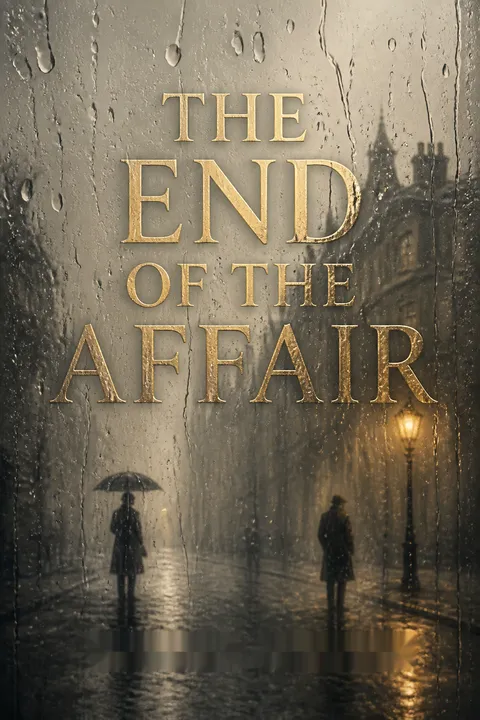
On a bleak, rain-drenched night in postwar London, Maurice Bendrix, a novelist, crosses paths with Henry Miles, the husband of his former lover, Sarah. Their awkward conversation, full of veiled resentments and unspoken history, sets the stage for a story driven by jealousy, longing, and the search for meaning. Bendrix's bitterness is palpable; he claims to hate both Henry and Sarah, yet his every thought circles back to them. The encounter stirs up memories of the passionate affair he once shared with Sarah, and the pain of its abrupt end. As the rain pours down, the boundaries between love and hate blur, and Bendrix's obsession with the past is reignited, propelling him into a spiral of suspicion and self-destruction.
Jealousy's Poisoned Bargain
Bendrix's jealousy festers, fueled by the uncertainty of Sarah's feelings and the possibility of her new lover. When Henry confides his own suspicions about Sarah's fidelity, Bendrix seizes the opportunity to act. He offers to investigate Sarah on Henry's behalf, under the guise of friendship, but truly to satisfy his own need for answers. This leads him to hire a private detective, Mr. Parkis, to follow Sarah and uncover her secrets. The arrangement is both farcical and tragic, exposing the depths of Bendrix's insecurity and the corrosive power of jealousy. The investigation becomes a mirror for Bendrix's own self-loathing, as he realizes he is complicit in the very betrayal he fears.
The Affair Ignites
Recalling the origins of their affair, Bendrix remembers meeting Sarah at a party, initially interested only in her as material for his writing. Yet, over shared meals and conversations, a genuine connection forms. Their relationship quickly becomes physical, marked by a sense of urgency and abandon heightened by the backdrop of war. The secrecy and danger of their meetings intensify their bond, but also sow the seeds of future distrust. Bendrix's need for reassurance clashes with Sarah's elusive honesty, and even in moments of happiness, the specter of loss looms. Their love is both a refuge and a source of torment, as each tries to possess the other completely.
Love and War Intertwined
The affair unfolds against the relentless uncertainty of the London Blitz. Air raids, blackouts, and the constant threat of death create a heightened atmosphere where every moment together feels stolen from fate. Bendrix and Sarah's passion is both intensified and haunted by the war's destruction. Their clandestine meetings are punctuated by the sounds of bombs and sirens, and the possibility of sudden loss is ever-present. The war becomes a metaphor for their emotional turmoil—love and hate, hope and despair, all amplified by the world's instability. Yet, even as they cling to each other, the pressures of war and secrecy begin to erode their trust.
The Trap of Suspicion
As Parkis's investigation unfolds, Bendrix becomes both detective and victim, ensnared by his own need to know. Reports of Sarah's movements, her visits to mysterious addresses, and scraps of her writing found in the trash only deepen his obsession. The evidence is ambiguous, fueling Bendrix's paranoia rather than providing clarity. He is tormented by the idea of Sarah's infidelity, yet also by the knowledge that his actions are a betrayal of their love. The surveillance, meant to bring certainty, instead exposes the futility of trying to possess another person. Bendrix's jealousy becomes a prison, isolating him from both Sarah and himself.
The Promise in the Rubble
During a night of bombing, Bendrix is nearly killed when a V1 rocket strikes his building. Sarah, believing him dead, is driven to her knees in prayer—a gesture foreign to her rational, secular upbringing. In her anguish, she makes a desperate promise to God: if Maurice is spared, she will give him up forever. When Bendrix appears, alive but wounded, Sarah is bound by her vow. This moment marks a turning point, introducing the theme of faith and the possibility of the miraculous into the narrative. The promise, made in a moment of hysteria, becomes the invisible force that tears the lovers apart.
The Desert of Separation
After the bombing, Sarah abruptly ends the affair, leaving Bendrix in a wasteland of longing and confusion. He is tormented by her absence, replaying memories and imagining her with other men. Sarah, too, is adrift—her diary reveals her struggle to reconcile her love for Maurice with her promise to God. Both are trapped in a desert of separation, unable to move forward or let go. The pain of loss is compounded by the sense that something larger and incomprehensible has intervened in their lives. The desert becomes a metaphor for spiritual emptiness and the search for meaning in suffering.
Watching, Waiting, Withdrawing
Bendrix tries to fill the void left by Sarah with other women, but finds himself incapable of desire without love. His efforts at distraction—work, casual encounters, even suicide—prove futile. Sarah, meanwhile, seeks solace in routine and in her marriage to Henry, but remains haunted by her love for Maurice and her sense of spiritual obligation. Both are watched—by detectives, by each other, by their own consciences—and both withdraw further into isolation. The act of watching becomes a symbol of their inability to trust, to surrender, or to find peace.
The Diary's Confession
When Parkis finally obtains Sarah's diary, Bendrix is confronted with the truth of her feelings. The diary is a raw, intimate confession—Sarah's love for Maurice, her agony over the promise, her struggle with faith, and her longing for ordinary human happiness. She writes of her inability to believe in God, yet finds herself drawn inexorably toward belief by the force of her promise and the inexplicable events that follow. The diary exposes the limits of jealousy and suspicion; it is not another man who has come between them, but something transcendent and mysterious. For Bendrix, reading the diary is both a revelation and a wound.
Faith, Doubt, and Despair
Sarah's journey becomes one of reluctant faith. She seeks out Richard Smythe, a rationalist speaker, hoping he will free her from her promise, but instead finds herself drawn further into spiritual questioning. Her encounters with churches, priests, and the rituals of Catholicism are marked by ambivalence—she resists belief, yet cannot escape it. Bendrix, too, is forced to confront the possibility of the divine, especially as inexplicable coincidences and apparent miracles begin to accumulate. Both are caught between faith and doubt, longing for certainty but finding only despair. The novel's emotional core shifts from romantic love to the search for meaning in suffering.
Miracles and Coincidences
After Sarah's death from pneumonia, strange events begin to occur. Parkis's son is miraculously healed after dreaming of Sarah; Richard Smythe's disfigured face is inexplicably cured. Sarah's childhood inscription in a book seems to predict these events. For Bendrix and Henry, these "miracles" are both a comfort and a threat, challenging their rational understanding of the world. The line between coincidence and providence blurs, and the characters are forced to reckon with the possibility that Sarah's sacrifice and faith have had real, tangible effects. The supernatural becomes a source of both hope and fear.
Death and Unfinished Love
Sarah's death leaves Bendrix and Henry adrift, united in grief and confusion. The funeral is a scene of unresolved tensions—questions of faith, propriety, and memory collide. Bendrix is haunted by the sense that Sarah is still present, that love and hate persist beyond death. He struggles with the idea that he never truly possessed her, that she belonged to something greater than himself. The living are left to grapple with the unfinished business of love, the persistence of longing, and the challenge of forgiveness. Death does not bring closure, but a new kind of relationship with the absent beloved.
The Living and the Dead
Bendrix moves in with Henry, and together they inhabit a house filled with Sarah's absence. Objects, memories, and routines become charged with meaning. Both men find themselves talking about Sarah as a way of keeping her alive, yet are painfully aware of her loss. The boundaries between the living and the dead blur—Sarah's influence lingers, shaping their actions and thoughts. The process of forgetting is slow and incomplete; love and grief become indistinguishable. The novel explores the ways in which the dead continue to shape the lives of the living, and how memory can be both a comfort and a torment.
The Persistence of Memory
As time passes, Bendrix and Henry attempt to resume their lives, but find themselves unable to escape Sarah's shadow. Attempts at new relationships, work, and routine are haunted by the past. The discovery of Sarah's childhood books, her mother's revelations, and the ongoing rumors of miracles keep her memory alive. Bendrix is torn between the desire to forget and the need to remember, between hatred and love, between faith and skepticism. The novel ends not with resolution, but with a prayer—a plea for peace, for release from the grip of love and loss, and for the strength to endure.
The Final Surrender
In the end, Bendrix confronts the limits of his own hatred and the possibility of transformation. He recognizes that his obsession with Sarah, his jealousy, and his anger are all forms of love in disguise. The miracles surrounding Sarah's death, the persistence of her influence, and the challenge of faith force him to reconsider his relationship with the divine. Though he resists belief, he is unable to deny the power of Sarah's sacrifice and the reality of grace. The novel closes with Bendrix's reluctant, anguished prayer—not for love, but for the strength to be left alone, to accept loss, and to find peace in the aftermath of passion.
Analysis
Graham Greene's The End of the Affair is a profound meditation on love, jealousy, faith, and the search for meaning in a world marked by suffering and uncertainty. At its core, the novel explores the limits of human love—the ways in which passion can both elevate and destroy, and the inevitability of loss. Through the intertwined stories of Bendrix, Sarah, and Henry, Greene examines the destructive power of jealousy and the futility of trying to possess another person. Yet, the novel is also a journey toward grace; Sarah's reluctant embrace of faith, her self-sacrifice, and the apparent miracles that follow her death suggest that love, in its highest form, is an act of surrender. The narrative's nonlinear structure, shifting perspectives, and use of confession invite the reader to inhabit the characters' psychological landscapes, experiencing their doubts, fears, and moments of transcendence. Ultimately, The End of the Affair is less a story of romantic fulfillment than a meditation on the possibility of redemption—the idea that suffering, when accepted and transformed by love, can lead to a deeper understanding of oneself and the divine. In a modern context, the novel's exploration of faith and doubt, the persistence of memory, and the challenge of forgiveness remain deeply resonant, offering a nuanced portrait of the human condition in all its complexity.
Review Summary
Reviews of The End of the Affair are largely positive, averaging 3.9/5. Many readers praise Greene's masterful prose, describing it as emotionally powerful and beautifully written. The novel's exploration of love, jealousy, hate, and faith resonates deeply with many. Critics highlight the complexity of narrator Maurice Bendrix and the affair's spiritual dimensions. Some readers found the religious themes tiresome or heavy-handed, and a few felt the miraculous ending strained credibility. The audiobook narrated by Colin Firth received exceptional praise.
People Also Read





Characters
Maurice Bendrix
Maurice Bendrix is the novel's narrator and protagonist, a writer whose affair with Sarah Miles becomes the axis of his emotional and spiritual life. Driven by jealousy, insecurity, and a desperate need for certainty, Bendrix's love for Sarah is both passionate and destructive. His psychological complexity is revealed through his self-loathing, his compulsion to surveil Sarah, and his oscillation between love and hate. Bendrix's journey is one of reluctant self-discovery; he is forced to confront the limits of rationality, the pain of loss, and the possibility of faith. His relationship with Henry evolves from rivalry to uneasy companionship, and his ultimate confrontation with the divine is marked by resistance, fear, and a grudging openness to grace.
Sarah Miles
Sarah Miles is the enigmatic center of the novel, a woman whose capacity for love is matched by her vulnerability and self-doubt. Married to Henry but passionately involved with Bendrix, Sarah is driven by a longing for connection and a fear of abandonment. Her psychological struggle is most evident in her diary, where she confesses her love, her guilt, and her spiritual awakening. The promise she makes to God during the bombing becomes the defining act of her life, leading her toward reluctant faith and self-sacrifice. Sarah's development is marked by a movement from self-indulgence to selflessness, from skepticism to belief, and from earthly love to a transcendent longing for peace.
Henry Miles
Henry Miles, Sarah's husband, is a civil servant whose emotional life is largely hidden beneath a veneer of propriety and routine. Initially portrayed as oblivious and dull, Henry is gradually revealed to be deeply vulnerable, capable of jealousy, grief, and unexpected insight. His relationship with Sarah is marked by habit and dependence rather than passion, yet her loss devastates him. Henry's interactions with Bendrix shift from rivalry to a kind of brotherhood in suffering. His psychological journey is one of gradual awakening to the complexities of love, loss, and forgiveness.
Mr. Parkis
Mr. Parkis is the private detective hired by Bendrix to follow Sarah. Though initially a figure of comic incompetence, Parkis emerges as a symbol of ordinary decency and suffering. His devotion to his son, his respect for Sarah, and his willingness to believe in miracles contrast with Bendrix's cynicism. Parkis's reports, full of mundane details and misunderstandings, serve as a counterpoint to the novel's emotional intensity. His character highlights the themes of faith, humility, and the unexpected ways in which grace can manifest.
Richard Smythe
Richard Smythe is a rationalist speaker with a disfigured face, whom Sarah consults in her search for freedom from her promise. Smythe's intellectual certainty masks deep insecurity and a longing for acceptance. His relationship with Sarah is marked by both attraction and frustration; he is both her confidant and a would-be lover. Smythe's eventual "miraculous" healing challenges his skepticism and forces him to confront the limits of reason. His character embodies the struggle between faith and doubt, pride and vulnerability.
Maud (the Maid)
Maud, the Mileses' maid, is a peripheral but significant figure. She becomes an unwitting participant in the surveillance of Sarah, providing information to Parkis and serving as a link between the private and public worlds of the household. Her presence underscores the themes of secrecy, complicity, and the ways in which ordinary people are drawn into the dramas of others.
Parkis's Son (Lance)
Parkis's young son assists his father in the detective work, often serving as a decoy or observer. His innocence and vulnerability are highlighted when he falls ill and is apparently healed through a dream of Sarah. Lance's experience becomes one of the novel's central "miracles", raising questions about faith, coincidence, and the power of love to transcend boundaries.
Father Crompton
Father Crompton is the Catholic priest who becomes involved after Sarah's death. He represents the institutional face of faith—dogmatic, uncompromising, and often insensitive to individual suffering. His interactions with Bendrix and Henry reveal the tensions between personal belief and religious authority, and his presence forces the characters to confront the implications of Sarah's spiritual journey.
Mrs. Bertram (Sarah's Mother)
Sarah's mother appears late in the novel, providing crucial information about Sarah's childhood baptism. Her matter-of-fact approach to life, her financial troubles, and her ambiguous relationship with faith add depth to the novel's exploration of family, inheritance, and the unpredictable ways in which the past shapes the present.
Sylvia Black
Sylvia is a young woman who briefly enters Bendrix's life after Sarah's death. Her kindness and openness offer a contrast to the novel's prevailing atmosphere of loss and regret. Sylvia represents the potential for new beginnings, but also the difficulty of moving on from a love that has defined one's existence.
Plot Devices
Nonlinear Narrative and Shifting Perspectives
The novel employs a nonlinear narrative, moving fluidly between past and present, memory and immediate experience. Bendrix's first-person narration is interspersed with excerpts from Sarah's diary, providing multiple perspectives on the same events. This structure mirrors the characters' psychological states—haunted by the past, unable to escape memory, and constantly reinterpreting their experiences. The use of confession, both in Bendrix's narrative and Sarah's diary, creates a sense of intimacy and immediacy, drawing the reader into the characters' inner lives.
Jealousy as a Narrative Engine
Jealousy is the primary engine of the plot, motivating Bendrix's actions and shaping his relationships with Sarah and Henry. The hiring of Parkis, the surveillance, and the obsessive analysis of evidence all stem from Bendrix's inability to trust. Jealousy is both a destructive force and a catalyst for self-discovery, forcing the characters to confront their deepest fears and desires.
The Promise and the Miracle
The promise Sarah makes to God during the bombing is the novel's central plot device, introducing the theme of faith and the possibility of the miraculous. This vow, made in desperation, becomes the invisible force that shapes the characters' lives, leading to separation, suffering, and ultimately, transformation. The subsequent "miracles"—the healing of Parkis's son, Smythe's cure, and the coincidences surrounding Sarah's death—challenge the boundaries between the natural and the supernatural, forcing the characters to grapple with questions of meaning and belief.
The Diary as Revelation
Sarah's diary serves as both a plot device and a symbol of the limits of knowledge. Its discovery provides Bendrix (and the reader) with access to Sarah's true feelings, motivations, and spiritual journey. The diary exposes the inadequacy of jealousy and suspicion, revealing that the true obstacle to love is not another person, but the demands of faith and conscience. It also serves as a vehicle for the novel's exploration of confession, forgiveness, and the search for truth.
Foreshadowing and Symbolism
The novel is rich in foreshadowing and symbolism—the rain-soaked common, the squeaking stair, the recurring references to "the desert," and the use of objects like books, letters, and relics. These motifs create a sense of inevitability and interconnectedness, reinforcing the themes of memory, loss, and the persistence of love. The interplay between the mundane and the miraculous, the ordinary and the transcendent, is central to the novel's emotional impact.
About the Author
Other books by Graham Greene




Download PDF
Download EPUB
.epub digital book format is ideal for reading ebooks on phones, tablets, and e-readers.








































