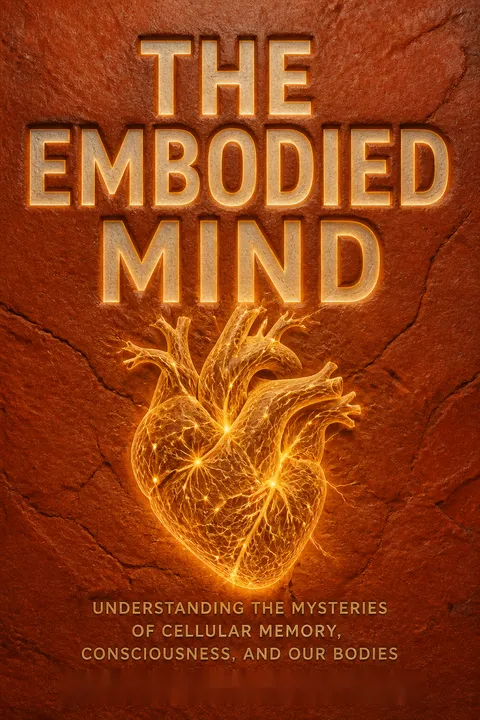

Key Takeaways
1. The Mind Extends Beyond the Brain: An Embodied Network
Our embodied mind is not the old enskulled one. It is an extended mind that relies on the intelligence of all the cells in our body that contain specific bits of information, micro-memories.
Challenging dogma. The traditional view that the mind is solely a product of the brain is incomplete. The author introduces the "Embodied Mind" hypothesis, proposing that consciousness, memory, and identity are distributed across a vast, interconnected network throughout the entire body. This paradigm shift is supported by compelling evidence that defies the brain-centric model.
Beyond the skull. Cases of individuals functioning normally despite significant brain damage highlight the existence of a "backup system" within the body. For example:
- A French civil servant with 90% of his brain replaced by fluid lived a normal life with an IQ of 75.
- Children who underwent hemispherectomy (removal of half the brain) retained memory, personality, and humor.
These instances suggest that the brain, or what remains of it, is part of a larger communication network, with other bodily systems contributing to cognition and behavior.
A sentient network. The embodied mind functions as a linked, sentient network where all cells contribute intelligence and micro-memories. This holistic perspective views the body not as a mere vessel for the brain, but as an active participant in mental processes. The brain acts as a conductor, coordinating messages from this body-wide orchestra of information.
2. Epigenetics: Your Experiences Shape Your Genes and Future Generations
Genes are not destiny. Environmental influences, including nutrition, stress, and emotions, can modify the expression (whether they are turned on or off) of those genes without changing the genes themselves.
Beyond Darwin. Epigenetics is a revolutionary science demonstrating that life experiences can alter gene activity, and these changes can be passed down through generations. This concept, closer to Lamarck's theory of acquired characteristics, explains how parents' environmental exposures "inform" their offspring, preparing them for similar conditions.
Switches, not blueprints. DNA is not a fixed blueprint; rather, epigenetic "switches" (like methylation and acetylation) turn genes on or off in response to physical and psychosocial factors. These dynamic changes occur throughout a person's lifetime and can be inherited. Examples include:
- Dutch famine: Children born to pregnant women during famine carried epigenetic marks linked to higher rates of diabetes, obesity, and cardiovascular disease across three generations.
- Parental stress/toxins: Paternal nicotine or cannabis use, and maternal stress, can lead to neurodevelopmental issues and anxiety in offspring.
- Social environment: Bees raised in aggressive hives became genetically similar to their new hivemates, demonstrating rapid gene expression changes due to social context.
Personal agency. This understanding empowers individuals, as our choices in nutrition, stress management, and relationships can positively or negatively impact our gene expression and the health of our descendants. We are not merely products of our genes but active architects of our biological legacy.
3. Memory Resides Throughout the Body, Not Just in Synapses
The findings of Glanzman, Lois, Trettenbrein, and the other neuroscientists I have referred to indicate that synapses provide "access points" to neurons. Information flows through the synapses to the neurons.
Synaptic dogma challenged. The long-held belief that memories are stored primarily in brain synapses is being overturned by recent research. While synapses are crucial for neuronal communication, they appear to be conduits for information rather than its storage sites.
Memory within neurons. Studies on the marine snail Aplysia showed that memories persisted even after synapses were chemically erased, suggesting that memories are stored inside neurons. Further research indicates:
- Cytoskeleton: Microtubules within the neuronal cytoskeleton are strong candidates for memory storage.
- Metabolic enzymes: Key enzymes like ACSS2 work within neuron nuclei to regulate genes during memory formation.
- Teamwork: Strong memories are encoded by teams of neurons firing in synchrony, not just individual synaptic connections.
Beyond the brain. Memory storage extends beyond cortical neurons. Glial cells, particularly astrocytes, play a significant role in learning and information processing, communicating faster than neurons. Even neurons in the spinal cord and the enteric nervous system (gut) have demonstrated the ability to learn and retain memories independently of the brain.
4. Cells Possess Innate Intelligence and Communicate Actively
Based on the evidence, as counterintuitive as this may be, we can conclude that the cells in our bodies are truly intelligent and as such, form an essential and necessary substrate of the embodied mind.
Microscopic marvels. Our bodies contain trillions of cells, each a complex biological machine with surprising intelligence. These cells are not passive components but active participants in information processing, learning, and memory storage, forming a fundamental substrate of the embodied mind.
Internal complexity. Within each cell, organelles like mitochondria (powerhouses, aging regulators) and the cytoskeleton (structural support, memory storage via microtubules) perform intricate functions. Communication within and between cells is constant and sophisticated:
- Gap junctions: Small channels allowing direct electrical and chemical communication between cells.
- Extracellular vesicles & RNA: "Transport pods" and signaling molecules carrying messages between cells.
- Tunneling nanotubes (TNTs): Long, thin filaments that transfer healing substances, proteins, and even organelles between stressed or sick cells, acting as "Good Samaritans."
Cellular memory. Cells exhibit various forms of memory:
- Mechanical memory: Cells remember properties of their previous environment for days.
- Embryonic memory: Adult tissues retain a retrievable memory of their embryonic origins, capable of "playing their development in reverse."
- DNA as iCloud: DNA in the cell nucleus has immense data storage potential, hypothesized to hold memories of trauma, phobias, or talents.
5. The Gut-Brain Axis: A "Second Brain" Influencing Mood and Cognition
Taking into account the crucial part that the "Thoughtful Bowel" plays in our behavior and thinking, when somebody says, "I had this gut feeling," don’t laugh it off and reflexively dismiss it.
A vast microbial universe. The human gut harbors a microbiome of 100 trillion bacterial cells, collectively possessing 3.3 million genes—far more than the human genome. These microbes produce neuroactive compounds and metabolites vital for health, profoundly influencing the brain and body.
Bidirectional communication. The "microbiota-gut-brain axis" is a complex, two-way communication system involving:
- Vagus nerve: The primary neural highway, conveying reward signals from the gut to the brain.
- HPA axis: The central stress response system.
- Neuroendocrine and immune systems: Influenced by gut microbes.
- Enteric Nervous System (ENS): The "Second Brain" in the gut, capable of implicit learning, memory, and independent control of gut behavior.
Impact on mental health. A healthy, diverse gut microbiota is crucial for normal brain function. Dysfunctions in the gut-brain axis are linked to:
- Psychiatric illnesses: Depression, anxiety, schizophrenia, autism, multiple sclerosis.
- Gastrointestinal diseases: Irritable bowel syndrome (IBS), often comorbid with mood disorders.
- Mood regulation: Gut bacteria produce serotonin and dopamine, influencing emotional states.
This suggests that mental illness may be more complex than just a brain disorder, with gut health playing a significant role.
6. Memories Endure Despite Radical Brain and Body Regeneration
The only credible answer to that question, based on the research presented, seems to be that memory, in addition to being stored in the brain, must also be encoded in other cells and tissues of the body.
Challenging brain-centric memory. The persistence of memories in animals that undergo drastic brain and body remodeling provides compelling evidence that memory is not solely confined to the brain. This phenomenon is observed across diverse species.
Remarkable examples:
- Planarian flatworms: These worms can regenerate a new head after decapitation, yet retain memories of learned behaviors (e.g., light-shock aversion, spatial recognition). This suggests memory traces are distributed throughout the body's cells and tissues.
- Hibernating mammals: Animals like arctic ground squirrels experience massive loss and shrinking of cortical neurons during winter, but upon waking, they retain complex social memories and learned tasks.
- Metamorphosing insects: Moths and butterflies retain memories formed as larvae (e.g., aversion to certain smells) despite undergoing complete reorganization of their nervous systems during pupation.
Somatic and cognitive memory. These findings strongly support the existence of both somatic (body) and cognitive (brain) memory systems that mutually support each other. The body's cells and tissues act as a distributed memory archive, ensuring the continuity of learned information even when the brain undergoes profound changes.
7. The Heart: A Center of Emotion, Identity, and Information
It seems that the ideas we carry in our collective unconscious about the heart as a center of thought, feeling, and personality are closer to modern science than science previously postulated.
Beyond a pump. Centuries of folk wisdom and common expressions linking the heart to emotions, thought, and personality are gaining scientific validation. The heart is far more than a simple blood pump; it is a sophisticated sensory and information-processing organ.
An intrinsic "brain." The heart possesses its own intrinsic nervous system, comprising approximately 40,000 neurons (sensory neurites) that relay information to the brain. This "heart brain" enables the heart to:
- Learn and remember: Conditioned stimuli can activate the heart faster over time, demonstrating memory and adaptation.
- Function autonomously: It operates and processes information independently of the cranial brain, crucial for heart transplant recipients.
- Secrete hormones: The heart acts as an endocrine organ, producing hormones like natriuretic peptide and oxytocin ("love hormone"), which influence brain function, metabolism, and social bonding.
Electromagnetic influence. The heart generates the body's most powerful and extensive rhythmic electromagnetic field, detectable several feet away. This field changes with emotions (erratic with anger, coherent with love) and can synchronize with others' heart rhythms, fostering social bonding and explaining phenomena like "love at first sight" or intuition.
8. Mind Over Matter: Beliefs and Consciousness Drive Physiological Change
A person expecting a certain outcome, such as pain relief, will by way of his mental operations initiate a cascade of physiological responses (hormonal, immunological, etc.) that will cause effects similar to what a medication might achieve.
The power of intention. Human thoughts, emotions, and beliefs exert a profound influence on the physical body and its processes. This "mind over matter" phenomenon is evident in various scientific observations.
Key examples:
- Emoto's water/rice experiments: Demonstrated that positive or negative words and emotions could alter the crystalline structure of water and the decay of rice, suggesting human vibrational energy affects molecular structures.
- Hypnosis: A heightened state of focus where suggestions can induce analgesia, alter bodily movements, or retrieve forgotten memories, proving the mind's capacity to effect physiological changes.
- Placebo effect: Inert treatments (sugar pills) can produce measurable physiological changes (e.g., heart rate, blood pressure, pain relief) based solely on a patient's positive expectations. This involves complex neurobiological reactions, including the release of endorphins and dopamine.
- Consciousness under anesthesia: Even when the brain is suppressed, the mind remains active, processing emotionally charged words and triggering physiological responses, indicating the mind's continuous operation.
Shaping reality. Our brains constantly generate predictions and expectations, influencing what we perceive. These mental operations can initiate cascades of hormonal and immunological responses, demonstrating the mind's direct role in health and healing.
9. Quantum Biology Offers New Insights into the Mind-Body Connection
The view that the mind is both dependent and independent of the brain and the rest of the body is supported by experimental evidence from the very cutting edges of academic scholarship.
Beyond classical physics. Classical Newtonian physics, with its materialist and reductionist assumptions, struggles to explain consciousness, free will, and the mind-body relationship. Quantum mechanics, which governs particles at atomic and subatomic levels, offers a new framework.
Quantum phenomena in biology:
- Wave-particle duality: Elementary particles behave as both particles and waves, suggesting a complementarity between matter and energy, and by analogy, between mind and matter.
- Orchestrated Objective Reduction (Orch OR): Hameroff and Penrose propose that consciousness arises from quantum vibrations in microtubules within brain neurons, linking consciousness to deeper ripples in space-time geometry.
- Quantum coherence: Demonstrated in biological systems at room temperature, including plant photosynthesis, bird navigation, and the human sense of smell (Turin's vibration theory).
- Entanglement: "Spooky action at a distance" where linked particles instantaneously affect each other, potentially explaining phenomena like telepathy or sympathetic communication between individuals.
The Poised Realm. Theoretical biologist Stuart Kauffman suggests a "Poised Realm" hovering between quantum and classical states, where consciousness might reside. This emerging field of quantum biology posits that our bodies and minds are governed by a confluence of classic and quantum laws, offering a more comprehensive understanding of reality.
10. Embracing the Embodied Mind for Holistic Health and Personal Agency
The Embodied Mind hypothesis allows for the agency of free will and empowers each of us to fully live up to our potential by way of self-regulation rather than by the exigencies of an unpredictable environment.
Interconnected systems. The embodied mind hypothesis necessitates a shift from organ-centered medical care to an interdisciplinary, holistic approach. All bodily systems—neurons, immune cells, somatic cells, heart, gut, and microbiome—form a dynamic, interconnected network that influences overall health and disease.
Empowerment through knowledge. Understanding this body-wide intelligence empowers individuals to take greater responsibility for their well-being:
- Lifestyle choices: Diet, exercise, stress management, and social connections profoundly impact gene expression (epigenetics) and cellular health.
- Mind-body practices: Meditation, positive emotions, and social support enhance telomere length (a biomarker of aging) and immune function.
- Self-regulation: Consciously addressing self-defeating thoughts and emotional traumas can lead to profound healing, as the body "remembers" and stores these experiences at a cellular level.
Future of medicine. This paradigm shift promises new therapeutic avenues:
- Neurocognitive disorders: Interdisciplinary approaches targeting gut health, inflammation, and cellular stress pathways for conditions like Alzheimer's.
- Memory retrieval: Potential therapies to retrieve lost memories from body cells in cases of brain injury or degenerative diseases.
- Personalized health: Assessing an individual's microbiome before treatment, or leveraging the heart's electromagnetic field for healing.
The embodied mind concept transforms our understanding of self, health, and potential, revealing that we are constantly changing works in progress, capable of shaping our biology and future.
People Also Read





Download PDF
Download EPUB
.epub digital book format is ideal for reading ebooks on phones, tablets, and e-readers.








































