

Key Takeaways
Measure yourself by impact per hour, not hours worked
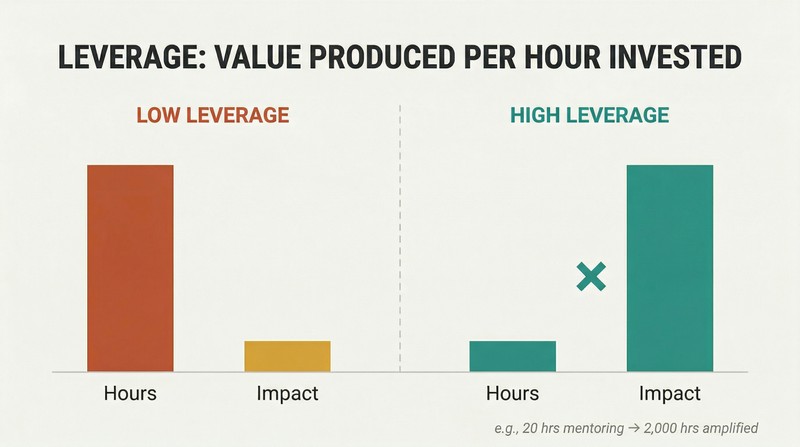
Leverage is the book's operating principle. Defined as value produced per unit of time invested, it functions like ROI for engineering work. The author spent years pulling 70-80 hour weeks at startups, building features customers never used and infrastructure that constantly needed babysitting. The breakthrough wasn't working harder — it was recognizing that 80% of impact flows from 20% of effort. Former Intel CEO Andrew Grove outlined three ways to increase leverage:
1. Reduce the time an activity takes
2. Increase the output of an activity
3. Shift to higher-leverage activities
At Quora, the author spent 20 hours mentoring a new hire — just 1% of their first-year work hours — yet dramatically amplified that person's remaining 99% of working time. That's leverage at work: a small input generating disproportionate output.
Treat learning like compound interest — invest early and aggressively
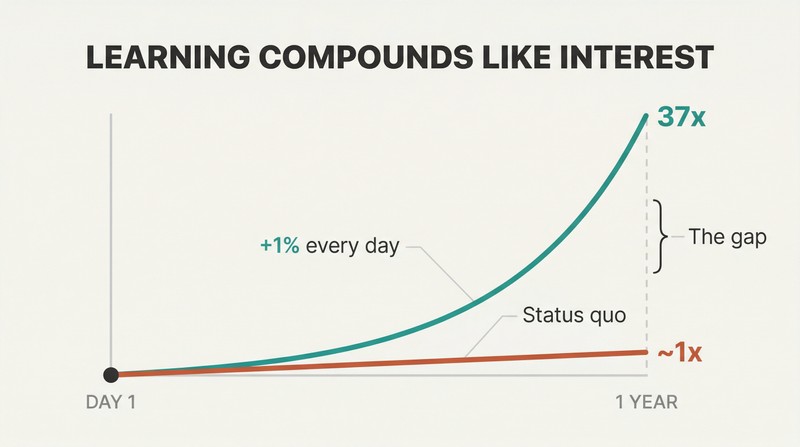
Learning follows an exponential curve. Just as a 5% savings account produces 82% higher returns than a 4% one over 60 years, small daily differences in learning rate create career-defining gaps. Zappos challenged employees to improve 1% per day — which compounds to 37x improvement in a year, not 3.65x.
The author left Google — free food, Maui team trips, and all — after two years because his learning curve had plateaued. He knew a steeper curve at a startup would compound into far greater career capital. He recommends carving out daily "20% time" for skill development, modeled after Google's program that spawned Gmail, Google News, and AdSense. When choosing jobs, evaluate six factors: growth rate, training quality, openness to feedback, iteration pace, colleague talent, and autonomy.
Build time-saving tools — they compound like nothing else
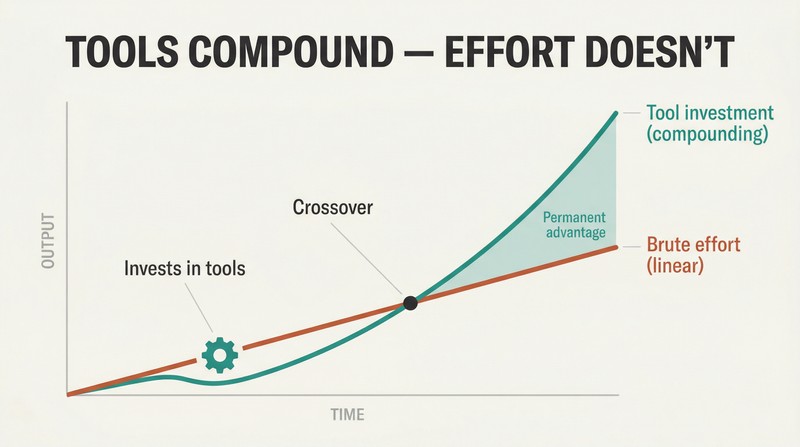
Tools are force multipliers. Consider two engineers: one dives into features immediately, the other spends two weeks optimizing her workflow for 33% faster iteration. The second falls behind initially but catches up within two months — and stays permanently ahead. What's more, faster tools get used more frequently and enable entirely new workflows that weren't possible before.
Compilation speed illustrates the dynamic. When Google's C++ builds took 20+ minutes, engineers compiled a few times daily. When times dropped to minutes, they compiled fifty or hundreds of times per day — fundamentally changing how they wrote and tested code. Quora deployed code 40-50 times daily via continuous deployment, letting engineers ship fixes, verify them, and move on in a single sitting. There are only a finite number of work hours in the day, so increasing your effort as a way to increase your leverage fails to scale.
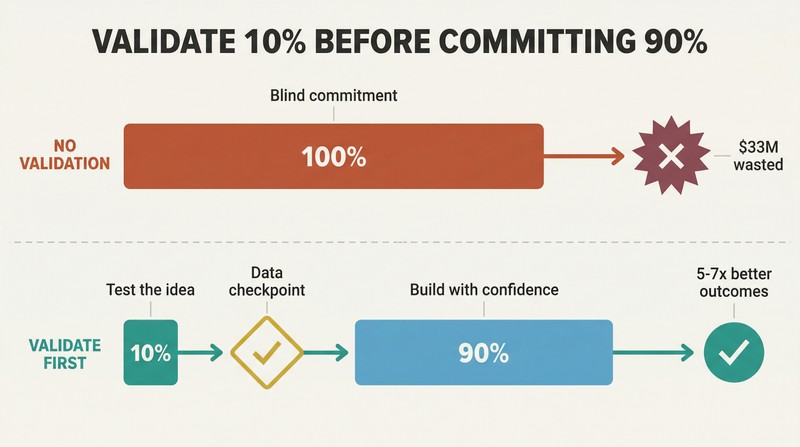
Spend 10% of effort validating before committing the other 90%
Cuil spent $33 million building a search engine nobody tested. The 2008 launch was a PR disaster — critics called results "buggy," "pathetic," and "stupid." Without alpha testers, the team had overinvested in indexing scale and underinvested in quality. Drew Houston took the opposite approach: he validated Dropbox's premise with a 4-minute demo video. Overnight, the beta waitlist jumped from 5,000 to 75,000 — without building the full product.
A/B testing systematizes validation. Obama's 2012 campaign tested 10,000 email variations and found that the best subject lines raised 5-7x more donations than the worst. That infrastructure generated the majority of $690 million in online fundraising. Even faking features works: Asana added a non-functional Google Signup button, measured click-through rates, and only built the full flow after data confirmed demand.
The metric you choose reshapes the work your team actually does
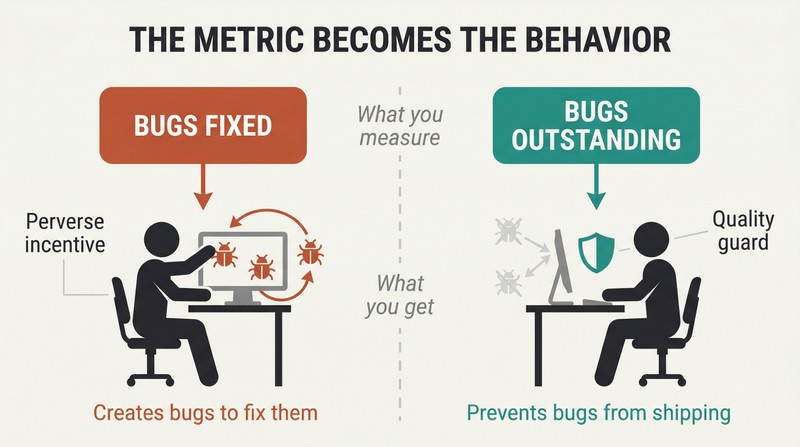
Metrics shape behavior more than strategy does. Google guarded its core search quality metric for over a decade: the "long click" — when a user clicks a result and doesn't return. This single measure guided thousands of experiments. Raw click-through rates would have rewarded clickbait that frustrated users.
The wrong metric backfires spectacularly. When Adobe rewarded developers for bugs fixed, engineers became less rigorous about testing — creating easy bugs to fix later. Tracking bugs outstanding would have prevented this perverse incentive. Zappos deliberately refused to measure call handle times because it pushed representatives to rush customers off the phone. Box invented performance ratcheting — a threshold that prevents any new deployment from worsening latency — ensuring metrics only trend in the right direction.
Adopt only proven tech — each new system is a future fire to fight
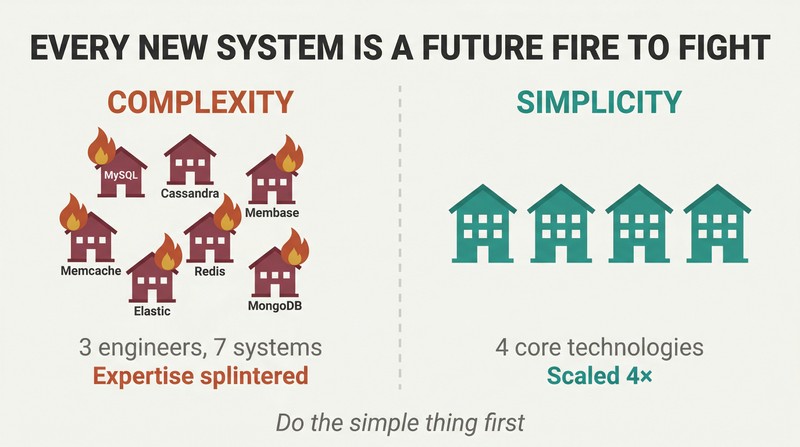
Instagram served 40 million users with 13 employees. Their secret was disciplined simplicity. Co-founder Mike Krieger operated like a fire chief: every new system was another house the team might need to firefight. They chose PostgreSQL, Memcache, and Redis over trendy NoSQL alternatives, and posted "Do the simple thing first" on office walls.
Pinterest learned the cost of complexity the hard way. Their 3-person engineering team simultaneously ran MySQL, Cassandra, Membase, Memcache, Redis, Elastic Search, and MongoDB. Expertise splintered, single points of failure multiplied, and new engineers faced an overwhelming learning curve. They eventually simplified to four core technologies and grew 4x by adding more machines — no new system types required.
Limit work in progress — context switching kills exponentially
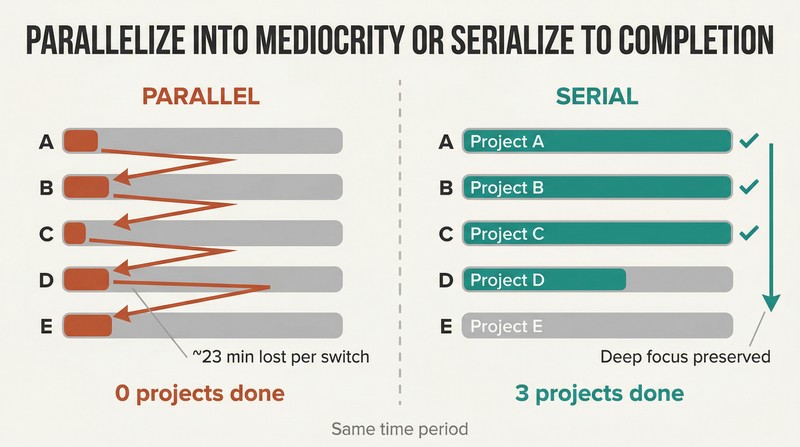
The brain's working memory holds only 7±2 items. When engineers juggle too many projects, the prefrontal cortex spends more energy swapping context than actually thinking. The author learned this at Quora by volunteering for multiple exciting projects simultaneously. Progress came in fits and starts; momentum evaporated across all of them.
Research confirms the steep cost of fragmentation. A Microsoft study found employees take 10-15 minutes to refocus after interruptions; UC Irvine measured 23 minutes. Paul Graham's maker's schedule concept explains why engineers need 4+ hour contiguous blocks to enter flow. Protect these blocks by clustering meetings at day's edges, using calendar holds, or declaring "No Meeting Wednesdays." Serialize projects to maintain deep engagement rather than parallelizing them into mediocrity.
Schedule slips come from termites, not tornadoes
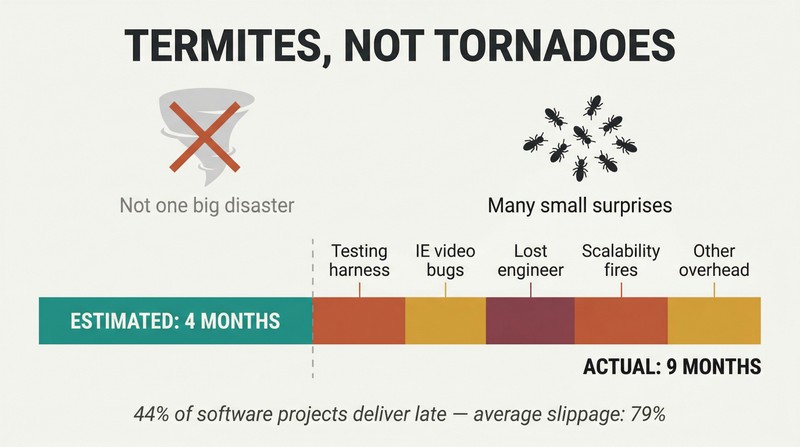
Ooyala's 4-month player rewrite took 9 months. The team — talented engineers from Google — hadn't accounted for cascading small surprises: building a testing harness, debugging video corruption on Internet Explorer, losing an engineer mid-project, firefighting scalability emergencies. Each was manageable alone; together, they doubled the timeline. The Standish Group found 44% of software projects deliver late, with average slippage of 79%.
Practical defenses against estimation creep:
1. Decompose all tasks to under 2 days each — long estimates hide nasty surprises
2. Treat estimates as probability distributions, not best cases
3. Separate work time from calendar time (Asana maps 1 ideal engineering day to 2 workdays)
4. Have the person doing the work make the estimate
5. Track actual vs. estimated time to calibrate future accuracy
Convert big rewrites into a series of small, shippable phases
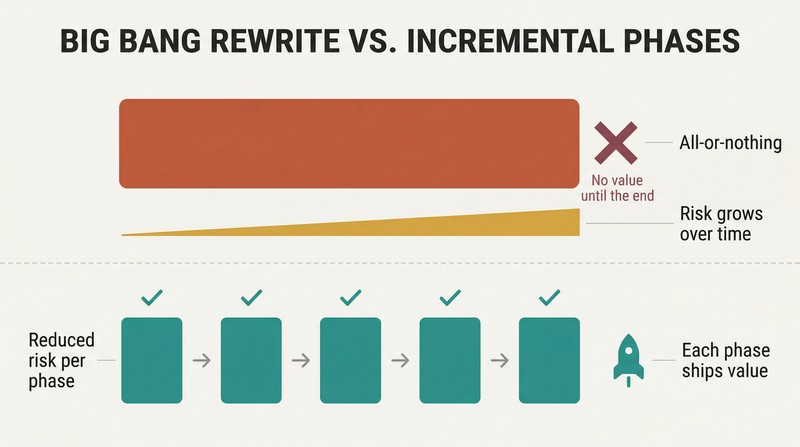
Rewrite projects are engineering's most dangerous trap. They carry standard estimation challenges plus unique risks: familiarity breeds overconfidence, scope creep tempts at every turn, and any new feature during the rewrite must be built twice. Brooks called this the second-system effect — engineers pour in every improvement they held back the first time around.
The antidote is incrementalism. When Google acquired Writely (later Google Docs), the 4-person team needed to port from C# to Java. Rather than simultaneously redesigning, they took the shortest path to a working Java version first, then refactored separately. They completed the port in 12 weeks — setting a record for fastest acquisition integration at Google. Over a century of research also shows overtime doesn't help: Henry Ford's experiments proved 40-hour weeks maximize total output.
Your career rises on the success of those around you
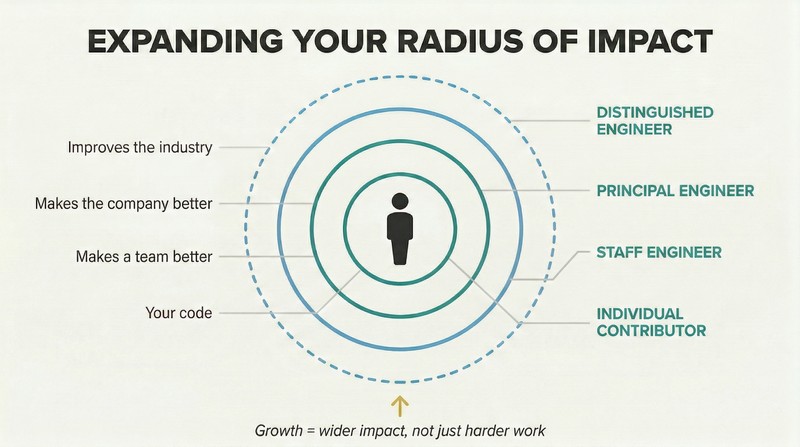
Senior engineering levels are defined by team impact. As one VP described: staff engineers make a team better, principal engineers make the company better, distinguished engineers improve the industry. When the author built Quora's onboarding program — pairing hires with mentors, creating codelabs that explained core abstractions, and organizing tech talks — many new engineers deployed their first bug fix within a week.
Shared code ownership multiplies flexibility. When the author was the sole person who understood Ooyala's analytics processor, he got paged while hiking a Hawaiian volcano — and nobody else could help. Increase your team's bus factor (the number of people who can be lost before a project stalls) by rotating responsibilities, documenting workflows, and conducting post-mortems. NASA debriefs after every mission, building Flight Rules — a compendium of thousands of lessons — that prevents repeating costly mistakes.
Analysis
Lau's The Effective Engineer occupies a peculiar gap in the professional development canon: it's the first serious attempt to build a unified theory of engineering effectiveness, grounded not in management philosophy but in the daily reality of shipping software at Google, Facebook, and Quora. The central construct — leverage as value produced per unit time — derives from Andy Grove's High Output Management, but Lau's innovation is applying it systematically across every dimension of an engineer's work: learning, prioritization, tooling, measurement, estimation, quality, operations, and team building.
What elevates the book above typical productivity advice is its intellectual honesty about tradeoffs. Unlike prescriptive frameworks demanding 100% test coverage or mandatory code reviews, Lau insists these decisions exist on continuums — the optimal point varying by team size, product stage, and competitive pressure. Instagram shipped to 40 million users with minimal formal process; Google requires readability reviews for every programming language. Neither is universally correct. This nuance reflects genuine engineering maturity.
The book's deepest insight may be its treatment of learning as compound interest. Most career advice treats learning as a discrete activity. Lau reframes it as a continuous rate-of-return problem: even tiny differences in daily learning rates create order-of-magnitude gaps over a career. This makes seemingly irrational decisions — leaving Google's paradise for an uncomfortable startup — economically rational through the lens of long-term compounding.
The primary limitation is temporal. Published in 2015, the book predates cloud-native infrastructure, DevOps maturity, and AI-assisted coding that have reshaped many tactical recommendations. The strategic principles, however, remain durable precisely because they address human cognitive constraints — 7±2 working memory items, 23-minute interruption recovery — that no technology has circumvented. In an industry obsessed with novelty, Lau's emphasis on leverage, simplicity, and validation constitutes an enduring counter-narrative to the cult of overwork.
Review Summary
The Effective Engineer receives mostly positive reviews, praised for its practical advice on productivity, leveraging time, and improving engineering practices. Readers appreciate the real-world examples from tech companies and find it particularly valuable for early-career engineers. Some criticize repetitiveness and autobiographical elements. The book covers topics like prioritization, automation, and fostering a learning culture. While experienced engineers may find less new information, many still consider it a worthwhile read for its reminders and comprehensive overview of effective engineering practices.
People Also Read






Glossary
Leverage
Value produced per time investedThe book's central framework for measuring engineering effectiveness. Defined as the value or impact produced divided by the time invested, leverage functions like ROI for engineering activities. Borrowed from Andy Grove's High Output Management, Lau applies it to every engineering decision—from choosing what to work on, to whether to build a tool, to how to structure a team. Higher-leverage activities produce more impact per hour spent.
Performance ratcheting
Metric threshold preventing regressionA technique used at Box where engineering teams set a performance threshold (the 'ratchet') that no new code deployment can exceed. If a change would push latency or other key indicators past the ratchet, it cannot be deployed until optimized or offset by improvements elsewhere. Each time the performance team makes a system-level improvement, they lower the ratchet further, ensuring metrics only trend in the right direction.
Long click
User stays on search resultGoogle's key metric for measuring search quality. A long click occurs when a user clicks a search result and either doesn't return to the search page or stays on the result for a long time, indicating the result satisfied their intent. Its counterpart, the 'short click,' occurs when someone follows a link only to immediately return. The long click-through rate proved versatile enough to guide experiments ranging from name detection to universal search ranking.
Codelabs
Guided code walkthroughs with exercisesTraining documents originally developed at Google and adopted at Quora for onboarding new engineers. A codelab explains why a core software abstraction was designed and how it's used, walks through relevant code internals, and provides programming exercises to validate understanding. They serve as reusable, self-paced learning resources that reduce the burden on mentors and ensure consistent foundational knowledge across new hires.
If-then plan
Pre-committed situational action triggerA productivity technique from psychologist Peter Gollwitzer's research on implementation intentions. An if-then plan identifies a specific cue ('if it's after my 3pm meeting') linked to a specific behavior ('then I'll investigate this bug'). The pre-commitment creates an automatic link between situation and action, bypassing the activation energy that causes procrastination. Studies show if-then plans more than double task completion rates across diverse populations.
Maker's schedule
Long uninterrupted blocks for creatorsA concept from programmer and venture capitalist Paul Graham distinguishing how creators (engineers, writers) need time versus how managers use time. Managers work in one-hour blocks, but makers need half-day minimums to do meaningful work. Scattered meetings throughout the day destroy a maker's productivity because each interruption requires 10-23 minutes to return to focused activity, according to research from Microsoft and UC Irvine.
Bus factor
People lost before project stallsA measure of team resilience defined as the number of key team members who can be incapacitated (metaphorically 'hit by a bus') before the remaining team can no longer maintain a project. A bus factor of one means a single departure—whether from illness, vacation, or resignation—can halt progress. Increasing the bus factor through shared code ownership, documentation, and cross-training gives teams flexibility and reduces individual bottlenecks.
Second-system effect
Overdesigning the rebuilt versionA concept from Frederick Brooks' The Mythical Man-Month describing the tendency to over-engineer a system's rewrite. When building something for the first time, teams proceed cautiously and keep things simple. But the second version becomes 'the most dangerous system' because engineers pour in every idea and improvement they deferred the first time. This scope expansion makes rewrite projects particularly susceptible to schedule delays and budget overruns.
FAQ
What's The Effective Engineer about?
- Focus on Engineering Effectiveness: The book emphasizes maximizing impact through high-leverage activities rather than working harder or longer.
- Framework for Success: Introduces "leverage" as a framework to analyze and prioritize tasks for the highest return on investment.
- Actionable Strategies: Offers practical strategies and insights from successful engineers and leaders in the tech industry.
Why should I read The Effective Engineer?
- Enhance Your Career: Helps you become a more effective engineer, leading to better job performance and career satisfaction.
- Learn from Experts: Shares lessons from Edmond Lau's experiences at top tech companies like Google and Quora.
- Practical Framework: Provides a structured approach to improving work habits and decision-making processes.
What are the key takeaways of The Effective Engineer?
- Leverage is Key: Focus on high-leverage activities that maximize impact, defined as value produced per time invested.
- Iterate Quickly: Encourages validating ideas early and often to avoid wasted effort.
- Prioritize Learning: Emphasizes environments that foster growth and continuous skill investment.
How does The Effective Engineer define leverage?
- Value per Time Invested: Leverage is the value or impact produced per unit of time invested in an activity.
- High-Leverage Activities: Focus on tasks that yield the highest return on investment, often following the 80-20 rule.
- Maximizing Impact: Prioritize work to ensure time is spent on tasks producing significant outcomes.
How can I focus on high-leverage activities as suggested in The Effective Engineer?
- Identify Key Tasks: List and evaluate tasks for potential impact, focusing on those aligning with goals.
- Use the Pareto Principle: Apply the 80-20 rule to prioritize tasks yielding the most results.
- Regularly Reassess Priorities: Continuously evaluate and adjust focus to work on impactful activities.
What strategies does The Effective Engineer suggest for optimizing learning?
- Adopt a Growth Mindset: Embrace the belief that skills can be developed through effort and learning.
- Seek Learning Opportunities: Look for environments with strong mentorship and skill development opportunities.
- Invest in Continuous Learning: Dedicate time to learning new skills through various educational methods.
How does The Effective Engineer recommend validating ideas early and often?
- Use Prototyping: Build MVPs or prototypes to test ideas with real users for quick feedback.
- Implement A/B Testing: Compare different product versions to measure impact on user behavior.
- Gather User Feedback: Seek feedback from users and stakeholders throughout development.
What specific methods does The Effective Engineer recommend for project estimation?
- Decompose Tasks: Break projects into smaller tasks for improved estimation accuracy.
- Use Historical Data: Validate estimates against past data to refine prediction skills.
- Probability Distributions: Treat estimates as ranges of outcomes for better planning.
How does The Effective Engineer define technical debt?
- Deferred Work: Accumulated work to improve code quality postponed during development.
- Interest Payments: Unaddressed technical debt increases maintenance costs over time.
- Strategic Repayment: Prioritize repaying high-impact areas to maintain a healthy codebase.
What is the importance of feedback loops in The Effective Engineer?
- Continuous Improvement: Feedback loops allow ongoing validation of ideas and processes.
- Informed Decision-Making: Transform guesswork into data-driven decisions with feedback mechanisms.
- Iterative Learning: Encourages an experimental mindset for valuable insights in future projects.
What are the best practices for onboarding new engineers according to The Effective Engineer?
- Structured Onboarding: Include mentorship, training materials, and clear expectations.
- Codelabs and Talks: Teach core abstractions and introduce team values through structured resources.
- Starter Tasks: Assign manageable tasks to build confidence and integrate new hires.
What are the best quotes from The Effective Engineer and what do they mean?
- "If you can’t measure it, you can’t improve it.": Emphasizes the necessity of metrics in driving progress and effectiveness.
- "Focus on high-leverage activities.": Encourages prioritizing tasks that yield the greatest impact.
- "Moving fast enables us to build more things and learn faster.": Highlights the importance of iteration speed in product development.
Download PDF
Download EPUB
.epub digital book format is ideal for reading ebooks on phones, tablets, and e-readers.








































