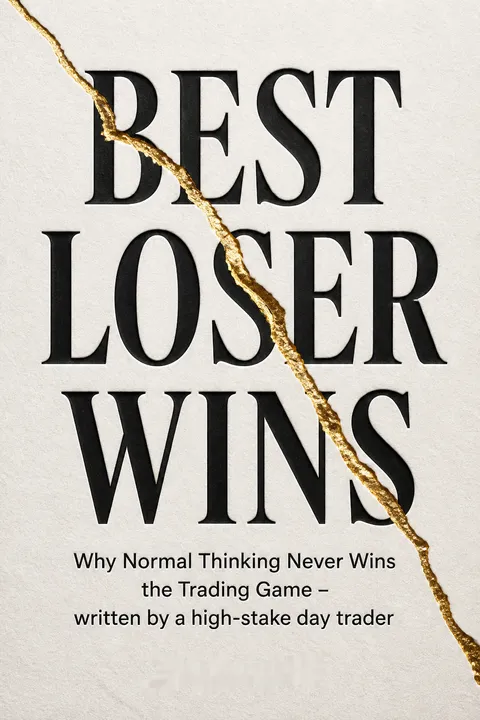


Key Takeaways
Traders win on 62% of trades — and still lose money overall
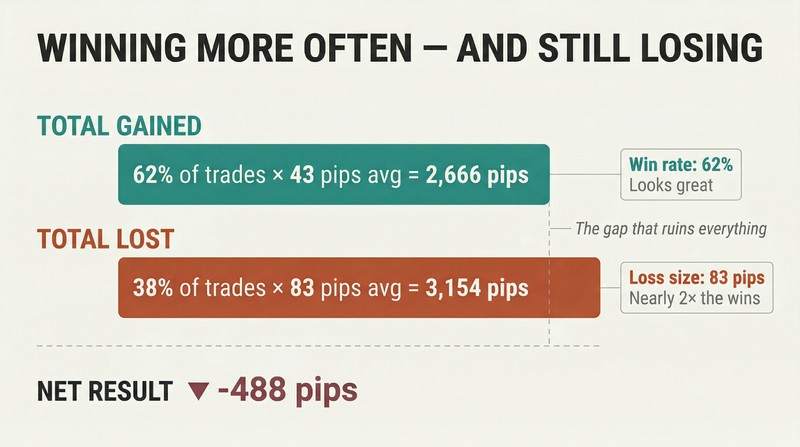
The paradox is staggering. Analyst David Rodriguez examined 43 million FX trades by 25,000 traders over 15 months. Fully 62% of trades ended in profit — a solid hit rate. Yet the vast majority lost money. Why? Average winning trade: 43 pips. Average losing trade: 83 pips. They won often but lost catastrophically.
Meanwhile, tools have never been better. Spreads are a fraction of what they were 20 years ago. Brokers provide hundreds of free indicators, instant news, and sophisticated charting. Yet European law forces brokers to publish failure rates: IG Markets 75%, Markets.com 89%, Saxo Bank 74%. The problem isn't knowledge or infrastructure — it's something inside the trader.
In trading, your skill at losing determines your wealth
Hougaard's central thesis is counterintuitive. After a decade on London trading floors watching thousands of clients execute millions of trades, he identified one universal pattern: traders could pick winners but couldn't manage losses. They'd hold losers hoping for recovery and dump winners fearing profit reversal. His own transformation came not from learning new indicators but from conditioning his mind to lose without anxiety, emotional attachment, or desire for revenge.
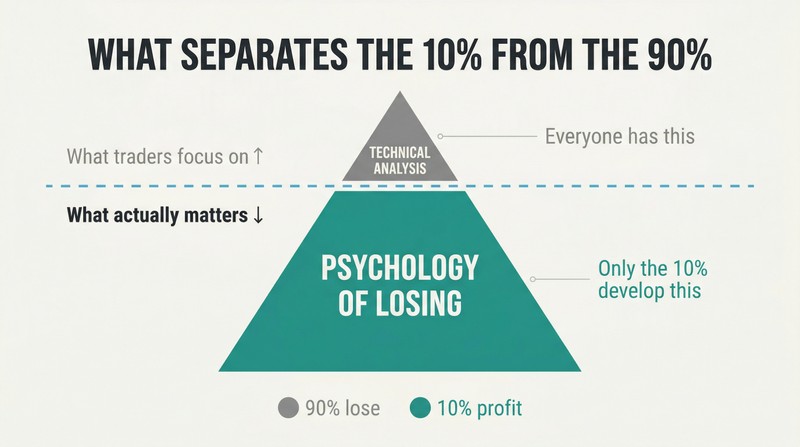
Technical analysis is table stakes. Everyone knows head-and-shoulders patterns and Fibonacci ratios — and everyone loses. What separates the profitable 10% from the losing 90% is psychological. Hougaard runs a public Telegram channel with timestamped trades proving his results come not from superior chart reading, but superior losing.
Your bargain-hunting instincts will bankrupt your trading account
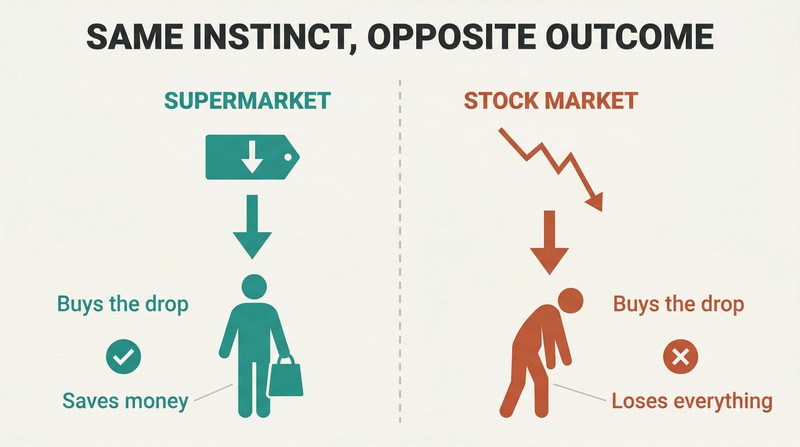
Our consumer brains betray us. We're wired to buy discounts and avoid price increases — rational at the grocery store, lethal in markets. Hougaard watched clients pour money into Northern Rock as it fell from 1,200 pence to zero, treating it like half-price detergent. On October 26, 2021, when the Dow made all-time highs, IG Markets' sentiment report showed 71% of retail Dow positions were short. Traders were fighting the biggest trend of the year.
A falling stock is not on sale. Hougaard's mentor Dr. David Paul captured this epiphany when his wife — with zero trading knowledge — looked at his screen and simply observed the market was going down, while he and his software insisted it should go up. He realized he'd been trading his opinion, not the market.
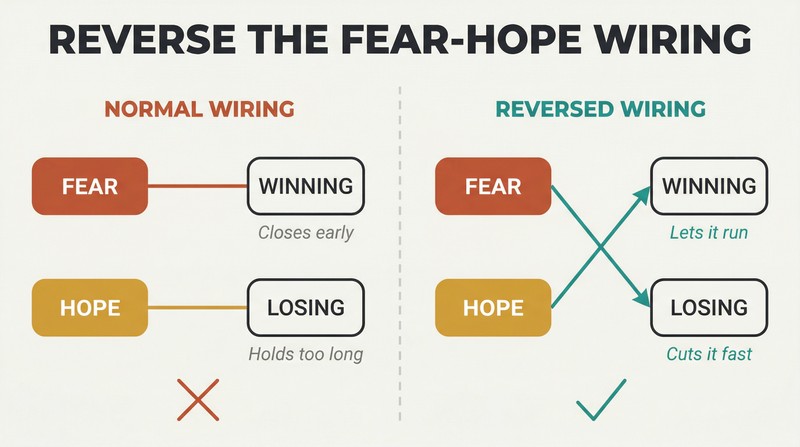
Reverse the fear-hope wiring that makes traders human
Traders feel the wrong emotion at the wrong time. When holding a winning position, they fear the profit will vanish — so they close early. When holding a losing position, they hope for recovery — so they hold too long. This is cognitive dissonance in action: the brain resolves the stress of an open profit by closing it, and resolves the stress of an open loss by avoiding the crystallization of pain.
Hougaard's student proved the pattern. Sitting on 40 pips of profit, the student said: "I just don't want to see my profits disappear." Yet that same student would happily let a 40-pip loss run to 80, always hoping. The profitable trader must reverse this instinct — be hopeful when winning and fearful when losing.
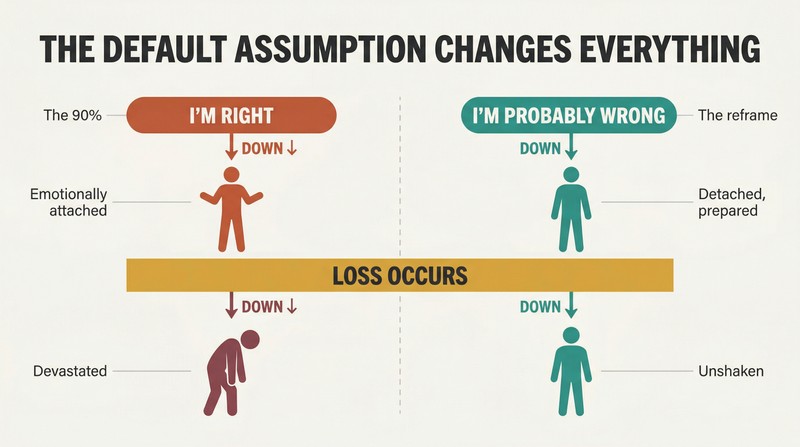
Assume you're wrong on every trade until the market proves it
Hougaard's Flip the Switch framework recodes the brain's automatic pain responses into four rules:
1. Assume you are wrong until the market proves otherwise
2. Expect to be uncomfortable
3. Add to your position when you are right
4. Never add when you are wrong
The 90% enter trades assuming they're right. This creates emotional attachment to the outcome, making losses feel like personal failures. By starting from "I'm probably wrong," your stop-loss becomes an expected friend, not a devastating enemy. The discomfort becomes anticipated, not shocking. This reframe — not a new indicator — is what Hougaard credits for his streak of no losing days spanning nearly seven consecutive months.
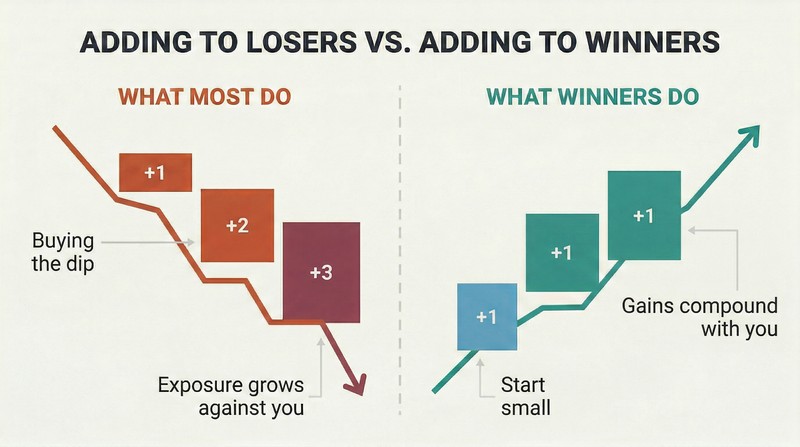
When you're right, press harder — add to winning trades
Dr. David Paul asked one question that changed everything: "When you are in a winning position, instead of thinking where to get out, why don't you think about where to get in more?" Most traders find it easy to add to losers — a lower price feels like a bargain. But adding to winners feels terrifying because it raises the breakeven point. This is backwards: adding to losers doubles exposure when the market disagrees, while adding to winners compounds gains when the market confirms your thesis.
Start fractionally small. The purpose isn't immediate profit — it's rewiring the neural pathway from "Where do I take profit?" to "How do I make my right trade bigger?" Even adding a tiny amount builds the critical habit that separates the 10% from the 90%.
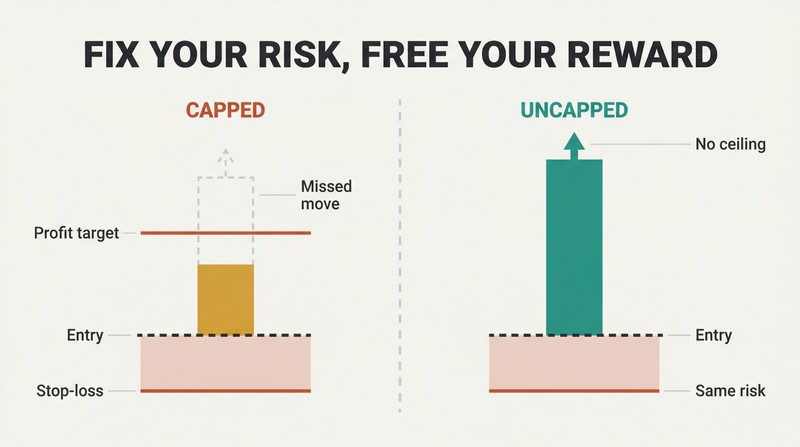
Define your risk on every trade; never cap your reward
Hougaard never sets profit targets. He defines exactly how much he'll lose via stop-loss — the only variable he controls — and lets the market determine the upside. Setting a 2:1 risk-reward target means closing at your target while the market runs 200 more points without you. On at least 20% of stock index trading days, the market closes at its high or low — those uncapped trend days fund entire months.
The tradeoff is painful but necessary. Hougaard regularly watches 100-point winners evaporate to zero. He accepts this because always capping profits means never catching monster moves. Paul Tudor Jones embodied this philosophy: asked how far down he'd buy a falling market, he replied he'd sell it "down to zero" — and buy a rising one "to infinity."
Plot every trade on a chart — then stare at your worst ones daily
Hougaard's Book of Truths is a PowerPoint containing his old trades — brilliant and terrible — plotted on actual price charts. He reviews it every morning as mental warm-up. When he first analyzed his trading this way, devastating truths emerged: 8 of 10 trades were impulse trades, he consistently fought trend days, and he gave away morning profits every afternoon.
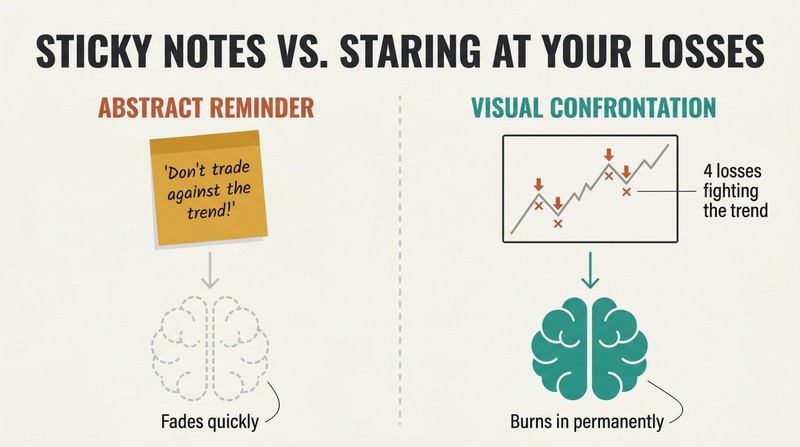
Visual confrontation outperforms sticky-note mantras. Writing "Don't trade against the trend" on a Post-It does nothing. But staring at a chart showing five consecutive counter-trend shorts — each one a loss — burns the lesson into neural pathways. Hougaard calls this the single most beneficial practical exercise in his trading transformation, producing immediate measurable improvement from the day he started.
Visualize large losses each morning to neutralize pain's grip
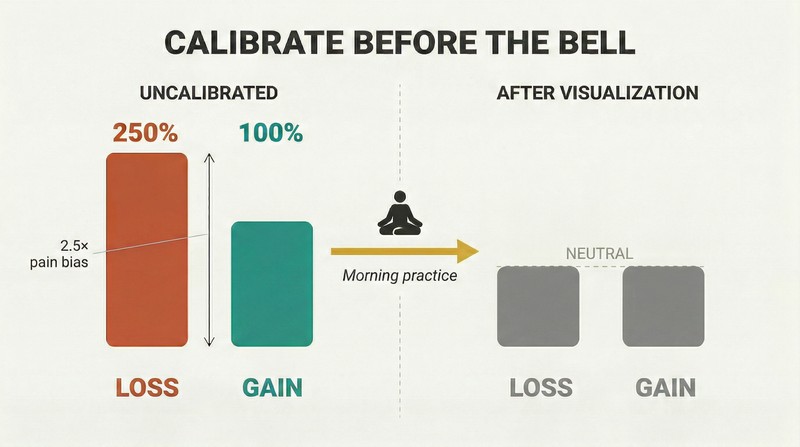
Each morning, Hougaard sits in silence and breathes — seven seconds in, eleven seconds out. Then he visualizes losing an emotionally significant sum, perhaps £78,000. He feels the misery fully. Then he visualizes winning the same amount — and notices the joy is weaker. He cycles between loss and gain imagery until both feel equally neutral.
The goal is emotional flatness. Without calibration, the brain's 250% pain asymmetry distorts every decision. Hougaard also visualizes maximum position size, watches his imagined P&L plummet, then calms his breath. By the opening bell, he has already "experienced" the worst. The real market feels manageable — much like Philippe Petit exaggerated his fears before walking a wire between the Twin Towers, so that reality felt tame by comparison.
A 25% win rate can be wildly profitable — hit rate is overrated
Trevor Neil's hedge fund traded the DeMark Sequential indicator on one-minute charts of South African shares. Their hit rate hovered around 25% — losing 75 out of every 100 trades. But winners paid 25 times the risk. They were wildly profitable. Hougaard's own May 2020 record: 137 trades, only 53 winners (39%), 66 losers, yet he netted 1,513 points total.
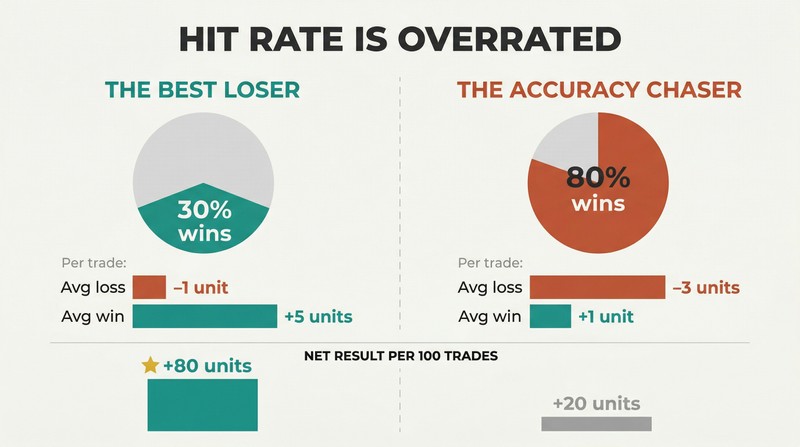
The obsession with high win rates is the wrong game. The 43-million-trade study proved retail traders already pick winners more often than losers. Their catastrophe isn't selection — it's loss management. A trader with a 30% hit rate who loses one unit and gains five will crush a trader with 80% accuracy who loses three units and gains one. The math is unforgiving, but it favors the best loser.
Analysis
Hougaard's framework, while presented as hard-won practitioner wisdom, maps precisely onto three decades of behavioral finance research. His 'fear-hope inversion' — traders fear profits disappearing while hoping losses recover — is the disposition effect identified by Shefrin and Statman in 1985. His observation that losses sting 250% more than equivalent gains echoes Kahneman and Tversky's prospect theory, which estimated a loss-aversion coefficient of roughly 2 to 2.5. The 43-million-trade study he cites is essentially a real-world confirmation of these laboratory findings at industrial scale.
What makes the book genuinely distinctive is not the diagnosis but the prescription. Academic papers describe what traders do wrong; Hougaard describes what he does each morning at 5 a.m. to counteract it. His Book of Truths — a visual confrontation with past failures — functions as a form of exposure therapy, borrowed intuitively from clinical psychology. His breathing exercises (7 seconds in, 11 out) mirror vagal-toning techniques used in anxiety treatment. His visualization of worst-case losses before trading begins parallels pre-mortem analysis popularized by Gary Klein in decision science. None of this is accidental; it is the convergent evolution of a practitioner arriving at clinical principles through trial and error rather than textbooks.
The book's most provocative contribution is redefining the success criterion itself. In a culture that celebrates winning streaks and perfect setups, Hougaard argues the competitive advantage is losing well. This is not motivational fluff — it's operationally specific. His Flip the Switch framework (assume wrong, expect discomfort, add when right, never add when wrong) inverts every instinct retail traders bring to the screen.
A legitimate critique is survivorship bias: Hougaard survived high-stakes day trading, but his approach demands psychological resilience that may be dispositionally rare. His disgust-based motivation and military-grade morning routines are not universally replicable. Still, the core insight — that trading mastery is a psychological discipline, not a technical one — stands on evidence that extends far beyond one trader's career.
Review Summary
Best Loser Wins receives high praise for its focus on trading psychology and mindset. Readers appreciate Hougaard's insights on embracing losses, managing emotions, and developing a process-oriented approach. The book challenges conventional trading wisdom and offers practical exercises for self-improvement. Many consider it a must-read for traders at all levels, citing its engaging writing style and relatable examples. While some find parts repetitive, most agree it provides valuable lessons on achieving consistent profitability in trading. The book's emphasis on understanding oneself rather than just market mechanics resonates strongly with readers.
People Also Read


Glossary
Book of Truths
Visual file of past trading flawsA PowerPoint file Hougaard maintains containing his old trades—both good and bad—plotted on actual price charts. Reviewed each morning as a mental warm-up, it provides visual confrontation with recurring mistakes (impulse trades, counter-trend entries, premature profit-taking) and reinforces correct behavior. Hougaard considers it the single most beneficial practical exercise in his trading transformation.
Flip the Switch
Four rules reversing instinctive trading behaviorHougaard's four-rule framework for recoding the brain's automatic pain responses during trading: (1) Assume you are wrong until the market proves otherwise, (2) Expect to be uncomfortable, (3) Add to your position when you are right, (4) Never add when you are wrong. Designed to counteract the normal human tendency to assume trades will succeed and panic when they don't.
Ask for Help
Journaling exercise to uncover hidden beliefsA reflective practice where the trader sits with a blank piece of paper, poses a specific question about a trading fear or destructive pattern (e.g., 'Why am I afraid to join a downtrend after it started?'), then writes down everything that surfaces without censoring. The exercise is complete when the answer distills into a single clarifying sentence. Used to identify and diffuse counterproductive subconscious beliefs.
Mind Loop
Self-reinforcing cycle sustaining ideal trading mindsetHougaard's framework describing the self-reinforcing psychological cycle behind consistent trading performance: Trust (in markets and self) supports Patience, which feeds Confidence, which dictates Inner Dialogue, which supports a process-oriented mindset, which enables present-moment Focus. Mental exercises (visualization, breathing, Book of Truths review) feed and sustain the loop daily.
20 Trades
Exercise to achieve conflict-free trade executionAn exercise from Dr. David Paul in which the trader executes 20 consecutive trades exactly as signals dictate, without deviation. The purpose is not profit but smoking out internal conflicts—hesitation, fear, revenge impulses, association with past losses. Success is defined as completing all 20 trades without competing thoughts or emotional resistance, indicating a carefree and fearless trading state.
FAQ
What's "Best Loser Wins" about?
- Trading Mindset Focus: "Best Loser Wins" by Tom Hougaard is about developing the right mindset for successful trading, emphasizing that the best loser wins in the trading game.
- Personal Journey: The book details Hougaard's personal journey from struggling trader to successful high-stakes day trader, sharing insights and lessons learned along the way.
- Psychological Approach: It focuses on the psychological aspects of trading, arguing that understanding oneself is more crucial than mastering technical analysis.
- Practical Advice: The book provides practical advice on how to handle losses, manage emotions, and develop a mindset that embraces failure as a stepping stone to success.
Why should I read "Best Loser Wins"?
- Unique Perspective: The book offers a unique perspective on trading, focusing on the psychological aspects rather than just technical analysis.
- Real-Life Experience: It is written by a successful trader who shares real-life experiences and practical advice, making it relatable and actionable.
- Mindset Development: It emphasizes the importance of developing a mindset that can handle losses and embrace failure, which is crucial for long-term success in trading.
- Applicable Lessons: The lessons and strategies discussed are applicable not only to trading but also to other areas of life where risk and decision-making are involved.
What are the key takeaways of "Best Loser Wins"?
- Embrace Failure: The book teaches that embracing failure and learning from losses is crucial for success in trading.
- Mind Over Tools: It emphasizes that the right mindset is more important than technical tools or strategies in trading.
- Process Over Outcome: Hougaard advocates focusing on the trading process rather than the outcome, which helps in maintaining emotional balance.
- Self-Understanding: Understanding oneself and one's emotional responses is key to becoming a successful trader.
How does Tom Hougaard define success in trading?
- Best Loser Wins: Success is defined by the ability to lose well, meaning managing losses effectively and learning from them.
- Emotional Control: Success involves controlling emotions and not letting fear or greed dictate trading decisions.
- Process-Oriented: A successful trader focuses on the process and not just the financial outcome of trades.
- Adaptability: Being able to adapt and change strategies based on market conditions and personal performance is crucial.
What is the "Best Loser Wins" method?
- Embrace Losses: The method involves embracing losses as part of the trading process and learning from them.
- Mindset Shift: It requires a shift in mindset from fearing losses to seeing them as opportunities for growth.
- Focus on Process: The method emphasizes focusing on the trading process and maintaining discipline rather than fixating on profits.
- Continuous Improvement: It encourages continuous self-improvement and adaptation to changing market conditions.
What are the best quotes from "Best Loser Wins" and what do they mean?
- "The best loser wins." This quote encapsulates the book's central theme that success in trading comes from managing losses effectively.
- "Control your mind – control your future." It highlights the importance of mental discipline and emotional control in achieving trading success.
- "Trading is a battle of the self." This quote emphasizes that the biggest challenge in trading is overcoming one's own psychological barriers.
- "Focus on the process, not the outcome." It advises traders to concentrate on their trading strategy and execution rather than obsessing over profits.
How does Tom Hougaard suggest handling trading slumps?
- Self-Reflection: Hougaard suggests reflecting on past trades to understand what went wrong and learn from mistakes.
- Emotional Balance: Maintaining emotional balance and not letting a series of losses affect future trading decisions is crucial.
- Process Adherence: Sticking to the trading process and not deviating from the strategy during slumps is important.
- Seek Support: He advises seeking support from fellow traders or mentors to gain perspective and encouragement.
What role does fear play in trading according to "Best Loser Wins"?
- Fear of Losses: Fear of losing money can lead to poor decision-making and emotional trading.
- Fear Management: Managing fear is crucial for maintaining discipline and sticking to the trading plan.
- Fear as a Barrier: Fear can prevent traders from taking necessary risks and seizing opportunities.
- Overcoming Fear: The book emphasizes overcoming fear through mental preparation and focusing on the process.
How does "Best Loser Wins" address the concept of technical analysis?
- Secondary Importance: The book argues that technical analysis is secondary to having the right mindset for trading success.
- Tool, Not a Solution: Technical analysis is seen as a tool that can aid decision-making but is not the sole solution for profitable trading.
- Mindset Over Charts: Hougaard emphasizes that understanding oneself and managing emotions is more important than mastering chart patterns.
- Avoid Over-Reliance: Traders are cautioned against over-relying on technical indicators and instead focus on psychological resilience.
What practical exercises does Tom Hougaard recommend for traders?
- Visualization: Hougaard recommends visualization exercises to mentally prepare for trading scenarios and manage emotions.
- Trade Journaling: Keeping a detailed trade journal to analyze past trades and identify patterns in behavior and decision-making.
- Mindfulness Practices: Engaging in mindfulness or meditation practices to enhance focus and emotional control.
- Simulated Trading: Practicing with simulated trades to build confidence and refine strategies without financial risk.
How does "Best Loser Wins" redefine the concept of risk in trading?
- Risk Acceptance: The book emphasizes accepting risk as an inherent part of trading and not something to be feared.
- Calculated Risks: Encourages taking calculated risks based on thorough analysis and a well-defined trading plan.
- Risk Management: Focuses on managing risk through stop-loss orders and position sizing to protect capital.
- Emotional Detachment: Advocates for emotional detachment from risk to make rational and objective trading decisions.
What is the significance of the title "Best Loser Wins"?
- Counterintuitive Success: The title suggests that success in trading comes from being the best at managing and learning from losses.
- Mindset Shift: It signifies a shift in mindset from fearing losses to embracing them as part of the trading journey.
- Focus on Process: The title underscores the importance of focusing on the trading process rather than just the outcome.
- Winning Through Losing: It highlights the paradox that in trading, those who handle losses well ultimately achieve long-term success.
Download PDF
Download EPUB
.epub digital book format is ideal for reading ebooks on phones, tablets, and e-readers.








































