

Key Takeaways
Leaders never rule alone; every ruler answers to backers who can dump them
No such thing as absolute power. The book's founding move is to strip away the myth of the all-powerful tyrant. Even Louis XIV, who supposedly declared "I am the state," survived seventy-two years only by carefully managing his court, military officers, and civil servants. When he inherited a near-bankrupt throne at twenty-three, he expanded the pool of aristocrats eligible for power (the noblesse de robe) so his existing backers knew they were replaceable.
The authors argue politics is never about nations, ideologies, or cultures. It is about specific named individuals wanting to gain power, keep power, and control money. Stop saying "the United States wants" or "China should." States have no interests. People do. Every leader forges a symbiotic bargain: I reward you, you keep me in office.
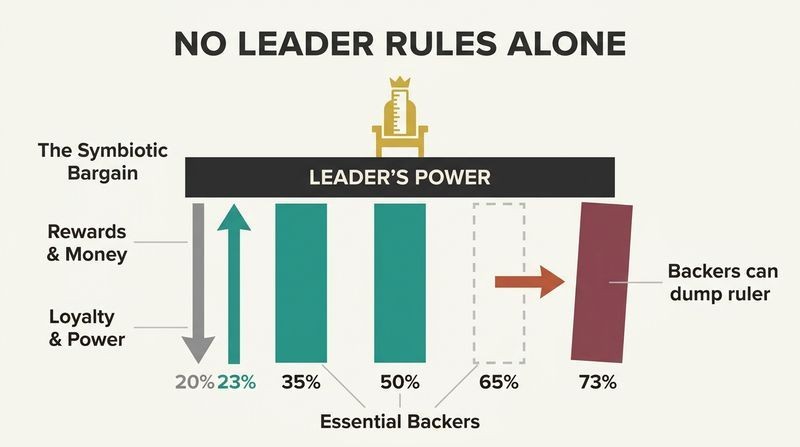
This anti-heroic framing echoes principal-agent theory in economics and Mancur Olson's "stationary bandit" model, where even a self-interested autocrat provides some order to maximize his own take. What is bracing here is the refusal of moral explanation. Journalists blame bad character; the authors blame incentive structures. This mirrors situationist psychology (Milgram, Zimbardo), which shows ordinary people commit atrocities under certain systems. The claim that "no one rules alone" is nearly tautological but analytically powerful: it forces attention onto the coalition rather than the personality. The weakness is that personality and ideology do sometimes matter at the margins, a nuance the model deliberately sacrifices for predictive clarity.
Sort everyone into interchangeables, influentials, and essentials to decode any regime
The three-dimensional map of power. Rather than sorting governments into "democracy" versus "dictatorship," the authors slice every organization into three groups:
1. Nominal selectorate (interchangeables): everyone with a nominal say, like all eligible voters, or Soviet citizens who could rubber-stamp a ballot.
2. Real selectorate (influentials): those who actually pick the leader, like Communist Party members or a company's big institutional shareholders.
3. Winning coalition (essentials): the backers a leader truly cannot survive without.
North Korea has millions of interchangeables but a winning coalition of maybe a few hundred. Publicly traded corporations mirror this exactly: millions of small shareholders, a few big ones, and a board of ten to fifteen essentials. The relative sizes of these three groups, the authors claim, determine nearly everything about how a place is governed.
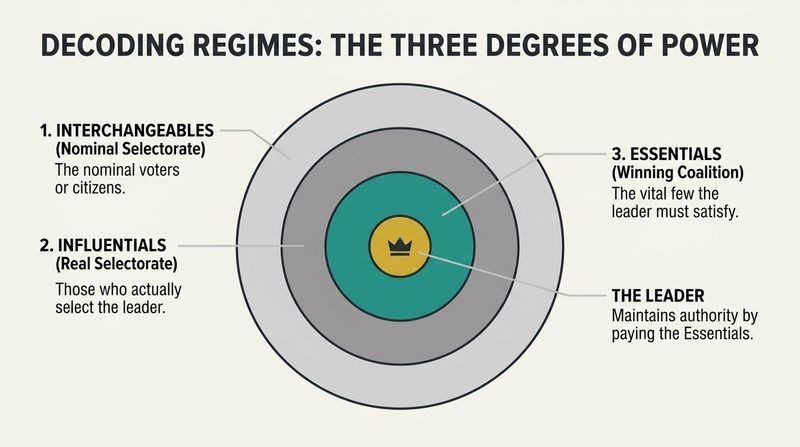
This taxonomy is the book's genuine intellectual contribution, derived from the authors' academic "selectorate theory." Its power lies in treating governments as points on a continuous spectrum rather than binary categories, which lets it compare a mafia family, a corporation, and a nation-state with one framework. Political scientists had long used blunt regime-type codings; this adds resolution. The framework resembles Pareto's theory of elites and Michels's "iron law of oligarchy," which held that all organizations, even democratic ones, drift toward rule by a small few. The open question is measurement: pinning down the exact size of a winning coalition is notoriously slippery, which limits the theory's precision in practice.
Bad behavior is almost always good politics, not personal villainy
The title thesis, illustrated in a poor California suburb. Robert Rizzo, city manager of tiny, impoverished Bell, California, was paid $787,000 a year, nearly twice the US president's salary. This was not simple theft. Rizzo and the city council engineered it legally by converting Bell into a "charter city" through a special election that drew fewer than 400 voters out of 36,000 residents. With almost no one watching, a handful of insiders controlled taxing and spending.
The lesson: outrageous outcomes flow from the structure, not the scoundrel. Bell's property tax rate ran about 50 percent higher than wealthy neighbors like Beverly Hills. When power depends on only a few hundred votes, enriching your tiny coalition and taxing everyone else is not a bug. It is the winning strategy any rational player would adopt.
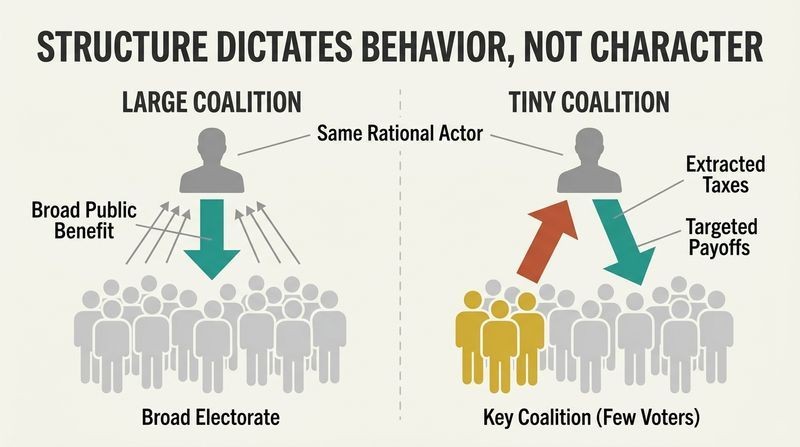
The Bell case is a masterstroke because it proves the theory on American soil, defusing the reflex to blame "foreign" corruption on culture. It resonates with public-choice economics (Buchanan, Tullock), which models politicians as self-interested utility-maximizers rather than public servants. The deeper insight is about voter turnout and information: low-salience elections are engines of capture, a finding echoed in research on off-cycle local elections that consistently produce unrepresentative electorates favoring organized interests. One caveat worth noting: Rizzo was eventually jailed and exposed, suggesting the free press and legal accountability of a large-coalition system do eventually bite, even if slowly.
Follow five brutal rules: shrink your coalition, then pay it just enough
The dictator's operating manual. The authors distill survival into five rules that work for tyrants and, in muted form, democrats:
1. Keep your winning coalition as small as possible.
2. Keep your nominal selectorate as large as possible, so troublemakers are easily replaced.
3. Control the flow of revenue.
4. Pay key supporters just enough to stay loyal, never more.
5. Never take from your supporters to help the people.
Lenin's genius was introducing universal suffrage in a one-party state, creating a vast pool of replaceable backers. Zimbabwe's Mugabe always found money to pay his army during coup threats. The reason democrats gerrymander districts, fight over tax codes, and argue about immigration is that they too are playing these rules, just constrained by law.
Presenting statecraft as a cynical checklist is rhetorically devastating and pedagogically brilliant. It functions like Machiavelli's advice to the Medici, updated with modern data. The provocative move is applying the same rules to democracies: gerrymandering as Rule 1, immigration debates as Rule 2. This unification is the book's boldest bet. Critics might argue it flattens meaningful differences (a US senator is not Kim Jong Il), but the authors would counter that the difference is one of degree along the coalition-size axis, not of kind. The rules also illuminate corporate governance, where CEOs pack boards with loyalists exactly as autocrats shuffle their inner circles.
Loyal incompetents beat talented rivals: competence is a threat to autocrats
Why tyrannies fill with mediocrities. The three most important traits of a coalition member are loyalty, loyalty, and loyalty. Saddam Hussein's most trusted lieutenant, "Chemical Ali," was a former motorcycle courier whose chief skill was murder. Six days after taking power, Saddam staged a videotaped assembly where dozens of Ba'ath Party colleagues were named as traitors and hauled off to execution. The survivors, terrified then relieved, became fiercely loyal.
Meritocracy is dangerous because competent people make competent rivals. This is why Byzantine emperors staffed top posts with eunuchs, who could never inherit the throne, and why Saddam kept a Christian, Tariq Aziz, as his number two in a Muslim country. Rulers surround themselves with people who cannot plausibly replace them.
This principle explains a puzzle that baffles outsiders: why do dictatorships promote obvious incompetents? The answer inverts the logic of healthy organizations. In firms and democracies, talent is rewarded because output matters; in autocracies, output matters far less than the survival calculus. This connects to the "dictator's dilemma" in economics: leaders need information and competence but fear the empowered agents who provide it. Stalin's purge of the Red Army officer corps before World War II, which nearly cost the USSR the war, is the classic cautionary tale. The framework also predicts why succession is so bloody: any capable heir is simultaneously the most dangerous rival.
Small coalitions buy loyalty with cash; big coalitions must deliver public goods
Why democracies build schools and dictators build palaces. When a leader needs only a few backers, the cheapest way to keep them loyal is private rewards: bribes, sinecures, stolen oil revenue. When a leader needs millions, private payoffs get spread too thin, so the efficient strategy shifts to public goods that benefit everyone: education, clean water, health care, and freedoms.
The evidence is stark. Autocrats provide solid primary education (literate workers pay taxes) but starve universities, which teach dangerous independent thinking. Only China and Singapore, among non-democracies, have a university ranked in the world's top 200. Clean drinking water reaches 90 percent of Hondurans but only 44 percent in far richer Equatorial Guinea. Roads to the airport are suspiciously straight in dictatorships, built by bulldozing powerless villagers.
This is the theory's most testable and most humane implication: coalition size predicts quality of life better than wealth does. It dovetails with Amartya Sen's famous observation that no substantial famine has ever occurred in a functioning democracy with a free press. The public-goods logic reframes freedoms (speech, assembly, press) not as moral luxuries but as cheap, productivity-enhancing tools that large-coalition leaders cannot avoid providing. The straight-road-to-the-airport example is delightfully concrete. A nuance: resource wealth can sever the link, since oil-rich autocrats need neither taxes nor productive citizens, which is precisely why the resource curse produces such oppressive, unequal states.
Natural resources are a curse: oil lets leaders ignore and crush their people
When wealth flows from the ground, not from work. Oil pumps whether taxed at zero or 100 percent, and it requires almost no participation from the population. This frees leaders from the one thing that normally forces liberalization: needing productive, and therefore free, citizens. Nigeria accumulated $350 billion in oil revenue from 1970 to 2000, yet per capita income fell and the share living on under a dollar a day nearly doubled to about 70 percent.
Resource-rich nations grow slower, fight more civil wars, and stay more autocratic. Luanda, Angola, is among the world's most expensive cities for expatriates while most Angolans live in poverty. The perverse fix the authors propose: rich nations should tax their own oil consumption, lowering global oil revenue and forcing petro-tyrants to actually tax and therefore free their people.
The resource curse is well documented in development economics (Sachs, Warner, Ross), and the book's contribution is the coalition-based mechanism: unearned revenue lets rulers skip the implicit bargain between taxation and representation that built modern democracies. This echoes the historical adage "no taxation without representation" run in reverse: no taxation, no representation. The policy prescription, taxing oil in consumer nations to weaken producers, is provocative and rarely voiced. It also has a climate co-benefit the authors barely emphasize. The sobering implication is that mineral windfalls, foreign aid, and easy loans all work identically: they decouple leaders from citizens, which is bad news for the governed.
Foreign aid buys policies, not compassion, and props up thieves by design
Aid is a transaction between donor and recipient elites. Democracies give aid to make their own voters happy by purchasing policy concessions from autocrats, who can be bought cheaply because they answer to so few. The US gave Egypt billions for recognizing Israel and gave Liberia's brutal Sergeant Doe roughly $500 million for anti-Soviet loyalty. Doe and cronies allegedly pocketed $300 million.
The uncomfortable math: buying a policy from a democracy is expensive (many people must be compensated) but cheap from a dictator (a handful of essentials). That is why aid flows to corrupt regimes, and why the people in top aid-recipient nations like Egypt and Pakistan often hate the donor. The authors propose escrow: pay only after the recipient actually delivers, never on a promise.
This reframing punctures the humanitarian self-image of development assistance and aligns with William Easterly's critique of top-down aid and with realist accounts of statecraft. The escrow idea, paying for verified outcomes rather than intentions, mirrors results-based financing and cash-on-delivery aid models that development economists have since tested. The provocative claim that aid actively entrenches bad governance is supported by the fungibility problem: money for schools frees up funds for palaces. One counterpoint the framework underweights: targeted NGO interventions (the Carter Center nearly eradicated Guinea worm disease) can bypass governments entirely, suggesting the pessimism about aid applies mainly to government-to-government transfers.
Revolutions ignite not in the worst tyrannies but in the wavering middle
Why the most brutal regimes rarely fall to their people. Rebellion requires citizens to calculate that the future under current rule is bad enough, and their odds of success high enough, to justify the risk. Truly savage regimes (North Korea, Than Shwe's Myanmar) deter revolt entirely because the penalty for stepping forward is death. The genuinely dangerous zone is the reformist middle, like Mubarak's Egypt or Gorbachev's USSR, where oppression is real but survivable and hope of change exists.
The decisive factor is almost always whether the military will fire on crowds. The Shah of Iran, Marcos in the Philippines, and Russia's Czar all fell when soldiers, unpaid or sensing a dying leader, stood aside. Revolts succeed when the money to buy loyalty dries up.
This inverts the intuitive assumption that suffering causes revolution. It aligns with de Tocqueville's paradox (the French Revolution came as conditions were improving) and with the "J-curve" theory of rising expectations. The book's sharper contribution is the coalition mechanism: revolts hinge on the loyalty calculus of security forces, not on the misery of the masses. This explains the Arab Spring's uneven results, where oil-poor Tunisia and Egypt toppled leaders while oil-rich Libya and Bahrain could pay mercenaries to fight. The framework also yields a chilling corollary: letting disaster victims die can strengthen an autocrat, since dead people cannot protest and foreign aid still flows.
Democracies win wars because they try hard; autocrats hoard resources for cronies
Two opposite manuals for war. Sun Tzu advised quick campaigns, no reinforcements, and motivating troops with spoils, perfect counsel for a small-coalition ruler. The modern Weinberger-Powell doctrine advises overwhelming force and escalation until victory, perfect for a large-coalition leader. In the 1967 Six Day War, tiny Israel crushed a far larger Arab coalition partly because democracies spend heavily to protect and equip soldiers (voters are watching), while autocrats spend on private rewards and lightly armor their expendable conscripts.
The deeper logic: for an autocrat like Nasser, diverting cronies' cash to the war effort risked a coup, so losing a war was safer than shortchanging backers. Across two centuries, democracies won about 93 percent of the wars they started; autocracies only about 60 percent. Democracies also rarely fight each other, preferring to bully weak targets.
The war-fighting application shows the theory's reach beyond domestic politics. The finding that democracies try harder because leaders fear electoral punishment for defeat connects to audience-cost theory in international relations. The claim that autocrats rationally accept battlefield defeat to preserve coalition payments is genuinely counterintuitive and well illustrated by Saddam pulling his elite Republican Guard back to protect himself rather than the nation. The "democratic peace" gets a materialist rather than normative explanation: democracies avoid fighting each other not from shared values but because both would fight hard, making victory too uncertain. The uncomfortable implication is that democracies are enthusiastic bullies of weak states, hardly the peaceful actors of their own rhetoric.
Reform arrives when leaders are new, dying, or broke, so strike then
The windows where change becomes possible. Because insiders and leaders both benefit from small coalitions, meaningful reform almost never happens voluntarily. It becomes possible only at moments of maximum coalition insecurity: right after a leader takes power, when a leader is visibly dying, or when the treasury runs dry and loyalty can no longer be bought. At these junctures, essential backers fear being purged and become willing to trade their shrinking privileges for the security of a larger, more stable coalition.
Ghana's J.J. Rawlings, a brutal coup leader, became a genuine democrat only because his economy collapsed and he had to free citizens to get them working again. The practical advice: outsiders wanting democratization or corporate reform should apply pressure during these narrow windows, and tie debt relief and aid to actual freedoms, never to promises.
This is the book's constructive payoff, and it is refreshingly modest: no utopias, just leverage at pressure points. The insight that economic crisis is the midwife of liberalization aligns with the historical link between fiscal desperation and constitutional concessions (England's Glorious Revolution, Magna Carta, all born of broke monarchs needing money). The Rawlings case is compelling precisely because he was no idealist. A modern extension: the authors argue technology like cell phones and the internet forces autocrats into a bind, since the same tools that raise productivity also let citizens coordinate. This anticipates debates about digital authoritarianism, where regimes now race to capture rather than ban these tools.
Enlarge the coalition and everything improves, even in your own company
The universal fix, applied to shareholders and voters. Since the size of the winning coalition drives outcomes, the path to better governance is always the same: make leaders depend on more people. The Green Bay Packers, owned by 112,000 fans with a 43-member board and a rule barring anyone from controlling the team, are beloved and perpetually sold out, unlike CEO-captured corporations answering to a board of twelve. The authors urge shareholders to use social networks to organize and reclaim control from insiders.
For democracies, the prescription is concrete: end gerrymandering with neutral computer-drawn districts, abolish the electoral college, and expand citizenship through immigration, since each new voter enlarges the coalition and pressures leaders to provide public goods. Even amnesty for immigrants, they argue, historically strengthened American governance by growing the essential group.
Ending on actionable institutional design keeps the book from mere cynicism. The Green Bay Packers example is inspired, turning an abstract theory into something a sports fan instantly grasps. The corporate-governance angle anticipated the rise of shareholder activism and proxy battles now amplified by exactly the online coordination the authors predicted. The redistricting prescription aligns with reform movements that have since adopted independent commissions in states like California and Michigan. The immigration argument is the most contestable, resting on the premise that enfranchisement reliably expands the effective coalition, which depends on new citizens actually voting and not being suppressed. Still, the core move, engineer dependence on more people, is a genuinely portable design principle for any organization.
Analysis
The Dictator's Handbook is a thesis-driven work of political science that popularizes the authors' academic "selectorate theory" for a general audience. Its structure is relentlessly deductive: one mechanism (leaders maximize personal power by managing three nested groups) is applied across an astonishing range of domains, from Roman papal elections and Ottoman fratricide to Hewlett-Packard boardroom coups, Wall Street bonuses, FIFA bribery, and the physics of airport roads. The difficulty in summarizing it lies precisely in this breadth: the theory is simple, but its explanatory ambition is total, so the value is in the accumulation of cases that make an abstract model feel inevitable.
The book's great strength is parsimony. By reducing all politics to the arithmetic of coalition size, it dissolves the false comfort of blaming bad outcomes on wicked individuals, alien cultures, or flawed ideologies. This is both liberating and unsettling. It shares intellectual DNA with public-choice economics, Olson's stationary bandit, and Michels's iron law of oligarchy, but it operationalizes these ideas into predictions about infant mortality, university rankings, and war outcomes that can be checked against data.
The framework's limits are the mirror image of its strengths. In insisting that only incentives matter, it underweights the cases where leadership, ideology, and contingency genuinely bend history: Mandela's choice of reconciliation, Deng's competence versus Mao's catastrophe, the role of ideas in mobilizing revolt. The authors would reply that these are variations within coalition constraints, but the model's near-unfalsifiability is a real cost. Its treatment of foreign aid and democratization is bracingly contrarian and has aged well alongside Easterly's critiques.
Ultimately the book is less a handbook for dictators than a decoder ring for citizens. Its final, almost hopeful argument, that every small-coalition regime eventually rots under its own corruption, and that reform is possible at moments of leader insecurity, transforms cold cynicism into a practical theory of change. Read it and you will never again believe a politician's stated reasons.
Review Summary
The Dictator's Handbook is a provocative analysis of political power dynamics, arguing that all leaders, democratic or autocratic, prioritize their own survival in power. The book explains how rulers maintain control through strategic allocation of resources and rewards to key supporters. While some readers found it insightful and eye-opening, others criticized its oversimplification and repetitiveness. The authors' cynical perspective on politics and foreign aid sparked both praise and skepticism. Overall, the book offers a thought-provoking, if controversial, framework for understanding political behavior and decision-making.
People Also Read




Glossary
Selectorate theory
Coalition-size explains all politicsThe authors' overarching framework holding that political outcomes are determined by the relative sizes of three groups a leader depends on, not by ideology, culture, or personality. It applies identically to nations, corporations, mafias, and clubs, treating every leader as a self-interested actor seeking to gain power, keep power, and control revenue.
Nominal selectorate (interchangeables)
Everyone with nominal sayThe pool of people who have at least some legal or formal claim to a voice in choosing a leader, such as all eligible voters in a country or all shareholders in a firm. Individually they have little real power and are easily replaced, hence "interchangeables," but they form the reservoir from which real influence is drawn.
Real selectorate (influentials)
Those who actually chooseThe subset of the nominal selectorate whose support genuinely influences who leads, such as voting members of a ruling party, senior royals, or large institutional shareholders. They matter more than ordinary interchangeables but still are not individually indispensable to the leader's survival.
Winning coalition (essentials)
Backers a leader cannot loseThe small group of essential supporters whose backing a leader absolutely must retain to stay in power, such as key generals, inner-circle cronies, or a corporate board. Its size is the single most important variable in the theory: small coalitions produce corruption and private payoffs, large ones produce public goods and freedoms.
The five rules to rule by
Autocrat's survival playbookA distilled strategy for staying in power: keep the winning coalition small, keep the nominal selectorate large, control revenue flow, pay supporters just enough to stay loyal, and never take from supporters to benefit the general public. The authors argue democrats follow softened versions of these same rules, constrained by law.
Resource curse
Mineral wealth breeds oppressionThe pattern whereby countries rich in easily extracted resources like oil or diamonds grow more slowly, suffer more civil wars, and stay more autocratic. Because such revenue requires no productive or free population, leaders can enrich a tiny coalition and repress everyone else without economic penalty, severing the taxation-for-representation bargain.
Kleptocrat
Ruler who governs by theftA leader who treats the national treasury as a personal account, exemplified by Zaire's Mobutu Sese Seko, who allegedly stole billions. The term describes the logical endpoint of small-coalition rule, where discretionary revenue not needed to buy loyalty is diverted into private wealth and secret accounts.
Aid-in-escrow
Pay only for delivered resultsThe authors' proposed reform of foreign aid: rather than paying recipient governments in advance on a promise of reform or cooperation, funds are held in an independent account and released only when specified objectives are actually achieved, removing the incentive for leaders to merely pretend to comply while pocketing the money.
FAQ
What's The Dictator's Handbook about?
- Political Survival Focus: The book examines the rules of political behavior, highlighting that leaders prioritize their survival over citizens' welfare.
- Selectorate Theory: It introduces selectorate theory, categorizing political actors into interchangeables, influentials, and essentials to explain power dynamics.
- Corruption and Governance: Discusses how corruption is used by leaders to maintain power, especially in small-coalition regimes.
Why should I read The Dictator's Handbook?
- Understanding Political Dynamics: Offers insights into the mechanics of political systems, helping demystify political actions and outcomes.
- Real-World Applications: Concepts apply to governments, corporations, and organizations, relevant for leadership and management analysis.
- Critical Perspective on Leadership: Challenges conventional views on governance, prompting reconsideration of political behavior assumptions.
What are the key takeaways of The Dictator's Handbook?
- Leaders Prioritize Survival: Leaders focus on staying in power, often at the populace's expense, driving many political decisions.
- Coalition Size Matters: Governance style is influenced by coalition size; smaller coalitions allow private rewards, larger ones require public goods.
- Corruption as a Tool: Corruption is a strategic choice for leaders in small-coalition systems to secure loyalty from essential backers.
How does The Dictator's Handbook define the concept of selectorate theory?
- Three Groups Defined: Political actors are categorized into interchangeables, influentials, and essentials, explaining power maintenance.
- Impact on Governance: The essentials group's size affects reliance on public goods versus private rewards, influencing governance quality.
- Political Dynamics Explained: Provides a framework for understanding why some leaders are more corrupt and why democracies often yield better outcomes.
What role does corruption play in maintaining power according to The Dictator's Handbook?
- Corruption as a Survival Strategy: Used by leaders to secure loyalty from essential supporters, ensuring their continued backing.
- Contrast with Democracies: In larger coalitions, corruption risks alienating a broader base, making it less viable.
- Cycle of Corruption: Corruption creates a cycle where leaders rely on it to maintain power, entrenching positions and diminishing governance quality.
How do leaders come to power according to The Dictator's Handbook?
- Removing the Incumbent: Achieved through assassination, coup, or uprising, depending on political context and resources.
- Seizing Control of Government: New leaders must quickly control state apparatus, including treasury and military, to prevent rival organization.
- Forming a Support Coalition: Establishing a manageable yet supportive coalition is crucial for maintaining power against challengers.
What strategies do leaders use to stay in power as discussed in The Dictator's Handbook?
- Rewarding Loyal Supporters: Essential backers are rewarded with private goods to maintain loyalty and support.
- Keeping Coalition Members Off-Balance: Leaders keep coalition members uncertain about their positions to ensure loyalty.
- Manipulating Public Perception: Tactics like controlling media narratives help maintain an image of strength and stability.
How does The Dictator's Handbook explain the relationship between taxation and political survival?
- Taxation as a Tool for Loyalty: Revenue is redistributed to essential supporters, making high taxes viable in small-coalition regimes.
- Constraints in Democracies: Democracies face constraints on taxation to avoid alienating a broader coalition, focusing on public goods.
- Revenue Generation: Leaders balance extracting revenue to reward coalitions without overburdening the populace, crucial for stability.
How do the authors of The Dictator's Handbook view foreign aid?
- Aid as a Double-Edged Sword: Often reinforces corrupt regimes rather than promoting development, providing resources without accountability.
- Incentives Matter: Changing leaders' incentives is crucial for effective aid, beyond increasing penalties for corruption.
- Call for Structural Change: Advocates reevaluating aid distribution, tying it to measurable outcomes and accountability.
What examples do the authors use to illustrate their points in The Dictator's Handbook?
- Historical Leaders: References like Julius Caesar illustrate the risks of neglecting coalition loyalty.
- Contemporary Regimes: Examples like Mobutu Sese Seko highlight resource exploitation for personal benefit in autocratic regimes.
- Case Studies of Revolutions: Analyzes revolutions in Tunisia and Egypt to show how economic conditions and leadership changes spark movements.
How does The Dictator's Handbook explain the relationship between war and political survival?
- War as Political Tool: Leaders use war to consolidate power and distract from domestic issues, rallying support.
- Democratic vs. Autocratic Approaches: Democracies require public support for war, while autocrats may engage more casually.
- Consequences of Defeat: Military defeat impacts democracies politically, while autocrats can survive if coalition control is maintained.
What strategies do the authors suggest for improving governance in The Dictator's Handbook?
- Expanding Coalitions: Including more citizens in the coalition can lead to better governance and public goods.
- Encouraging Accountability: Independent audits and transparent practices ensure leaders are held responsible for actions.
- Reevaluating Foreign Aid: Suggests aid should be tied to specific outcomes and accountability to improve governance and welfare.

Download PDF
Download EPUB
.epub digital book format is ideal for reading ebooks on phones, tablets, and e-readers.








































