

Key Takeaways
Nothing is good or bad on its own; you supply the meaning
The blank screen principle. Roach's central idea, drawn from the ancient Diamond Cutter sutra, is what Buddhists call emptiness: no person, event, or object carries an innate quality of good or bad. Proof is simple. The coworker who grates on you is beloved by someone else in the same room, watching him say the exact same things. If irritation flowed from him, everyone would feel it. It does not, so it must come from you.
A neutral world, not a wished-away one. When Andin bought a Manhattan building, it was simultaneously good (managers got space), bad (owners watched values drop), and mixed (some commutes shortened, others lengthened). The building itself held no verdict. Even a root canal looks like opportunity to the dentist billing for it.
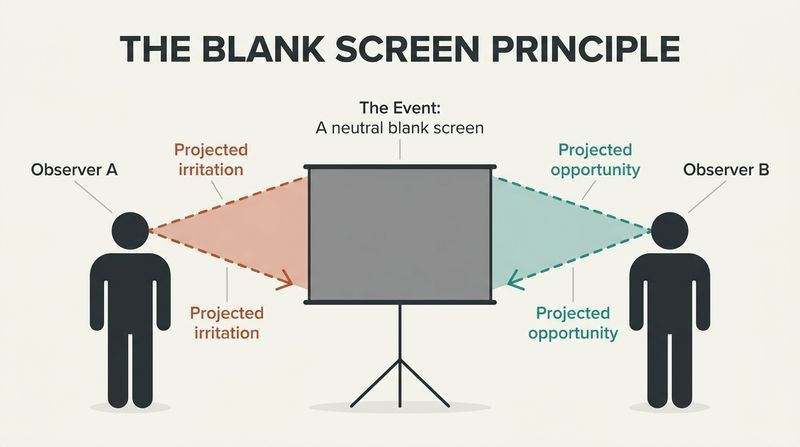
What's striking is how precisely this tracks Stoicism. Epictetus wrote that people are disturbed not by things but by their judgments about things, and modern cognitive behavioral therapy rests on the identical move: separate the event from the appraisal. Roach's contribution is insisting the appraisal is not free but compelled by past conduct, which raises the stakes. The one caveat he stresses honestly: recognizing a problem is a projection does not make it vanish. You cannot wish a bankruptcy away. This guards the idea against the naive positive-thinking trap, keeping it closer to reframing than to magical thinking.
Every kindness or cruelty plants a mental seed that later grows your reality
Karma as gardening, not morality. If perception comes from us, what forces it? Roach's answer is mental imprints: every action, word, and thought toward others records itself on the mind like film, at roughly sixty-five frames per second. These seeds incubate in the subconscious, doubling in strength over time like an acorn becoming a ton of oak, then surface to color and even create what you perceive.
Four rules govern the harvest.
1. Content matches: hurting others yields unpleasant experiences, helping yields pleasant ones.
2. Seeds grow during incubation, so tiny acts bloom huge.
3. Nothing happens without a prior seed.
4. No seed is ever wasted.
A lie you tell is the only thing that can later make you perceive someone lying to you.
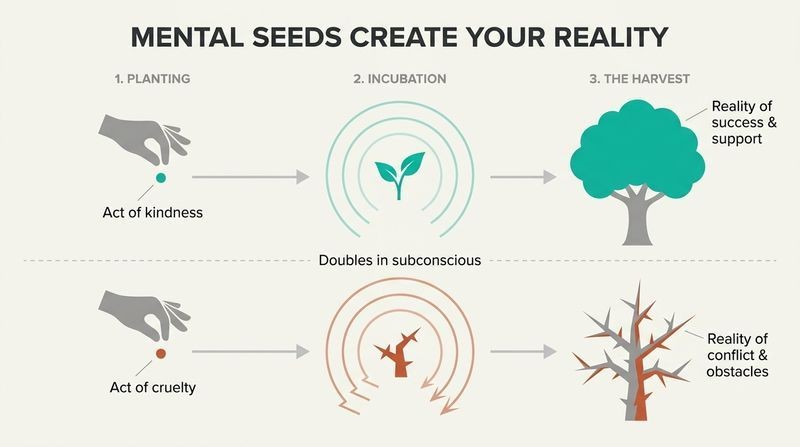
This is the book's most audacious and least falsifiable claim: not that attitude colors perception, but that generosity literally manufactures external events. Skeptics will note the theory is unfalsifiable, since any failure is explained as insufficient practice or older seeds still ripening. Yet the behavioral core has real support. The reticular activating system and priming research show the brain surfaces what it is primed to notice, and self-fulfilling prophecy is well documented. Treat the metaphysics as optional; the discipline of auditing your treatment of others produces measurable behavioral shifts regardless of whether cosmic bookkeeping is real.
Wealth is unlimited because it is created by giving it away
The economics of limitlessness. Roach's most heretical claim overturns every economic system, all of which assume scarce resources to be divided between a separate you and me. He argues the total amount of wealth in the world fluctuates constantly, expanding when penicillin or the personal computer is invented. If wealth can grow, scarcity is not fundamental. The real cause of money, he says, is the imprint left by generosity.
Twice the wealth, no one poorer. When you refuse to yell back at a boss, both you and the coworker beside you eventually perceive him as pleasant. Happiness in the room doubled at no one's expense. Money works identically: seeing a dollar requires having planted a seed by giving a penny. Sharing indiscriminately is the surest path to abundance.
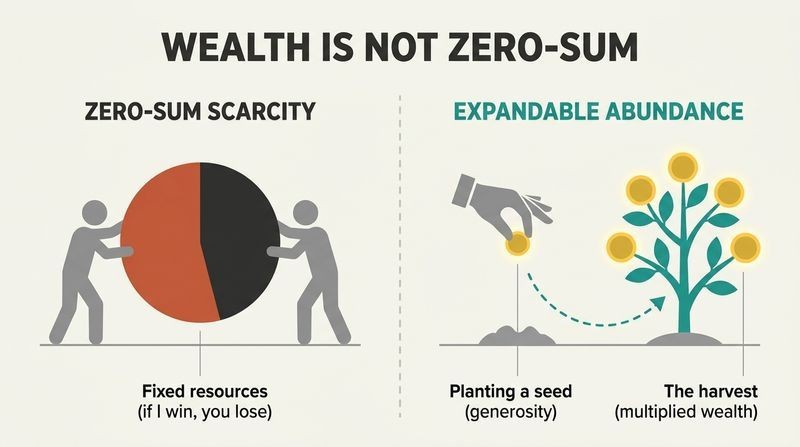
This resonates strongly with Adam Grant's research in Give and Take, which found that givers, despite occupying the bottom of success distributions, also dominate the top. Positive-sum thinking, the recognition that markets are not fixed pies, underpins most genuine innovation. Where Roach overreaches is in dismissing scarcity entirely; oil, clean water, and time remain genuinely finite, and generosity does not conjure lithium. The stronger, defensible version is that treating business as zero-sum blinds you to collaborative value creation, and that a generous operating posture attracts the relationships and reputation that compound into wealth.
Diagnose any business problem by reversing the harmful act behind it
Reverse-engineering results. Roach lists dozens of specific business ailments and their supposed karmic causes, always the near-opposite of instinct. Unstable finances? Share profits and never take a dishonest penny. Ruthless competitors gaining ground? Stop speaking harshly to anyone. Nobody listens to your ideas? Cut out useless talk, the idle gossip about news, sports, and scandal that clogs mental bandwidth.
The counterintuitive fixes.
1. Partners betray you: stop taking private pleasure in others' failures.
2. Filthy work environments: root out sexual harassment in your company.
3. Unreliable staff: be dependable in your own marriage.
4. Cash-strapped for a deal: give more generously, not less.
The logic is that you fix your world by fixing yourself, never by lecturing the other people.
The specificity here is both the charm and the weak point. Why should stinginess with Aunt Martha's guest room cause a branch office to fail to find rent? The pairings feel arbitrary and unfalsifiable, closer to sympathetic magic than mechanism. Yet reframed as a discipline, the practice has quiet power. It converts every external frustration into a prompt for self-examination, which is exactly what high-agency psychology recommends: locus of control research shows people who attribute outcomes to their own conduct persist longer and adapt faster than those who blame circumstances. The dubious causal claims still yield a useful reflex.
Track your conduct six times a day in a pocket notebook
The six-time book. Called tundruk in Tibetan, this is Roach's single most practical tool. Pick your three biggest problems from his list, write the karmic solution to each, and every couple of hours make a quick, specific entry. Under a plus sign, note one thing you did well ("3:15pm, thanked Susan in front of everyone for six months of quiet inventory work"). Under a minus, one failure. Then a small, symbolic to-do.
No guilt, just tracking. Tibetan has no word for guilt; the nearest is intelligent regret that decides to change. The early Kadampa monks carried white and black pebbles, moving one per good or bad thought, and discovered the black vastly outnumbered the white. The point is not shame but data. Just like tracking scratches on rings, measuring behavior changes it.
This is the book at its most empirically grounded. The pebble practice is a five-century-old anticipation of habit tracking, and the specificity requirement mirrors what makes journaling effective: vague self-assessment ("I was pretty nice") produces no change, while timestamped detail creates accountability. The Jesuit examen and modern gratitude journaling both exploit the same mechanism. The insistence on removing guilt is psychologically shrewd, since shame triggers avoidance and defensiveness, whereas neutral observation, as behavioral scientists note, is what actually moves the needle. The factory scratch-count anecdote nicely illustrates that measurement alone, without blame, often solves problems.
Spend fifteen silent minutes each dawn rehearsing tomorrow's problems
Setting the day. Penpa tang, literally close to "shooting an arrow," means aiming an entire day with a few quiet morning minutes. Roach prescribes a dedicated clean space (never your bed, which conditions sleep), a straight back, and ten slow counted breaths to still the mind. Then comes the real work.
Proactive rehearsal. Pick a recurring problem, say nobody helps you in a crunch. Replay a specific past instance, review its emptiness (others didn't see it as a problem), trace it to your own seed, then mentally rehearse the next occurrence. Catch your old reflex (refusing help in retaliation), and practice the new response: helping unilaterally. Because the situation will actually recur within days, you arrive rehearsed and break the cycle. Close by picturing yourself as your ideal future self.
Neuroscience gives this real teeth. Mental rehearsal activates many of the same motor and cognitive circuits as actual performance, which is why elite athletes visualize routines. The breath-counting opener is textbook mindfulness, now backed by studies showing reduced amygdala reactivity and improved emotional regulation after regular practice. The genuinely original wrinkle is targeting a specific anticipated conflict rather than seeking generic calm; Roach notes that pure breath-watching collapses at the first real crisis of the workday. Implementation-intention research (if-then planning) confirms that pre-deciding your response to a foreseen trigger dramatically raises the odds you execute the better behavior under pressure.
Schedule inviolable solitude weekly and a two-week forest retreat yearly
The Circle. Tsam means border or dividing line: drawing a ring around yourself to think. Roach took every Wednesday off for over fifteen years, even accepting a pay cut, spending mornings in total silence, then light exercise, elevated reading, a nap, hands-on learning, and evening service to others. The payoff was creative breakthroughs, like the color-coded, pre-printed diamond papers that made Andin's inventory control the industry's best and saved millions.
The Forest Circle. A longer version: two full weeks alone in a cabin, no phone, TV, or visitors, cycling between silence, reading, walking, and light meals. Expect a slump around day seven, then major insight bursts after ten to twelve days. He insists ideas that look naive back in the noise are actually clarity seen by a mind returned to distraction.
This anticipates Cal Newport's Deep Work almost exactly, and the neuroscience explains why it functions. Insight tends to arrive not during focused effort but in the diffuse, default-mode state that solitude and mind-wandering unlock, which is why breakthroughs famously come in showers and on walks. The hiring heuristic Roach buries here (asking candidates how they spend free time, distrusting heavy TV watchers, favoring readers, writers, parents, and volunteers) is a shrewd proxy for the creative range a person can bring. The scarce and underrated claim is that overworking your best people literally destroys the idea-generation that would have paid for the rest.
You have three seconds to kill anger before it plants its seed
The window of interception. When Roach's boss wrongly blamed him for buying ten thousand carats instead of one thousand, he had roughly three seconds before indignation swept him downstream. Yelling back is the single act that plants the seed to be yelled at again unjustly. Catching the anger before it forms is like smelling acid before you drink from the wrong cup.
Health is the hidden stake. Roach frames every burst of anger, jealousy, or irritation as physically corrosive: a hair grays, a wrinkle deepens, the heart strains. The ancient verse he cites is bracingly logical: if a situation can be fixed, why be upset; if it cannot, what use is being upset? Refusing anger also frees your mind instantly to solve the actual problem with a clear head.
Viktor Frankl located human freedom precisely in the gap between stimulus and response, and Roach operationalizes it with a stopwatch. Daniel Goleman's concept of amygdala hijack explains the urgency: once the limbic surge fires fully, the prefrontal cortex goes offline and reasoned response becomes nearly impossible, so interception must happen early. The claim that chronic anger accelerates physical aging is not mere metaphor; research links hostility and chronic stress to elevated cortisol, inflammation, cardiovascular damage, and shortened telomeres. The ancient two-line verse on fixable versus unfixable situations is arguably the most portable piece of practical philosophy in the entire book.
Ask each morning: if I died tonight, would I spend today this way?
Death Meditation. Not morbid tube-and-monitor imagery, but a daily bed-side question: I die tonight, what is the best use of my remaining hours? Practiced regularly, it streamlines life. You start discarding possessions you haven't used in six months, freeing mental hard-drive space you didn't know was consumed by mentally inventorying your shoes and old photos. Eventually you interrogate the career itself.
Shirley. The lesson is anchored in a colleague, a radiant Jamaican woman who ran Andin's distribution, worked past midnight, and drove herself so hard she skipped meals and medication. Diabetes took her legs, then her life. Her death forced Roach and his peers to look back on their frantic empire-building and finally ask whether it was worth it. Businesses die too; view yours from its inevitable end.
This is memento mori, the Stoic and monastic staple, repackaged for executives. Terror management theory in psychology shows mortality awareness can push people either toward defensive materialism or toward intrinsic values and generativity, depending on how it is framed; Roach's structured daily version deliberately steers toward the latter. The Shirley story does real work the abstract principle cannot, converting a philosophical exercise into visceral warning. There is also a shrewd management insight embedded here that many leaders miss: your most driven employees will harm themselves without protest, and it is the manager's job to force rest even when output suffers short-term.
Erase the line between you and your people in three escalating steps
Exchanging self and others. Roach calls this the ultimate management tool, credited with running a floor of ten nationalities in near-perfect harmony. It has three stages.
1. The Jampa Method: study what each person genuinely likes and needs, then quietly supply it, like the monk who reads your eyes and has your favorite drink waiting.
2. Switching Bodies: mentally inhabit an employee, look back at yourself, and ask what you would want from you.
3. The Rope Trick: imagine a lasso around both of you until you are literally one person, sharing one bonus, one welfare.
Why the self is negotiable. A mother's sense of "me" expands to cover her child; a diabetic amputee's shrinks to exclude a leg. The boundary of self is a habit, not a fact, so it can be redrawn to include everyone.
This is servant leadership given a metaphysical engine. Empathy research distinguishes cognitive perspective-taking (Switching Bodies) from the deeper affective merging Roach pushes toward, and organizational studies consistently link leaders' genuine attentiveness to subordinates' needs with retention, discretionary effort, and reduced conflict, exactly the frictionless floor he describes. The philosophical claim that self-boundaries are constructed echoes Derek Parfit's work on personal identity and Buddhist anatta. The practical caution Roach himself flags is the burnout risk of unbounded responsibility; his answer, that resources expand through the very act of expanding the self, is inspiring but leans again on the unfalsifiable karma engine rather than sustainable delegation.
Analysis
The Diamond Cutter is a genre hybrid with few peers: part corporate memoir (a Princeton graduate turned ordained monk builds a diamond division from a $50,000 loan to over $100 million), part translation and commentary on a 2,500-year-old Buddhist sutra, and part actionable business manual. Its difficulty for a summarizer is that the metaphysics and the pragmatics are welded together. Strip the karma and you gut the book's claimed mechanism; keep it literally and you must accept that generosity reshapes external reality, not merely perception.
The intellectual signature is the leap from a defensible idealist premise (emptiness: events carry no innate valence, proven by the fact that observers disagree) to a bold causal one (mental imprints from moral conduct compel and create your world). The first is compatible with Stoicism and cognitive behavioral therapy. The second is closer to a rigorous, ethicized law of attraction, and here the book distinguishes itself sharply from The Secret: the currency is not wishing but giving. That is a meaningful upgrade, because it prescribes concrete other-directed behavior rather than passive visualization.
The book's real durability lies in its tools, which work regardless of one's cosmology. The six-time book is disciplined behavioral tracking; setting the day is implementation-intention rehearsal; the Circle is deep work and diffuse-mode incubation; the three-second anger interception is Frankl's gap made practical; Death Meditation is memento mori for executives. Each has independent support in psychology and organizational research.
The honest weakness is falsifiability. Every failure is attributed to insufficient practice or slow-ripening older seeds, so the theory can never be wrong. A discerning reader can extract enormous value by treating the karmic claims as a motivating frame and the practices as the payload. The framing gets you to do the giving; the giving, whether through cosmic bookkeeping or ordinary reputation, relationships, and clarity of mind, tends to pay.
Review Summary
The Diamond Cutter receives mixed reviews. Some praise its application of Buddhist principles to business, finding it insightful and transformative. Others criticize it as oversimplified, contradictory, or misrepresenting Buddhist concepts. Many readers appreciate the practical advice and personal growth aspects, while some find the writing style difficult or the diamond industry focus distracting. Critics argue that the book's core ideas about karma and imprints are flawed or potentially harmful. Overall, readers tend to either strongly embrace or reject the book's teachings.
People Also Read









FAQ
What's The Diamond Cutter about?
- Integration of Buddhism and Business: The Diamond Cutter by Michael Roach combines ancient Buddhist wisdom with modern business strategies, focusing on how spiritual principles can enhance both personal and professional success.
- Three Business Goals: The book outlines three main goals: making money, enjoying it, and finding meaningfulness in work, all tied to Buddhist teachings.
- Concept of Emptiness: Central to the book is the idea of "hidden potential" or "emptiness," suggesting that perceptions shape our experiences and outcomes.
Why should I read The Diamond Cutter?
- Unique Perspective: It offers a blend of spirituality and practical business strategies, appealing to those seeking ethical integrity in business.
- Real-Life Applications: The author shares personal experiences from the diamond industry, making the teachings relatable and actionable.
- Transformative Insights: Readers can gain insights into how thoughts and actions shape reality, improving relationships and business outcomes.
What are the key takeaways of The Diamond Cutter?
- Generosity Leads to Success: A generous mindset is crucial for financial success, as sharing profits creates positive mental imprints.
- Emptiness and Perception: Situations are neutral, and our perceptions shape experiences, helping navigate challenges effectively.
- Mindful Imprints: Actions, words, and thoughts create mental imprints influencing future experiences, guiding better decision-making.
What is the significance of "hidden potential" in The Diamond Cutter?
- Understanding Emptiness: "Hidden potential" aligns with the Buddhist concept of emptiness, teaching that nothing has inherent qualities.
- Influencing Outcomes: Recognizing hidden potential allows individuals to shift perceptions and influence outcomes positively.
- Practical Application: The book provides methods to harness this potential, encouraging a mindset that sees opportunities over obstacles.
How does The Diamond Cutter define success?
- Ethical Financial Prosperity: Success is not just financial gain but achieving it through ethical means, aligning with spiritual values.
- Personal Fulfillment: True success involves enjoying wealth while maintaining health and well-being.
- Meaningful Impact: Success is about feeling that one’s work has positively impacted the world, reflecting Buddhist principles.
What is the "Six-Time Book" method in The Diamond Cutter?
- Tracking Actions and Thoughts: This journaling method involves making entries every two hours to reflect on positive and negative actions.
- Specificity is Key: Entries should be specific, focusing on particular instances of behavior to recognize patterns.
- Daily Review: At day's end, individuals review entries to reinforce positive behavior and encourage personal growth.
How can I apply the teachings of The Diamond Cutter in my daily life?
- Practice Generosity: Incorporate small acts of generosity into daily routines, creating positive imprints.
- Reflect on Actions: Regularly reflect on actions and their impacts, aligning decisions with values.
- Embrace Challenges: View challenges as opportunities to practice principles of emptiness and hidden potential.
What is the "Setting the Day" practice mentioned in The Diamond Cutter?
- Morning Reflection: Spend quiet time each morning to mentally prepare for the day, focusing thoughts and intentions.
- Visualization of Challenges: Visualize potential challenges and mentally rehearse handling them effectively.
- Creating a Sacred Space: Establish a dedicated, quiet space for this practice, enhancing reflection and visualization.
What does The Diamond Cutter say about the importance of generosity?
- Generosity as Wealth Source: True wealth results from generosity, encouraging an abundance mindset.
- Planting Positive Imprints: Acts of generosity create positive imprints, manifesting as opportunities and success.
- Building Relationships: Generosity fosters goodwill, strengthening personal and professional relationships.
How does The Diamond Cutter address common business problems?
- Identifying Solutions: Links solutions to principles of mental imprints and hidden potential, understanding root causes.
- Practical Examples: Illustrates solutions with examples from the diamond industry, making teachings relatable.
- Encouraging Reflection: Empowers readers to reflect on situations and apply principles to find solutions.
What are some of the best quotes from The Diamond Cutter and what do they mean?
- “The more you give, the more you receive.”: Highlights the relationship between generosity and wealth, suggesting helping others creates success.
- “Every experience we undergo is triggered by a previous imprint.”: Emphasizes mental imprints, indicating past actions influence current experiences.
- “If I were going to die tonight, is this the way I would spend my last day?”: Encourages evaluating priorities and actions, focusing on meaningful living.
How does The Diamond Cutter address the concept of impermanence?
- Understanding Change: Emphasizes all things are impermanent, encouraging embracing change with adaptability.
- Reflection on Life's Transience: Prompts consideration of actions and relationships, fostering appreciation for the present.
- Motivation for Meaningful Living: Recognizing impermanence motivates pursuing meaningful goals and relationships, leading to fulfillment.
Download PDF
Download EPUB
.epub digital book format is ideal for reading ebooks on phones, tablets, and e-readers.








































