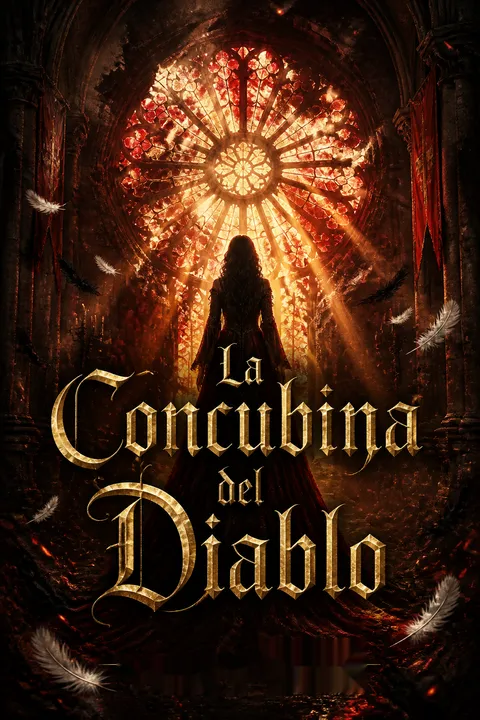

Plot Summary
Prisoner's Confession Begins
In a stark prison cell, a woman awaits execution for murders she did not commit. Father DiCaprio, a young priest, is sent to hear her confession. She is cold, beautiful, and unrepentant, challenging the priest's faith and composure. She insists her true crimes are far greater than those for which she is condemned, and that her story begins centuries ago. The priest, both fascinated and horrified, agrees to listen, promising to pray for her soul. Thus begins her tale, stretching back to medieval France, where she claims her life truly began.
Blood and Fire at Saint-Ange
The woman, Juliette, recounts her youth in 13th-century Languedoc, France. Her family prospers under the guidance of Monsieur de Saint-Ange, whose son Geniez is her closest friend. Religious tensions erupt into violence as crusaders attack their home. Juliette witnesses the brutal murder of her family and friends, barely escaping with Geniez and her loyal dog, Deacon. The trauma leaves her orphaned, her innocence destroyed, and her heart filled with grief and rage. This night of blood and fire marks the end of her childhood and the beginning of her long journey through suffering and survival.
Orphans on the Road
Juliette and Geniez, now orphans, wander through a devastated land. They hear of the Children's Crusade, a movement led by the boy prophet Stephen of Cloyes, promising a miraculous journey to the Holy Land. Geniez is swept up in the fervor, but Juliette is haunted by dread. Despite her reluctance, she follows Geniez, feeling alone and numb, her will eroded by grief. Their journey is grueling, marked by hunger, exhaustion, and the oppressive Mediterranean heat. Juliette's despair deepens, and she contemplates death as the only escape from her pain.
The Children's Crusade
Arriving in Marseille, Juliette and Geniez join thousands of children awaiting Stephen's miracle: the parting of the sea. The miracle never comes. The children's faith turns to despair and anger. Ruthless merchants offer ships to take them to the Holy Land, but it is a trap. Juliette is separated from Geniez and sold into slavery in Alexandria. Her ordeal in the slave market is brutal and humiliating, culminating in a near-rape from which she is saved by a mysterious, beautiful stranger—Shallem—who will change her fate forever.
Marseille: A Stranger Appears
In Marseille, before her enslavement, Juliette glimpses a man of unearthly beauty. His presence haunts her dreams and sustains her through her suffering. After her rescue from the Egyptian nobleman, she awakens on a Nile islet, alone with Shallem. He reveals himself as more than human—an angel, or perhaps a fallen one. Their connection is immediate and profound, but fraught with danger and secrets. Shallem's love is both salvation and curse, drawing Juliette into a world beyond mortal comprehension.
Betrayal and Slavery in Alexandria
Juliette's time in Alexandria is a descent into hell. She is stripped, auctioned, and nearly raped, only to be saved at the last moment by Shallem, who kills her attacker and spirits her away. On a remote island, he begins to reveal his true nature. Their relationship is passionate, but shadowed by the presence of other angels—some benevolent, some predatory. Juliette learns that she is a pawn in a cosmic struggle, desired by beings whose motives are inscrutable and whose powers are terrifying.
The Angel's Rescue
Shallem and Juliette flee through time and space, pursued by Eonar, the prince of angels, who seeks to father a child with a mortal woman. Shallem's love for Juliette is tested by jealousy, guilt, and the threat of Eonar's vengeance. They find brief happiness in Egypt and later in France, but are never free from danger. Juliette's longing for a child with Shallem is thwarted by the threat that Eonar will destroy any offspring. The lovers' immortality becomes both blessing and curse, as they are forced to watch the world change and decay around them.
Temptation and Revelation
Shallem's brother Cannat arrives, bringing both joy and peril. Cannat is dazzling, seductive, and dangerous—a mirror and rival to Shallem. Through Cannat, Juliette learns the true history of the angels: their rebellion, exile, and the ambiguous nature of good and evil. Cannat's love for Shallem is possessive and fierce, and his relationship with Juliette is fraught with rivalry and dark attraction. The three form a strange, passionate family, bound by love, jealousy, and the ever-present threat of divine retribution.
The Devil's Bargain
To save their child from Eonar's wrath, Shallem and Cannat embark on a killing spree, sacrificing hundreds of innocents to fulfill a diabolical pact. Juliette is horrified by the bloodshed, but complicit in the crime. Their son, Chretien, is born with supernatural gifts but grows into a monster, ultimately murdering his adoptive father. Juliette's guilt and grief are overwhelming, and she becomes a prisoner of her own immortality, unable to die, unable to escape the consequences of her choices.
Immortal Love and Loss
Shallem and Juliette, joined by Cannat, retreat to the jungle, where they live as gods among the natives. They have more children—immortal, beautiful, and powerful—but happiness is fleeting. Their son Cyr is killed by Eonar in a fit of vengeance. Juliette's soul grows weary, her humanity eroded by centuries of loss and violence. She changes bodies repeatedly, each time losing a piece of herself. The love between Shallem and Cannat endures, but Juliette is increasingly alienated, her soul sickened by the weight of her sins.
Cannat's Arrival
Cannat's presence is both a balm and a torment. He teaches Juliette the secrets of the angels, their origins, and their powers. His love for Shallem is absolute, and his relationship with Juliette is complex—by turns tender, cruel, and seductive. Cannat's influence draws Juliette deeper into the world of the immortals, blurring the line between victim and accomplice. Together, they witness the rise and fall of civilizations, the endless cycle of human folly and suffering.
The Price of Immortality
As Juliette's soul grows sick from centuries of unnatural life, she becomes addicted to changing bodies, each new form a temporary reprieve from the agony of existence. Cannat enables her, while Shallem grows increasingly sorrowful and withdrawn. Juliette's crimes multiply—she kills without remorse, her humanity eroded by the endless cycle of death and rebirth. The love that once sustained her becomes a source of torment, as she realizes that immortality is a curse, not a gift.
Paradise and Exile
The family's time in the jungle is a brief paradise, but even there, tragedy strikes. Their children leave, seeking their own destinies. Juliette's soul is now irreparably damaged, her only hope for peace lying in death. Shallem, too, is weary—his longing for God's forgiveness has become an obsession. Cannat, ever loyal, is left to care for Juliette as she spirals toward self-destruction. The immortals are exiles, unable to find rest in any world.
The Jungle Gods
In the Americas, Cannat and Shallem are worshipped as gods by the natives. Their power is absolute, but their happiness is fleeting. Human sacrifice, jealousy, and the relentless passage of time erode their peace. The city they rule is destroyed, and the family is scattered. Juliette's children, immortal and beautiful, are lost to her. The gods are left alone, haunted by memories and regrets.
The Children of Angels
Juliette's immortal children grow distant, seeking their own paths. The family fractures, each member isolated by their own pain and longing. Shallem's obsession with redemption deepens, Cannat's love turns to despair, and Juliette is left alone with her sickness and guilt. The cycle of love, loss, and violence repeats, each iteration leaving deeper scars.
The Sickness of the Soul
Juliette's soul is now terminally ill. She confesses to crimes beyond human comprehension—murder, body theft, complicity in angelic violence. Her only hope is that Shallem, now reconciled with God, will find her soul and bring her peace. Cannat, left behind, is both her jailer and her last companion. The story comes full circle, as Juliette awaits execution for murders she did not commit, her final confession a plea for understanding and forgiveness.
The Final Confession
In the prison cell, Juliette finishes her story. Father DiCaprio is shaken to his core, unable to judge her, convinced that only God can weigh such sins. Cannat appears, supernatural and terrifying, to claim Juliette's soul. The priest is left alone, haunted by the encounter, uncertain whether he has witnessed a miracle, a tragedy, or a cosmic joke. The story ends with the lingering question: is there redemption for those who have loved, sinned, and suffered beyond the limits of mortal endurance?
Analysis
A meditation on immortality, guilt, and the search for redemptionThe Devil's Concubine is a sweeping, gothic fantasy that uses the supernatural to explore the deepest anxieties of the human soul. Through Juliette's confession, the novel interrogates the nature of sin, the burden of memory, and the corrosive effects of endless life. Immortality, far from being a blessing, is depicted as a curse that erodes identity, empathy, and hope. The angels, for all their power, are as lost and wounded as the mortals they love and destroy. The story's structure—an extended confession—invites the reader to judge, forgive, or simply bear witness. In the end, the novel suggests that redemption is possible, but only through the acceptance of suffering, the relinquishing of control, and the embrace of love in all its flawed, desperate forms. The boundaries between good and evil, human and divine, are shown to be porous and unstable, and the ultimate lesson is one of humility: only God can judge the soul, and even the damned may find grace.
Review Summary
The Devil's Concubine receives mixed reviews averaging 3.81 stars. Many readers praise the unique premise about a woman confessing her centuries-long relationship with fallen angels to a priest, calling it engrossing and thought-provoking. Positive reviews highlight the complex exploration of immortal-mortal relationships and innovative angel mythology. However, critics note the book suffers from pacing issues, excessive length, grammatical errors, and difficulty connecting with characters who disdain humanity. Several Spanish-language reviewers appreciate the story but find the prose unnecessarily dense or elaborate, while English readers occasionally struggle with translation quality.
Characters
Juliette (The Confessor)
Juliette is the central figure, whose confession frames the entire narrative. Born in medieval France, she is orphaned by violence and thrust into a world of suffering. Her beauty and intelligence set her apart, but also isolate her. Through her relationship with Shallem, she becomes immortal, but at a terrible cost: she is forced to witness centuries of loss, violence, and moral decay. Her soul grows sick from repeated trauma, body-swapping, and complicity in angelic crimes. Juliette is both victim and perpetrator, her humanity eroded by the endless cycle of love and loss. Her final confession is a desperate search for meaning, forgiveness, and peace.
Shallem
Shallem is Juliette's savior, lover, and the source of her immortality. He is beautiful, melancholic, and tormented by his exile from God. His love for Juliette is profound but ultimately destructive, as it draws her into the world of the immortals and their cosmic struggles. Shallem is obsessed with regaining God's favor, and his longing for redemption shapes his every action. His relationship with his brother Cannat is equally intense, marked by love, rivalry, and shared guilt. Shallem's journey is one of suffering, hope, and the eternal search for grace.
Cannat
Cannat is Shallem's brother and the story's most ambiguous figure. He is dazzling, charismatic, and dangerous—a being of immense power and appetites. Cannat's love for Shallem is possessive and absolute, and his relationship with Juliette is fraught with rivalry, seduction, and cruelty. He enables Juliette's descent into spiritual sickness, providing her with new bodies and encouraging her worst impulses. Yet he is also capable of tenderness and loyalty, especially toward Shallem. Cannat's actions are driven by love, boredom, and a deep sense of exile.
Eonar
Eonar is the most powerful of the fallen angels, driven by envy, pride, and a desire to create a child with a mortal woman. His pursuit of Juliette and his vendetta against Shallem and Cannat set much of the plot in motion. Eonar is both a tempter and a destroyer, his motives inscrutable and his power terrifying. He represents the darker side of divinity—the capacity for cruelty, manipulation, and cosmic indifference.
Father DiCaprio
Father DiCaprio is the young priest who hears Juliette's final confession. He is initially skeptical, but becomes increasingly unsettled and fascinated by her story. His faith is tested by the enormity of her sins and the supernatural events he witnesses. DiCaprio serves as the reader's surrogate, struggling to judge Juliette and ultimately concluding that only God can weigh such a soul. His encounter with Cannat leaves him forever changed, haunted by the possibility that the boundaries between good and evil, human and divine, are far more porous than he imagined.
Geniez
Geniez is Juliette's closest companion in her youth, the son of Monsieur de Saint-Ange. His idealism and religious fervor contrast with Juliette's skepticism. Their friendship is shattered by violence, and Geniez's fate is left ambiguous. He represents the possibility of a different life—a path not taken.
Chretien
Chretien is the son of Juliette and Eonar, raised by Dolmance de Grieux. He is a prodigy, beautiful and brilliant, but ultimately monstrous. Chretien's descent into violence and murder mirrors Juliette's own moral decline. His death at Shallem's hands is both a tragedy and a release.
Dolmance de Grieux
Dolmance is Juliette's husband in Orleans, a wealthy and cultured man who offers her sanctuary and respect. Their marriage is one of convenience and mutual understanding. Dolmance's murder by Chretien is a turning point, marking the end of Juliette's last connection to ordinary human life.
Cyr
Cyr is the child of Juliette and Shallem, made immortal by his father's power. He is beautiful, gifted, and beloved, but ultimately killed by Eonar in a fit of vengeance. Cyr's death is the final blow to Juliette's hope for happiness and redemption.
Leonardo
Leonardo is Cannat's son, gifted with supernatural powers. He becomes Juliette's confidant and friend, sharing her sense of alienation and longing. Leonardo's eventual death at Cannat's hands is both a sacrifice and a testament to the destructive power of immortal love.
Plot Devices
Framing Confession
The novel is structured as a confession, with Juliette recounting her life to Father DiCaprio. This device allows for a blend of first-person intimacy and retrospective analysis. The confession is both a plea for understanding and a final act of self-examination, framing the entire narrative as a search for meaning and absolution.
Immortality and Body-Swapping
The central supernatural device is the transfer of souls between bodies, enabled by the angels' powers. Immortality is depicted not as a gift, but as a source of endless suffering, alienation, and moral decay. Each new body brings temporary relief, but also erodes Juliette's sense of self and humanity.
Angelic Rivalry and Cosmic Struggle
The angels are not simple embodiments of good or evil, but complex, conflicted beings driven by love, jealousy, and longing. Their rivalry shapes the fate of mortals, blurring the line between divine and diabolical. The cosmic struggle is mirrored in the personal relationships between Juliette, Shallem, and Cannat.
Foreshadowing and Recursion
The narrative is marked by recurring motifs—massacres, betrayals, forbidden love, and the longing for redemption. Each generation repeats the sins of the last, and the characters are trapped in cycles they cannot escape. Foreshadowing is used to build tension and highlight the inevitability of tragedy.
Theological Ambiguity
The novel constantly interrogates the boundaries between good and evil, human and divine. The angels are both saviors and destroyers, and God's silence is a source of both hope and despair. The story resists easy answers, leaving the reader to grapple with the same questions as the characters.
Download PDF
Download EPUB
.epub digital book format is ideal for reading ebooks on phones, tablets, and e-readers.








































