
Plot Summary
Midnight Plan, Crimson Revenge
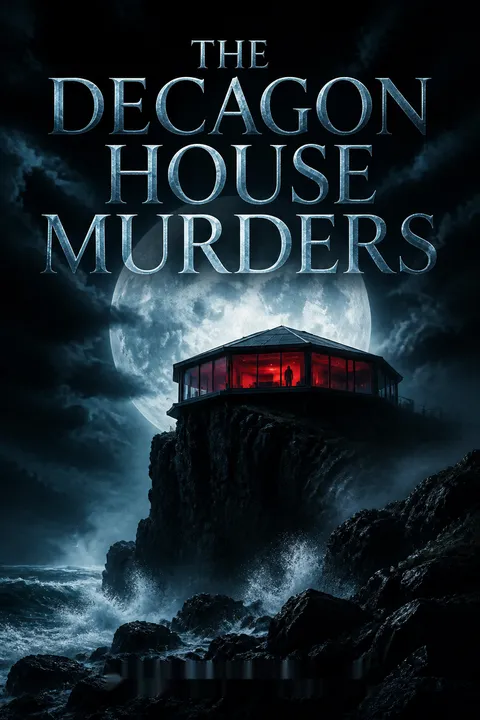
On a dark breakwater, a man hatches an elaborate, flexible scheme, consciously aware that he is no god—only a soul burning with a desire for judgement and retribution. He crafts a confession, sealing it in a green bottle, then surrenders it to the ocean, asking the origin of all life to weigh the morality of his coming crime. He does not deny the madness of his actions—a devouring obsession, not momentary emotion—targeted at those who, in his eyes, are beyond ordinary justice. The trap he sets is not blunt but a slow, theatrical punishment, echoing a classic tale where death strikes one by one. The stage for murder: a decagonal house on an isolated island, soon to be crimson-stained by his vengeance.
The Island's Silent Host
A university Mystery Club, comprising six members and their preparer Van, arrives at the strange Decagon House on remote Tsunojima. Nicknamed after mystery writers—Ellery, Carr, Poe, Leroux, Agatha, Orczy, Van—they banter about detective fiction, sealed mysteries, and the faded romance of logic in modern crime. The island's desolation and recent bloody history—quadruple murder, missing gardener, burned mansion—hang over their arrival. The club settles in, marvels at the oddity of the architecture, and plays at games of intellectual tricks, oblivious to the storm of real murder about to break.
Invitations with Ghosts Attached
Local superstitions—the ghost of Nakamura Seiji, flickering lights, drowned fishermen—are shared half playfully, half seriously with the newcomers. Agatha and Orczy, the only women, reflect on their roles within the group and with each other. Orczy harbors private anxiety about coming, tied to the death of her only close friend, Chiori, once native to the island. The group's mock-detective camaraderie is sharp at the edges: each member harbors jealousy, regret, or resentments, setting a dark emotional substrate beneath their playful logic games and creative ambitions.
Shadows Beneath Blue Mansions
The club explores the burnt-out Blue Mansion, where, six months prior, the Nakamura family and servants were murdered gruesomely—drugged, bound, beheaded, strangled, burned, a hand cut off and missing, and the gardener vanished. Discussion circles between official theory (missing gardener = murderer) and the unsolved enigma of motivation, method, and the vital detail of the missing hand. The story's shadows—family secrets, unfulfilled ambitions, and loss—merge with the students' own rivalries and secrets, blurring the line between fiction and the real, seductive dread pulsating beneath the surface.
The Plates Foretell Murder
On the second morning, someone has arranged seven white plates with red-lettered labels—'Detective,' 'Victim,' 'Murderer,' and more—on the table, mimicking the "And Then There Were None" motif. No one claims responsibility. Their presence sows paranoia, as each suspects the others of either a cruel prank or announcing actual murder. Attempts at rational explanations fail; underlying mistrust boils up, and the club's playful logic turns into icy suspicion. The plates' theatricality both arouses and terrifies, as the group feels the inescapable chills of being inside a story turned true.
Letters From the Dead
Simultaneously, on the mainland, club alumni and a relative of the prior victims receive uncanny letters: "My daughter Chiori was murdered by all of you," signed by the long-dead Nakamura Seiji. Former members, now outsiders—Kawaminami, Morisu, Shimada—connect the dots, rekindling memories of Chiori's alcohol-poisoned death after a club party, and the unsolved island massacre. The mysterious missives, typed and unsigned, inflame conscience, draw old wounds to the surface, and spur private detective inquiries that, while grounded in genre logic and armchair theorizing, point toward fresh calamity.
Discord and Isolation
Arguments and psychological games erupt as Carr and Poe accuse each other—and Van as host—of orchestrating the "game." Agatha cracks under suspicion, Orczy is haunted by guilt and loss, Ellery is calm yet inscrutable, Leroux is overwhelmed by fear. The group, once bound by intellectual play, fractures under suspicion. They strategize about escape—boats, fires, signals—but realize the isolation is complete; their only certainty is their sealed fate, echoing their beloved locked-room mysteries, now made lethal.
The First Victim Falls
The next morning, Orczy is found strangled, her hand hacked off—a gruesome enactment of the prior island killings. Poe, her childhood friend and would-be protector, is devastated; Carr's aggressive insistence on investigation makes him suspect. The group's dynamic collapses into dread—any one could be next, any friend a possible killer. The plates' prophecy comes alive. The neatly arranged body, the surgical removal of the hand, and the echo of literary allusion deepen the sense that someone is staging not just a massacre, but a message.
Poison, Panic, and Accusation
Panic intensifies as Carr collapses and dies, poisoned during a communal coffee. Immediate suspicion falls on Agatha, who prepared the drinks—and on Ellery's sleight of hand. Logical analysis of who handled what only sows further confusion. Van, Poe, and Agatha break down; Ellery methodically prods, inciting paranoia. Each's past motives are scrutinized. All are prisoners of their knowledge, fearful of each other's skills and secrets. The "decagon" motif—cups, rooms, table—becomes sinister, yet holds a buried clue.
The Trap of Decagons
Ellery, nearly killed by a booby trap during a search for a secret room in the Blue Mansion's ruins, becomes the next would-be victim, saved by luck. The group discovers evidence of someone living in the underground spaces, reinforcing the theory of an outside killer or a traitor among them. Rain and fatigue grind down their stamina. Paranoia peaks as Agatha suffers a meltdown, accusing everyone and herself—then, after being soothed by Poe's sleeping tablets, she is found dead, poisoned by lipstick.
Footsteps in the Ash
Leroux is found bludgeoned to death in the ash-laden garden. Ellery, Poe, and Van analyze the muddled footprints in the morning rain, reconstructing the chaos of the scene—a dance of approaches and escapes, two sets of tracks that betray someone arriving by sea, navigating the cliffs, and returning to a hidden base. Their previous hypothesizing becomes more desperate and less certain, as each clue threatens to implicate everything and nothing—no longer a puzzle but a labyrinth without solution.
Dark Motive Revealed
The deadly pattern points back to Chiori's death, the deep trauma that connects the club's survivors to the vengeful mastermind. The police on the mainland, having received the letters and news of the catastrophe, deduce that the killings are both personal and symbolic—a reckoning for a guilt-ridden, alcohol-fueled tragedy that the survivors buried with excuses. Meanwhile, Ellery deciphers the secret of the eleven-sided cup—a key to a hidden underground room, where they discover the skeletal remains of the long-missing gardener, resolving the oldest of the island's mysteries.
The Final Judgement
In the infernal climax, the Decagon House is set ablaze. Poe dies from a poisoned cigarette, leaving only Ellery and Van (Morisu in disguise, the true killer). Ellery, misled by clues and his own intellect, is drugged and consigned to die in a burning room, made scapegoat for the murders. The real murderer—Morisu Kyōichi—escapes the island, his intricate alibi, forged through nights of boating and misdirection, holding. The plan executes not just death, but a narrative of guilt, retribution, and self-justification—his vengeance a story that closes the circle of club, crime, confession, and flame.
Ashes on the Water
Rescue comes too late; investigators recover charred bodies and a half-buried, rotted corpse beneath the house. The massacre's horror and intricacy baffle press and police. Survivors and alumni, including Morisu himself (unbeknownst to all), gather to mourn and debrief. Blame falls on Ellery, carefully framed by the real killer. The truth is buried in ashes and official conjecture, yet ripples of doubt persist—some, like Shimada, suspect deeper layers but lack proof.
Confession to the Twilight Sea
Morisu, alone at dusk on the breakwater, struggles to find solace after his completed revenge. Haunted by visions of Chiori and the finality of loss, he is approached by Shimada, who hints gently at knowing more than he pretends. Morisu, still defended by plausible deniability, wavers between relief and anxiety, until a child hands over a green bottle—the "judgement" he once cast into the sea. The circle is closed; the question of justice, guilt, and redemption is left to eternity.
Analysis
Yukito Ayatsuji's The Decagon House Murders masterfully fuses homage and subversion of the classic locked-room mystery. It is at once a puzzle for the intellect, a psychological autopsy of guilt, and a meditation on the toxic aftermath of unresolved harm. The decagon motif—symbolizing both order and complexity—frames a story in which neat categories (detective, victim, murderer) collapse under pressure, exposing the costs when play becomes reality. Through its structure—interweaving perspectives from within and without—the book challenges the reader's faith in deduction, the reliability of motive, and the redemptive power of confession. It asks whether vengeance can ever restore lost humanity, or if, in seeking judgement, one only deepens emptiness. In the end, the ultimate mystery is not whodunit, but whether there can be absolution when the line between justice and obsession is crossed—and whether truth, like the bottle cast into the sea, ever returns with an answer.
Review Summary
The Decagon House Murders is a Japanese mystery novel that pays homage to Agatha Christie's "And Then There Were None." Seven university students visit an isolated island where murders occurred six months prior. As they're killed one by one, they must solve the mystery. Readers appreciate the clever plot twists and surprising ending, though some find the characters underdeveloped. The novel's translation can feel stilted at times. Overall, it's praised for its puzzle-like nature and intriguing storyline, making it a cult classic in the locked-room mystery genre.
People Also Read
Characters
Morisu Kyōichi (Van Dine)
The true architect of the murders, Morisu's psyche is a storm of grief, rage, and meticulous calculation. Once mild, withdrawn, and creative, Chiori's death at the hands of club insensitivity transforms him into a vessel for vengeance, borrowing both the roles of detective and murderer—a double life wrapped in performative logic, guilt, and self-justification. He orchestrates the entire massacre from within, manipulating clues, framing others, and sealing his alibi with cunning. Morisu's transformation explores how trauma and unresolved loss metastasize into violence; his journey climaxes in existential emptiness, despite "success."
Ellery (Matsu'ura Junya)
The self-styled detective, Ellery is cool, intelligent, and addicted to logic—yet emotionally distant. He anchors the group's intellectual games, unravels partial truths, and suspects a murderer from outside, failing fatally to see his friend's deception. As the final scapegoat, Ellery's tragic flaw is both his pride and his isolation; he is instrumentalized as the club's "deductive hero," then as the vilified culprit. Ellery's story embodies the limits of logic when confronted by trauma, emotion, and deceit. His end is both ironic and pitiable—a detective consumed by the story he cannot control.
Poe (Yamasaki Yoshifumi)
Poe, the bearded medical student, is a voice of rational skepticism, rarely moved to panic even as group dynamics crumble. His childhood friendship with Orczy imbues him with humanity and loyalty, yet he is slow to see danger in time to save her. His medical competence makes him both helpful and suspicious, and he mediates several conflicts, but is ultimately destroyed by trust, a pawn in Morisu's endgame. Poe represents the reliable friend undone by a world that punishes reason and care with betrayal.
Agatha (Iwasaki Yōko)
Outwardly bold, witty, and vivacious, Agatha's self-possession is a fragile armor. Beneath the surface, she is haunted by insecurity, the gendered marginalization within the club, and the horror of being hunted by an unknown killer. Her unraveling under suspicion, culminating in hysterical confession and her own carefully staged murder (poisoned lipstick), demonstrates how fear can strip away constructed identities, and how social roles offer no sanctuary from violence or blame.
Carr (Suzuki Tetsurō)
Perennially disgruntled, Carr relishes conflict and provocation—quick to suspect, quick to accuse, and eager to dig at others' "superior" airs. He embodies the dangers of insincerity and the blindness of a self-declared skeptic unable to see his own descent into paranoia. Carr's death by poisoned coffee is both a literal silencing of the accuser and a symbol of the way distrust feeds the killer's scheme.
Leroux (Higashi Hajime)
The club's next editor-in-chief, Leroux clings to structure, optimism, and group cohesion. His youthful earnestness is unable to withstand the gathering crisis, and his reasonableness is ultimately no defense—the island's horrors annihilate his illusions. Leroux's nervous breakdown and brutal murder underline the fate of innocence amid a dark logic.
Orczy (Ōno Yumi)
Orczy is shy, plump, quiet, yet talented—a sharp contrast to Agatha's flamboyance. Her deep friendship with Chiori, and her uneasy belonging in the club, make her the first target; her sociability is matched by loneliness, introversion, and survivor's guilt. Her death is both calculated mercy (by Morisu) and collateral damage, igniting the club's descent from logic into carnage.
Van (Morisu's cover identity)
As Van, Morisu implements his scheme while feigning illness—his physical withdrawal masking deadly action. He is observer and manipulator, the hidden blade in the heart of the club, always a step ahead of suspicion. Van's layers—of identity, motive, and action—make him the true "decagon" among decagons, a living paradox who fits yet eludes the group.
Kawaminami (Conan Doyle)
A former club member, Kawaminami is driven by curiosity and regret over Chiori's death. He acts as a surrogate "Watson" to the amateur investigations on the mainland, always seeking answers, yet never seeing the plot's heart. His consciousness of his own shallowness and energetic pursuit of clues foreshadow the cost of leaving wounds unexamined.
Shimada Kiyoshi
Shimada, the Buddhist priest's son and amateur sleuth, is an insightful, inspired, but ultimately powerless analyst. His intuition leads to uncomfortable truths about the old island crime and Chiori's family, but he arrives too late to change events, serving as the story's conscience and observer—an embodiment of the gap between knowledge and action.
Plot Devices
Decagon Motif
The decagon—the house, rooms, table, cups—serves not only as a physical setting but as a motif for the layered, recursive structure of the crime. It evokes multiplicity, symmetry, and sealed worlds, visually manifesting the idea of a perfectly calculated "game" in which players are ultimately trapped and destroyed.
Sealed Room/Locked Island
The familiar trope of the "locked-room" mystery is upscaled to the entire island, ensuring no possibility of outside help or escape. This literal and psychological sealing amplifies suspicion, creating a pressure cooker where trust breaks down and violence is both possible and plausible.
Red Herrings and Foreshadowing
False leads—such as the missing gardener, unknown footprints, the possible presence of an external killer, and allusions to past literary mysteries—are layered with genuine hints (the eleven-sided cup, the letters, the origin of the plates). The foreshadowing is both a game for the reader and a commentary on the risk of over-interpreting patterns at the cost of observing intentions.
Dual Timelines
Main chapters alternate between the group's deadly struggle on the island and investigations on the mainland, converging only at the close. This structure provides relief and an outside analytic perspective, yet ironically shows how even knowledge and concern outside the sealed world cannot avert catastrophe inside.
Unreliable Narration and Perspective
Morisu's psychological strategy as Van—and his narrative control—ensures that both characters and readers doubt every conclusion. The story's use of detective fiction jargon, "armchair detecting," and explicit genre references reminds readers that logic is only as good as the sincerity of its performers.
館シリーズ Series
Download PDF
Download EPUB
.epub digital book format is ideal for reading ebooks on phones, tablets, and e-readers.








































