
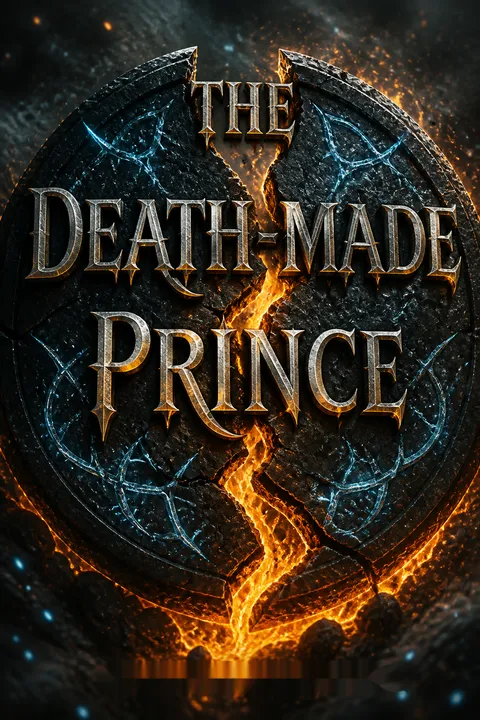


Plot Summary
A Witch Unchains Herself
Thraga1 has spent eight days in a Svein's Creek prison cell, nine hours from the gallows, wearing a dead man's blood in a vial around her neck. When guards shove a tall, one-eyed stranger into her cell — all sharp angles and a carrion crow's stillness — she watches him begin picking his own shackles with a stolen pin.
He's deathmade: a necromancer, the one kind of mage who could bring her dead lover Lark3 back from the afterlife of Niflheim. He sees no use in her until she chokes out words she's hidden her entire life.
She's a runewitch. He demands proof. She curls trembling fingers into the shape of the thorn rune, and the iron shackles around her ankles snap like twigs. The stranger pauses mid-stride at the open door. Then he holds it for her.
The Dead Prince's Bargain
Their escape goes sideways when Thraga1 insists on retrieving all six of her rune-forged knives from the prison storeroom — a compulsive, time-devouring need she cannot override. Fire erupts from the stranger's scarred hands to cover their retreat, revealing curved horns beneath his hood.
He's fireborn, from the royal family that killed Thraga's1 mother. Fleeing on horseback, she spots his signet ring and names him aloud: Durlain Averre,2 supposedly dead third prince, murdered alongside his younger sister Cimmura4 by their half-brothers.
Both returned as deathmade mages. But Cimmura4 remains imprisoned in King Lesceron Garnot's7 dungeons, and Durlain2 cannot breach them without rune magic. His bargain is blunt: help free his sister, and he'll drag Lark3 back from hell.
The Tunnel Behind the Waterfall
A prison guard recognizes Thraga1 outside their inn at Horn's End. Durlain2 and the innkeeper16 lie, swearing she's been their guest for days; every patron backs the story without hesitation. But soldiers are converging.
Thraga1 carves runes into the saddle leather to lighten their weight — her first useful spell in Durlain's2 service — and the horse surges forward with uncanny speed. When he asks which way to ride, she surprises herself: proposing a route through a hidden tunnel behind a waterfall at Moon Lake, a passage she once discovered during a mission for King Aranc.5
The gamble works. They emerge on the far side aimed toward the city of Elenon. It's the first time she's navigated without Lark,3 and Durlain2 follows her lead without a single question.
The Servant and the Heir
In Elenon, Durlain2 assumes the persona of a spoiled nobleman and forces Thraga1 into the role of his servant — the only plausible position for a human woman beside a fireborn lord.
He dines with a Garnot noblewoman to extract intelligence and learns that Kings Lesceron7 and Varraulis8 are negotiating an exchange of unspecified people — potentially involving Cimmura.4 Meanwhile, Thraga1 stumbles into Belloc Estiën,6 Aranc's5 brother and heir. He studies her face with the nagging recognition of a man who's seen a tool many times but never truly examined it.
Durlain2 materializes in the doorway, dripping theatrical drunkenness, dismissing Thraga1 as a peasant girl too stupid to iron his shirts. Belloc6 retreats, but the near-miss accelerates their timeline dangerously.
Why Pollara Died
During the First Fruits festival in Brainne, an Estiën courtier pins Thraga1 against a gallery railing and begins pulling at her clothes. Years of conditioning keep her frozen — fighting only invites worse pain.
Durlain2 arrives bare-fisted and unmasked, beating the man bloody before shoving a ball of fire down his throat and hurling the burning corpse into the revelry below. Carrying Thraga1 to safety, he reveals the truth about Pollara Estiën:13 Aranc5 had demanded fourteen-year-old Cimmura4 as a bride. The wedding between Durlain2 and Pol13 was the exchange.
Durlain2 poisoned Pol13 to destroy the deal, planning to resurrect her later from stored blood. His brothers destroyed that archive during the torture preceding his murder. The monster Thraga1 had cursed was a man who'd been trying to save a child.
Geyser in the Marshes
Jay14 and Rook15 — two of Aranc's5 covert agents called birds — appear at their Brainne inn. In the stables, Thraga1 comes face to face with Jay14 and instinctively silences him with a rune spell, exposing her witch identity to the one person most likely to spread it. They bolt south into the poisoned Brainne marshes, guards in pursuit.
Durlain2 wakes the volcanic fire sleeping beneath the swamp and detonates a geyser: a colossal blast of scalding water and mud that obliterates the pursuing garrison. Jay14 survives — Thraga1 stops Durlain2 from finishing him, for reasons she cannot fully articulate. They emerge filthy and singed on the far side. Aranc's5 people now know their quarry is a witch. The possibility of anonymity has been incinerated.
The Queen Who Spoke Once
Sheltering in a ghost town during a downpour, Durlain2 draws an explicit parallel between Lark3 and his own father. His mother, Queen Izenore,8 believed she loved her husband because he never permitted her to believe otherwise. She criticized him publicly — just once — and was dead within five days.
Durlain2 watched it happen as a twelve-year-old, hidden in a closet with infant Cimmura4 in his arms. Thraga1 insists Lark3 is different, but the comparison cuts to bone: Lark3 discouraged her from navigating, though she knows every ridge and valley.
He claimed credit for a tunnel she discovered first. The one skill no one disputes — her rune magic — is the precise skill he made her too frightened to use. Durlain2 doesn't argue further. The questions alone have left fractures in everything she thought she knew.
Drowning and the Dawn House
At the swollen Svala River, a broken bridge forces Thraga1 to wade across leading the horses. Midstream, she slips and the current swallows her. She blacks out, lungs filling with meltwater.
Durlain2 — whose deathmade scars burn with Niflheim's cold, who risks total shutdown in frigid water — plunges in after her anyway. She wakes in fragments: moonlit riding, strangers' voices, hot cloths pressed to burning skin. Four days of fever pass before she opens her eyes in a pastel-marble bedroom with gold-inlaid floors and rune-carved arches.
She knows this room. She grew up in one exactly like it, in a house that burned when she was five. Durlain2 has brought her to the Dawn House, his aunt Estegonde's10 hidden refuge, protected by ancient runic standing stones.
Two Houses, One Rebellion
Estegonde10 — King Varraulis's8 exiled sister, Durlain's2 effective second mother — reveals that Thraga's1 childhood home was called the Dusk House, a twin to this Dawn House. Both structures were built by leaders of a runewitch resistance movement.
Thraga's1 mother, Gunn, was almost certainly one of those leaders, which explains why Averre's royal guard was dispatched specifically to kill her rather than leaving matters to a local provost. The foster father who raised Thraga1 afterward, a smith named Kjell,12 was likely part of the same network.
His years of teaching her runes were never idle hobby — they were preparation for a fight she was never old enough to understand. Everything Thraga1 believed about her quiet, unremarkable origins crumbles. She is the orphaned daughter of a rebel who died fighting the same kings her own hands have served.
The Portrait in Cimmura's Book
Wandering into Cimmura's4 bedroom at the Dawn House — the twin of her own childhood room — Thraga1 discovers a sketchbook on the desk. Page after page of labeled portraits: courtiers, friends, the dead. She turns a page and the breath leaves her body.
Lark3 stares up at her in colored pencil, golden-haired and grinning, captioned in a girl's careful handwriting as Leif Estridson — a friend of Prince Nalzen. Durlain2 confirms the identification. The man Thraga1 loved was a highborn Averre spy planted at Mount Estiën after Pol's13 death, sent by Varraulis8 to gather intelligence.
Leif had an estate, a noble family, resources to flee at any time — all concealed while he convinced Thraga1 they had nowhere to run. Four years of love were an intelligence operation. She barely reaches the bathroom before she vomits.
Blood Surrendered
Days of grief pass before Thraga1 emerges from her room. A midnight conversation with Errik,11 Estegonde's10 taciturn guard, crystallizes her thinking: she cannot make clear decisions while Lark's3 blood still hangs against her chest, whispering his voice into her every thought.
She finds Durlain2 and asks him to hold the vial. He resists — pointing out she no longer has any reason to help him at all, that she could simply walk away. She tells him she has plenty of reasons. They renegotiate: she'll still rescue Cimmura;4 he'll either revive Lark3 later or find her a safe life, her choice.
Their handshake lingers far longer than business requires. His thumb traces the inside of her wrist. Hers traces back across his ice-cold scars. Neither lets go until the silence between them grows too charged to bear.
Five Days of Almost
Riding south along the Garnot coastline through alien terrain — black sand, purple lakes, luminescent algae — Durlain's2 seduction is as precise as his lockpicking. He remarks on the way she flinches at fire but lights it anyway. Tells her he'd risk worse than a cliff edge to hear her laugh.
Notes that her eyes were the third thing he noticed about her; the first was that she feared life more than death. Each observation peels back a layer she didn't know she was wearing. They sleep in flood huts, play cards by candlelight, argue about whether worlds exist beyond Niflheim.
He never touches her. She discovers, with bewilderment bordering on vertigo, that she is having fun — a sensation so foreign she can barely name it. Then Jay's14 poison bottle appears on the black sand, and they remember Belloc6 is somewhere ahead.
Belloc Dies Twice
Belloc6 and the birds ambush Thraga1 outside their cave and chain her wrists to a wooden bar. He flings each of her six rune-forged knives into a volcano he's commandeered, savoring her screams with every loss.
But Thraga1 manipulates him into boasting — coaxing a full confession that he murdered Queen Izenore on Varraulis's8 behalf while young Durlain2 hid in a closet clutching his baby sister. When Durlain2 returns, having fueled the volcano's fire beyond Belloc's6 control, he pins the Estiën prince in hardening lava and kills him.
Then he tears open a gate to Niflheim, drags Belloc's6 screaming spirit back to life, forces a second confession, and executes him again. He returns Thraga's knives — the volcano had rejected the rune-forged steel, unable to melt it.
Fire Against the Lock
Back in the cave, Thraga's1 compulsive need to check the door lock flares unbearably. Durlain2 doesn't mock her. Instead he asks her to explain what happens in her mind, then refuses to confirm whether the door is locked — making her sit with the fear rather than feeding the cycle.
He keeps his gaze on hers like an anchor. The terror crests but doesn't break her. When it finally begins to ebb, the relief is so staggering she channels it the only direction she can: asking him to distract her.
Their first kiss is less tenderness than mutual combat — biting, grasping, each of them claiming ground. He brings her to a devastating climax but stops before sex, recognizing she doesn't yet know whether she wants him or simply needs to feel alive. The restraint infuriates her. The honesty behind it terrifies her more.
Surrender in the Hot Spring
The next night, Durlain2 admits the truth: caring about her feels like hurtling toward his second death, and he can no longer bring himself to care whether it kills him. Thraga1 tells him she decided days ago that Lark3 isn't coming back — and that his attempts to protect her from himself are just another cage.
In the cave's hot spring, they come together at last: fierce, thorough, nothing held back. Afterward, wrung empty and half-asleep, Durlain2 tries one more time to keep her from Mount Garnot. She refuses.
He extracts one promise: no rune magic inside the palace. King Lesceron7 is a fanatic who will kill any witch discovered in his home, and nothing Durlain2 could do would save her. She promises. The constraint feels manageable in the warm dark. It will not remain so.
Through the Maw
They bluff past Mount Garnot's tunnel guards with a fabricated identity and enter the palace — a stifling labyrinth of volcanic stone. When the dungeon commander demands written authorization, Thraga1 kills the assigned escort with her death knife and they change plans: navigating the lethal fumes outside the palace to slip through a door in the Maw, Lesceron's7 shark-filled execution theatre.
Inside the dungeons, Thraga1 uses rune magic to interrogate a guard and learns Cimmura4 has been moved upstairs to the royal wing. Ascending through the palace corridors, a Garnot noblewoman attacks them with fire.
Thraga's1 hands move before thought catches up — she signs protection runes, shielding them both in a flash of ice. The woman screams one word before Durlain2 silences her permanently: witch. The promise is broken.
The Witch He Promised Away
King Lesceron7 arrives wreathed in volcanic fire, flanked by armored guards. He greets Durlain2 warmly and announces the prince has honored their agreement at last. The original deal — never mentioned to Thraga1 — was to deliver a runewitch in exchange for Cimmura's4 freedom.
Durlain2 protests, demands an amendment, but Lesceron7 simply takes Thraga.1 She meets Durlain's2 wild, desperate eye and calls him a vile liar. In a brief shift to Durlain's2 devastated perspective, Cimmura4 is returned to him — but she confronts her brother about his bargain, steals the vial of Lark's blood from his bag, and vanishes into the night.
Alone in a furnished prison, stripped of her knives, Thraga1 decides she is done being anyone's weapon but her own. When Lesceron7 asks her name, she answers: Kestrel.
Analysis
Lark's3 protection infantilized; Aranc's5 was slavery with extra steps; Durlain's2 begins as mercenary calculation and evolves into something genuinely uncomfortable for him, precisely because he recognizes his own capacity to replicate the pattern he despises.
Thraga's1 OCD — her compulsive knife-checking, lock-testing, and spiraling self-doubt — functions not merely as representation but as the novel's central metaphor. Her compulsions are safety behaviors: she checks and re-checks because trust in her own perception has been systematically eroded. Lark3 did not create her anxiety, but he weaponized its architecture, reinforcing the cycle every time he positioned himself as the only reliable narrator of her reality. The novel's most radical insight arrives through Durlain:2 the checking never satisfies because the doubt was never about knives or locks, but about whether one's own mind can be trusted. His instinctive approach — sitting with discomfort rather than feeding it — mirrors Exposure and Response Prevention, the evidence-based treatment for OCD.
The fireborn-runewitch power dynamic maps onto structures of colonial occupation: a conquering force justifying its rule through genuine service (keeping the ice at bay) while systematically erasing indigenous knowledge and claiming moral superiority after its opponents' worst atrocity. That Thraga1 herself was weaponized by this system — forced to deliver violence against her own people — gives the political allegory visceral, personal weight.
Most strikingly, the novel refuses to let its heroine's growth depend on finding a better man. Durlain2 catalyzes Thraga's1 transformation not by offering a prettier cage but by systematically demonstrating that the cage existed — then demanding she dismantle it herself. His climactic betrayal becomes the ultimate test of whether she internalized the lesson or merely transferred her dependency to a new protector.
Review Summary
The Death-Made Prince has captivated readers with its unique blend of dark fantasy, slow-burn romance, and complex characters. Thraga, a rune witch with OCD, and Durlain, a sarcastic necromancer prince, embark on a perilous journey filled with magic, political intrigue, and personal growth. Reviewers praise the witty banter, well-developed world-building, and authentic representation of mental health. The slow-burn enemies-to-lovers dynamic and unexpected plot twists keep readers engaged throughout. Many describe it as a refreshing take on the romantasy genre, eagerly anticipating the sequel after the book's shocking cliffhanger ending.
People Also Read
Characters
Thraga
Runewitch on the runA runewitch raised in secret by a smith named Kjell12 after her mother was killed by Averre soldiers. Trained as one of King Aranc's5 covert assassins — called birds — she spent seven years executing the king's dirty work while hiding her runic powers. She carries six rune-forged knives and compulsively checks them, along with locks and doors, in patterns she cannot control. Beneath her self-deprecation lies formidable intelligence and lethal skill, though years of being told she needs protection have convinced her otherwise. Her deepest wound isn't the violence she's endured but the way it taught her to distrust her own judgment. What drives Thraga is the need to be seen as herself — not as someone's tool, possession, or rescue project.
Durlain Averre
The deathmade prince of masksThird Prince of Averre, both fireborn mage and deathmade necromancer — an impossible combination born from being murdered by his own half-brothers and sent back by Death himself. He lost his left eye as a child for freeing one of his father's prisoners, and cannot bear to see his own reflection. Cold, cutting, and fluent in deception, he cycles through false identities the way others wield swords, so effortlessly that even allies wonder which face is real. Beneath every mask lives a fierce, damaged protector who has spent sixteen years keeping his younger sister4 alive at appalling personal cost. He distrusts sentiment not because he lacks it, but because every time he's shown vulnerability, someone has weaponized it against what he loves.
Lark
Thraga's dead loverThraga's1 dead lover, whose blood she carries in a vial around her neck. Charming, golden-haired, and seemingly selfless, he died fighting the soldiers who pursued their escape from Mount Estiën. In life, he positioned himself as Thraga's1 protector and navigator, handling all the tasks he insisted she couldn't manage. His warmth and patience made him the only person she trusted completely — yet the foundations of that trust, and the full story of who he truly was, become central questions as the narrative unfolds.
Cimmura
Durlain's imprisoned sisterDurlain's2 younger sister, also killed by their half-brothers and returned as deathmade. Imprisoned in King Lesceron's7 dungeons as political leverage, she is the single fixed point around which Durlain's2 every action orbits. Though she appears mainly through his protective descriptions, her drawings, her reported resilience at Mount Garnot, and the fierce loyalty she inspires suggest a perceptive young woman developing her own sharp moral compass — one that may not always align with her brother's ruthless pragmatism.
King Aranc Estiën
Thraga's former masterKing of Estiën, who discovered Thraga's1 witch powers and forced her into service through threats of execution. Violent, calculating, and capable of both explosive rage and chilling calm, he treats people as instruments. His shadow reaches across the entire narrative even though he never appears directly — his agents, his methods, and the fear he instilled shape every decision Thraga1 makes.
Belloc Estiën
Aranc's brother and heirAranc's5 brother and heir to the Estiën throne. Bullish, cruel, and shrewder than he appears, he represents the physical embodiment of Estiën's power — all brawn and entitlement, with a hunter's patience. He vaguely recognizes Thraga1 at their first meeting and pursues her with increasing determination across kingdoms, driven by both political duty and a personal appetite for dominance.
King Lesceron Garnot
Serpentine king of GarnotKing of Garnot, whose palace is built into a toxic, lava-flowing volcano. Skeletal and softly spoken, he projects authority through quiet menace rather than Aranc's5 explosive violence. A fanatic about witchcraft, he maintains the tightest surveillance of any fireborn king. His court is built on poison, information, and the omnipresent threat of his shark-filled execution theatre, the Maw.
King Varraulis Averre
The Thrice-Dead KingThe Thrice-Dead King of Averre, who has died and returned three times, defying the supposed natural limit of one resurrection. Father to Durlain2 and Cimmura4, he is the silent architect of much of the story's suffering: his court politics drove the murders, marriages, and alliances that shaped every major character's fate. He rules through strategic cruelty and exquisite plausible deniability.
Hevaine
Thief turned intelligence brokerA former thief turned intelligence broker, married to a deserting Averre general. Theatrical, jewel-draped, and disarmingly cheerful, she runs an information network from her husband's sprawling estate. She once worked for Durlain2 after he caught her stealing his sister's4 jewellery. Her loyalty is transactional but genuine — she helps at market rate and never for free, yet her warmth toward Cimmura4 hints at a softer core beneath the glittering performance.
Estegonde
Durlain's exiled royal auntVarraulis's8 sister, who fled Mount Averre after being accused of plotting against the throne. Elegant, composed, and unflappable, she lives in the Dawn House with her guard Errik11 and the ghostly presence of her former nursemaid. She loves Durlain2 deeply but does not fully trust him — a tension rooted in his resemblance to their father's methods and her own traumatic departure years ago without warning.
Errik
Estegonde's steadfast guardEstegonde's10 human guard. Silver-haired, taciturn, and devastatingly competent. His calm, patient wisdom provides a crucial counterpoint to Durlain's2 intensity, and his rare words tend to land with surgical precision.
Kjell
Thraga's foster fatherThraga's1 foster father, a runewitch smith who raised her after her mother's death. He forged her six rune knives, taught her everything about fighting and magic, and died in a witch's execution when she was thirteen.
Pollara
Aranc's murdered nieceAranc's5 niece, betrothed to Durlain2. Kind, fearless, and beloved by servants and nobles alike, she once secured Thraga1 her own room at the Estiën court. Her death reverberates through every relationship in the story.
Jay
Aranc's boyish knife-throwerOne of Aranc's5 bird agents. Small, blond, and boyish, with a gutter accent that belies his lethal precision with throwing knives and poisons.
Rook
Aranc's all-knowing trackerAnother of Aranc's5 birds. Tall, burn-scarred, and stoic, he absorbs information like porous stone and speaks only when ready to act on it.
Hedda
Loyalist innkeeper at Horn's EndInnkeeper at the Ash and Elm. Sturdy, maternal, and fearlessly loyal to those she considers friends, including Durlain2 despite his fireborn heritage.
Plot Devices
The Vial of Lark's Blood
Key to resurrection and freedomA small glass vial containing the blood of Thraga's1 dead lover, worn on a leather cord around her neck. In a world where deathmade mages can only resurrect souls whose bodily remains they possess, this vial represents Thraga's1 entire reason for surviving — and later, her greatest emotional burden. It begins as motivation (find a necromancer, bring Lark3 back), evolves into a symbol of dependency (his presence whispering in her thoughts), and becomes the object around which her liberation crystallizes when she surrenders it to Durlain2. The vial changes hands three times across the story, each transfer marking a seismic shift in allegiance, trust, and self-determination.
Thraga's Six Rune Knives
Identity, magic, and compulsionSix blades forged by Kjell12, each inscribed with a different rune granting a distinct magical property: Ehwaz (speed), Uruz (strength), Isa (ice), Kaunan (fire), Wunjo (runic inscription work), and Eihwaz (death on contact). They are simultaneously Thraga's1 weapons, her magical tools, and the primary focus of her compulsive checking behavior. She cannot stop verifying they're still on her body, cycling through each name and location dozens of times a day. The knives externalize her OCD: the ritual of checking provides temporary relief that immediately demands repetition. Their destruction by Belloc6 and miraculous recovery represent both her worst fear realized and the discovery that she can survive losing them.
Durlain's Spelled Eyepatch
Disguise through collaborative magicAn eyepatch enchanted by Thraga1 with a complex sequence of rune magic that creates the illusion of a functional second eye. Its creation marks a turning point in their partnership — the first time Thraga's1 rune expertise and Durlain's2 need for disguise produce something neither could achieve alone. The patch enables Durlain2 to travel unrecognized, cycle through false identities, and bluff past hostile guards. It also symbolizes the intersection of their respective powers: fireborn magic burns and destroys, while rune magic can create, conceal, and transform. Later upgraded with additional runes to alter his entire facial appearance, the eyepatch becomes essential to the Mount Garnot infiltration.
The Dawn and Dusk Houses
Heritage hidden in architectureTwin houses built by the runewitch resistance, each protected by eight standing stones inscribed with sophisticated runic shielding spells that render the buildings invisible to anyone who doesn't already know they exist. Thraga1 grew up in the Dusk House until Averre soldiers burned it; Durlain's2 aunt Estegonde10 inhabits the surviving Dawn House. The architecture is identical — carved marble, gold-inlaid birchwood, spelled glass windows that filter sunlight into impossible colors. When Thraga1 wakes in the Dawn House and recognizes every room, the discovery recontextualizes her entire origin: she isn't a random witch's orphan but the daughter of resistance leaders, raised in a structure built to shelter the movement's most important members.
Durlain's Deal with Lesceron
The hidden price of rescueBefore the events of the story, Durlain2 struck a bargain with King Lesceron7: deliver a runewitch in exchange for Cimmura's4 freedom. This arrangement is the secret engine driving Durlain's2 recruitment of Thraga1, his insistence that she promise not to use rune magic inside the palace (to protect her from discovery), and his increasingly desperate attempts to find alternative solutions as he grows to care for her. The deal is never mentioned to Thraga1 until Lesceron7 reveals it during their confrontation inside Mount Garnot. It retroactively reframes every protective gesture Durlain2 made — each kindness tainted by the knowledge that he originally intended to trade her life for his sister's.
About the Author

Download PDF
Download EPUB
.epub digital book format is ideal for reading ebooks on phones, tablets, and e-readers.








































