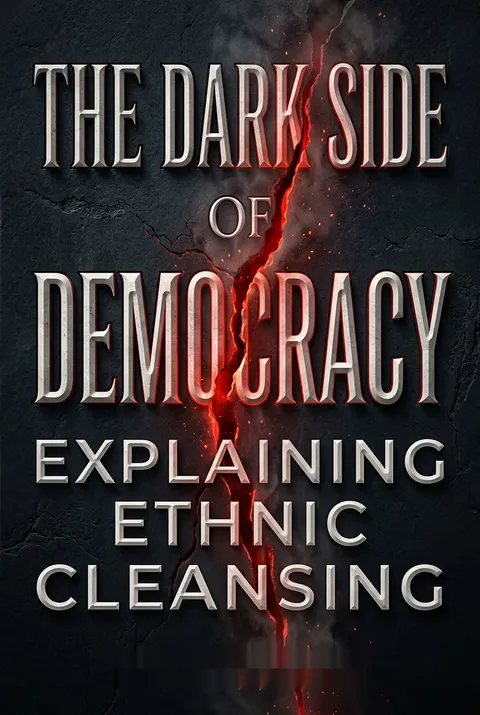

Key Takeaways
1. Modernity's Dark Side: Democracy's Perversion into Ethnic Cleansing
murderous ethnic cleansing has been a central problem of our civilization, our modernity, our conceptions of progress, and our attempts to introduce democracy. It is our dark side.
A modern phenomenon. Ethnic cleansing, while not entirely new, became more frequent and deadly in modern times, particularly in the 20th century, claiming over 70 million lives through ethnic conflict. This surge is intrinsically linked to the rise of the nation-state and the democratic ideal of "rule by the people," transforming warfare to increasingly target entire populations.
Democracy's dual meaning. The danger arises when "the people" (demos) is confused with "the ethnic group" (ethnos). If a nation-state is defined in ethnic terms, the majority can tyrannize minorities, leading to their exclusion or removal. This perversion of democratic ideals, where ethnic unity outweighs citizen diversity, is a hallmark of modern murderous cleansing.
Perpetrators are not alien. The individuals who commit these atrocities are not inherently evil or primitive; rather, they are ordinary people shaped by conflicts inherent to modernity. These conflicts, often involving unexpected escalations and frustrations, force individuals into moral choices that can lead to terrible outcomes, revealing a dark capacity within civilization itself.
2. Ethnicity Trumps Class in the Danger Zone
Murderous cleansing does not occur among rival ethnic groups who are separate but equal. Mere difference is not enough to generate much conflict. It is not Christians against Muslims that causes problems, but contexts in which Muslims feel oppressed by Christians (or vice versa).
Hierarchy, not just difference. Ethnic conflict escalates to murderous cleansing not from mere cultural or historical differences, but from perceived hierarchies and exploitation. When one ethnic group views itself as materially exploited by another, or as a "proletarian nation" oppressed by an "imperial nation," the conflict intensifies.
Class sentiments rechanneled. Historically, class divisions often overshadowed ethnic identities in large societies. However, in modern contexts, particularly during struggles for democracy or national liberation, class resentments can be captured and redirected towards ethnonationalism. This rechanneling makes ethnic identity a potent mobilizer, especially when intertwined with economic grievances or claims of historical injustice.
Sovereignty claims ignite. The "danger zone" for murderous cleansing is reached when two established ethnic groups both lay claim to their own state over the same territory. These claims must appear legitimate and achievable to both sides, transforming abstract ethnic differences into a zero-sum struggle for political control and survival.
3. The Brink: Power Imbalance and External Intervention
The brink of murderous cleansing is reached when one of two alternative scenarios plays out. (4a). The less powerful side is bolstered to fight rather than to submit (for submission reduces the deadliness of the conflict) by believing that aid will be forthcoming from outside – usually from a neighboring state, perhaps its ethnic homeland state... (4b) The stronger side believes it has such overwhelming military power and ideological legitimacy that it can force through its own cleansed state at little physical or moral risk to itself.
Two paths to escalation. Conflict intensifies to the brink of mass murder under specific conditions of power imbalance. Either a weaker group, facing subjugation, chooses to fight due to perceived external support from a homeland state or allies, or a stronger group, confident in its overwhelming military and ideological superiority, believes it can achieve its goals with minimal risk.
Interactions are key. These scenarios highlight that escalation is not a unilateral act but a complex interaction between perpetrator and victim groups, often involving external actors. The perception of strength or weakness, and the belief in external backing, can transform a tense situation into a violent confrontation, as seen in Yugoslavia where external aid emboldened weaker factions.
Preemptive strikes. The stronger side's belief in its invincibility can lead to preemptive strikes, aiming to neutralize a perceived future threat. This was evident in colonial settler cases, where Europeans, with superior military technology, felt justified in displacing or eliminating native populations, and in the Nazi regime's actions against Jews, whom they falsely believed were conspiring with external enemies.
4. State Fragmentation Fuels Radicalization
Going over the brink into the perpetration of murderous cleansing occurs where the state exercising sovereignty over the contested territory has been factionalized and radicalized amid an unstable geopolitical environment that usually leads to war.
Weakened state, heightened risk. A state's inability to maintain internal cohesion and control is a critical factor in the escalation to murderous cleansing. When a state is deeply divided by factions and operates within an unstable international environment, particularly during wartime, it becomes vulnerable to radical elements.
Radicals seize opportunity. In such fragmented states, moderate voices are sidelined, and radical factions gain influence, advocating for harsher measures against perceived ethnic enemies. These radicals exploit the crisis to push their agendas, often portraying their extreme actions as necessary for national survival or defense, as seen in the Young Turks' radicalization during World War I.
Beyond failed states. While "failed states" are often associated with civil conflict, murderous cleansing is typically directed by states that retain some coherence and capacity, albeit radicalized ones. This allows for organized, albeit often chaotic, implementation of violent policies, distinguishing it from anarchic violence.
5. Genocide's Twisted Path: Unintended Escalation from Milder Plans
Murderous cleansing is rarely the initial intent of perpetrators. It is rare to find evil geniuses plotting mass murder from the very beginning. Not even Hitler did so.
Evolution of intent. Mass murder seldom begins as a premeditated, singular plan. Instead, it typically emerges as a "Plan C," a more extreme response developed after initial, milder strategies fail. These initial strategies, often involving compromise or straightforward repression (Plan A), followed by more radical repression (Plan B), are frustrated by unforeseen resistance or geopolitical shifts.
Contingent escalations. The path to mass murder is often circuitous and contingent, rather than a direct, logical progression. Perpetrators, facing unexpected obstacles, feel "forced" into escalating their actions, leading to a series of choices that gradually push them towards more terrible outcomes. This was evident in the Armenian genocide, where the "final solution" to the Armenian problem appeared more contingent than pre-planned.
Moral discomfort and justification. This evolutionary process can be morally uncomfortable, as it suggests that extreme suffering might arise from a series of unintended consequences. However, perpetrators often rationalize their actions as historically necessary or as self-defense, believing they are overcoming obstacles with increasingly radical means, as seen in the justifications offered by Nazi and Young Turk leaders.
6. Perpetrators: A Spectrum from Elite Planners to Ordinary Killers
ordinary people are brought by normal social structures into committing murderous ethnic cleansing, and their motives are much more mundane.
Beyond "evil elites." Mass atrocities are not solely the work of malevolent leaders or "primitive peoples." They result from complex interactions among radical elites who formulate policy, militant groups who execute violence, and "core constituencies" who provide popular support. This multi-layered involvement means blame cannot be placed on a single group.
Mundane motivations. The motivations of perpetrators are often surprisingly ordinary, ranging from career advancement and material gain (looting) to fear, conformity, and a desire for comradeship. These "mundane murderers" are not necessarily disturbed individuals but are integrated into social structures that normalize violence and diffuse individual responsibility.
Social structures as "cages." Perpetrators are often "caged" within specific social structures—like paramilitary organizations, concentration camps, or state bureaucracies—that foster loyalty, discipline, and a shared ethos. These environments can transform casual prejudices into active participation in violence, making it difficult for individuals to resist or dissent without risking their careers, social standing, or even their lives.
7. Colonialism's Brutal Legacy: Settler Democracies as Early Genocidal Actors
In modern colonies, settler democracies in certain contexts have been truly murderous, more so than more authoritarian colonial governments.
Democracy for the ethnos. The earliest and most successful instances of murderous cleansing occurred in settler democracies like the United States and Australia. These regimes, while democratic for their European settlers, were ethnocracies that excluded and dehumanized indigenous populations. The settlers, often acting with de facto local control, pursued policies of displacement and extermination.
Land and labor conflicts. A primary driver of this violence was direct economic conflict over land, particularly where settlers did not require native labor. Indigenous hunter-gatherer societies, needing vast territories, clashed fundamentally with European agricultural and pastoral expansion. This often led to ethnocide through disease and starvation, exacerbated by deliberate killings and forced removals.
Ideological insulation. Settlers justified their actions through ideologies of "civilization versus barbarity" and later, racial superiority. This ideological framework, combined with overwhelming military power and a lack of effective external restraint, insulated perpetrators from moral qualms, allowing for widespread, often unplanned, "rolling genocides" that decimated native populations.
8. Communist Cleansing: Class War with Ethnic Undertones
To neglect either ethnicity or class is mistaken. Sometimes one or the other may come to dominate, but this will involve the capturing and channeling of the other.
Class as the primary enemy. Communist regimes, particularly Stalin's USSR, Mao's China, and Pol Pot's Cambodia, primarily targeted "class enemies" rather than ethnic groups. Their ideology defined "the people" as the proletariat, justifying the elimination of opposing classes through politicide (killing political opponents) and classicide (killing entire social classes).
Mistaken revolutionary projects. Most deaths under these regimes resulted from disastrous "mistaken revolutionary projects," such as forced collectivization and rapid industrialization, which led to widespread famine and disease. When these policies failed, the blame was often shifted to "saboteurs" or "traitors," escalating into deliberate killings and callous disregard for human life.
Ethnic and national channeling. Despite their class-centric ideology, Communist movements often acquired nationalist credentials by resisting foreign enemies, leading to a fusion of class and national identities. This sometimes resulted in ethnic cleansing, as seen in Stalin's deportations of "disloyal" nationalities or the Khmer Rouge's targeting of ethnic minorities perceived as foreign agents, demonstrating how class conflict could channel and be channeled by ethnonationalism.
9. The Role of Ideology: Dehumanization and Righteous Rage
The killer protests that he is really the victim.
Dehumanization as a precursor. A critical step in enabling mass murder is the dehumanization of the victim group. Perpetrators, whether nationalist or communist, consistently label their enemies as "vermin," "cockroaches," "microbes," or "subhuman." This ideological framing strips victims of their humanity, making it easier to overcome moral inhibitions against killing.
Righteous rage and self-defense. Perpetrators often justify their actions as righteous self-defense, believing they are protecting their own community from an existential threat. This narrative, fueled by a sense of humiliation and anger, transforms murder into a moral imperative. The "killer protests that he is really the victim," a psychological inversion that allows for extreme violence.
Ideology's pervasive influence. Ideology, whether racial, nationalist, or class-based, provides the overarching framework that legitimizes atrocities. It permeates propaganda, shapes perceptions of the enemy, and offers a "higher purpose" that can override individual moral qualms. This ideological rigor, particularly among elites, helps sustain the killing process even when it is economically or militarily irrational.
10. Preventing Escalation: Stable States and Cross-Communal Ties
In cases where states and geopolitics remain stable, even severe ethnic tensions and violence tend to be cyclical and manageable at lesser levels of violence.
Stability as a deterrent. The most effective antidote to murderous ethnic cleansing is the presence of stable, institutionalized states that can effectively manage ethnic tensions. Where state institutions are robust and not prone to fragmentation or radicalization, they can intervene decisively to repress violence, enforce order, and prevent local conflicts from escalating into mass atrocities, as often seen in India's riot cycles.
Cross-communal ties. Strong cross-ethnic social and political ties within civil society are crucial for defusing conflict. In communities where associations, political parties, and professional groups span ethnic divides, they can act as mediators, challenge rumors, and promote dialogue, preventing the "information failure" and "security dilemmas" that fuel escalation.
International engagement. External geopolitical stability and international intervention can also play a vital role. International pressure, aid conditionality, and the threat of intervention can restrain states from pursuing extreme policies. However, intervention is often selective and can be counterproductive if it exacerbates existing conflicts or is perceived as biased, as seen in the complexities of the "war against terrorism."
Review Summary
The Dark Side of Democracy receives a 4.06/5 rating with polarized reviews. Readers praise Mann's materialist analysis linking ethnic cleansing to democratization, examining cases from Armenia to Rwanda through an eight-thesis framework. Supporters appreciate his clinical approach and comprehensive historical coverage. Critics fault factual errors, omissions regarding German expulsions and Hungarian events, and misleading connections between democracy and genocide. Some find the theoretical framework insufficient, while others value the perpetrator/victim categorizations. Translation quality in non-English editions reportedly varies. Overall, readers consider it informative but debate its analytical rigor and completeness.
People Also Read
About the Author
Other books by Michael Mann
Download PDF
Download EPUB
.epub digital book format is ideal for reading ebooks on phones, tablets, and e-readers.








































