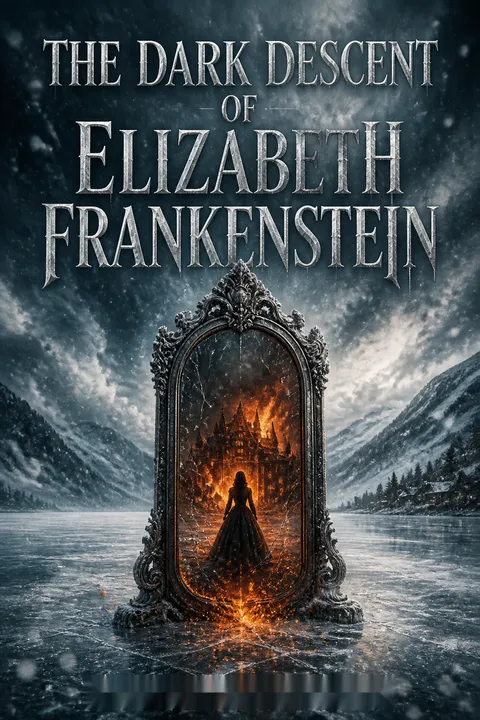

Plot Summary
Lightning Over Lake Como
Elizabeth Lavenza, a young woman marked by hardship, travels with her friend Justine to Ingolstadt, seeking Victor Frankenstein, her childhood savior and the center of her world. As lightning splits the sky, Elizabeth recalls her first meeting with Victor, when she was a bruised, hungry child taken from poverty to be his companion. The storm outside mirrors the turmoil within: Elizabeth's need for security, her fear of being cast out, and her determination to reclaim her place in the Frankenstein family. The journey is not just physical but emotional, as Elizabeth steels herself to do whatever it takes to keep Victor—and her own future—safe.
The Gifted Companion
Elizabeth's childhood is shaped by her role as Victor's "gift," a companion meant to soothe his volatile nature. She learns to read his moods, to be what he needs, and to survive by pleasing those in power. Her beauty and adaptability become her tools. Victor, brilliant but troubled, is both her protector and her charge. Their bond is forged in shared secrets and mutual dependence, but it is also fraught with manipulation and unspoken expectations. Elizabeth's identity becomes inseparable from Victor's, setting the stage for a lifetime of sacrifice and self-effacement.
Survival and Manipulation
Elizabeth's survival depends on her ability to manipulate those around her. She rescues Justine from an abusive home, not just out of compassion but to secure an ally and further her own position. Elizabeth's stories are crafted for effect, her emotions carefully performed. She is acutely aware of her precarious status in the Frankenstein household, always at risk of being deemed unnecessary. Her relationship with Victor is both genuine and transactional, a delicate dance of affection, need, and self-preservation. The lines between love and survival blur, as Elizabeth becomes an expert in the art of being indispensable.
Victor's Obsessions Unleashed
Victor leaves for university, and his absence destabilizes Elizabeth's world. In Ingolstadt, Victor's obsession with conquering death and controlling nature grows unchecked. He isolates himself, driven by a feverish pursuit of forbidden knowledge. Elizabeth, sensing his unraveling, embarks on a quest to find him, accompanied by Justine. The city is cold and unwelcoming, and Victor's trail is elusive. Elizabeth's search is as much about reclaiming her own security as it is about saving Victor. The darkness gathering in Victor's mind foreshadows the horrors to come.
The Search in Ingolstadt
Elizabeth and Justine navigate the labyrinthine city, following clues from professors, landlords, and booksellers. Their journey is marked by frustration, fear, and the growing realization that Victor has changed. They encounter Mary, a perceptive bookseller who aids their search. The city's undercurrents of violence and secrecy mirror Victor's own descent. When Elizabeth finally finds Victor, he is feverish and delirious, haunted by the consequences of his experiments. The reunion is bittersweet, as Elizabeth senses that the Victor she knew is slipping away, replaced by someone she cannot fully understand or control.
Justine's Rescue and Bond
Elizabeth's rescue of Justine cements a deep, sisterly bond between them. Both are survivors of abuse, finding solace and strength in each other. Justine becomes the beloved governess to Victor's younger brothers, bringing warmth and stability to the household. Her goodness is a stark contrast to Elizabeth's calculated nature, yet their friendship is genuine. Justine's presence allows Elizabeth to share the burdens of care and to experience a rare, unconditional love. But this happiness is fragile, threatened by the darkness lurking in Victor and the secrets Elizabeth keeps.
The Monster's Shadow
Victor's creation—a being stitched from corpses and animated by forbidden science—casts a long shadow over the family. Murders begin: first young William, then the framing of Justine. Elizabeth is wracked with guilt, believing her actions have set these tragedies in motion. The monster, misunderstood and rejected, becomes both a symbol of Victor's hubris and a real, stalking threat. Elizabeth's world unravels as she loses those she loves, her sense of safety shattered. The monster's vengeance is relentless, and Elizabeth's complicity—witting or not—haunts her every step.
The Price of Protection
Elizabeth's lifelong mission to protect Victor comes at a devastating cost. She manipulates, lies, and even destroys evidence to shield him from the consequences of his actions. But as the body count rises, the weight of her choices becomes unbearable. Justine's execution, in particular, marks a turning point: Elizabeth's attempts to save others only lead to more suffering. She is forced to confront the limits of her loyalty and the moral compromises she has made. The line between victim and accomplice blurs, and Elizabeth's identity fractures under the strain.
Betrayal and Madness
After a failed attempt to confront Victor and stop his experiments, Elizabeth is betrayed and committed to an asylum. Victor's possessiveness and madness are fully revealed: he sees Elizabeth as his creation, destined to be remade in his image. The asylum is a microcosm of the world that punishes women for defiance and independence. Elizabeth's time there is marked by despair, self-examination, and the gradual realization that she must reclaim her agency. With the help of Mary, who infiltrates the asylum, Elizabeth escapes, determined to end Victor's reign of terror.
The Asylum's Cage
In the asylum, stripped of her roles and performances, Elizabeth confronts the truth of her life. She is forced to ask who she is without Victor, without the need to please or protect others. The stories she told herself and others unravel, leaving her raw and uncertain. Yet, in this crucible, Elizabeth finds a new strength—a resolve to act not out of fear or obligation, but out of conviction. The bonds of sisterhood, forged with Mary and the memory of Justine, become her new foundation. Elizabeth emerges from the asylum transformed, ready to face Victor and her own past.
Truths and Transformations
Elizabeth, Mary, and the monster—now revealed to be a composite of those Victor destroyed—converge for a final reckoning. The monster, more human than his creator, seeks understanding and peace. Victor, consumed by his quest for control, is exposed as the true villain. Elizabeth's confrontation with Victor is both personal and symbolic: she rejects his claim over her, refuses to be remade, and asserts her own will. The lines between creator and creation, victim and perpetrator, blur. In the chaos, Elizabeth chooses her own fate, breaking free from Victor's grasp.
Burning Down the Past
Elizabeth, Mary, and the monster set fire to the Frankenstein estate, erasing the physical and symbolic remnants of Victor's tyranny. The act is both cathartic and tragic—a funeral pyre for lost innocence, love, and the old order. The fire is a cleansing force, but it cannot undo the past or resurrect the dead. As the flames consume the house, Elizabeth mourns what was lost but also embraces the possibility of a new beginning. The trio—an unlikely family forged in suffering—prepare to leave, pursued by Victor's vengeful obsession.
A New Family Forged
On the run, Elizabeth, Mary, and the monster—now named Adam—form a new kind of family, bound not by blood but by shared trauma and mutual support. They travel across Europe, seeking refuge and meaning. Elizabeth, freed from her old roles, begins to discover who she is and what she wants. Mary's intelligence and resourcefulness provide stability, while Adam's struggle for acceptance and identity mirrors Elizabeth's own journey. Together, they find moments of joy and connection, even as Victor's shadow looms. Their bond is a testament to resilience and the power of chosen family.
Pursuit Across the Ice
Victor, obsessed with reclaiming Elizabeth and eradicating Adam, pursues them across frozen landscapes. The chase is both literal and metaphorical—a battle between the old world and the new, between control and freedom. Elizabeth refuses to be a passive victim, using her wits and courage to stay ahead. The journey is grueling, testing the limits of endurance and loyalty. As they near the polar wastes, the final confrontation becomes inevitable. The ice, vast and indifferent, is both a barrier and a crucible, stripping away all but the essential truths of each character.
The Final Confrontation
In a final, desperate encounter, Victor corners Elizabeth, intent on remaking her or destroying her. Elizabeth, drawing on all she has learned, refuses to submit. In a moment of clarity and sacrifice, she chooses her own death over Victor's control, pulling him into the icy depths with her. Adam and Mary, left behind, mourn but also recognize the significance of Elizabeth's choice. Victor's reign of terror ends, not with triumph, but with the loss of everything he sought to possess. The cycle of violence is broken, and the survivors are left to forge a new path.
Freedom and Rebirth
Elizabeth awakens—alive, transformed, and free. Rescued by Mary and Adam, she is no longer defined by her past or by Victor's designs. The trio, battered but unbroken, look to the future with hope and determination. They are a family of survivors, united by love, loss, and the refusal to be defined by others' expectations. The story ends not with vengeance or despair, but with the possibility of healing and self-discovery. Elizabeth, at last, is her own creation.
Analysis
Kiersten White's The Dark Descent of Elizabeth Frankenstein is a radical reimagining of Mary Shelley's classic, shifting the narrative focus from the ambitious scientist to the woman whose life is shaped—and nearly destroyed—by his obsessions. Through Elizabeth's eyes, the novel interrogates themes of survival, complicity, and the search for agency in a world that values women only as objects or caretakers. The story is both a Gothic thriller and a psychological study, using the conventions of horror to explore the costs of self-effacement and the dangers of unchecked ambition. By centering female experience, White exposes the ways in which women are forced to perform, manipulate, and sacrifice to survive in patriarchal systems. The monster, reimagined as a victim and a seeker of belonging, becomes a symbol of the consequences of neglect and the possibility of redemption. Ultimately, the novel is a story of transformation: of burning down the past, forging new bonds, and claiming the right to define oneself. In a modern context, it speaks to the ongoing struggle for women's autonomy, the importance of chosen family, and the necessity of confronting the monsters—both within and without—that shape our lives.
Review Summary
People Also Read




Characters
Elizabeth Lavenza
Elizabeth is the protagonist and emotional core of the story, a woman shaped by trauma, survival, and the need to be loved. Adopted as a child to be Victor's companion, she learns to read people, to perform whatever role is required, and to manipulate situations for her own security. Her relationship with Victor is complex—part love, part dependence, part rivalry. Elizabeth's journey is one of self-discovery: from a girl who exists only for others, to a woman who claims her own agency. Her guilt over the consequences of her actions, especially regarding Justine and the monster, drives her to seek redemption. Ultimately, Elizabeth's greatest act is to break free from Victor's control, choosing her own fate and forging a new identity beyond the roles imposed on her.
Victor Frankenstein
Victor is both Elizabeth's savior and her captor, a man whose genius is matched only by his arrogance and emotional instability. From childhood, he is marked by a need to control and understand the world, leading him to the forbidden act of creating life. Victor's love for Elizabeth is possessive and conditional; he sees her as his creation, meant to complete and obey him. His inability to accept limits—moral, natural, or emotional—leads to tragedy. Victor's descent into madness is both personal and symbolic, representing the dangers of unchecked ambition and the refusal to accept responsibility. In the end, Victor is undone by his own creations, both literal and metaphorical.
Justine Moritz
Justine is Elizabeth's closest friend and emotional opposite: open-hearted, nurturing, and genuinely good. Rescued from abuse by Elizabeth, she becomes the beloved governess to the Frankenstein children. Justine's kindness and devotion make her a target for the family's misfortunes. Framed for William's murder, she becomes a scapegoat for Victor and Elizabeth's failures. Her execution is a turning point, shattering Elizabeth's illusions and forcing her to confront the cost of her loyalty. Justine's memory haunts Elizabeth, serving as both a source of guilt and a model of unconditional love.
Henry Clerval / Adam (the Monster)
Henry is Victor's childhood friend, a gentle and idealistic soul who becomes collateral damage in Victor's quest for greatness. In this retelling, elements of Henry's identity are fused with the monster, Adam—a being created from the bodies of the dead, rejected by his creator, and doomed to loneliness. Adam's journey mirrors Elizabeth's: a search for acceptance, identity, and love. His violence is born of rejection and pain, not inherent evil. Adam's relationship with Elizabeth and Mary becomes a source of healing and hope, as he learns to define himself beyond Victor's intentions. His existence raises questions about responsibility, humanity, and the possibility of redemption.
Mary Delgado
Mary is a bookseller in Ingolstadt who aids Elizabeth and Justine in their search for Victor. Sharp-witted and independent, she quickly sees through Elizabeth's deceptions and becomes a crucial ally. Mary's own losses—her uncle's murder at Victor's hands—bind her to Elizabeth's cause. She is practical, courageous, and unafraid to challenge authority. Mary's friendship offers Elizabeth a model of female solidarity and self-sufficiency. Together, they form a new kind of family, one based on choice rather than obligation.
Judge Frankenstein
Victor's father is a figure of authority and tradition, more concerned with appearances and legacy than with the emotional well-being of his family. He adopts Elizabeth for practical reasons and later seeks to control her inheritance. His inability to see or address the dysfunction in his household enables Victor's descent and Elizabeth's suffering. Judge Frankenstein represents the failures of patriarchal authority and the dangers of valuing reputation over truth.
Madame Frankenstein
Victor's mother is a figure of both kindness and weakness. She brings Elizabeth into the family, hoping to heal Victor, but is unable to protect her children from harm. Her death leaves a void that Elizabeth is expected to fill, burdening her with responsibilities she cannot bear. Madame Frankenstein's legacy is one of good intentions gone awry, illustrating the limits of maternal influence in a world governed by male power.
Ernest Frankenstein
Ernest is Victor's younger brother, largely untouched by the family's darkness but ultimately affected by its consequences. His relationship with Justine is one of genuine affection, and his grief at her loss is profound. Ernest represents the collateral damage of Victor and Elizabeth's choices—a reminder of the innocent lives destroyed by the pursuit of control and perfection.
William Frankenstein
William's murder is the first and most devastating consequence of Victor's experiments. His death sets off a chain of events that leads to Justine's execution, Elizabeth's unraveling, and the family's destruction. William is both a symbol of innocence lost and a reminder of the far-reaching impact of unchecked ambition.
The Monster (Adam)
Adam, the monster, is both a literal creation and a metaphor for the consequences of neglect, rejection, and the refusal to accept responsibility. His violence is a response to pain, his longing for connection a reflection of the human need for belonging. Adam's journey forces Elizabeth and Victor to confront the limits of their own humanity. In the end, Adam's capacity for growth and self-awareness offers a glimmer of hope, suggesting that even the most damaged can find redemption.
Plot Devices
Shifting Perspectives and Unreliable Narration
By centering the narrative on Elizabeth, the novel reinterprets the events of Frankenstein through the lens of a woman whose survival depends on performance and manipulation. Flashbacks, letters, and confessions blur the line between truth and fiction, forcing readers to question what is real and what is constructed. Elizabeth's unreliable narration reflects her fractured identity and the ways in which women's voices are marginalized or dismissed. The use of shifting perspectives allows for a deeper exploration of guilt, complicity, and the search for agency.
Gothic Atmosphere and Symbolism
The novel employs classic Gothic elements—lightning, storms, ruined houses, and haunting landscapes—to externalize the characters' psychological states. The Frankenstein estate, once a symbol of security, becomes a prison and a site of horror. The monster's presence is often heralded by storms, linking the supernatural to the uncontrollable forces within the characters themselves. Symbolism—white dresses, locked doors, burning houses—reinforces themes of innocence, captivity, and transformation.
Foreshadowing and Irony
From the opening storm to Elizabeth's reflections on her own role, the narrative is laced with foreshadowing. The reader is made aware of impending doom, even as the characters cling to hope. Irony abounds: Elizabeth's efforts to protect Victor lead to destruction; Victor's quest to conquer death brings only more loss. The use of foreshadowing heightens tension and underscores the inevitability of tragedy.
Female Agency and Subversion
The novel subverts the traditional Gothic heroine by giving Elizabeth a voice, agency, and a complex interior life. Her transformation from Victor's "gift" to an autonomous actor is both personal and political. The alliance with Mary and Adam represents a rejection of the roles assigned to women and outcasts, forging a new kind of family and future. The narrative structure itself—centered on a woman's perspective—serves as a critique of the original's male-dominated worldview.
The Monster as Mirror
The monster is not merely a villain but a mirror for the other characters' failings and desires. His journey parallels Elizabeth's, both seeking acceptance and identity in a world that rejects them. The monster's humanity, contrasted with Victor's inhumanity, raises questions about what it means to be truly alive. The interplay between creator and creation, victim and perpetrator, is central to the novel's exploration of responsibility and forgiveness.
About the Author
Other books by Kiersten White


Download PDF
Download EPUB
.epub digital book format is ideal for reading ebooks on phones, tablets, and e-readers.








































