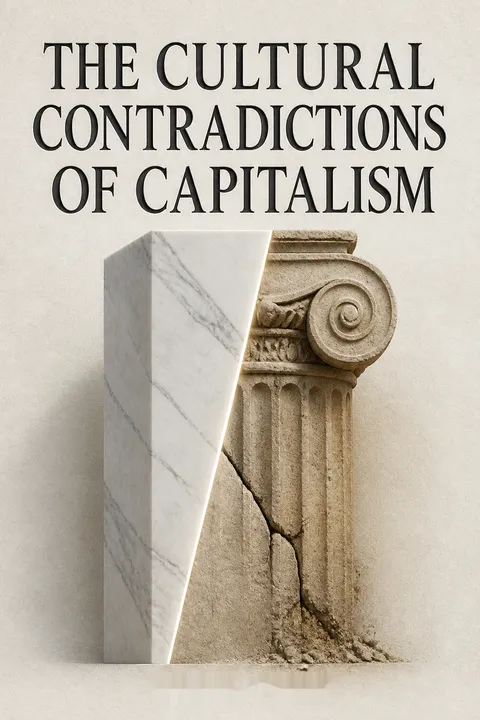

Key Takeaways
1. Modern Society's Disjunction: Three Realms with Conflicting Principles
It is my belief, on the other hand, that one can best analyze modern society by thinking of it as an uneasy amalgam of three distinct realms: the social structure (principally the techno-economic order), the polity, and the culture.
Society's fragmented nature. Modern society is not a unified, integrated system, as classical theories like Marxism or functionalism suggest. Instead, it is composed of three distinct realms—the techno-economic structure, the polity, and the culture—each governed by its own "axial principle" and operating with different rhythms of change. This inherent disjunction is the root cause of many contemporary social contradictions and tensions.
Conflicting axial principles. Each realm adheres to a primary organizing principle that often clashes with the others.
- Techno-economic order: Driven by efficiency and functional rationality, treating individuals as roles or "things" to maximize output.
- Polity: Governed by legitimacy and the principle of equality, expanding civil and social rights, and demanding participation.
- Culture: Focused on self-expression and self-gratification, valuing individual feelings and subjective judgments over objective standards.
These divergent principles lead to conflicts, such as the tension between bureaucratic efficiency and demands for equality or individual fulfillment.
Discordant rhythms of change. The pace and nature of change also differ across these realms. The techno-economic order exhibits linear progress, with innovations displacing less efficient predecessors. Culture, however, experiences a "ricorso," a cyclical return to fundamental existential questions, with new forms adding to a permanent repertoire rather than replacing old ones. The polity, mediating conflicts, operates on its own timeline, often reacting to pressures from the other two.
2. Culture's Ascendancy: The Institutionalization of the Avant-Garde
Thus, our culture has an unprecedented mission: it is an official, ceaseless search for a new sensibility.
Culture as a driving force. In contemporary civilization, culture has become the most dynamic element, even surpassing technology in its capacity for change. Society now actively embraces cultural innovation, viewing novelty as inherently superior to older forms. This creates a continuous demand for new sensibilities, styles, and experiences, making culture a primary engine of social transformation.
The avant-garde's triumph. The concept of the avant-garde, originally conceived by Saint-Simon as artists leading society toward a glorious future, has achieved its victory. What was once a rebellious stance against bourgeois norms is now institutionalized. The constant pursuit of the new means that the avant-garde is no longer shocking but expected, its role absorbed into the mainstream cultural apparatus.
Emergence of a cultural class. This institutionalization has led to the formation of a distinct "cultural class" – a large stratum of intelligentsia in knowledge and communications industries. This group, though a minority, significantly influences cultural establishments like publishing houses, museums, and media. They perpetuate the "adversary culture" against traditional bourgeois values, even as those values have largely dissipated, creating a paradox where the critique itself becomes the dominant orthodoxy.
3. Modernism's Essence: The Eclipse of Distance and the Imperious Self
Modernism, too, insists on the meaninglessness of appearance and seeks to uncover the substructure of the imagination.
Disorientation of perception. Modernism, a cultural temper spanning over a century, arose from two profound shifts in the 19th century: a disorientation of space and time due to revolutions in communication and transport, and a crisis of self-consciousness stemming from the loss of religious certitude. Artists responded by seeking to reassemble a fragmented world, leading to new aesthetic forms.
Eclipse of distance. Stylistically, modernism aims to eliminate aesthetic, psychic, and social distance. This means:
- Immediacy and impact: Art seeks to overwhelm the spectator, pulling them into the experience rather than allowing contemplation.
- Simultaneity: Breaking traditional sequences in time and space, as seen in cubism's multiple viewpoints or stream-of-consciousness literature.
- Sensation over interpretation: Prioritizing direct emotional and sensory experience, often through technical means, over rational understanding.
This rejection of traditional "rational cosmology" (foreground/background, beginning/middle/end) creates a sense of absolute presentness.
The self-infinitizing spirit. Thematically, modernism is driven by the "absolute imperiousness of the self," a "megalomania of self-infinitization" that refuses to accept limits. This quest for boundless experience, often exploring the "demonic" and suspending morality, became the core of modern man's spiritual enterprise. However, this endless striving, without memory or external anchors, ultimately leads to a "sense of nothingness" and an "eschatological anxiety," where life becomes a constant, unfulfilling search for new sensations.
4. Capitalism's Self-Undermining: The Erosion of the Protestant Ethic
The Protestant ethic had served to limit sumptuary (though not capital) accumulation. When the Protestant ethic was sundered from bourgeois society, only the hedonism remained, and the capitalist system lost its transcendental ethic.
Traditional values eroded. The Protestant ethic, emphasizing work, sobriety, frugality, and delayed gratification, was the moral bedrock of early American bourgeois society. It provided a transcendental justification for economic activity and constrained sumptuary display. However, this ethic was not primarily attacked by cultural modernism, but rather undermined by the very economic system it helped create.
Mass consumption's impact. The rise of mass production and mass consumption, particularly after the 1920s, fundamentally transformed American life. Key social inventions like the assembly line, sophisticated marketing, and especially installment buying (credit) encouraged immediate gratification and spending, directly contradicting the Puritan fear of debt and emphasis on saving. This shift from a production-oriented to a consumption-oriented society redefined success from character and work to status and taste.
Hedonism as the new ethic. By the 1950s, American culture had become predominantly hedonistic, prioritizing pleasure, fun, and display. This "fun morality" displaced traditional "goodness morality," making failure to have fun a source of low self-esteem. This created a profound contradiction within capitalism: it demanded a Protestant ethic (hard work, delayed gratification) in production, while simultaneously promoting a hedonistic lifestyle (pleasure, instant joy) in consumption. This disjunction left capitalism without a coherent moral or transcendental ethic.
5. The Rise of the Public Household: State as Central Economic Actor
The public household (as against the market, which seeks to serve diverse private wants) has always existed to meet common needs, to provide goods and services which individuals cannot purchase for themselves, e.g., military defense, roads, railways, and so forth.
Beyond market and domestic spheres. In addition to the domestic household and the market economy, a third, increasingly dominant sector has emerged: the public household. This realm, managed through the government budget, is the arena for satisfying public needs and wants, and for registering political forces. It represents a fundamental shift in societal organization, where collective decisions increasingly supersede individual market choices.
Three new state functions. The public household's expanded role stems from three new tasks undertaken by the state in the last 40 years:
- Normative economic policy: Governments now actively manage the economy through fiscal and monetary policies, controlling economic activity, directing investment, and effecting income redistribution.
- Underwriting science and technology: The state has become the primary financier and director of scientific research, technological innovation, and higher education, recognizing their centrality to economic and managerial policy.
- Normative social policy: Governments are committed to creating a substantial welfare state, addressing civil rights, housing, healthcare, and income support, aiming to redress social inequalities.
Fiscal sociology and class struggle. These expanded commitments mean that the public household is no longer just a provider of common goods but an arena for fulfilling private and group wants. This politicalization of decision-making, coupled with the constant pressure to increase services, leads to a structural imbalance between expenditures and revenues. Joseph Schumpeter's concept of "fiscal sociology" becomes central, as the budget transforms into the new field of class struggle, with groups contending over taxation and resource allocation.
6. The Revolution of Rising Entitlements: Overloading the Polity
What is clear is that the revolution of rising expectations, which has been one of the chief features of Western society in the past 25 years, is being transformed into a revolution of rising entitlements for the next 25.
Expectations become rights. The post-World War II era saw a "revolution of rising expectations," but this has evolved into a "revolution of rising entitlements." Citizens now demand a wider array of political, civil, and social rights as claims on the community, such as guaranteed minimum income, educational access, or lifetime employment. These are not just demands from disadvantaged groups but from all segments of society.
Expansion of services and urban crisis. This shift necessitates an enormous expansion of human, professional, and technical services, with health, education, and government employment becoming the fastest-growing sectors. This growth, however, creates a structural imbalance between the productivity gains in industrial sectors and the lower productivity in services. When public sector wages rise in parallel with industrial wages, it leads to a significant "inflationary gap," contributing to a deep and continuing urban crisis.
Political overload and instability. The public household faces two major problems:
- Overload of issues: As more aspects of life become matters of public policy, the political system becomes burdened with an unmanageable number of explicit and contentious issues.
- Fiscal strain: The constant pressure for rising entitlements leads to increasing state expenditures, demanding more taxes or stimulating inflation due to productivity imbalances.
These factors combine to create increased political instability and discontent, as governments struggle to balance demands with available resources and avoid politically unacceptable outcomes like high unemployment or rampant inflation.
7. Liberty vs. Equality: The Dilemma of Conflicting Values
Everything is what it is: liberty is liberty, not equality or fairness or justice or culture, or human happiness or a quiet conscience.
Incompatible objectives. The fundamental tension in modern liberal society lies between the values of liberty and equality, which are often incompatible. Classical liberalism defined equality as "equality before the law," emphasizing procedural fairness and individual freedom within established rules, even if it led to unequal outcomes. The overriding value was the reduction of government coercion.
The push for equality of outcomes. Contemporary demands for equality have broadened to include "equality of outcomes," aiming to make persons more equal in income, status, or authority. However, achieving this requires administrative determination of differences and redress, which inevitably means treating people unequally. This logic is inescapable: to make people equal, one must treat them unequally, often curtailing the liberty of some to enhance the equality of others.
Principle of relevant differences. To navigate this dilemma, a new public philosophy must employ the "principle of relevant differences." This means recognizing that while all persons deserve equal treatment in public liberties (e.g., before the law), different criteria apply to other spheres. For instance, in taxation, proportional equality (wealthier pay more) is just, but in professional appointments, competence, not group representation, should be the criterion. This approach seeks to reduce undue and illegitimate influence while respecting earned effort and the appropriate privileges within each sphere.
8. The Crisis of Belief: Loss of Civitas and Moral Cohesion
The major consequence of this crisis—I leave aside its deeper cultural dilemmas—is the loss of civitas, that spontaneous willingness to obey the law, to respect the rights of others, to forgo the temptations of private enrichment at the expense of the public weal —in short, to honor the 'city' of which one is a member.
Erosion of traditional anchors. The decline of traditional religious authority and the exhaustion of modernism have led to a profound crisis of belief in Western societies. Religion, historically the source of ultimate meanings and social solidarity, has seen its institutional authority shrink and its beliefs "demythologized." Modernist culture, in its "nothing sacred" ethos and embrace of the demonic, has further eroded traditional taboos and moral norms.
The rise of cults and "society without fathers." As formal religion wanes, cults emerge, offering esoteric knowledge, communal rites, and direct, personal experience, often emphasizing release over restraint. This reflects a "society without fathers," where the rejection of authority extends to any notion of parent beyond the peer group. However, such faith, detached from memory and tradition, struggles to provide lasting meaning or a coherent moral framework.
Loss of civitas. The most significant consequence is the loss of "civitas"—the spontaneous willingness to prioritize the public good over private gain, to respect laws and others' rights. Without this shared moral purpose, society risks becoming a battleground of polarized interests, leading to political anomie, cynical deals, or even terrorism. This crisis of belief, coupled with economic and political instability, shakes individuals' faith in their societies and undermines the very elements that sustain a moral order.
9. Toward a New Public Philosophy: Reconciling Private Wants and Public Needs
Some new purposes have to be established. Some new assumptions have to be laid down. The implicit agreements of the past were a great strength, for articulation always lays bare the contradictions between ideology and reality, and calls for a resolution which cannot always be given.
The public household's directive role. The inescapable centrality of the public household demands a new theoretical underpinning and a political philosophy. This philosophy must recognize the state's prior and directive role in coordinating economic and social effects, moving beyond mere market mechanisms to consciously shape societal directions based on publicly debated and philosophically justified decisions. It must prioritize "the good condition of human beings" over mere property.
Redefining rights and responsibilities. A new socio-economic bill of rights is needed to redefine social needs that the polity must satisfy, using the public budget as the mechanism. This involves rejecting bourgeois hedonism and its utilitarian emphasis on economic appetite, while retaining political liberalism's concern for individual differences and liberty. The challenge is to find common purposes while preserving individual means of fulfillment, and to define individual and group needs while finding common means of meeting them.
A renewed social compact. This new public philosophy must be a "social compact," renegotiated in the present but deeply informed by the past. It requires:
- Reaffirmation of the past: Acknowledging inherited traditions to understand obligations to posterity.
- Recognition of limits: Prioritizing needs (individual and social) over unlimited wants and appetites, especially concerning resources.
- Agreement on equity: Establishing fairness and inclusion, ensuring that within relevant spheres, people become more equal so they can be treated equally.
This approach, while rejecting the hubris of discarding the past, seeks a self-conscious maturity that balances power with its limits, providing a moral foundation for a liberal society to survive.
Review Summary
The Cultural Contradictions of Capitalism argues that capitalism undermines its own Protestant work ethic foundation through promoting consumer hedonism and instant gratification. Readers find Bell's analysis of culture, economics, and politics insightful but often dated. Many appreciate his division of society into three realms and his critique of modernism's cultural fragmentation. The book's central thesis—that capitalism's consumer culture conflicts with the disciplined values that enabled its rise—resonates more strongly today amid contemporary crises. However, some find it dense, poorly organized, or overly nostalgic for unified culture. Most agree it remains an important sociological work.
People Also Read




Download PDF
Download EPUB
.epub digital book format is ideal for reading ebooks on phones, tablets, and e-readers.








































