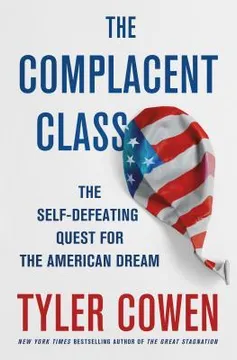
Key Takeaways
1. The rise of the Complacent Class has traded American dynamism for comfortable stasis.
I’ve coined the phrase the complacent class to describe the growing number of people in our society who accept, welcome, or even enforce a resistance to things new, different, or challenging.
The comfort trap. Peace and high incomes have drained the restlessness out of the American spirit, replacing a pioneer drive with a collective desire to postpone change. This complacent class spans three distinct tiers: the highly educated "privileged class" who insulate themselves from hardship, the middle-tier "diggers-in" who cling to their homes and assets, and the marginalized "stuck class" who are too disillusioned to disrupt the status quo.
The cost of stasis. While individuals make economically rational decisions to protect their comfort, the aggregate societal effect is a severe loss of economic and social dynamism. We have built a superstructure of stability that is ultimately unsustainable because it fails to generate the growth needed to fund itself.
- The Privileged Class: The top 3 to 5 percent who enjoy cosmopolitan lives but remain insulated from painful change.
- Those Who Dig In: The middle class holding wealth in homes, terrified of financial instability.
- Those Who Get Stuck: The marginalized, facing subpar education, addiction, or incarceration, who remain politically disengaged.
A lack of urgency. The defining feature of this new era is a profound lack of urgency among those who have the power to change things. Even when elites complain about inequality or stagnation, their actions reveal a preference for the appealing comforts of everyday life over disruptive progress.
2. Americans have stopped moving, choosing geographic and professional lock-in over transformation.
The interstate migration rate has fallen 51 percent below its 1948 to 1971 average and has been falling steadily since the mid-1980s.
The end of the road. Americans once defined themselves by their restlessness, viewing geographic mobility as a primary vehicle for self-transformation and economic advancement. Today, that physical restlessness has withered, replaced by a desire to settle down, entrench, and avoid the friction of relocation.
Declining job fluidity. This geographic immobility is deeply intertwined with a dramatic drop in job switching, as workers spend longer tenures with single employers. Furthermore, regional economies have homogenized into a standardized service-sector landscape, removing the wage premiums that once lured ambitious workers to new states.
- A 51% drop in interstate migration compared to the post-war average.
- The rise of occupational licensing, which locks professionals into state-specific regulations.
- High housing costs in high-productivity cities like San Francisco and New York, which price out lower-income seekers.
- The outsourcing of physical mobility to recent immigrants, particularly mobile Latino workforces.
The economic toll. When workers refuse to move, labor markets become sluggish, prolonging unemployment during recessions. By restricting housing construction in high-productivity hubs, we cost the U.S. economy an estimated 9.5% in lost GDP, severely limiting upward income mobility.
3. Socioeconomic and racial segregation have reemerged through economic sorting and gentrification.
The new segregation is superficially based on economics but more deeply rooted in a culture of matching—rich to rich and well educated to well educated—and a culture of stasis...
The sorting mechanism. While explicit racial animus has declined, America has become increasingly segregated by income, education, and social class. The wealthy and highly educated use their resources to cluster in exclusive neighborhoods and school districts, effectively walling themselves off from the rest of society.
Resegregation of schools. This economic sorting has led to a quiet but devastating resegregation of public education, particularly in the South and major progressive states like New York and California. The civil rights dream of integrated classrooms has retreated, leaving disadvantaged students isolated in underfunded, intensely segregated schools.
- High-income families are far less likely to live in mixed-income neighborhoods than poor families.
- The percentage of black students in majority-white Southern schools fell from 43.5% in 1988 to 23.2% in 2011.
- Progressive states like New York, Illinois, and Maryland rank as the most segregated school systems in the nation.
- Gentrification prices out historically integrated communities, replacing them with socioeconomically homogeneous enclaves.
The empathy gap. By living in highly sorted bubbles, the privileged class loses touch with the lived realities of the broader American population. This physical and cultural isolation breeds a dangerous complacency among elites, who remain blind to the growing undercurrents of domestic discontent.
4. The illusion of high-tech disruption masks a severe decline in business start-ups and productivity.
Contrary to common impressions, America is creating start-ups at lower rates each decade, and a smaller percentage of those start-ups is rising to prominence...
The innovation mirage. We are constantly told that we live in an era of unprecedented technological disruption, yet outside of the consumer tech sector, the American economy has grown remarkably static. The rate of business start-up formation has been in steady decline since the 1980s, and our corporate landscape is aging rapidly.
The productivity slowdown. This lack of corporate churn is reflected in sluggish productivity metrics, particularly Total Factor Productivity (TFP), which has underperformed since 1973. Rather than creating revolutionary new physical technologies, modern businesses focus on cost-cutting, brand preservation, and accumulating massive cash reserves.
- Start-ups have fallen from 12-13% of all firms in the 1980s to just 7-8% today.
- Over 80% of the S&P 500's value is now tied to intangible assets (brands, patents) rather than physical capital.
- Median male wages, adjusted for inflation, were higher in 1969 than they are today.
- Corporate investment in new physical infrastructure has plummeted, replaced by record-breaking mergers and acquisitions.
The stagnation of wages. Because productivity growth has stalled, typical American households have experienced decades of stagnant living standards. If productivity had maintained its pre-1973 growth rate, the median household would earn an additional $30,000 per year today, illustrating the massive cost of our collective complacency.
5. Algorithmic matching maximizes short-term happiness while cementing long-term societal division.
We are using the acceleration of information transmission to decelerate changes in our physical world.
The matching revolution. Information technology has turned us into a nation of matchers, using sophisticated algorithms to find the perfect music, the ideal romantic partner, and the exact breed of dog we want. While this matching increases our immediate satisfaction and "happiness capital," it shifts our societal energy away from building a new world and toward rearranging the pieces of the old one.
Assortative mating and inequality. In the social realm, matching manifests as assortative mating, where highly educated, high-earning individuals marry each other rather than mixing across class lines. This creates hyper-resourced, stable family units at the top, while leaving less-educated populations with lower social stability and fewer opportunities for advancement.
- Over one-third of marriages between 2005 and 2012 began online, rising to 70% for same-sex couples.
- Assortative mating accounts for roughly one-third of the rise in American income inequality since 1960.
- Algorithmic curation on platforms like Spotify and YouTube ensures we rarely encounter art or ideas that challenge us.
- Animal shelters use matching algorithms to boost pet adoption rates to historic highs, showing the positive side of the trend.
The loss of serendipity. By eliminating the friction, surprise, and accidental pairings of the physical world, matching makes our lives comfortable but intellectually sterile. We trade the electric, ambitious moments of happenstance for the safe, predictable comfort of code.
6. A culture of safety and medication has pacified public dissent and eliminated physical protest.
But of all the drugs that might have been legalized, American citizens chose the one—marijuana—that makes users spacey, calm, and sleepy.
The pacified public. The turbulent, riot-torn America of the 1960s and 1970s has been replaced by a society that prioritizes calm, safety, and order above all else. We have systematically medicated and regulated away our capacity for public disruption, choosing tranquility over the messy friction of civil disobedience.
The rise of therapeutic control. This obsession with safety begins in childhood, where outdoor play has been replaced by screen time, and disruptive behavior is quickly managed with prescription medications. In the adult world, we rely on antidepressants and legalized cannabis to maintain a medicated sense of calm, while schools and universities ban even the mildest forms of physical or intellectual conflict.
- Nearly 20% of American boys have been diagnosed with ADHD, reflecting a societal demand for classroom conformity.
- The average nine-year-old spends fifty hours a week looking at electronic screens rather than playing outside.
- Modern policing uses "strategic incapacitation" and "free-speech zones" to keep protests far from the public eye.
- The legal right to physical assembly has been quietly restricted by municipal bureaucracies and NIMBY-driven zoning laws.
The death of the grand project. When a society becomes entirely allergic to risk and conflict, it loses the ability to execute grand, transformative projects. We no longer build massive subway systems, explore the physical frontier, or tolerate the social disruption required to achieve historic breakthroughs.
7. Casual culture and "countersignaling" act as invisible barriers to upward social mobility.
Much as many of us might not want to admit it, the casual and the egalitarian are closer to enemies than to allies.
The casual trap. Modern America prides itself on its casual, egalitarian aesthetic, where tech billionaires wear hoodies and corporate dress codes have largely disappeared. However, this relaxed culture actually makes social mobility more difficult by replacing clear, visible rules of advancement with subtle, unwritten social codes.
The power of countersignaling. In a highly sorted society, the wealthy use "countersignaling"—deliberately dressing down or avoiding formal titles—to show they have nothing to prove. For an outsider trying to climb the social ladder, this casualness is a minefield; without traditional markers of status, acceptance is determined by cultural fit, which is easily verified by a quick Google search.
- The relaxation of dress codes makes it harder for lower-class strivers to visually demonstrate their professionalism.
- "Cultural fit" in elite firms often screens for shared high-class hobbies, tastes, and media consumption.
- Highly mobile, developing societies (like mid-century Japan or modern China) are typically obsessed with formal status markers.
- The casual aesthetic serves those who have already achieved status, while locking out those who still need to prove themselves.
The illusion of openness. By pretending that our institutions are flat and egalitarian, we mask the deep, structural sorting that keeps the privileged class in power. The casual culture of the complacent class is not a tool for liberation, but a highly effective mechanism for maintaining the status quo.
8. The death of fiscal democracy has put the American government on autopilot.
Today, however, it is harder to have a meaningful debate about how the money should be spent because most of the money is already spoken for...
Autopilot governance. American political debate has become increasingly shrill and symbolic because our actual government has creaked to a fiscal standstill. The vast majority of the federal budget is locked into automatic entitlement spending, leaving our elected representatives with almost no power to allocate resources to new priorities.
The erosion of fiscal democracy. This loss of budgetary control means that "fiscal democracy"—the ability of current voters to shape government spending—is virtually dead. As the population ages and healthcare costs rise, automatic programs like Medicare, Medicaid, and Social Security devour an ever-larger share of national revenue, starving the state of the capacity to invest in the future.
- In 1962, two-thirds of the federal budget could be allocated freely; today, that number has fallen to about 20%.
- The Steuerle-Roeper Fiscal Democracy Index is projected to fall below 10% by 2022, putting the state on permanent autopilot.
- Trust in the federal government has plummeted from 77% in 1958 to just 19% today.
- Congress routinely avoids voting on military actions, preferring the "creative ambiguity" of undeclared, executive-led conflicts.
The retreat from accountability. Because politicians cannot offer real, material solutions to their constituents, they resort to divisive cultural rhetoric and symbolic battles to motivate their bases. The resulting political polarization is not a sign of ideological vitality, but a symptom of a rigid, helpless system that has lost the capacity to govern.
9. The current era of comfortable stasis is unsustainable and will inevitably end in a "Great Reset."
A Great Reset is what happens when you postpone change for too long, and it is like opening up a valve on an overheating engine; there is a sudden rush of outward force, and not always in a pleasant or orderly manner.
The breaking point. The comfortable, change-avoiding world built by the complacent class is a temporary phase, not a permanent state of affairs. By systematically postponing necessary economic, social, and political adjustments, we have allowed immense pressures to build up beneath the surface of our stable institutions.
The return of cyclical history. History is cyclical, and long periods of artificial calm inevitably culminate in sudden, chaotic corrections. The financial crisis of 2008, the rise of populist political movements like Brexit and the election of Donald Trump, and growing domestic unrest are the first major cracks in the complacent facade, signaling that the "Great Reset" is already underway.
- A looming fiscal and budgetary crisis driven by unsustainable entitlement commitments.
- The inability of an autopilot government to respond flexibly to the next major global emergency.
- Exorbitant rental costs in productive cities, leading to a breaking point for the working class.
- A resurgence of domestic conflict and crime, particularly through the vulnerable, unpoliced nodes of the internet.
The end of complacency. When the pot finally boils over, the transition will be bumpy, disruptive, and highly unpleasant for those who have grown used to the comforts of stasis. Yet, this return of chaos is also the only mechanism through which America can shake off its complacency, regenerate its pioneer spirit, and rebuild a truly dynamic society.
Review Summary
People Also Read




About the Author


Download PDF
Download EPUB
.epub digital book format is ideal for reading ebooks on phones, tablets, and e-readers.








































