
Key Takeaways
1. The Dual Pillars of Catholic Truth: Scripture and Tradition
That whether I or any one else should wish to detect the frauds and avoid the snares of heretics as they rise, and to continue sound and complete in the Catholic faith, we must, the Lord helping, fortify our own belief in two ways; first, by the authority of the Divine Law, and then, by the Tradition of the Catholic Church.
Foundational defense. To safeguard the Catholic faith against the insidious deceptions of heresy, one must rely upon a dual fortification: the divine authority of Holy Scripture and the venerable tradition of the Catholic Church. These two sources, far from being contradictory, are complementary, providing a robust framework for discerning truth from falsehood. The Divine Law, being complete and sufficient, serves as the primary guide, yet its profound depths necessitate a consistent and authoritative interpretation.
Interpreting the Sacred. The necessity of tradition arises from the inherent complexity of Holy Scripture, which, if left to individual interpretation, can lead to a multitude of conflicting understandings. Various heretics, from Novatian to Nestorius, have each claimed scriptural backing for their divergent doctrines, demonstrating that Scripture alone, without a guiding interpretive principle, can be twisted to support almost any error. Therefore, the Church's tradition acts as the essential lens through which the sacred texts are rightly understood, ensuring fidelity to the original divine intent.
A unified standard. The Church's interpretation provides a universal standard, preventing the fragmentation of belief that results from private judgment. It ensures that the understanding of prophetic and apostolic writings remains consistent with the faith handed down through generations. This harmonious interplay between Scripture and Tradition forms the bedrock of Catholic doctrine, offering clarity and stability amidst the shifting sands of novel opinions.
2. The Triple Standard of Faith: Universality, Antiquity, Consent
Moreover, in the Catholic Church itself, all possible care must be taken, that we hold that faith which has been believed everywhere, always, by all.
The Catholic hallmark. The true mark of Catholic faith is its adherence to what has been believed "everywhere, always, by all." This celebrated triple criterion—universality, antiquity, and consent—serves as the ultimate test for distinguishing genuine doctrine from heretical innovation. It is a rule designed to ensure that the faith embraced is truly "Catholic," meaning universal and comprehensive, reflecting the unbroken continuity of belief across time and space.
Threefold application.
- Universality: Confessing the faith that the entire Church throughout the world acknowledges. This guards against regional or sectarian deviations.
- Antiquity: Never departing from interpretations demonstrably held by holy ancestors and fathers from the earliest times. This preserves the apostolic deposit.
- Consent: Adhering to the unanimous definitions and determinations of all, or nearly all, priests and doctors within that antiquity. This ensures a collective, authoritative understanding.
A bulwark against error. By rigorously applying this rule, the faithful are equipped to identify and reject any doctrine that lacks these essential characteristics. It provides a clear, objective measure against the subjective and often fleeting claims of novelty, ensuring that the Church remains anchored in the unchanging truth revealed by God and faithfully transmitted through the ages.
3. Navigating Novelty: Preferring the Whole, the Ancient, and Councils
What then will a Catholic Christian do, if a small portion of the Church have cut itself off from the communion of the universal faith? What, surely, but prefer the soundness of the whole body to the unsoundness of a pestilent and corrupt member?
Prioritizing the universal. When confronted with dissent or novel teachings, a Catholic Christian must always prioritize the soundness of the universal Church over the errors of a dissenting part. If a small faction separates itself, the faithful must cleave to the integrity of the whole body. Should a new contagion threaten to infect not just a small portion but the entire Church, the imperative is to cling steadfastly to antiquity, which, by its very nature, cannot be swayed by the deceptions of novelty.
Consulting authority. In cases where error might be found even within antiquity, perhaps from a few individuals or a single region, the faithful must then appeal to the higher authority of ancient General Councils. Their decrees, representing the collective wisdom and discernment of the universal priesthood, are to be preferred over the rashness or ignorance of a few. These councils serve as definitive arbiters, solidifying the Church's understanding of truth.
Seeking consensus. If a novel error arises on which no specific council has pronounced, the diligent Catholic must then collate and consult the opinions of the ancient Fathers. These are the approved authorities who, though living in diverse times and places, remained in communion and faith with the one Catholic Church. Whatever they held, wrote, and taught with one consent—openly, frequently, and persistently—must be embraced without doubt or hesitation, as it reflects the enduring truth of the Church.
4. Heresy as a Divine Test: God Permits Error to Prove the Faithful
For the Lord, your God, trieth you, to know whether you love Him with all your heart and with all your soul.
A profound question. It is a perplexing question why God permits eminent and learned individuals within the Church to become authors of novel doctrines. The answer, drawn from divine law and Church determination, reveals that such occurrences are often a divine trial, designed to test the sincerity and depth of the faithful's love for God. Just as Moses warned of prophets who might lead people to "strange gods," so too does God allow respected teachers to introduce "strange errors" to discern who truly loves Him.
Examples of trials. History provides numerous examples of such trials:
- Nestorius: Initially admired, he became a "wolf" devouring the flock, his prestige making his error more dangerous.
- Photinus: A man of great ability and eloquence, he led many astray in Pannonia, yet the vigilant faithful recognized the trial.
- Apollinaris: Highly esteemed, his novelties caused great perplexity, forcing disciples to choose between his influence and Church authority.
The purpose of the test. These instances demonstrate that the greater the learning and influence of the erring teacher, the greater the trial for the people. It forces individuals to look beyond human authority and cling to the established faith of the Church. This divine permission for error serves to reveal the steadfastness of those who prefer the ancient belief to novel misbelief, proving their unwavering devotion to God and His truth.
5. The Perilous Nature of Innovation: Disrupting Faith and Society
For then truly not only interests of small account, but others of the very gravest importance, were subverted. For not only affinities, relationships, friendships, families, but moreover, cities, peoples, provinces, nations, at last the whole Roman Empire, were shaken to their foundation and ruined.
Widespread devastation. The introduction of novel doctrine is not merely an intellectual deviation but a profound calamity with far-reaching consequences, capable of subverting not only spiritual truths but also the very fabric of society. The historical examples of Donatism and Arianism vividly illustrate this destructive power, demonstrating how a departure from established faith can shake nations to their foundations.
Societal breakdown.
- Donatists: In Africa, their "mad error" led many to prefer the "sacrilegious temerity of one man" over the Church of Christ, causing widespread schism and division.
- Arians: This "poison" infected almost the entire world, blinding bishops and leading to immense suffering. It captured emperors, subjected principal persons to new laws, and involved everything in confusion—public and private, sacred and profane.
- Consequences: Wives violated, widows ravished, virgins profaned, monasteries demolished, clergy ejected, saints imprisoned, exiled, and left to perish in deserts.
The root of the evil. Such widespread ruin stems from the lust of "profane and novel curiosity" that refuses to restrict itself within the "chaste limits of hallowed and uncorrupt antiquity." When human superstitions supplant heavenly doctrine, and wicked novelty subverts well-established antiquity, the result is not merely theological error but a catastrophic unraveling of order and peace, both within the Church and in the broader world.
6. True Progress vs. Corrupt Alteration: Growth in Understanding, Not Substance
The intelligence, then, the knowledge, the wisdom, as well of individuals as of all, as well of one man as of the whole Church, ought, in the course of ages and centuries, to increase and make much and vigorous progress; but yet only in its own kind; that is to say, in the same doctrine, in the same sense, and in the same meaning.
Legitimate growth. Christian doctrine is not meant to remain stagnant; indeed, it is expected to undergo "all possible progress." However, this progress must be a true development, an enlargement within its own kind, rather than an alteration or transformation into something fundamentally different. It is a deepening of understanding, a clarification of what was once obscure, and a more detailed exposition of what was previously expressed in general terms.
Analogies for understanding.
- Human body: An infant grows into a mature adult, but remains the same person. Limbs enlarge, form changes, but the nature and identity are constant. New features are developments of what was latent.
- Plant life: Wheat sown in a field yields wheat, not tares. The plant grows, flourishes, and ripens, but its essential nature remains unchanged.
Preserving integrity. The Church, as a careful guardian, cultivates and refines the doctrines entrusted to her, ensuring they are consolidated, strengthened, and made more definite, but never changed, maimed, or mutilated. To admit the license of impious fraud, allowing new elements to mingle with the old, would inevitably lead to the destruction of religion, transforming the sanctuary of truth into a "brothel of impious and base errors." Councils, in their decrees, aim only to ensure that what was believed simply is now believed intelligently, and what was practiced negligently is now practiced with double solicitude.
7. Heretics' Deceptive Use of Holy Scripture: Cloaking Poison in Divine Words
But the more secretly they conceal themselves under shelter of the Divine Law, so much the more are they to be feared and guarded against.
A cunning strategy. Heretics, in their attempts to propagate error, frequently appeal to Holy Scripture, citing passages from Moses, the Psalms, the Prophets, and the Gospels. This deceptive tactic is particularly dangerous because it cloaks their "evil stench of doctrine" with the "perfume of heavenly language," making it difficult for the unsuspecting to discern the underlying poison. They mimic nurses who smear honey on a bitter draught or disguise noxious juices under the names of medicines.
Following the arch-deceiver. This method of misusing Scripture directly mirrors the strategy of the Devil himself, who, in tempting our Lord, quoted Scripture to justify his impious suggestions. "If thou be the Son of God," he said, "cast thyself down, for it is written..." This serves as a crucial warning: when false apostles or teachers cite divine law to prop up their errors, they are undoubtedly following the cunning devices of their father, Satan.
Discerning the truth. The Saviour's admonition, "Beware of false prophets who come to you in sheep's clothing, but inwardly they are ravening wolves," highlights the need for vigilance. The "sheep's clothing" refers to the words of prophets and apostles, while the "ravening wolves" are the savage glosses of heretics. It is only when they begin to expound these divine words, interpreting them in a novel and perverse sense, that their bitterness, rage, and the "ill-savour of that novel poison" become apparent, revealing the broken hedge and the assailed Catholic faith.
8. The Catholic Rule for Scriptural Interpretation: Guided by Tradition
They must be very careful to pursue that course which, in the beginning of this Commonitory, we said that holy and learned men had commended to us, that is to say, they must interpret the sacred Canon according to the traditions of the Universal Church and in keeping with the rules of Catholic doctrine, in which Catholic and Universal Church, moreover, they must follow universality, antiquity, consent.
The essential method. Given that heretics cunningly employ Scripture to advance their errors, Catholics must adhere strictly to the prescribed method for interpreting the sacred Canon. This involves interpreting Scripture according to the traditions of the Universal Church and the established rules of Catholic doctrine. This approach ensures that the divine words are understood not through private judgment, but through the collective wisdom and continuous faith of the Church.
Applying the triple standard. The interpretation must be guided by the principles of universality, antiquity, and consent:
- Universality: Preferring the soundness of the whole Church to the corruption of a part.
- Antiquity: Prioritizing the religion of antiquity over the profaneness of novelty.
- Consent: In antiquity itself, preferring the decrees of a Universal Council, or failing that, the consentient belief of many and great masters, over the temerity of one or a few.
Detecting error. By faithfully, soberly, and scrupulously observing this rule, the noxious errors of heretics can be detected and condemned with little difficulty. This method ensures that the interpretation remains consistent with the faith "once for all delivered," safeguarding the faithful from being "precipitated from the height of Catholic truth to the lowest abyss of heresy" by misapplied scriptural passages.
9. Illustrious Examples: Councils and Popes Upholding Ancient Faith
And that nothing might be wanting to the credibility of the matter, we recorded the names and the number (though we had forgotten the order) of the Fathers, according to whose consentient and unanimous judgment, both the sacred preliminaries of judicial procedure were expounded, and the rule of divine truth established.
Ephesus as a model. The Council of Ephesus, held in 431 AD, stands as a prime example of how the Church upholds antiquity against novelty. Faced with Nestorius's profane innovations, the nearly two hundred assembled priests did not rely on their own judgment but instead brought forth the sentiments of holy Fathers—martyrs, confessors, and Catholic priests—to confirm ancient truth and condemn blasphemous novelty. This collective wisdom ensured that Nestorius was rightly judged contrary to Catholic antiquity.
Venerable authorities. The Council cited a sacred number of ten Fathers, representing diverse regions of the Church, whose writings served as judges and witnesses:
- Alexandria: St. Peter, St. Athanasius, St. Theophilus, St. Cyril.
- Cappadocia: St. Gregory of Nazianzus, St. Basil, St. Gregory of Nyssa.
- Rome: St. Felix, St. Julius.
- Carthage: St. Cyprian.
- Milan: St. Ambrose.
Papal steadfastness. Beyond councils, the Apostolic See consistently championed antiquity. Pope Stephen resisted the iteration of baptism with the rule: "Let there be no innovation—nothing but what has been handed down." Similarly, Pope Sixtus III decreed, "Let no license be allowed to novelty, because it is not fit that any addition should be made to antiquity." Pope Celestine likewise charged the priests of Gaul to "let novelty cease to assail antiquity," underscoring the unwavering commitment of the Roman bishops to preserve the faith received from their predecessors.
10. The Steadfast Catholic: Adhering to the Fathers, Rejecting Novelties
Whoever then gainsays these Apostolic and Catholic determinations, first of all necessarily insults the memory of holy Celestine, who decreed that novelty should cease to assail antiquity; and in the next place sets at naught the decision of holy Sixtus, whose sentence was, "Let no license be allowed to novelty, since it is not fit that any addition be made to antiquity;"
The true Catholic's character. A true and genuine Catholic is one who profoundly loves the truth of God, the Church, and the Body of Christ, valuing divine religion and Catholic faith above all human authority, genius, or eloquence. Such an individual remains steadfast in believing only what the Catholic Church has held universally and from ancient times, rejecting any new or unheard-of doctrine furtively introduced by individuals. This discernment is guided by the Apostle Paul's teaching that "there must needs be heresies, that they who are approved may be made manifest among you."
Resisting the allure of error. When novelty arises, the difference between the "weight of the wheat and the lightness of the chaff" becomes apparent. Those who are approved remain tenacious and faithful to the Catholic faith, while others, shaken by error, may fall away or remain in a wretched state of vacillation. This affliction, however, can be a divine mercy, prompting them to abandon self-conceit and return to the secure harbor of the Catholic Faith, unlearning what was ill-learnt and embracing the Church's entire doctrine.
A call to unwavering loyalty. To gainsay the Apostolic and Catholic determinations—the decrees of Popes like Celestine and Sixtus, the decisions of councils like Ephesus, and the injunctions of St. Paul—is to insult the memory of saints and despise the whole Church of Christ. Therefore, all genuine sons of Mother Church are called to adhere to the holy faith of the Fathers, to be wedded to it, and to die in it, while detesting, abhorring, and opposing the profane novelties of profane men, guarding the deposit entrusted to them.
Review Summary
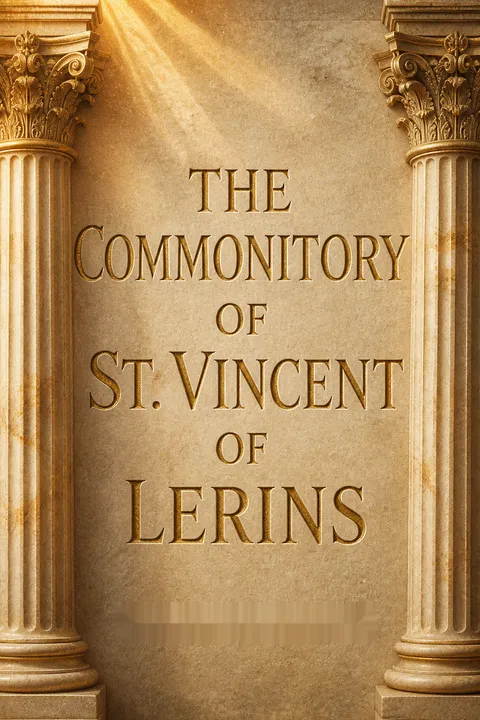
Readers broadly praise The Commonitory of St. Vincent of Lerins as a timeless and practical guide for discerning true Christian doctrine from heresy. The "Vincentian Canon" — that true faith is believed everywhere, always, and by all — is widely celebrated. Many highlight Vincent's nuanced treatment of Scripture and Tradition, emphasizing that Tradition serves as the interpretive guide rather than a separate authority. Several reviewers note the work's prophetic relevance to later schisms, including the Reformation. A few critics note limited refutation of heresies or underdeveloped doctrinal scope.
People Also Read




Download PDF
Download EPUB
.epub digital book format is ideal for reading ebooks on phones, tablets, and e-readers.








































