
Key Takeaways
1. The modern world is mirroring the fragile, multipolar volatility of the pre-1914 era.
Our current world is becoming more complex and more uncertain.
A dangerous historical parallel. The post-Cold War era of predictable, single-superpower hegemony has officially drawn to a close. Today, we are entering a highly volatile multipolar landscape where multiple Great Powers—such as the United States, China, India, and Russia—jostle for regional and global supremacy. This structural shift closely resembles the late nineteenth century, a period characterized by intense nationalist rivalries, trade wars, and a fragile globalized economy that ultimately collapsed into the cataclysm of World War I.
Structural similarities abound. The geopolitical dynamics of our time echo the pre-1914 world in several alarming ways. Just as the rapid rise of a unified Germany disrupted the European balance of power, China's meteoric economic and military ascent is reshaping the global order.
- Rising populism and anti-foreign sentiment across major nations.
- Increasing protectionism, tariffs, and weaponized trade policies.
- Widespread public anxiety regarding immigration, terrorism, and technological disruption.
- A dangerous combination of jingoism, fear, and fatalism among political elites.
The illusion of stability. Many modern observers falsely assume that eighty years of relative Great Power peace since 1945 guarantee future stability. However, the nineteenth century was also largely peaceful, yet it birthed the horrors of the Somme and Verdun when systemic pressures reached a boiling point. If we fail to heed the warnings of history, we risk repeating the same miscalculations that led to the destruction of an entire generation.
2. The rapid rise of new powers inevitably triggers existential anxiety in declining hegemons.
Just as Britain before 1914, the United States is today deeply uncertain about its role in the world and insecure about its domestic and imperial order.
The psychology of decline. When a dominant global power begins to lose its relative economic and military edge, its political discourse becomes obsessed with decline and vulnerability. In the early twentieth century, Great Britain watched anxiously as Germany and the United States surpassed its industrial output. Today, the United States faces a similar psychological crisis as China overtakes it in purchasing power parity and dominates global manufacturing supply chains.
Blaming the outsider. Rather than addressing the root causes of domestic stagnation, declining hegemons routinely project their anxieties onto rising rivals. British politicians before 1914 blamed German trade for domestic job losses, while modern American leaders across the political spectrum accuse China of economic manipulation and intellectual property theft.
- The loss of over five million US manufacturing jobs since 2000.
- The rise of protectionist rhetoric, exemplified by Donald Trump's "Tariff Man" persona.
- Accusations of state-sponsored industrial espionage and forced technology transfers.
- A bipartisan consensus in Washington focused on confronting the rising challenger.
The danger of overstretch. Both Edwardian Britain and modern America suffered from severe strategic overcommitment. Trying to police the entire globe while facing domestic decay creates a dangerous gap between a nation's actual capabilities and its geopolitical promises. When a hegemon's commitments exceed its resources, it becomes highly unpredictable, increasing the likelihood of global instability.
3. Domestic inequality and political polarization fuel aggressive, outward-facing nationalism.
Under such circumstances, few of those in charge want to risk their own political careers through defusing tensions with other countries.
Internal strife drives external aggression. Deep social divisions and economic inequality within Great Powers frequently lead political elites to weaponize nationalism as a tool for domestic cohesion. Before 1914, Britain faced a near-civil war over Irish Home Rule and massive labor strikes, while Germany's Kaiser struggled against the rise of the Social Democrats. Today, the United States is fractured by extreme political polarization, and China's Communist Party faces slowing growth and a ticking demographic time bomb.
The nationalist trap. To maintain their grip on power, modern leaders cultivate a fierce, exclusionary brand of patriotism that leaves no room for diplomatic compromise. In China, the CCP promotes a Han-centric nationalism that portrays the West as an existential threat bent on "splitting" the country.
- The rise of the "America First" doctrine and Christian nationalism in the US.
- Vladimir Putin's mystical, imperialist vision of a "Russian World."
- Narendra Modi's Hindu supremacist agenda in India, which demonizes minorities.
- The systematic suppression of ethnic minorities in China's Xinjiang and Tibet regions.
The cost of moderation. When public sentiment is hyper-nationalistic, any attempt at international compromise is branded as weakness or treason. Political leaders, fearful of losing office or facing domestic rebellion, align themselves with aggressive agendas they privately know could lead to disaster. This political cowardice destroys the diplomatic flexibility needed to defuse international crises before they escalate into war.
4. Rigid military doctrines and the "cult of the offensive" drastically shorten diplomatic windows.
The 1914 example shows that the weapons of mass destruction of that time were not sufficient reasons for Great Powers to avoid war.
The trap of mobilization. In the lead-up to World War I, European general staffs developed highly complex, rigid mobilization timetables that relied heavily on railway networks. The prevailing military consensus—the "cult of the offensive"—dictated that the side that struck first would secure a decisive advantage. Consequently, when Russia mobilized its forces in July 1914, German planners felt structurally compelled to launch the Schlieffen Plan, invading Belgium and France before diplomacy could even begin.
Modern offensive doctrines. Today's military strategies are similarly built around speed, preemption, and seizing the initiative. China's anti-access/area denial (A2/AD) systems and the United States' maritime-air doctrines both emphasize striking early to neutralize the adversary's capabilities.
- The reliance on long-range precision strikes and hypersonic missiles.
- The integration of cyber warfare to disable critical infrastructure at the onset of conflict.
- The temptation to launch preemptive strikes on regional bases to delay enemy intervention.
- The belief that conventional conflicts can be won quickly before nuclear escalation occurs.
The illusion of control. Just as pre-1914 generals believed their scientific battle plans would guarantee a swift victory, modern strategists often suffer from the illusion of rapid, controlled warfare. In reality, once the first shot is fired, rigid doctrines and automated systems take over, leaving political leaders with virtually no time to communicate, de-escalate, or negotiate a peaceful exit.
5. Technological revolutions accelerate the pace of conflict and induce strategic panic.
The new world of technology made the new century harder to comprehend and probably a more confrontational place altogether.
Unprecedented technological disruption. The late nineteenth century was transformed by electricity, chemical industries, and the Dreadnought battleship, which rendered older naval fleets instantly obsolete. This rapid pace of innovation created intense anxiety among Great Powers, who feared that a single technological breakthrough by a rival could permanently alter the balance of power. Today, we are living through a parallel military-technological revolution driven by artificial intelligence, quantum computing, and autonomous systems.
The compression of decision time. Modern technologies have compressed the time available for human decision-making to a fraction of what it was in the past. Artificial intelligence can analyze battlefields and select targets in real time, tempting military commanders to remove human oversight to maintain a competitive edge.
- The deployment of fully autonomous drone swarms and combat vehicles.
- The threat of devastating cyberattacks that can paralyze a nation's command and control.
- The development of hypersonic weapons that bypass traditional missile defense systems.
- The use of quantum sensing to render stealth technologies obsolete.
The danger of automated escalation. When strategic decisions are outsourced to algorithms and high-speed networks, the risk of accidental escalation increases exponentially. A glitch in an AI-driven targeting system or a misunderstood cyber probe could trigger an automated military response, dragging nuclear-armed Great Powers into a catastrophic war before political leaders even realize a crisis has begun.
6. Ambiguous alliance commitments invite miscalculation rather than deterring aggression.
The problem with pre-1914 alliances was that they failed to keep the peace, not that they provoked war.
The failure of deterrence. Alliances are theoretically designed to preserve peace by deterring potential aggressors. However, before 1914, the complex web of European alliances—such as the Austro-German alliance and the Triple Entente—actually increased instability. Because Germany felt chained to a weak and reckless Austria-Hungary, it gave Vienna a "blank check" in the Balkans, mistakenly believing that its firm backing would force Russia to back down.
The peril of strategic ambiguity. Today, the United States' security architecture is plagued by similar ambiguities, particularly regarding its commitment to Taiwan. While Washington maintains a policy of "strategic ambiguity," this posture risks inviting miscalculation from both sides of the Taiwan Strait.
- China may calculate that the US lacks the political will to intervene militarily.
- Taiwanese leaders may be emboldened to push for independence, assuming US protection is guaranteed.
- The US-Philippine Mutual Defense Treaty could drag Washington into a shooting war over barren reefs.
- The expansion of NATO has left Russia feeling permanently excluded and deeply insecure.
Chained to reckless partners. When Great Powers bind their security to highly volatile regional actors, they surrender control over their own destiny. Just as Germany was dragged into war by Austria's obsession with Serbia, the United States or China could easily be pulled into a global conflict by the reckless actions of their regional allies in East Asia, Europe, or the Middle East.
7. Taiwan is the ultimate modern flashpoint, combining territorial, strategic, and ideological disputes.
The Taiwan conflict is a bit like Alsace, Bosnia, and Belgium rolled into one.
An explosive geopolitical mix. Taiwan represents the most dangerous flashpoint in the contemporary world because it sits at the intersection of China's nationalist identity, America's global credibility, and the global high-tech economy. For the Chinese Communist Party, absorbing Taiwan is a "sacred duty" and the final step in reversing the "century of humiliation." For the United States, defending Taiwan is essential to maintaining its security umbrella in the Western Pacific and protecting the island's vibrant democracy.
The economic and strategic stakes. A war over Taiwan would instantly shatter the global economy, as the island produces the vast majority of the world's advanced semiconductors. Furthermore, a Chinese takeover of Taiwan would allow the People's Liberation Army to project power deep into the Pacific, threatening Japan and US territories.
- The collapse of cross-strait economic integration, with Taiwan's trade with China plummeting.
- The rise of a distinct Taiwanese identity, with 65% of the population identifying solely as Taiwanese.
- The militarization of the Taiwan Strait, with daily PLA air and naval incursions.
- The risk of a preemptive Chinese strike on US bases in Japan and Guam to delay intervention.
The closing window. As China's economic growth slows and its demographic crisis worsens, leaders in Beijing may conclude that their relative power has peaked. This "maximum moment" psychology is highly dangerous; if the CCP believes that time is running out to achieve unification peacefully, they may decide that a military invasion is their best remaining option, triggering a direct clash with the United States.
8. Regional conflicts are the powder kegs that drag competing Great Powers into global conflagrations.
A key lesson from the world before 1914 is that regional conflicts, long left unresolved, can be the powder kegs that set off a global conflagration.
The spark in the periphery. World War I did not begin because of a direct dispute between Britain and Germany; it was ignited by a regional conflict in the Balkans between Austria-Hungary and Serbia. When local disputes are left to fester, they inevitably attract the intervention of competing Great Powers seeking strategic advantage. Today, the world is littered with unresolved regional conflicts that possess the same explosive potential to drag the major powers into a wider war.
A multitude of modern powder kegs. From the frozen conflict on the Korean peninsula to the disputed borders of the Himalayas, local flashpoints are increasingly militarized. In the South China Sea, China's aggressive maritime claims have led to direct clashes with the Philippines, a treaty ally of the United States.
- The ongoing war in Ukraine, which has become a proxy conflict between Russia and NATO.
- The volatile border between India and China, where the 2020 Galwan clashes killed dozens of soldiers.
- The permanent instability of the Middle East, driven by statelessness and the Israel-Iran rivalry.
- The nuclear-armed standoff between India and Pakistan, backed respectively by the US and China.
The loss of escalation control. Once a regional conflict erupts, the participating Great Powers quickly lose the ability to control the narrative. National honor, alliance commitments, and strategic panic force leaders to escalate their involvement, transforming a localized crisis into a global catastrophe. To prevent a third world war, the international community must prioritize resolving these regional disputes before they reach a boiling point.
9. True deterrence requires clear, unyielding red lines paired with open channels of communication.
If German leaders in July 1914 had been convinced that Britain would join in against them, it is much less likely that they would have declared war on Russia and France.
The necessity of clarity. Miscalculation is the primary driver of Great Power wars. In 1914, Britain's refusal to clearly state that it would defend France and Belgium allowed German leaders to gamble on British neutrality. To preserve peace today, the United States and its allies must establish clear, credible, and unyielding red lines that leave no doubt in the minds of their adversaries about the consequences of aggression.
The breakdown of communication. However, deterrence is only half of the equation; it must be accompanied by robust, open channels of communication to prevent accidental escalation. During the Cold War, the US and the Soviet Union maintained hotlines to manage crises, but today, communication between Washington, Beijing, and Moscow is dangerously sparse.
- The frequent refusal of Chinese military leaders to answer calls from the Pentagon during crises.
- The erosion of arms control treaties and strategic confidence-building measures.
- The reliance on public, performative diplomacy over quiet, high-level negotiations.
- The danger of information overload and conflicting intelligence reports during an acute crisis.
The value of personal bonds. While personal relationships between leaders cannot prevent war on their own, they provide a crucial cushion during a crisis. If heads of state have met repeatedly and established a basic level of mutual respect, they are far more likely to pick up the phone and buy the extra time needed to defuse a ticking bomb.
10. Preserving global peace demands selective compromise and the acceptance of systemic change.
A multipolar world is not something that individual Great Powers can choose or prevent.
Managing the transition. The transition from a unipolar to a multipolar world is an unavoidable historical process driven by shifting economic and social realities. Trying to resist this change by force—such as the United States insisting on absolute global supremacy or China attempting to violently expel the US from Asia—is a guaranteed recipe for war. Preserving peace in the twenty-first century requires Great Powers to accept a gradual, peaceful adjustment of the international system.
The art of selective compromise. To avoid a catastrophic clash, the major powers must be willing to negotiate tentative deals on highly sensitive issues of sovereignty and territory. This does not mean appeasement or moral equivalence, but rather a realistic recognition of each other's core security interests.
- A "Shanghai +" agreement on Taiwan, where the US opposes independence and China renounces force.
- A nuclear and missile freeze in North Korea in exchange for sanctions relief and recognition.
- A negotiated settlement in Ukraine that guarantees its sovereignty and EU integration in exchange for neutrality.
- The revitalization of multilateral institutions like the UN to manage Great Power competition.
The ultimate choice. In the end, the choice facing today's leaders is the same one that confronted the statesmen of 1914: compromise or catastrophe. If we refuse to make the selective concessions necessary to accommodate a changing world, we will inevitably slide into a Great Power war that will destroy our global economy, kill millions, and set human progress back by generations.
Review Summary
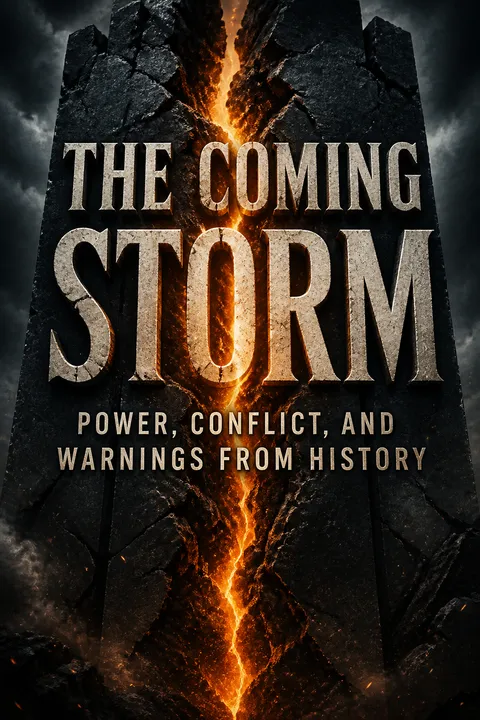
The Coming Storm draws comparisons between today's multipolar geopolitical landscape and the pre-WWI era, arguing that similar conditions — rising powers, shifting alliances, nationalism, and economic rivalry — make major conflict increasingly plausible. Reviewers praised its accessibility, concise writing, and timely relevance, while criticisms focused on its brevity, underdeveloped solutions, and occasionally weak analogies. Most agreed the contemporary analysis outshines the historical sections, and that despite its limitations, the book serves as a compelling and sobering warning.
Download PDF
Download EPUB
.epub digital book format is ideal for reading ebooks on phones, tablets, and e-readers.








































