

Key Takeaways
Truth is funnier than jokes, so mine your real humiliations
Carter's own origin proves it. A stand-up magician, she landed in Cincinnati while her prop trunk landed in Newark. Forced onstage with nothing, she babbled about the airline disaster and her life's humiliations, and the laughs grew bigger the more real she got. Lesson: audiences respond to authenticity, not memorized gags.
The distinction runs through the whole book. Normal people express humor by memorizing jokes. Comics transform lived experience into material. She quotes comics who turned cancer, alcoholic mothers, and divorce into laughs. Ellen DeGeneres wrote her breakthrough "Phone Call to God" bit while grieving a friend's death in a fleabag apartment. The rule: the more painful or humiliating something is, the more likely it makes an audience laugh. Bad for your life equals good for your act.
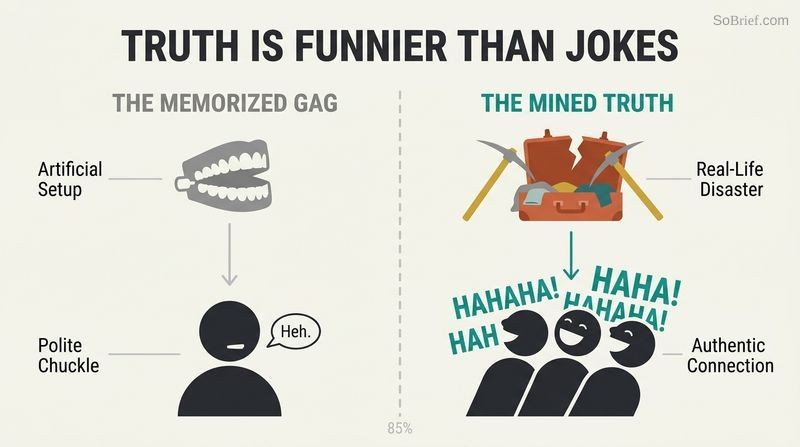
This mirrors what performance researchers call self-disclosure theory: audiences bond with vulnerability, not polish. Brene Brown built an empire on the same insight in a different register. What's striking is Carter inverts the amateur's instinct entirely. Beginners hunt for "funny" topics; professionals hunt for true ones and make them funny. There is a limit worth noting, though. Raw confession without craft is just therapy, and Carter knows it. The transformation of pain into structured comedy, not the pain itself, is the skill. The book's genius is treating trauma as raw ore rather than the finished product.
Build every joke from attitude plus topic plus premise plus act-out
Carter's core machine breaks a joke into five parts. The topic is what the joke is about (say, drugs). The attitude is one of four emotional words: weird, scary, hard, or stupid. The premise is your insightful, non-funny opinion answering "what's weird/hard/stupid/scary about this topic?" The setup equals attitude plus topic plus premise, and it should sound sincere, even serious.
The funny arrives in the act-out, where you stop describing and become the character, performing the scene rather than narrating it. Julia Sweeney sets up her cancer and hysterectomy dead straight, then jumps to "why can't people get cancer of fat?" An optional mix connects two unrelated things ("marriage is a five-thousand-piece jigsaw puzzle, all sky") for extra laughs. Beginners must literally say the attitude word aloud while writing, or the attitude, and the laughs, vanish.
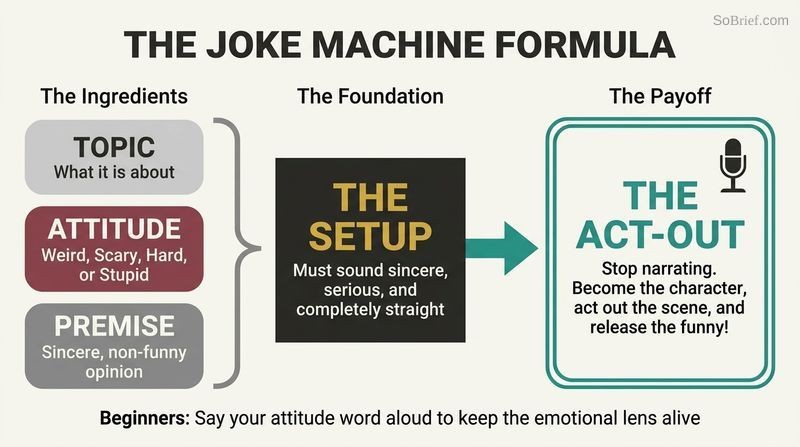
Carter's architecture resembles setup-punchline theory dressed in emotional clothing. The insistence on a serious, sincere setup aligns with incongruity theory of humor: laughter erupts from the gap between an earnest premise and an absurd payoff. Start funny and there is nowhere to climb. The four-attitude constraint is pedagogically clever, functioning like training wheels that force emotional commitment before nuance. Neuroscience of laughter supports the act-out emphasis: mirror neurons make embodied performance land harder than description. The debatable part is whether reducing all attitudes to four negative words limits range, but Carter frames it as scaffolding to remove once instinct takes over.
Write a premise, never a story, because stories die onstage
The single most common beginner mistake, Carter argues, is confusing a story with a premise. A story recounts what happened ("I was dating this girl and she dumped me and then..."). It takes too long, uses past-tense verbs, centers on "I," and lacks attitude. A premise cuts to a general, present-tense insight ("you never meet someone when you really want to").
Her diagnostic tests are ruthless: if you're not at an act-out within three lines, you're telling a story. If "so then I" appears, you're telling a story. Premises should avoid the words I, me, and my, starting general so everyone relates, then getting specific in the act-out. The party story that killed at dinner usually dies at the club, ending in the fatal "well, I guess you had to be there." Stand-up is premise-based, not story-based.
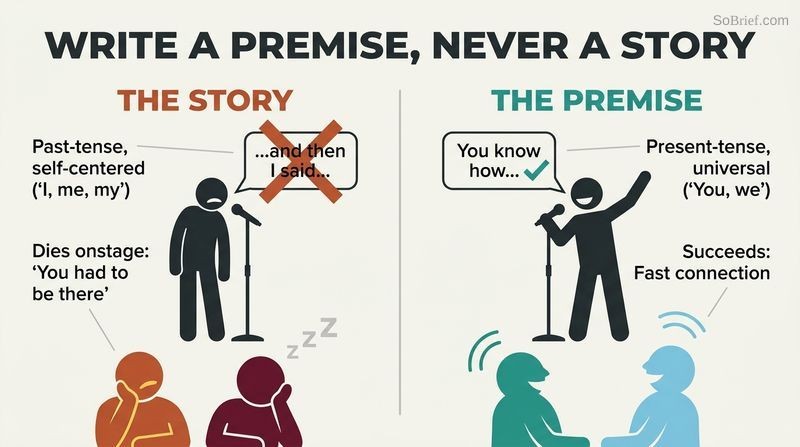
This is Carter's sharpest craft distinction and it generalizes far beyond comedy. Screenwriters, keynote speakers, and essayists all battle the same trap: mistaking chronology for meaning. The insight maps onto journalism's "nut graf" principle, where the point must surface fast or readers leave. Cognitively, a premise offers a portable schema the audience can slot their own lives into, whereas a story locks them into your specifics. One tension: some of the greatest comics (Pryor, Cosby in his prime) are master storytellers. Carter addresses this by noting they disguise finely crafted premise-chains as spontaneous stories, which is a subtle and important caveat.
Chase authentic, relatable topics where your obsession meets the crowd's
Carter maps two circles: your authentic topics (things you're genuinely passionate about) and the crowd's hot topics (what strangers actually care about). Fame lives in the overlap. A topic that resonates only with you is journaling. A topic that's relatable but you don't care about rings false, and audiences smell the fake.
She proves this with her own act. Her "biological clock" routine killed for years, then suddenly died, not because she changed a word, but because the topic stopped being true for her. A student built a whole act on "it's hard to meet men when you're older" that bombed, because she'd been happily married 25 years. Tim Allen knocked around for years until "men and tools" tapped a universal nerve, spawning a sitcom, films, and a tool line. Test topics by asking strangers what they know about them.
The Venn-diagram model echoes the Japanese concept of ikigai and, more concretely, product-market fit from startup theory: passion alone or market alone fails, the intersection wins. Carter's claim that audiences detect inauthenticity is supported by research on thin-slicing and micro-expressions, where people unconsciously register incongruence between speaker and content. The dead-routine anecdote is the book's most quietly profound moment, suggesting comedy has an expiration date tied to the performer's emotional truth, not the writing. A useful challenge: some working comics perform material they no longer feel and still get laughs through pure technique, implying authenticity may be sufficient but not strictly necessary once craft is mastered.
Fear proves you get it, so act despite the flop sweat
A USA Today survey found people fear public speaking more than death, which is why comics literally say "I died" and "I killed." Carter reframes fear as a green light, not a stop sign. If comedy doesn't scare you, check your pulse. Brave people aren't unafraid; they act while afraid. Phyllis Diller endured 15 years of flop sweat so bad it dissolved the leather lining of her boots.
Her five-step fear management program: admit your fears in writing, cross off the unrealistic ones (nobody dies onstage), confide them to a friend (fear loses power in the open), play each fear out step-by-step until it turns positive, then take one scary action today. Insecurity is itself funny, she notes: Woody Allen is funniest when most neurotic. The saintly and self-confident are rarely the funniest people alive.
Carter's reframe anticipates modern anxiety research on cognitive reappraisal, where relabeling arousal as "excitement" rather than "fear" measurably improves performance (Alison Wood Brooks's Harvard studies on "anxiety reappraisal"). Her step of playing fears to their positive conclusion is essentially exposure therapy through imagination, a technique cognitive behavioral therapists use daily. The observation that insecure people are funnier connects to studies linking humor production to mild depressive and anxious temperaments. What's smart here is she refuses the toxic-positivity route of "just be confident." Instead she treats fear as fuel and nervousness as the very edge that makes a performer alive rather than robotic.
Honor your ideas daily by capturing them before they vanish
Carter treats idea-capture as a professional discipline, not a mood. Comics carry a notebook and recorder everywhere because "funny" strikes in cars, at funerals, during sex, and you will not remember it later. Her morning ritual: before coffee, before you even pee, write for ten minutes in bed. Three pages a day becomes 21 pages a week, and a year later that's a book, a screenplay, or an act.
The rules are freeing: don't judge, be messy, don't try to be funny, and don't reread for a month so you see it with fresh eyes. Ideas are neither good nor bad, only starting points. She proves it with absurd-sounding pitches that became gold: a flying nun (Sally Field's hit show), funny doctors in the Korean War (M A S H), and Paula Poundstone's celebrated suicide bit. It's a numbers game; the more darts you throw, the more you hit.
The morning-pages practice is lifted straight from creativity pedagogy (Julia Cameron's The Artist's Way popularized it), and the neuroscience is sound: the hypnopompic state just after waking has reduced prefrontal filtering, loosening the inner critic that strangles novel associations. Carter's "don't judge before you investigate" rule aligns with divergent-thinking research showing that separating idea generation from evaluation dramatically increases output quality. The numbers-game framing is essentially the base-rate logic behind prolific creators: Edison, Picasso, and Dean Simonton's research all confirm that quantity predicts eventual quality. The one friction point is that raw volume without ruthless later editing produces noise, a step Carter handles elsewhere in her craft rules.
Never write comedy alone, because a buddy returns your serve
Carter insists on a comedy buddy, comparing a good session to a hot game of tennis where your partner returns and spins your ideas back. Solo-written jokes tend to sound literary and get blank "huh?" stares, because comedy is written for people and needs to be written with people. Jay Leno, Dennis Miller, and Rosie O'Donnell didn't develop material alone, and sitcom writers are routinely hired in teams.
The buddy's job is specific: keep asking "what's weird, hard, stupid, or scary about that?" until the premise is clear and specific, strip out the words I and my, keep the energy up, and be generous. Choose carefully. Some people make you feel funnier just by being near them; others make you doubt you were ever funny. She also warns against writing jokes by email, since jokes first written instead of spoken end up unfunny when performed.
The tennis metaphor captures something real about improvisational cognition: humor often emerges from rapid social iteration, not solitary reflection. This tracks with research on "group flow" and the collaborative circuitry behind writers' rooms, which dominate television precisely because comedy benefits from real-time audience simulation. Carter's rule that jokes must be spoken, not typed, aligns with the finding that spoken language activates prosody and timing centers the written word bypasses. A worthwhile nuance: some legendary humorists (Steven Wright, many essayists) are deeply solitary writers. The buddy system may be most crucial for performance comedy specifically, where the oral, rhythmic dimension cannot be simulated on a silent page.
Only mock targets the audience agrees deserve it
Audiences have a communal sense of fair play and will turn on a comic instantly if a joke feels unjust. The number-one rule for trashing anyone: prove in the setup that they deserve it. "My wife is such a bitch" loses the room; "my wife ran off with my best friend, what a bitch" earns the laugh. Better still, make yourself the idiot, because the safest target is you.
Carter bans punching down: never further oppress someone already seen as oppressed, like your underpaid secretary. Only mock a minority group if you belong to it. Chris Rock riffing on Black people reads as hip; a white comic doing it reads as bigoted. She also flags gender-bashing ("men are pigs," "women are impossible") as lazy hack, arguing the real truth is that all humans are terrible in relationships, and beneath hostility lies fear.
Carter articulates, in 2001 club vernacular, what academics call the "benign violation theory" of humor (McGraw and Warren): something must be wrong yet feel safe or deserved to be funny. Her punching-up-versus-down ethic predates its mainstream currency by over a decade and remains the sharpest line in comedy's ongoing culture wars. The insight that "beneath hostility is fear" is psychologically astute, echoing Adlerian and cognitive models where aggression masks vulnerability. Reframing "I hate men" as "men scare me" is both funnier and truer. The debatable edge: some transgressive comics thrive precisely by violating the deserve-it rule, suggesting Carter's ethic is one viable path, not the only one.
Perform stand-up even if you only want to write
Stand-up is the most condensed form of comedy, and Carter argues its structure underlies everything else. A joke has setup, turn, and tag; a sitcom has act one, a turn, and a resolve; a greeting card puts the setup on the cover and the punch inside. Master the sparest form and you can translate it to scripts, essays, speeches, and pitches.
The proof is in the resumes. Tom Shadyac started in her stand-up class and directed Ace Ventura two years later. Seth MacFarlane developed Family Guy's voices in his stand-up act. Most top sitcom writers began onstage. Even reluctant writers benefit: performing teaches you to pitch jokes and story ideas that get you hired, and gives a direct, immediate feel for what lands that no computer screen provides. When a Letterman writer applied, they demanded video of his stand-up, not just pages.
Carter's claim that a single micro-form scales into every macro-form is a compression argument familiar from music (mastering scales), martial arts (drilling one kata), and writing (the sentence as the unit of prose, per Stanley Fish). The transferable skill is not jokes per se but audience calibration: the instant feedback loop of a live room trains a writer to sense attention decay faster than any editor can. This connects to deliberate-practice research, where tight, immediate feedback accelerates skill acquisition. The mild overreach is treating stand-up as nearly mandatory; plenty of brilliant sitcom and essay writers never held a mic. Still, as a forcing function for developing comedic instinct, few training grounds are as brutal or efficient.
Structure sitcoms as six beats of escalating character conflict
Sitcoms use the same DNA as jokes: attitude, topic, premise, act-out. But the engine is character conflict, not gags. Carter (via her pros) insists sitcoms are story, not jokes, and the biggest beginner error is cramming in punchlines instead of building a spine. Every episode runs on a log line: when something happens to the hero, he tries something and gets into more trouble.
The six beats: 1) setup, a problem in paradise; 2) complicate and escalate; 3) the twist at the act break, where things go sideways; 4) the plan; 5) the big comedy scene where the plan fails; 6) the resolve, where loose ends tie up and the hero learns something. Humor comes from the gap between what a character wants (goal) and the obstacles blocking it. Put a character's personality flaw into a situation that triggers it, and the story writes itself.
This beat sheet is essentially Aristotelian dramatic structure compressed for 22 minutes, and it predates Blake Snyder's Save the Cat by years while covering similar ground. The "comedy gap" (Robert McKee's term, which Carter cites) between intended and actual outcome is incongruity theory applied to plot rather than punchline. What elevates the chapter is the insistence that events must flow from character flaws, not writer convenience, which is the difference between earned and contrived comedy. Modern prestige-comedy showrunners would add that the cleanest structures can feel formulaic, and the best contemporary sitcoms bend these beats. But as a foundation for a spec script meant to prove competence, Carter's rigidity is strategically correct: you break rules credibly only after demonstrating mastery of them.
Become your own agent, because nobody is coming to save you
Carter's three-step business strategy is blunt: get good, get noticed, get paid. Fame is easier than success (Lorena Bobbitt got famous fast; Paula Poundstone got good slowly), but only relentless daily craft-work lasts. The fatal fantasy, she says, is waiting to be discovered. Repeat after her: nobody is coming. No sane person works that hard for 10% of the little you currently earn.
So she built her own management firm, complete with an invented tough-talking manager "Pam Keller" (really Carter in a bathrobe using different voices), a hold button from Radio Shack, and letterhead. Agents use a throw-it-against-the-wall policy: they sign you, and if nothing sticks, they drop you. Even stars get burned. Diversify into theater, radio, essays, one-person shows, and public access, so when you finally meet a VIP you have a reel, not a wish. Her negotiation formula: surface the buyer's concerns, mirror them, then repitch around them.
Carter's "nobody is coming" is a bracing antidote to the discovery myth that still paralyzes creatives, and it anticipates the entire creator-economy logic of owning your platform and audience before gatekeepers matter. The invented-manager stunt is funny but also a serious lesson in what psychologists call self-efficacy plus signaling: acting like a business changes both how others treat you and how you treat your own work. Her negotiation method (elicit and mirror objections before repitching) is textbook active listening from Chris Voss and Rogerian therapy alike, defusing resistance by making the other party feel heard. The realism about agents dropping you reframes representation as a tool, not a rescue, which remains the healthiest professional stance a performer can hold.
Analysis
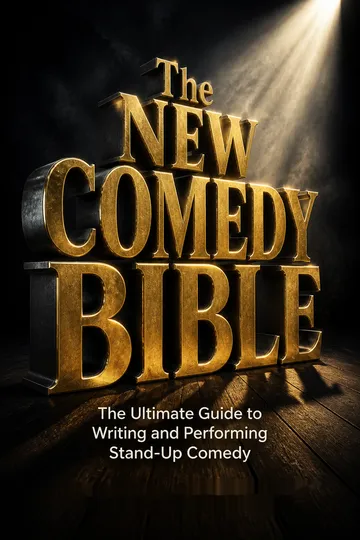
The Comedy Bible is a workbook disguised as a manifesto, and its ambition is unusual: it treats comedy not as a mystical gift but as a learnable craft with reproducible mechanics, then wraps that engineering in the voice of a working comic who has bombed enough to be trusted. Judy Carter's structural insight, that a joke, a sitcom, a greeting card, and a keynote all share the same skeleton (setup, turn, payoff), is the book's intellectual backbone and its most transferable idea. Everything else radiates from it.
The book's deepest and most contrarian move is redefining creativity as archaeology rather than invention. Beginners believe they must think up funny things; Carter insists the funny already exists in your real pain, your family's dysfunction, and your specific humiliations, and the job is excavation plus structural refinement. This reframe (attitude before topic, premise before punchline, truth before technique) is psychologically sophisticated and aligns with modern research on vulnerability, incongruity, and benign-violation theories of humor without ever using the jargon.
What dates the book is superficial: the celebrity roster, the Radio Shack hold buttons, the fax-your-commitment instructions. What endures is the pedagogy. Carter understands that the enemy of the aspiring comic is not lack of talent but fear, perfectionism, story-telling instead of premise-writing, and the passive fantasy of being discovered. Her remedies (book the open mike before you have an act, capture ideas before dawn, find a comedy buddy, become your own agent) are all forcing functions that convert intention into action.
The book's limitation is its rule-boundedness, which Carter herself flags by quoting the Dalai Lama: learn the rules so you can break them properly. The four-attitude constraint and rigid six-beat sitcom structure are scaffolding, not scripture. For a beginner drowning in blank-page terror, though, scaffolding is exactly what saves you. The result is one of the most practical creativity manuals in any discipline.
Review Summary
The Comedy Bible receives mixed reviews, with an average rating of 3.84 out of 5. Many readers find it helpful for aspiring comedians, offering practical advice, exercises, and insights into comedy writing. Some praise its comprehensive approach and motivational tone. However, critics argue that parts of the book are outdated, contradictory, or too formulaic. Several reviewers note that while the book provides useful tools for beginners, experienced comedians may find limited value. Some readers appreciate the book's applicability to various forms of comedic writing beyond stand-up.
People Also Read
Glossary
Attitude
The emotional charge driving a jokeOne of four emotional words (weird, scary, hard, or stupid) that Carter says every joke must express to get big laughs. Attitude gives a topic energy and direction, like putting gas in a car. Beginners must literally say the attitude word aloud while writing, because without it a funny idea stays flat and literary rather than becoming a joke that lands.
Premise
Insightful non-funny opinion about a topicThe core of Carter's joke structure: an original, present-tense observation that answers the question posed by the attitude and topic ("what's weird/hard/stupid/scary about this?"). It is insightful rather than funny, avoids the words I, me, and my, and sets up the laugh. Confusing a premise with a story (recounting what happened) is the most common beginner mistake.
Act-out
Performing the joke's scene physicallyThe funny part of a joke where the comic stops describing and becomes the characters, acting out the situation with voices, gestures, and exaggeration. Act-outs replaced the old vaudeville punchline and are where big laughs live. Anyone mentioned in the setup must be acted out, and the act-out must match the attitude established in the setup.
Mix
Connecting two unrelated thingsAn optional joke element where a comic links two things people don't normally associate, generating a laugh from the surprising connection. Mixes usually begin with "what if" or "can you imagine," then launch a second act-out. Example: comparing marriage to a five-thousand-piece jigsaw puzzle that is all sky. They add extra laughs to a premise already working.
Setup
Attitude plus topic plus premiseThe non-funny opening of a joke that captures attention and gets the audience to relate. Carter defines it as attitude plus topic plus premise combined. It should sound serious, sincere, and personally revealing, because starting funny leaves nowhere to build. Many comics consider the setup more important than the punchline, since it is where the audience decides whether they like you.
Comedy buddy
A collaborator for writing materialA trusted partner who helps you develop and test material through jam sessions, described as a tennis game where good ideas get returned and spun back. The buddy asks probing attitude questions, strips out self-absorbed language, keeps energy up, and catches jokes that only make sense to you. Carter considers working with one essential, since solo-written comedy tends to sound literary and unfunny.
Hack
Overused, unoriginal comedy materialCarter's term for tired, done-to-death material: cliche topics (airplane food, drugs, Viagra), bathroom humor, celebrity trashing, predictable segues, and jokes chosen because they seem funny rather than because they are true to the comic. Hack material signals a lack of original perspective, and word travels fast in the industry about comics who rely on it.
Spec script
Sample episode written for freeShort for speculative script, an episode of an existing TV show written without pay to demonstrate your talent and land a writing job. Producers rarely buy spec scripts and rarely read specs of their own show; instead a strong spec of a tonally similar sitcom proves you can nail character voice, structure, and formatting. Even established writers must submit fresh specs for new jobs.
Funny zone (F-zone)
The energized state of spontaneous humorCarter's term for the loose, playful, in-the-moment state where a person naturally generates funny material, like riffing at a party and riding the laughs. She argues the best killer material is captured and expanded from these spontaneous moments rather than written cold at a computer, and that recreating the circumstances that trigger this state helps produce comedy on demand.
Calling the moment
Voicing what everyone is thinkingAn advanced performance skill of saying aloud what the entire audience is silently thinking about the room, a disruption, or an obvious situation. Carter describes verbalizing the communal consciousness, like acknowledging a striking audience member or a mishap onstage. It puts the audience at ease, proves you are present rather than running a canned act, and signals a professional is in control.
FAQ
What's The Comedy Bible about?
- Comprehensive Comedy Guide: The Comedy Bible by Judy Carter is a detailed guide for aspiring comedians and writers, covering everything from stand-up to sitcom writing.
- Hands-On Workbook Format: It includes exercises that encourage active participation, helping readers develop their comedy skills through practical application.
- Insider Tips and Techniques: Carter shares her industry insights, teaching readers how to write jokes, pitch material, and negotiate contracts.
Why should I read The Comedy Bible?
- Expert Guidance: Judy Carter, a seasoned comedian and coach, offers valuable insights that can help you navigate the comedy landscape.
- Transformative Exercises: The book provides exercises to help you develop your unique comedic voice and style, building confidence and creativity.
- Monetizing Humor: It outlines various ways to turn your humor into a career, making it a comprehensive resource for aspiring comedians.
What are the key takeaways of The Comedy Bible?
- Finding Your Unique Voice: Authenticity is crucial in comedy, and Carter encourages exploring personal experiences for relatable material.
- Structure of Jokes: Understanding joke components like setup, punchline, and act-out is essential for effective comedy writing.
- Handling Hecklers: The book offers strategies for dealing with hecklers and maintaining audience engagement, emphasizing adaptability.
What are the best quotes from The Comedy Bible and what do they mean?
- "You are only as authentic as you allow yourself to be.": Highlights the importance of genuineness in comedy, which resonates with audiences.
- "Comedy is not for normal people.": Suggests that unique perspectives enhance comedic material, encouraging comedians to embrace their quirks.
- "If you want to be a comic, you have to be willing to take risks.": Emphasizes vulnerability and courage in comedy, as taking risks can lead to more profound material.
How does Judy Carter suggest finding authentic topics in The Comedy Bible?
- Reflect on Personal Experiences: Carter advises exploring your life, including relationships and challenges, for authentic material.
- Use Stream of Consciousness Writing: This technique helps uncover hidden topics and premises by allowing thoughts to flow freely.
- Reality Testing: Testing topics with others ensures they resonate, helping identify relatable material.
What is the structure of a joke according to The Comedy Bible?
- Setup and Punchline: A joke consists of a setup introducing the premise and a punchline delivering the humor with a twist.
- Act-Outs and Mixes: Performing jokes rather than just telling them enhances humor and audience engagement.
- Attitude: Each joke should have a clear attitude, guiding the audience's emotional response and shaping the premise effectively.
How can I handle hecklers effectively as suggested in The Comedy Bible?
- Stay Calm and Collected: Maintaining composure allows for effective responses and keeps the audience on your side.
- Use Humor to Defuse Tension: Responding with humor can engage the audience and showcase quick thinking.
- Signal for Help if Necessary: If a heckler is disruptive, it's okay to seek assistance to protect your performance.
What specific methods does Judy Carter recommend for generating comedy material?
- Mind Mapping: This technique allows for brainstorming ideas related to a topic, helping overcome creative blocks.
- Top Ten Lists: Creating lists encourages thinking of multiple angles on a topic, leading to richer comedic content.
- Act-Outs and Character Development: Bringing characters to life enhances the comedic impact of jokes.
How does The Comedy Bible address the business side of comedy?
- Self-Promotion Strategies: Carter emphasizes creating promotional materials like business cards and press releases to get noticed.
- Networking Importance: Building relationships with industry professionals can lead to more opportunities.
- Understanding Contracts: Knowing how to negotiate and what to expect in contracts is crucial for a successful career.
What are some common mistakes to avoid according to The Comedy Bible?
- Using Hack Material: Avoid relying on overused topics or clichés; originality is key to standing out.
- Overly Long Setups: Long setups can lose audience attention; keep jokes concise and to the point.
- Ignoring Feedback: Being open to feedback and constructive criticism is essential for growth as a comedian.
How can I develop my comedic voice using The Comedy Bible?
- Explore Personal Experiences: Drawing from your life can lead to unique material that resonates with audiences.
- Experiment with Different Styles: Trying various comedic styles helps refine your voice and make it distinct.
- Practice Regularly: Consistent practice and performance are crucial for discovering what works best for you.
What exercises does The Comedy Bible recommend for improving comedy writing?
- Daily Writing Prompts: Setting aside time daily to write about experiences or observations keeps creative juices flowing.
- Comedy Jam Sessions: Collaborating with a comedy buddy for brainstorming and feedback enhances the writing process.
- Recording and Reviewing Performances: Taping and reviewing performances provides insights into what works and what doesn’t.
About the Author
Download PDF
Download EPUB
.epub digital book format is ideal for reading ebooks on phones, tablets, and e-readers.








































