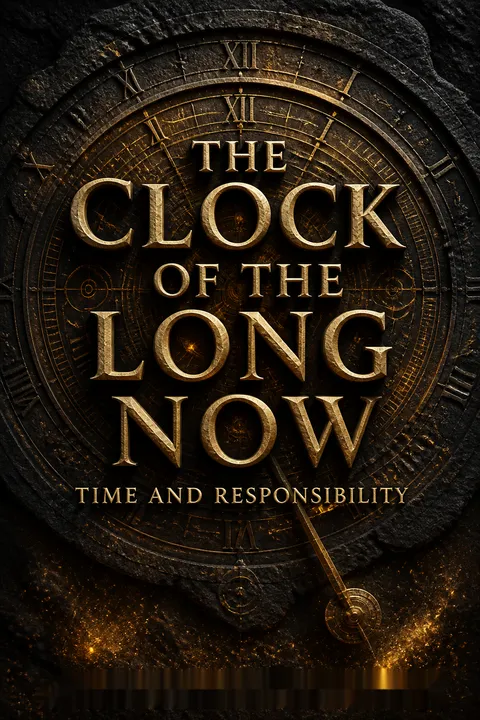

Key Takeaways
1. The Long Now: Cultivating a Sense of Deep Time
Civilization is revving itself into a pathologically short attention span.
Short-term thinking. Modern society is characterized by a focus on the immediate, driven by technological acceleration, market pressures, and political cycles. This short-sightedness neglects long-term consequences and hinders our ability to address complex, enduring problems. The book proposes a counter-narrative, "The Long Now," which encourages us to expand our concept of the present, considering centuries and millennia rather than weeks or years.
- The author notes that the future has been shrinking by one year per year for his entire life.
- This is a call to action to start a long-term project that gets people thinking past the mental barrier of the Millennium.
Deep time perspective. The Long Now is not just about thinking further into the future, but also about understanding our place within the vast sweep of history. By recognizing the long arc of civilization, we can gain a sense of humility and responsibility, realizing that our actions have consequences that extend far beyond our own lifetimes. This perspective is crucial for addressing issues like climate change, resource depletion, and cultural preservation.
- The book suggests that 10,000 years is the appropriate time envelope for the project, as it marks the end of the Ice Age and the beginning of agriculture and civilization.
- It is a call to develop an equal perspective into the future.
The Clock as a symbol. The proposed 10,000-Year Clock is a physical embodiment of the Long Now, a mechanism designed to tick once a year, bong once a century, and have a cuckoo emerge every millennium. This slow, deliberate pace serves as a counterpoint to the frenetic pace of modern life, encouraging us to think in terms of centuries rather than seconds. The Clock is not just a time-keeping device, but a symbol of our commitment to long-term responsibility.
- The Clock is meant to be a charismatic place to visit, interesting to think about, and famous enough to become iconic in the public discourse.
- It is meant to do for thinking about time what the photographs of Earth from space have done for thinking about the environment.
2. Moore's Law and the Acceleration of Change
The pace of Moore’s Law has become the pacesetter for human events.
Exponential growth. Moore's Law, the observation that the number of components on a computer chip doubles approximately every 18 months, has driven an unprecedented rate of technological advancement. This exponential growth has led to rapid changes in computing power, communication, and information access, transforming nearly every aspect of modern life.
- The author notes that Moore's Law brings tenfold structural changes every three years or so, thus three revolutions every decade, for five decades straight.
- This has led to a world where the fast eat the slow.
Moore's Wall. While Moore's Law has fueled progress, it has also created a sense of instability and disorientation. The rapid pace of change can be overwhelming, making it difficult for individuals and institutions to adapt. The book refers to this as "Moore's Wall," where the exponential growth of technology clashes with the linear pace of human experience.
- The author notes that people call progress "change" and brace themselves against its force.
- Technology is treated as something that pushes us around rather than something we create.
The need for balance. The relentless acceleration of technology requires a counterbalancing force, a mechanism or myth that encourages long-term thinking and responsibility. The Long Now project is an attempt to provide such a corrective, offering a framework for understanding and navigating the rapid changes of our time.
- The author asks, "If Moore's Law is true, over time is time more or less valuable?"
- The question is whether compressed time is dearer or more disposable.
3. The Singularity: A Point of No Return?
At this singularity the laws of science and our ability to predict the future would break down.
The black hole metaphor. The concept of the Singularity, borrowed from astrophysics, describes a hypothetical point in the future where technological progress becomes so rapid and profound that it is impossible to predict what will happen next. Like a black hole, the Singularity represents a point of no return, where the rules of the game change fundamentally.
- The author notes that the Singularity is a place where extrapolation breaks down and new models must be applied.
- These new models are beyond our intelligence.
Self-accelerating change. The Singularity is often associated with the convergence of technologies like nanotechnology, biotechnology, and artificial intelligence, each accelerating the other. Some futurists predict that this convergence will lead to a radical transformation of human life, potentially surpassing human intelligence and control.
- The author notes that some enthusiasts have a consensus date for the techno-rapture—2035 C.E., give or take a few years.
- The tipping point is seen as the moment when machine intelligence surpasses normal human intelligence and takes over its own further progress.
The need for caution. While the Singularity is a source of fascination and excitement for some, it also raises serious concerns about the future of humanity. The book suggests that we need to approach technological advancement with caution, recognizing the potential for unintended consequences and the need for ethical frameworks to guide our actions.
- The author assumes that we will somehow dodge or finesse the Singularity in reality.
- One way to do that is to warn about it early and begin to build in correctives.
4. The Perils of "Rush" and the Value of Patience
Access takes the waiting out of wanting.
The culture of immediacy. Modern society is characterized by a culture of immediacy, where instant gratification is valued over long-term planning. This "rush" mentality is fueled by technology, market pressures, and a constant barrage of information, making it difficult to focus on the slow, deliberate processes that are essential for addressing complex problems.
- The author notes that the gap between need or desire and fulfillment collapses to zero.
- In real time, the best is the enemy of the good.
The dangers of short-sightedness. The pursuit of immediate rewards can lead to short-sighted decisions with long-term negative consequences. The book uses the example of gambling, which has become a powerful industry by exploiting our desire for instant gratification, often at the expense of long-term well-being.
- The author notes that the price of the routine rush is futureless melodrama, in personal life as in business.
- There is no outside perspective, no side view, no story larger than "now what?"
The importance of patience. The Long Now project emphasizes the value of patience, encouraging us to slow down, reflect, and consider the long-term implications of our actions. By cultivating a sense of patience, we can resist the urge for instant gratification and make more thoughtful, responsible decisions.
- The author notes that if the hangover preceded the binge, drunkenness would be considered a virtue and not a vice.
- The reality of binge-first annihilates both patience and memory.
5. Civilization's Pace Layers: Balancing Innovation and Stability
Every form of civilization is a wise equilibrium between firm substructure and soaring liberty.
The layered model. The book proposes a model of civilization based on different "pace layers," each operating at a different rate of change. These layers range from fast-moving fashion and commerce to slow-moving infrastructure, governance, culture, and nature. A healthy society requires a balance between these layers, allowing innovation to flourish while maintaining stability and continuity.
- The author proposes six significant levels of pace and size in the working structure of a robust and adaptable civilization.
- From fast to slow the levels are: Fashion/art, Commerce, Infrastructure, Governance, Culture, and Nature.
The role of each layer. Each layer plays a distinct role in the overall system. Fast layers like fashion and commerce drive innovation and change, while slow layers like culture and nature provide stability and continuity. The layers interact with each other, with fast layers informing slow layers and slow layers constraining fast layers.
- The job of fashion and art is to be froth: quick, irrelevant, engaging, self-preoccupied, and cruel.
- Culture is where the Long Now operates.
The need for balance. When one layer dominates the others, the system becomes unbalanced and vulnerable. For example, if commerce is allowed to dictate the pace of nature, the environment will suffer. The Long Now project seeks to promote a more balanced approach, recognizing the importance of all layers and their interactions.
- The author notes that if commerce is allowed by governance and culture to push nature at a commercial pace, all-supporting natural forests, fisheries, and aquifers will be lost.
- If governance is changed suddenly instead of gradually, you get the catastrophic French and Russian revolutions.
6. The Role of Religion and Myth in Long-Term Thinking
They are not following time, but sustaining it.
Religion as a timekeeper. Historically, religion has played a crucial role in shaping our understanding of time, providing a framework for thinking about the past, present, and future. Religious rituals and practices often emphasize long-term perspectives, encouraging people to consider the consequences of their actions across generations.
- The author notes that mechanical clocks were first invented for monasteries in the late thirteenth century and only later ordered the life of towns.
- It was the monks who taught us to keep time.
The limits of religious time. While religion can be a powerful force for long-term thinking, it can also be limited by its focus on the eternal and transcendent, sometimes neglecting the importance of history and the future. The book suggests that we need a new kind of myth, one that embraces both the sacred and the secular, the past and the future.
- The author notes that religious time is time out from personal striving or suffering, time out from the chaos of history.
- From the perspective of the sacred, history is just one damned thing after another.
The power of myth. The Long Now project seeks to create a new myth, one that is grounded in the realities of our time but also capable of inspiring long-term vision and responsibility. This myth is not about escaping the present, but about embracing it with a sense of purpose and connection to the past and future.
- The author notes that the Clock/Library aims for the mythic depth to become one of those system-level ideas which sets in motion all sorts of behavior without ever having to be referred to directly again.
- This is what dominant myths do: they make some sorts of behavior ring with recognition and familiarity and value and a sense of goodness.
7. The Clock/Library: A Tangible Symbol of the Long Now
A traditional clock depicts time in the context of our lives. This Clock depicts our lives in the context of time.
A physical manifestation. The Clock/Library is not just an abstract concept, but a tangible project designed to embody the principles of the Long Now. The Clock is a physical mechanism that operates on a timescale of millennia, while the Library is a repository of knowledge and wisdom designed to endure for generations.
- The author notes that the main characteristic of the Clock is its linearity.
- It treats one year absolutely like another, oblivious of Moore's Law accelerations, national fates, wars, dark ages, or climate changes.
A place for reflection. The Clock/Library is intended to be a place of pilgrimage, a site where people can come to reflect on their place in time and their responsibility to future generations. The experience of visiting the Clock is meant to be both awe-inspiring and humbling, encouraging a sense of connection to the long arc of history.
- The author notes that after an encounter with the Clock a visitor should be able to declare with feeling, “Whew. Time! And me in it.”
- It is not so much a conversion experience as a deep pause.
A call to action. The Clock/Library is not just a monument, but a call to action, inviting people to participate in the process of long-term thinking and responsibility. The project is open to new ideas and collaborations, seeking to engage a wide range of people in the effort to build a more sustainable and meaningful future.
- The author notes that the Clock should be powered by people coming to visit it.
- If it is forgotten, it stops.
8. The Digital Dark Age and the Need for Digital Continuity
It is only slightly facetious to say that digital information lasts forever—or five years, whichever comes first.
The illusion of permanence. While digital information seems to offer the promise of immortality, the reality is that it is often highly fragile and ephemeral. Rapid technological obsolescence, incompatible file formats, and decaying storage media all contribute to a "digital dark age," where vast amounts of information are lost forever.
- The author notes that magnetic media such as disks and tape lose their integrity in five to ten years.
- Optically etched media such as CD-ROMs, if used at all, only last five to fifteen years before they degrade.
The problem of legacy systems. The problem of digital discontinuity is not just about personal files, but also about the large-scale computer systems that run our world. These "legacy systems" become increasingly complex and difficult to maintain over time, potentially leading to catastrophic failures.
- The author notes that outdated legacy systems make themselves so essential over the years that no one can contemplate the prolonged trauma of replacing them.
- They cannot be fixed completely because the problems are too complexly embedded and there is no one left who understands the whole system.
The need for digital preservation. The Long Now project recognizes the need for a more responsible approach to digital information, one that prioritizes long-term preservation and accessibility. This requires developing new standards, tools, and institutions to ensure that our digital heritage is not lost to future generations.
- The author notes that preservation means keeping the stored information catalogued, accessible, and usable on current media, which requires constant effort and expense.
- The default condition of paper is persistence, if not interrupted; the default condition of electronic signals is interruption, if not periodically renewed.
9. The 10,000-Year Library: A Repository of Knowledge and Wisdom
What has been done, thought, written, or spoken is not culture; culture is only that fraction that is remembered.
A strategic information reserve. The 10,000-Year Library is envisioned as a repository of knowledge and wisdom, designed to endure for millennia. It is not just a collection of books, but a strategic information reserve, providing access to the knowledge and insights that are essential for the long-term flourishing of civilization.
- The author notes that the Library could conserve the information that is needed from time to time for the deep renewals of renaissance.
- It would provide, and even embody, the long view of things, where responsibility is said to reside.
Beyond traditional libraries. The 10,000-Year Library is not meant to be a traditional library, but a dynamic and evolving institution that adapts to the changing needs of future generations. It will incorporate both physical and digital resources, and it will actively engage with the challenges of long-term preservation and accessibility.
- The author notes that the Library should be a physical place, a refuge from the present, a place of weathered stone walls and labyrinthine stacks of books, at a remote location with far horizons.
- It is a place for contemplative research and small, immersive conferences on topics of centenary and millennial scope.
A catalyst for long-term thinking. The Library is not just a passive repository of information, but an active catalyst for long-term thinking and responsibility. It will provide services such as time mail, a responsibility record, and a registry for time capsules, all designed to encourage a more thoughtful and future-oriented approach to decision-making.
- The author notes that the Library could provide, for a fee, time-mail service across generations forward.
- The Library could offer personalized I-Told-You-So! services.
10. Tragic Optimism: Embracing Both Hope and Reality
Short term worse, long term better. Maybe the way to resolve them is tragic optimism.
The tension between hope and despair. The book acknowledges the tension between optimism and pessimism, recognizing that both perspectives have their limitations. While optimism can lead to complacency, pessimism can lead to inaction. The concept of "tragic optimism" seeks to embrace both hope and reality, recognizing the challenges we face while maintaining a commitment to positive action.
- The author notes that in the short term the pessimists are right, and in the long term the optimists are right.
- Everything has been going to hell as long as anyone can remember.
The value of warnings. The book recognizes the importance of warnings, acknowledging that pessimism can be a valuable tool for identifying potential problems and motivating action. However, it also emphasizes the need for a balanced approach, avoiding the trap of despair and maintaining a sense of hope for the future.
- The author notes that in public, except for tonight, I usually say things are getting worse unless some particular change is made.
- Warnings are important.
The power of action. Tragic optimism is not about passively accepting the status quo, but about actively working to create a better future. It is a call to embrace the challenges we face with courage, resilience, and a commitment to long-term responsibility.
- The author notes that if you really think things are getting worse, won't you grab everything you can while you can?
- But if you think things are getting better, you invest in the future.
11. The Uses of the Past and the Future
The future is purchased by the present.
The past as a guide. The book emphasizes the importance of learning from the past, recognizing that history provides valuable lessons for navigating the present and future. By studying the successes and failures of previous generations, we can gain a deeper understanding of the challenges we face and the potential solutions.
- The author notes that those who cannot remember the past are condemned to repeat it.
- The past is both a comfort and a warning.
The future as a motivator. The future is not just a destination, but a powerful motivator for action in the present. By envisioning a better future, we can inspire ourselves and others to work towards positive change. The Long Now project seeks to harness the power of the future to create a more sustainable and meaningful world.
- The author notes that the future is purchased by the present.
- It is not possible to secure distant or permanent happiness but by the forbearance of some immediate gratification.
The interplay of past and future. The book suggests that the past and future are not separate entities, but interconnected aspects of a single, continuous process. By understanding the relationship between past, present, and future, we can make more informed decisions and create a more harmonious world.
- The author notes that the longer view you take, the more is in your self-interest.
- Seemingly altruistic acts are not altruistic if you take a long enough view.
12. Sustained Endeavor and the Infinite Game
A finite game is played for the purpose of winning, an infinite game for the purpose of continuing the game.
The value of slow, steady progress. The book emphasizes the importance of sustained endeavor, recognizing that many of the most important goals require long-term commitment and patience. By focusing on slow, steady progress, we can achieve results that are impossible through quick, short-term actions.
- The author notes that what happens fast is illusion, what happens slow is reality.
- The job of the long view is to penetrate illusion.
The infinite game mindset. The concept of the "infinite game" provides a framework for understanding the difference between short-term and long-term goals. Finite games are about winning, while infinite games are about continuing the game. The Long Now project is an infinite game, seeking to create a more sustainable and meaningful future for all.
- The author notes that infinite games thrive on occasional changes in the rules—agreed to by the players—so that the game constantly improves.
- Finite players seek to control the future; infinite players arrange things so the future keeps providing surprises.
The power of continuity. The book concludes by emphasizing the importance of continuity, recognizing that our actions have consequences that extend far beyond our own lifetimes. By embracing the long view and committing to sustained endeavor, we can create a world that is both more just and more sustainable for future generations.
- The author notes that you need the space of continuity to have the confidence not to be afraid of revolutions.
- You can always improve things as long as you're prepared to wait.
Review Summary
The Clock of the Long Now explores the concept of long-term thinking and its importance for humanity's future. Readers praise the book's thought-provoking ideas, optimistic outlook, and ability to shift perspectives on time. Many find the concept of a 10,000-year clock fascinating and appreciate the book's emphasis on responsible stewardship. While some sections feel dated, reviewers generally agree that the core ideas remain relevant and inspiring. The book's structure of short essays and its exploration of various time-related topics resonate with readers, encouraging them to consider the long-term consequences of present actions.
People Also Read
FAQ
1. What is "Clock of the Long Now: Time and Responsibility" by Stewart Brand about?
- Exploring Long-Term Thinking: The book centers on the concept of fostering long-term responsibility and thinking, using the idea of building a 10,000-year clock as a metaphor and practical project.
- The Long Now Foundation: Stewart Brand introduces the Long Now Foundation, which aims to encourage society to think in terms of centuries and millennia rather than years or decades.
- Time, Technology, and Responsibility: The book examines how accelerating technology and short-term thinking threaten civilization’s ability to plan for the future, and proposes mechanisms to counteract this.
- Clock/Library Project: Brand discusses the design and purpose of the Clock/Library—a physical clock and a library intended to last 10,000 years—as tools to inspire mythic, cultural, and practical engagement with deep time.
2. Why should I read "Clock of the Long Now" by Stewart Brand?
- Perspective Shift: The book challenges readers to expand their sense of time and responsibility, offering a new lens for understanding personal, societal, and global decisions.
- Relevance to Modern Issues: It addresses urgent contemporary problems like environmental degradation, digital obsolescence, and the loss of cultural memory, providing actionable frameworks for addressing them.
- Interdisciplinary Insights: Brand weaves together history, technology, philosophy, ecology, and design, making the book valuable for readers interested in any of these fields.
- Inspirational and Practical: The book is both visionary and grounded, offering concrete examples and proposals for how individuals and institutions can cultivate long-term thinking.
3. What are the key takeaways from "Clock of the Long Now" by Stewart Brand?
- Long-Term Responsibility: Taking responsibility for the distant future is essential for civilization’s survival and flourishing.
- Pace Layering: Societies are composed of layers (fashion, commerce, infrastructure, governance, culture, nature) that change at different rates, and understanding these layers helps manage change and resilience.
- Digital Dark Age: Without careful stewardship, digital information is at risk of being lost, making robust preservation strategies crucial.
- Mythic and Practical Tools: Physical artifacts like the 10,000-year clock and library can serve as icons and mechanisms to anchor long-term thinking in culture.
4. What is the 10,000-Year Clock and why is it important in Stewart Brand's "Clock of the Long Now"?
- A Symbol and Mechanism: The 10,000-Year Clock is both a real engineering project and a metaphor for long-term thinking, designed to keep accurate time for ten millennia.
- Forcing Long-Term Perspective: Its construction and maintenance require considering the needs and values of future generations, making long-term responsibility tangible.
- Design Principles: The clock is built for longevity, maintainability, transparency, evolvability, and scalability, using materials and mechanisms that can be understood and repaired with basic technology.
- Cultural Impact: The clock aims to become an icon that reframes how society thinks about time, similar to how photos of Earth from space changed environmental consciousness.
5. How does Stewart Brand define and use the concepts of "Kairos" and "Chronos" in "Clock of the Long Now"?
- Two Kinds of Time: "Kairos" refers to the opportune moment and cleverness, while "Chronos" represents ongoing, eternal time and wisdom.
- Modern Imbalance: Brand argues that contemporary society is dominated by kairos—short-term, opportunistic thinking—at the expense of chronos, which is necessary for long-term responsibility.
- Moral Implications: The book suggests that true responsibility means serving not just the present but the future, aligning actions with chronos.
- Practical Application: Recognizing and balancing both types of time is essential for making decisions that benefit both current and future generations.
6. What is "pace layering" and how does it help explain civilization in "Clock of the Long Now" by Stewart Brand?
- Six Layers of Change: Brand describes civilization as composed of layers—fashion/art, commerce, infrastructure, governance, culture, and nature—each changing at its own pace.
- Fast Learns, Slow Remembers: Fast layers innovate and adapt, while slow layers provide stability and memory; both are necessary for resilience.
- Managing Shocks: The interaction between fast and slow layers allows societies to absorb shocks and adapt without losing continuity.
- Guiding Policy: Understanding pace layering helps policymakers and organizations make better decisions by respecting the appropriate speed of change for each layer.
7. What is the "digital dark age" and how does Stewart Brand propose addressing it in "Clock of the Long Now"?
- Risk of Digital Loss: Brand warns that rapid technological obsolescence threatens to erase vast amounts of digital information, creating a "digital dark age."
- Preservation Challenges: Digital media are fragile, formats become unreadable, and legacy systems become unmanageable, making long-term access difficult.
- Proposed Solutions: Strategies include regular migration of data, use of common formats, robust metadata, emulation, and physical backups on durable media.
- Role of Institutions: Libraries, universities, and distributed networks like the Internet Archive are crucial for ensuring digital continuity across generations.
8. How does "Clock of the Long Now" by Stewart Brand address the relationship between technology, acceleration, and responsibility?
- Moore’s Law and Acceleration: The book discusses how exponential technological growth (e.g., Moore’s Law) accelerates change, often outpacing society’s ability to adapt responsibly.
- The Singularity: Brand explores the idea of a technological "singularity," where change becomes so rapid that the future is unpredictable and potentially disruptive.
- Need for Correctives: He argues for mechanisms—like the 10,000-Year Clock—that slow down thinking and encourage reflection, counterbalancing the rush of innovation.
- Responsibility in Design: Technological systems should be designed with maintainability, transparency, and long-term consequences in mind, not just short-term gains.
9. What is the purpose and envisioned function of the 10,000-Year Library in Stewart Brand's "Clock of the Long Now"?
- Deep-Time Record Keeping: The library is intended to preserve knowledge, wisdom, and records that will be valuable over centuries and millennia.
- Supporting Renewal: It serves as a resource for future renaissances, recoveries from catastrophe, and ongoing learning, ensuring that civilization’s memory endures.
- Physical and Digital Forms: The library is imagined as both a physical place (possibly underground or on the Moon) and a distributed digital archive.
- Innovative Services: Ideas include time mail (messages to the future), responsibility records (accountability for long-term decisions), and trend tracking for slow, significant changes.
10. How does Stewart Brand’s "Clock of the Long Now" use history and the concept of "applied history" to inform decision-making?
- Learning from the Past: Brand emphasizes the importance of historical perspective in avoiding repeated mistakes and understanding long-term trends.
- Applied History: He advocates for using history as a practical tool in policy and planning, not just as academic knowledge.
- The Goldberg Rule: Decision-makers should seek the full story behind issues, starting from the earliest relevant date, to gain deeper insight.
- Balance of Comfort and Warning: The past offers both reassurance and caution; embracing both is key to "tragic optimism" and responsible foresight.
11. What are the main methods and advice Stewart Brand offers for fostering long-term thinking and responsibility in "Clock of the Long Now"?
- Create Iconic Artifacts: Build physical symbols like the 10,000-Year Clock to anchor long-term thinking in culture.
- Institutional Design: Develop organizations and practices (like the Long Now Foundation) that are structured for longevity, renewal, and adaptability.
- Encourage Slow Science: Support long-term scientific studies and data collection, which are essential for understanding slow, powerful trends.
- Promote Intergenerational Projects: Engage in endeavors that require and reward patience, such as environmental restoration, infrastructure, and knowledge preservation.
12. What are the best quotes from "Clock of the Long Now" by Stewart Brand and what do they mean?
- "How do we make long-term thinking automatic and common instead of difficult and rare?" — This central question frames the book’s mission: to embed long-term responsibility into everyday life and institutions.
- "Fast learns, slow remembers." — Summarizes the dynamic between innovation and stability in society; both are necessary for resilience.
- "A finite game is played for the purpose of winning, an infinite game for the purpose of continuing the game." — From James P. Carse, this quote underlines the value of sustaining civilization as an ongoing, evolving process rather than seeking short-term victories.
- "The future is purchased by the present." — Reminds readers that present actions determine future outcomes, emphasizing the ethical imperative of foresight.
- "This present moment used to be the unimaginable future." — Highlights the continuity between past, present, and future, encouraging humility and responsibility in shaping what comes next.
Download PDF
Download EPUB
.epub digital book format is ideal for reading ebooks on phones, tablets, and e-readers.








































