

Key Takeaways
Our biggest failures now come from ineptitude, not ignorance
Knowledge outran our ability to use it. Philosophers Samuel Gorovitz and Alasdair MacIntyre named two reasons competent people fail. Ignorance means science hasn't figured out the answer yet. Ineptitude means the knowledge exists but we apply it wrong. For most of history, ignorance ruled medicine; we simply didn't know what caused heart attacks. Now the balance has flipped.
The evidence is damning. Today there are proven treatments for a dozen ways to prevent heart attacks, yet in 2006 fewer than half of eligible patients got balloon therapy within the crucial ninety-minute window. Studies show 30% of stroke patients, 45% of asthma patients, and 60% of pneumonia patients receive incomplete or wrong care. The steps are known. Getting them done consistently is the brutal part.
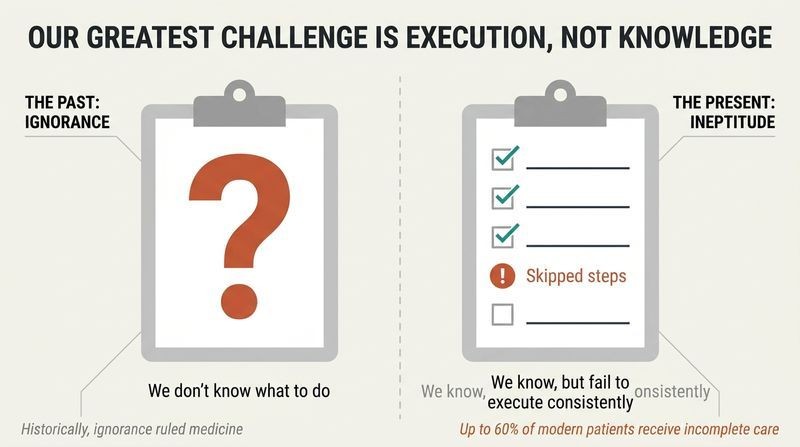
What's striking is how this reframes accountability. When a treatment doesn't exist, society forgives the doctor. When it exists and gets botched, the same failure feels like negligence. Gawande's distinction echoes James Reason's work on human error and the "Swiss cheese" model in safety engineering, where accidents slip through aligned holes in imperfect defenses. The uncomfortable implication for any knowledge worker: as expertise deepens, the frontier of failure migrates from what we don't know toward what we know but fumble. This is why aviation, nuclear power, and surgery increasingly resemble one another. Competence is no longer the bottleneck. Execution under complexity is.
A humble index card tamed the plane too complex to fly
The Model 299 crash birthed the checklist. In 1935, Boeing's sleek new bomber, faster and longer-range than rivals, crashed on its demonstration flight, killing the pilot. The cause wasn't mechanical. The pilot, the Army's chief of flight testing, had forgotten to release a locking mechanism amid the plane's many new controls. Newspapers called it "too much airplane for one man to fly."
The fix wasn't more training. Test pilots created a short pilot's checklist covering takeoff, flight, landing, and taxiing, brief enough for an index card. It listed dumb, obvious stuff: release the brakes, unlock the controls, close the windows. With it, pilots flew the renamed B-17 for 1.8 million miles without an accident. The Army ordered nearly thirteen thousand. Gawande's thesis: modern work in medicine, law, and finance has entered its own "B-17 phase," too complex to run reliably from memory.
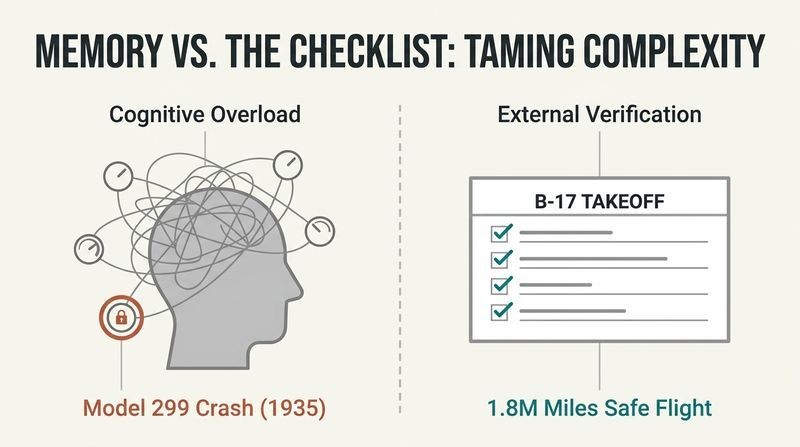
The genius here is what the pilots chose not to do. Facing catastrophe, the instinct is to demand more expertise, more hours, more heroics. They instead accepted that even the most skilled brain forgets mundane steps under load. Cognitive science backs this: working memory holds only a handful of items, and stress narrows attention further. The checklist offloads the routine so the mind can focus on judgment. What's worth noting is the counterintuitive humility required. The people most resistant to checklists are often the most expert, precisely because acknowledging fallibility clashes with a professional identity built on mastery.
Sort problems into simple, complicated, or complex before you act
Three problem types demand different tools. Drawing on complexity scholars Brenda Zimmerman and Sholom Glouberman, Gawande distinguishes:
1. Simple: baking a cake. A recipe reliably produces success.
2. Complicated: sending a rocket to the moon. No single recipe, but breakable into simple parts, repeatable once solved.
3. Complex: raising a child. Every case is unique, expertise helps but never guarantees, outcomes stay uncertain.
Most real work blends all three. Preventing central line infections or an airplane blowout is essentially a simple problem hiding inside complexity, solvable by a "forcing function" like a checklist. But an ICU patient needs 178 different actions a day, and no two pneumonia patients respond identically. The trap is treating a complex problem as if it were merely complicated, or drowning simple steps in improvisation.
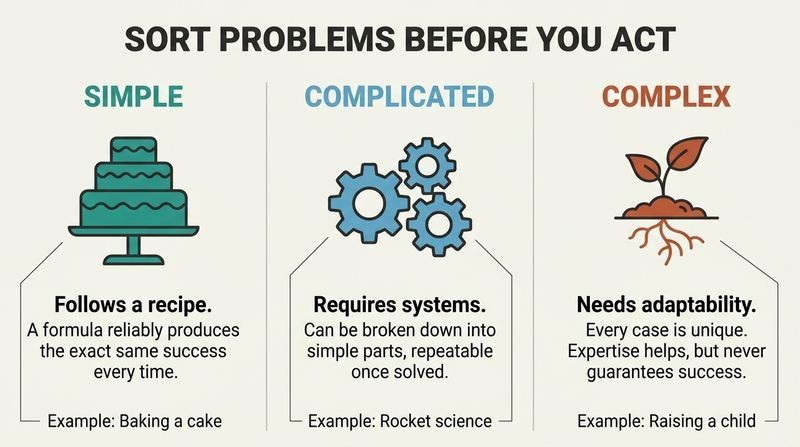
This taxonomy is more powerful than it first appears. It explains why so many reform efforts misfire: they apply recipe-thinking to child-rearing problems, or leave rocket-science problems to individual whim. It resonates with Dave Snowden's Cynefin framework, developed independently around the same period, which adds a fourth "chaotic" domain and warns that misclassifying a problem is the fastest route to disaster. The actionable move for readers is diagnostic: before reaching for a solution, ask which kind of problem this actually is. A checklist saves lives on the simple layer, but no checklist can substitute for the adaptive judgment that complexity demands.
A five-step checklist drove ICU infections from 11% to zero
Pronovost proved it in the real world. Critical care specialist Peter Pronovost at Johns Hopkins built a checklist for one task: inserting a central line without infection. The five steps were embarrassingly basic (wash hands, clean skin with antiseptic, drape the patient fully, wear mask and sterile gear, cover the site). When nurses observed doctors, physicians skipped at least one step in more than a third of cases.
Then he empowered the nurses. Hospital administration authorized nurses to stop doctors who skipped steps. The ten-day line-infection rate fell from 11% to zero. Over the following Michigan Keystone Initiative across many ICUs, infection rates dropped 66% within three months, saving an estimated 1,500 lives and $175 million in eighteen months. The average Michigan ICU soon outperformed 90% of hospitals nationwide.
The hidden lever here isn't the paper, it's the redistribution of authority. Giving nurses explicit permission to halt a surgeon quietly dismantled a rigid hierarchy that research consistently links to error. Aviation learned this the hard way through crew resource management after crashes caused by junior officers too intimidated to challenge captains. What's also instructive is Pronovost's shrewd rollout: he first asked hospitals merely to measure their own infection rates, letting the shameful data create demand for a solution. Behavioral economists would recognize this as reducing status-quo bias. Measurement itself became the wedge that made a boring checklist suddenly irresistible.
Skyscrapers stopped collapsing when Master Builders gave way to teams
Complexity killed the lone genius. For centuries, a single Master Builder designed and oversaw cathedrals and capitols from portico to plumbing. By the mid-twentieth century, construction grew too sophisticated for any individual, so the field fragmented into sixteen or more specialized trades. Yet buildings almost never fall: a 2003 study found the US averages just twenty serious "building failures" a year, a rate below 0.00002%.
Two checklists manage the chaos. Structural engineer Joe Salvia showed Gawande how projects like Boston's Russia Wharf tower run on a construction schedule (a task checklist specifying what happens in what order) and a submittal schedule (a communication checklist specifying who must talk to whom, by when, about what). When an unexpected problem arose, like upper floors tilting inward, the answer wasn't one expert's verdict. It was getting the right people in a room to decide together.
Medicine, Gawande argues, is still stuck in the Master Builder era with its lone "Master Physician," which explains why a third of dying patients juggle ten or more specialists with duplicated, uncoordinated care. The construction insight worth dwelling on is the second checklist. Most people think checklists dictate tasks; the submittal schedule instead forces conversation, treating communication itself as a scheduled deliverable. This anticipates modern distributed-systems thinking and Amazon-style operational reviews, where structured handoffs prevent "that's not my problem" gaps. The building industry essentially institutionalized humility: no one trusts a single brain, so they engineer the group to catch what individuals miss.
Under true chaos, push decisions outward instead of hoarding control
Katrina showed centralization failing. When Hurricane Katrina flooded New Orleans in 2005, the command-and-control model collapsed. Federal, state, and local officials fought over authority while water trucks were turned away and buses sat idle. FEMA's director downplayed the disaster partly because top officials didn't use email and missed an agent's urgent on-the-ground report for a full day.
Wal-Mart showed the alternative. CEO Lee Scott told managers to make decisions above their normal level using the best information available and to do the right thing. Store managers handed out diapers, water, and formula, ran bulldozers through wrecked stores to salvage goods, and even broke into a pharmacy to supply a hospital. Wal-Mart delivered supplies before the government arrived. The lesson isn't private-beats-public; it's that complexity demands dispersed power plus common goals and communication.
This is the checklist philosophy scaled to catastrophe. The submittal-schedule logic (freedom to act, obligation to coordinate) is exactly what Wal-Mart improvised. Military doctrine calls this "commander's intent": specify the goal, not every step, so people on the ground adapt. The nuance readers should hold onto is that decentralization without shared purpose is just anarchy, which is why Wal-Mart embedded a Red Cross member and ran a 24-hour employee call center to keep information flowing. Chertoff's excuse that the storm "exceeded anybody's foresight" is, as Gawande sharply notes, not an explanation but simply the definition of complexity, a problem you prepare for structurally, not predictively.
Good checklists list killer items, not every step
Boeing's checklist factory taught the craft. Veteran pilot Daniel Boorman, who has studied thousands of crashes, showed Gawande that bad checklists are vague, too long, and try to spell out everything, turning brains off. Good ones are precise, fit on a page, and target only the critical steps skilled professionals nonetheless miss.
Key design rules:
1. Define a clear pause point where the checklist is used.
2. Choose DO-CONFIRM (work from memory, then verify) or READ-DO (read and execute each step).
3. Keep it to roughly five to nine items; past sixty to ninety seconds people start skipping.
4. Use simple, exact, profession-familiar language and clean typography.
5. Test it in the real world and keep refining; first drafts always fail.
Boorman deliberately leaves off steps pilots reliably remember, like notifying the control tower, because clutter is the enemy.
The subtlety often lost on checklist enthusiasts is that a checklist is not a how-to manual. It's a memory aid for experts, and adding non-essential items actively degrades it by breeding the skipping behavior it aims to prevent. This mirrors interface design principles: cognitive load rises with every field, so ruthless subtraction beats comprehensiveness. Boorman's insistence on live testing also reflects engineering's iterative ethos over armchair authorship, the same reason software ships in beta. One tension worth flagging: identifying the true "killer items" requires data on which steps get missed and matter most, data that many fields, unlike aviation, simply don't collect yet.
A two-minute surgical checklist cut deaths by nearly half
The WHO trial delivered stunning results. Gawande led a World Health Organization effort to build a nineteen-item surgical safety checklist with three pause points: before anesthesia, before incision, and before leaving the room. It mixed narrow task checks (antibiotics, allergies, confirming the right patient and side) with communication checks (team members introduce themselves by name and role, discuss risks aloud).
Tested across eight wildly different hospitals, from Tanzania to Toronto to Seattle, major complications fell 36%, deaths fell 47%, and infections fell by nearly half. In roughly 4,000 patients, over 150 were spared harm and 27 spared death. Notably, before the checklist, hospitals missed at least one of six basic safety steps in two-thirds of patients. Even the best missed a step once in every sixteen patients.
The result that unsettles skeptics is that unrelated complications, like bleeding, also dropped, which no single task check explains. Gawande's inference is that communication was the active ingredient. The "activation phenomenon" is telling: simply letting nurses say their names at the start made them likelier to speak up about problems, a finding echoing psychological-safety research from Amy Edmondson showing that teams which feel safe to voice concerns catch more errors. A fair caveat: the study lacked a randomized control and could not fully rule out a Hawthorne effect, though Gawande checked observed versus unobserved cases and found identical gains. The 93% of staff who would want it used on themselves is perhaps the most persuasive data point.
Value investors who used checklists beat the market by discipline
Even money masters fall for "cocaine brain." Investor Mohnish Pabrai found that exciting deals triggered the same reward circuits neuroscientists link to cocaine, seducing him into cutting corners and misjudging risk. He studied every Berkshire Hathaway deal and built a written checklist of about seventy checks derived from real mistakes, including Charlie Munger's Cort Furniture blunder, where earnings inflated by the dot-com boom evaporated when it burst.
Checklists made investing faster, not slower. Another investor, "Cook," built stage-by-stage checklists with a Day Three review forcing his team to read financial footnotes and cross-check statements. Counterintuitively, decisions got more thorough yet quicker. Psychologist Geoff Smart's study of venture capitalists found the checklist-driven "Airline Captains" had a median 80% return versus 35% or less for intuitive types, yet only one in eight investors used the approach.
This chapter is the strongest evidence that checklists aren't just for physical safety but for cognition itself. The "cocaine brain" framing connects to Kahneman's System 1, the fast, confirmation-biased mode that latches onto evidence supporting a hunch. A checklist functions as a forced System 2 override, a structured pause that interrupts emotional momentum. What's genuinely puzzling, and Gawande leans into it, is the resistance. In a field obsessed with any edge, a proven, free edge gets ignored. The explanation seems cultural: checklists feel beneath the self-image of the brilliant, daring dealmaker. Smart's data suggest that vanity is expensive, costing roughly 45 percentage points of return.
The modern hero is disciplined, not daring and improvisational
Sully's landing was teamwork, not solo genius. When US Airways Flight 1549 lost both engines to geese in 2009 and landed in the Hudson with no deaths, the press crowned Captain Sullenberger a lone hero. He kept correcting them: it was a crew effort. He and copilot Skiles, who had never flown together, first ran their checklists and briefing, transforming two strangers into a coordinated team. During the crisis Skiles worked the engine-restart checklist while Sullenberger flew; flight attendants executed evacuation protocols; fly-by-wire systems optimized the glide.
Discipline is the missing professional virtue. Gawande argues that professions prize selflessness, skill, and trustworthiness, but aviation adds a fourth: discipline in following procedure and functioning with others. Medicine instead worships autonomy. The contrast with the 1977 Tenerife disaster, where a junior officer failed to stop a wrong captain and 583 died, shows what undisciplined hierarchy costs.
The cultural argument lands hardest here. Tom Wolfe's "right stuff" test-pilot mythology, the maverick improviser, actively obstructs safety in complex systems. Gawande's redefinition of heroism as the humility to prepare and coordinate is both radical and, on reflection, obvious once aviation's death rate is compared to medicine's. One nuance: discipline and improvisation aren't opposites. Sully still had to judge that no runway was reachable and choose the river. The checklist handled the routine ("fly the airplane" is literally step one on the engine-failure list) so his mind was free for the irreducible judgment. The goal isn't replacing courage with compliance; it's freeing courage for the moments that truly need it.
Analysis
The Checklist Manifesto is a thesis-driven work of narrative nonfiction that smuggles a management idea inside a surgeon's memoir. Gawande's structure is inductive and reportorial: he builds his case by roaming far outside medicine, into aviation, skyscraper construction, disaster response, fine dining, and value investing, then returns to the operating room. This breadth is both the book's strength and its rhetorical strategy. By the time the WHO surgical trial delivers its 47% drop in deaths, the reader has been primed to believe that the checklist is a universal answer to a universal problem: the gap between what we know and what we reliably do.
The book's deepest contribution is conceptual, not procedural. The ignorance-versus-ineptitude distinction and the simple-complicated-complex taxonomy give readers a diagnostic vocabulary that outlasts any specific list. Its most underappreciated insight is that the best checklists are less about tasks than about communication and the redistribution of authority. Pronovost's nurses stopping surgeons, the construction submittal schedule, and the surgical team's name introductions all quietly attack rigid hierarchy, which decades of error research identify as a primary cause of preventable harm.
The book's limitations are worth naming. The evidence, while compelling, leans on before-and-after studies vulnerable to confounding and observer effects, and Gawande is candid about this without fully resolving it. There is also a risk the book underweights: checklists can ossify into box-ticking theater, and in genuinely complex or novel situations they can create false confidence. Gawande guards against this by insisting checklists free judgment rather than replace it, yet the line between disciplined use and mindless compliance is thinner in practice than on the page.
Ultimately the manifesto's power is cultural. It asks proud experts to trade the romance of autonomous heroism for the unglamorous virtue of discipline, and it argues, persuasively, that this trade saves lives and money.
Review Summary
The Checklist Manifesto explores how simple checklists can dramatically improve outcomes in complex fields like medicine and aviation. Gawande presents compelling evidence and anecdotes showing how checklists catch errors, improve communication, and save lives. While some reviewers found the book repetitive or overly focused on medicine, many appreciated Gawande's engaging writing style and the broader applications of checklists. Critics praised the book's insights but wished for more practical guidance on creating effective checklists. Overall, most reviewers found it an enlightening and thought-provoking read on an unexpectedly fascinating topic.
People Also Read





FAQ
What's "The Checklist Manifesto" about?
- Overview: "The Checklist Manifesto" by Atul Gawande explores how checklists can improve efficiency and reduce errors in complex environments, particularly in medicine.
- Central Theme: The book argues that as the complexity of tasks increases, the likelihood of human error also rises, and checklists can help mitigate these errors.
- Examples and Evidence: Gawande uses examples from various fields, including aviation, construction, and finance, to demonstrate the effectiveness of checklists.
- Goal: The book aims to show that checklists are a simple yet powerful tool to enhance performance and ensure safety in high-stakes situations.
Why should I read "The Checklist Manifesto"?
- Practical Application: The book provides practical insights into how checklists can be applied in various fields to improve outcomes and efficiency.
- Broad Relevance: While it focuses on medicine, the principles discussed are applicable to any profession that involves complex tasks and decision-making.
- Engaging Stories: Gawande uses compelling stories and real-world examples to illustrate the impact of checklists, making the book both informative and engaging.
- Improvement Mindset: It encourages readers to adopt a mindset of continuous improvement and attention to detail, which can be beneficial in both personal and professional contexts.
What are the key takeaways of "The Checklist Manifesto"?
- Complexity and Error: As tasks become more complex, the potential for error increases, and checklists can help manage this complexity.
- Teamwork and Communication: Checklists promote better communication and teamwork, ensuring that all team members are on the same page.
- Simplicity and Effectiveness: A well-designed checklist is simple, focusing on critical steps that are often overlooked, and can significantly improve outcomes.
- Cultural Resistance: Despite their effectiveness, there is often resistance to adopting checklists due to a culture of autonomy and expertise in many professions.
How does Atul Gawande define a good checklist?
- Precision and Clarity: A good checklist is precise and clear, focusing on the most critical steps that are prone to being overlooked.
- Brevity: It should be short enough to be practical, typically containing between five and nine items to avoid overwhelming the user.
- Usability: The checklist should be easy to use, even in high-pressure situations, and should fit on a single page.
- Testing and Refinement: A checklist must be tested in real-world scenarios and refined based on feedback to ensure its effectiveness.
What are some examples of checklists improving outcomes in "The Checklist Manifesto"?
- Aviation: The book discusses how checklists have been crucial in aviation for preventing accidents and ensuring safety.
- Medicine: Gawande shares examples from hospitals where surgical checklists have significantly reduced complications and deaths.
- Construction: The construction industry uses checklists to manage complex projects and ensure that all safety and procedural steps are followed.
- Finance: Some investors have adopted checklists to avoid common decision-making errors and improve their investment outcomes.
What is the WHO Safe Surgery Checklist, and how does it work?
- Purpose: The WHO Safe Surgery Checklist is designed to improve surgical safety by ensuring that critical steps are not missed during operations.
- Structure: It consists of nineteen checks divided into three pause points: before anesthesia, before incision, and before the patient leaves the operating room.
- Implementation: The checklist encourages team communication and ensures that everyone is aware of the patient's details, the procedure, and any potential risks.
- Impact: Studies have shown that using the checklist can significantly reduce surgical complications and mortality rates.
How does "The Checklist Manifesto" address resistance to checklists?
- Cultural Challenges: Gawande acknowledges that many professionals resist checklists due to a culture of autonomy and expertise.
- Perceived Rigidity: There is a fear that checklists may stifle creativity and flexibility, which the book argues is a misconception.
- Evidence of Effectiveness: The book provides evidence and examples to demonstrate that checklists enhance rather than hinder professional judgment.
- Adoption Strategies: Gawande suggests involving professionals in the creation and refinement of checklists to increase buy-in and acceptance.
What are some best quotes from "The Checklist Manifesto" and what do they mean?
- "Checklists seem able to defend anyone, even the experienced, against failure in many more tasks than we realized." This highlights the universal applicability of checklists in preventing errors.
- "Discipline is hard—harder than trustworthiness and skill and perhaps even than selflessness." This emphasizes the challenge and importance of maintaining discipline in following procedures.
- "The volume and complexity of what we know has exceeded our individual ability to deliver its benefits correctly, safely, or reliably." This quote underscores the need for systems like checklists to manage complexity.
- "We are by nature flawed and inconstant creatures." Gawande reminds us of human fallibility and the necessity of tools to help us overcome it.
How does "The Checklist Manifesto" relate to teamwork and communication?
- Team Coordination: The book emphasizes that checklists facilitate better coordination among team members, ensuring everyone is aligned.
- Communication Checks: It includes steps for team members to introduce themselves and discuss critical aspects of a task, fostering open communication.
- Activation Phenomenon: Gawande describes how checklists can activate team members' sense of participation and responsibility.
- Breaking Down Hierarchies: By giving everyone a voice, checklists help break down traditional hierarchies and encourage collaborative problem-solving.
What lessons can other industries learn from "The Checklist Manifesto"?
- Adapting Checklists: Industries can adapt the checklist model to their specific needs, focusing on critical steps that are often missed.
- Continuous Improvement: Checklists should be regularly reviewed and updated based on feedback and new information.
- Balancing Autonomy and Protocol: Professionals can learn to balance their expertise with adherence to proven protocols for better outcomes.
- Embracing Simplicity: Even in complex fields, simple tools like checklists can have a profound impact on performance and safety.
How does Atul Gawande's personal experience influence "The Checklist Manifesto"?
- Surgical Background: Gawande's experience as a surgeon provides firsthand insights into the challenges and complexities of medical practice.
- Real-Life Examples: He shares personal stories of both successes and failures, illustrating the practical impact of checklists.
- Commitment to Improvement: His dedication to improving patient safety and outcomes drives the exploration and advocacy of checklists.
- Humility and Learning: Gawande's willingness to learn from mistakes and adopt new practices is a central theme throughout the book.
What is the broader impact of "The Checklist Manifesto" on healthcare and beyond?
- Healthcare Adoption: The book has influenced hospitals and healthcare systems worldwide to implement checklists, improving patient safety.
- Cross-Industry Influence: It has inspired other industries to consider the benefits of checklists in managing complexity and reducing errors.
- Cultural Shift: The book advocates for a cultural shift towards embracing systematic approaches and teamwork in professional settings.
- Ongoing Dialogue: "The Checklist Manifesto" has sparked discussions about the role of checklists in various fields, encouraging further research and innovation.
About the Author

Download PDF
Download EPUB
.epub digital book format is ideal for reading ebooks on phones, tablets, and e-readers.








































